

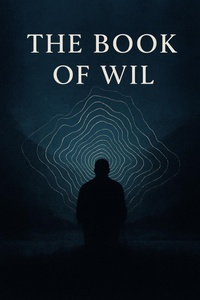
The Book of Wil (The Core Mythlogy Series, #1)
Description

The world is no longer broken. It is optimized.
When reality begins to stutter-time slipping, sound arriving late, grief refusing to settle-Wil is among the few who can perceive the fault. What others experience as noise, he experiences as structure: interference patterns, delay gradients, thresholds where human emotion destabilizes the systems now governing the world. Recruited into a hidden infrastructure tasked with stabilizing reality itself, Wil becomes a cartographer of variance, mapping the places where human life exceeds tolerance.
What begins as rescue becomes doctrine.
As global systems grow more precise, Wil learns that stability demands sacrifice. Joy propagates too easily. Memory resists compression. Grief, at least, can be weighted and contained. With each adjustment, Wil narrows the acceptable range of being human, replacing mercy with metrics and survival with compliance. The cities grow quieter. The world holds together. By every measurable standard, the system works.
Then Wil builds something the system cannot see.
In the blind zones beneath the lattice, he constructs a dampening field-an architecture that does not erase signal, but delays it. Here, the unindexable are hidden rather than corrected. Silence becomes an ecosystem. Over time, the sanctuary feeds on absence, sustained by those rendered compliant through prolonged exposure. The "Hollows" remain alive, calm, and empty, forming the unseen infrastructure of a peaceful world.
Wil tells himself this is necessary.
When Diane enters the sanctuary, she threatens everything-not by resisting the system, but by existing outside its logic. She does not propagate. She does not destabilize. She simply holds. Her presence reveals a different kind of quiet, one that cannot be optimized. Wil cannot map her without breaking the map. When their daughter Sarah is born, Wil recognizes an even greater danger: a child whose signal is not merely loud, but commanding-an apex resonance capable of bending the system itself.
To protect the world, Wil cages his daughter's voice.
Through ritualized "Renunciation," Sarah is taught to fold herself inward, to become small without disappearing. Silence becomes inheritance. Diane teaches her something else: how to hide inside other people, inside breath and irregularity, where systems cannot isolate her. Between them, Sarah learns to survive-but at a cost no one can quantify.
Years later, Wil makes one final choice. He spares his son Cole from indexing, allowing one human signal to remain uncorrected-not out of hope, but exhaustion. To prevent the system from erasing everything else, Wil becomes the final blind spot himself, entering a self-imposed hibernation where his body absorbs excess variance and delays correction.
He does not save the world.
He slows it.
In the aftermath, silence persists-but imperfectly. Some songs bruise the air instead of vanishing. Some names are spoken carefully. What survives is not freedom or collapse, but delay: the fragile space in which something human might land.
The Book of Wil is a speculative tragedy about control, inheritance, and the cost of engineered peace-a meditation on whether silence can ever be merciful, and what remains when the world becomes quiet enough to last.
More details
Person
Jerry Wright is a retired veteran of the United States Army, where he dedicated twenty years of distinguished service to his country. Following his military career, he transitioned to the world of literature, bringing a disciplined and unique perspective to his storytelling.
A devoted family man, Jerry resides in Lakeland, Florida, with his wife. When he is not writing, he is an avid traveler and outdoorsman who finds inspiration while fishing the local waters. An enthusiastic bowler and traveler, he balances his creative pursuits with a passion for exploring new places and spending quality time with his loved ones.
