

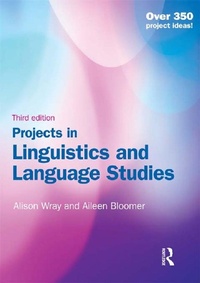
Projects in Linguistics and Language Studies
3rd Edition
Published on 22. January 2013
336 pages
978-1-134-63728-7 (ISBN)
Description

Projects in Linguistics and Language Studies, Third Edition, is your essential guide when embarking on a research project in linguistics or English language.
It is clearly divided into the subject areas that most appeal to you as a student: psycholinguistics; first- and second-language acquisition; structure and meaning; sociolinguistics; language and gender; accents and dialects; and the history of English. New chapters on researching computer-mediated communication (CMC) and on preparing and delivering oral presentations are also included.
It offers practical advice on
- identifying a topic
- making background reading more effective
- planning and designing a project
- collecting and analysing data
- writing up and presenting findings.
With over 350 project ideas that you can use directly or adapt to suit different contexts and interests, and with chapters on how to reference effectively and how to avoid plagiarism, this third edition of Projects in Linguistics and Language Studies is a reference guide that you will use again and again during your studies.
It is clearly divided into the subject areas that most appeal to you as a student: psycholinguistics; first- and second-language acquisition; structure and meaning; sociolinguistics; language and gender; accents and dialects; and the history of English. New chapters on researching computer-mediated communication (CMC) and on preparing and delivering oral presentations are also included.
It offers practical advice on
- identifying a topic
- making background reading more effective
- planning and designing a project
- collecting and analysing data
- writing up and presenting findings.
With over 350 project ideas that you can use directly or adapt to suit different contexts and interests, and with chapters on how to reference effectively and how to avoid plagiarism, this third edition of Projects in Linguistics and Language Studies is a reference guide that you will use again and again during your studies.
Reviews / Votes
Provides excellent guidance and material for those intending to research aspects of language. This [second edition] is a good book and, while written for undergraduate and postgraduate students in the field of language, it should serve as an important starting block for professionals wanting to become practitioner-researchers in this field.Child Language Teaching and Therapy
Excellent resource for any project-based course
Professor J Coates, University of Surrey
More details
Edition
3rd edition
Language
English
Place of publication
London
United Kingdom
Publishing group
Taylor & Francis Ltd
Target group
College/higher education
Product notice
Reflowable
Illustrations
19 figures
File size
9,31 MB
ISBN-13
978-1-134-63728-7 (9781134637287)
Copyright in bibliographic data and cover images is held by Nielsen Book Services Limited or by the publishers or by their respective licensors: all rights reserved.
Schweitzer Classification
Other editions
Additional editions
Alison Wray | Aileen Bloomer
Projects in Linguistics and Language Studies
A Practical Guide to Researching Language
Book
07/2017
3rd Edition
Routledge
€289.69
Shipment within 10-20 days
Alison Wray | Aileen Bloomer
Projects in Linguistics and Language Studies
A Practical Guide to Researching Language
Book
03/2012
3rd Edition
Routledge
€67.90
Shipment within 10-20 days
Persons
Alison Wray, Research Professor, Centre for Language and Communication Research, Cardiff University.
Aileen Bloomer, formerly Principal Lecturer in Language Studies and Linguistics, York St John University College.
Aileen Bloomer, formerly Principal Lecturer in Language Studies and Linguistics, York St John University College.
Content
Preface to the third edition
Acknowledgements
International Phonetic Alphabet
Chapter 1: Introduction: starting on the right foot
PART I: AREAS OF STUDY AND PROJECT IDEAS
Chapter 2: Psycholinguistics
Chapter 3: First-language acquisition and development
Chapter 4: Second-language acquisition
Chapter 5: Structure and meaning
Chapter 6: Style in spoken and written texts
Chapter 7: Sociolinguistics
Chapter 8: Language and gender
Chapter 9: Accents and dialects of English
Chapter 10: History of English
Chapter 11: Computer-mediated communication
PART II: TECHNIQUES FOR COLLECTING DATA
Chapter 12: Audio- and video-recorded data
Chapter 13: Experiments
Chapter 14: Questionnaires, interviews, and focus groups
Chapter 15: Observation and case studies
Chapter 16: Ethical considerations in research projects
PART III: TOOLS FOR DATA ANALYSIS
Chapter 17: Transcribing speech phonetically and phonemically
Chapter 18: Transcribing speech orthographically
Chapter 19: Using computers to study texts
Chapter 20: Statistics and your project
PART IV: PRESENTING YOUR WORK
Chapter 21: How to reference
Chapter 22: Plagiarism and how to avoid it
Chapter 23: Handy hints on writing good academic English
Chapter 24: Hints on giving a good oral presentation
References
Index
Acknowledgements
International Phonetic Alphabet
Chapter 1: Introduction: starting on the right foot
PART I: AREAS OF STUDY AND PROJECT IDEAS
Chapter 2: Psycholinguistics
Chapter 3: First-language acquisition and development
Chapter 4: Second-language acquisition
Chapter 5: Structure and meaning
Chapter 6: Style in spoken and written texts
Chapter 7: Sociolinguistics
Chapter 8: Language and gender
Chapter 9: Accents and dialects of English
Chapter 10: History of English
Chapter 11: Computer-mediated communication
PART II: TECHNIQUES FOR COLLECTING DATA
Chapter 12: Audio- and video-recorded data
Chapter 13: Experiments
Chapter 14: Questionnaires, interviews, and focus groups
Chapter 15: Observation and case studies
Chapter 16: Ethical considerations in research projects
PART III: TOOLS FOR DATA ANALYSIS
Chapter 17: Transcribing speech phonetically and phonemically
Chapter 18: Transcribing speech orthographically
Chapter 19: Using computers to study texts
Chapter 20: Statistics and your project
PART IV: PRESENTING YOUR WORK
Chapter 21: How to reference
Chapter 22: Plagiarism and how to avoid it
Chapter 23: Handy hints on writing good academic English
Chapter 24: Hints on giving a good oral presentation
References
Index
