


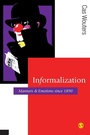
Informalization
Manners and Emotions Since 1890
1st Edition
Published on 29. October 2007
288 pages
978-1-84860-611-1 (ISBN)
Description

"This book shows that manners, far from being superficial adornments of behaviour, are thoroughly interwoven with our personalities and the structures of our societies. The concept of 'informalization' provides both an invaluable addition to Norbert Elias's theory of civilizing processes and a most useful tool for understanding how changes in manners are related to shifts in the balances of power between social classes, sexes, and generations"
- Johan Goudsblom, University of Amsterdam
"Cas Wouters stakes out a powerful theory about changes in human relationships in the Western world over the past twelve decades... essential reading for anyone interested in the contemporary human condition."
- Theory and Society
"It is written in clear, unequivocal language, abounds with detail and replaces many normative statements about the alienating state of contemporary, capitalist, mass-consumption-oriented bureaucracy.... A nuanced, subtle and theoretically informed analysis of the sometimes quite chaotic civilising process of the last century' - Figurations
This original book explains the sweeping changes to twentieth-century regimes of manners and self. Broad in scope and deep in analytic reach, it provides a wealth of empirical evidence to demonstrate how changes in the code of manners and emotions in four countries (Germany, Netherlands, England and the US) have undergone increasing informalization.
From the growing taboo toward the displays of superiority and inferiority and diminishing social and psychicogical distance between people, it reveals an 'emancipation of emotions' and the new representation of emotion at the centre of personality. This thought-provoking book traces:
The increasing permissiveness in public and private manners, such as introductions, the use of personal pronouns, social kissing, dancing, and dating.
The ascent and integration of a wide variety of groups - including the working classes, women, youth and immigrants - and the sweeping changes this has imposed on relations of social inferiority and superiority.
Shifts in self-regulation that require manners to seem 'natural', at ease and authentic.
Rising external social constraints towards being reflexive, showing presence of mind, considerateness, role-taking, and the ability to tolerate and control conflicts.
Growing interdependence and social integration, declining power differences and the diminishing social and psychic distance between people.
Continuing the analysis of Sex and Manners (SAGE, 2004), this book is a dazzling work of historical sociology.
- Johan Goudsblom, University of Amsterdam
"Cas Wouters stakes out a powerful theory about changes in human relationships in the Western world over the past twelve decades... essential reading for anyone interested in the contemporary human condition."
- Theory and Society
"It is written in clear, unequivocal language, abounds with detail and replaces many normative statements about the alienating state of contemporary, capitalist, mass-consumption-oriented bureaucracy.... A nuanced, subtle and theoretically informed analysis of the sometimes quite chaotic civilising process of the last century' - Figurations
This original book explains the sweeping changes to twentieth-century regimes of manners and self. Broad in scope and deep in analytic reach, it provides a wealth of empirical evidence to demonstrate how changes in the code of manners and emotions in four countries (Germany, Netherlands, England and the US) have undergone increasing informalization.
From the growing taboo toward the displays of superiority and inferiority and diminishing social and psychicogical distance between people, it reveals an 'emancipation of emotions' and the new representation of emotion at the centre of personality. This thought-provoking book traces:
The increasing permissiveness in public and private manners, such as introductions, the use of personal pronouns, social kissing, dancing, and dating.
The ascent and integration of a wide variety of groups - including the working classes, women, youth and immigrants - and the sweeping changes this has imposed on relations of social inferiority and superiority.
Shifts in self-regulation that require manners to seem 'natural', at ease and authentic.
Rising external social constraints towards being reflexive, showing presence of mind, considerateness, role-taking, and the ability to tolerate and control conflicts.
Growing interdependence and social integration, declining power differences and the diminishing social and psychic distance between people.
Continuing the analysis of Sex and Manners (SAGE, 2004), this book is a dazzling work of historical sociology.
Reviews / Votes
This book shows that manners, far from being superficial adornments of behaviour, are thoroughly interwoven with our personalities and the structures of our societies. The concept of 'informalization' provides both an invaluable addition to Norbert Elias's theory of civilizing processes and a most useful tool for understanding how changes in manners are related to shifts in the balances of power between social classes, sexes, and generations. -- Johan Goudsblom Cas Wouters stakes out a powerful theory about changes in human relationships in the Western world over the past twelve decades... essential reading for anyone interested in the contemporary human condition. -- Theory and Society It is written in clear, unequivocal language, abounds with detail and replaces many normative statements about the alienating state of contemporary, capitalist, mass-consumption-oriented bureaucracy.... A nuanced, subtle and theoretically informed analysis of the sometimes quite chaotic civilising process of the last century. -- Figurations Supplants and surpasses all previous work on the changing manners and emotional styles of the West in the last century. Wouters helps us to understand trends in Britain and the USA, comparing them not just with each other, but also with Germany and the Netherlands. -- Stephen Mennell In the academic environment in which I work, Norbert Elias' work on culture and civilizing processes continues to be a fundamental reference... I have often wondered when someone drawn to the Eliasian theoretical and methodological framework would come along to take up the task of extending Elias' work into more recent periods in the history of modern Western societies. Cas Wouters' thoroughly-researched book is a welcome contribution in this vein, picking up where Elias 'leaves off' and attempting to answer some very important questions regarding cultural trends and changes as they have unfolded over the course of the twentieth century... Wouters provides us with an invaluable resource for teaching and research in the areas of sociology of culture and sociology of the emotions. His attempt to ask - and answer - fundamental questions on the development of subjectivity, transformations of sociability, disciplining of the subject, relationships between the individual and the collective within modernity and post-modernity and the meaning of the shifting boundaries drawn around public and the private spheres, etc., all place his work in dialog with other important contemporary social theorists across the globe. -- International Sociology Review of BooksAll prices
More details
Series
Language
English
Place of publication
London
United Kingdom
Target group
Professional and scholarly
ISBN-13
978-1-84860-611-1 (9781848606111)
Copyright in bibliographic data and cover images is held by Nielsen Book Services Limited or by the publishers or by their respective licensors: all rights reserved.
Schweitzer Classification
Other editions
Additional editions

Book
10/2007
1st Edition
SAGE Publications Inc
€270.37
Article exhausted; check different version
Book
10/2007
1st Edition
SAGE Publications Inc
€113.30
Shipment within 10-20 days
Person
Cas Wouters is a senior lecturer at the Institute of General Social Sciences at Utrecht University.
Content
Manners: Theory and History
Social Mixing and Status Anxieties
Decreasing Social and Psychic Distance - Increasing Social Integration and Identification
Introductions and Friendships, Forms of Address and other Differences in National Habitus Formation
The Spiral process of Informalization
Phases of Informalization and Reformalization
Connecting Social and Psychic Processes
Third Nature
Social Mixing and Status Anxieties
Decreasing Social and Psychic Distance - Increasing Social Integration and Identification
Introductions and Friendships, Forms of Address and other Differences in National Habitus Formation
The Spiral process of Informalization
Phases of Informalization and Reformalization
Connecting Social and Psychic Processes
Third Nature
