

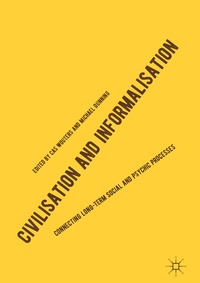
Civilisation and Informalisation
Description

Over the last century and a half, manners and formalities in the West have become less status-ridden, stiff and rigid. Debates around Norbert Elias' theory of civilising processes gave rise to questions of a change in direction of these patterns. The concept of informalisation, which describes these transformations, was first used to analyse the tumultuous changes of the 1960s and 1970s. This increasing informality, leniency and flexibility, comes hand-in-hand with a growing demand on individuals to self-regulate their emotions.
This book will stimulate debate around the changes in the standards of manners and emotion regulation, and will generate new avenues of enquiry that focus on issues involving informalisation. The chapters shed light on a variety of such moral and political issues over the last 150 years, offering a new and broader scope on the present social condition of humanity. Civilisation and Informalisation will be an important addition for students and scholars of figurational process sociology, and of broader interest to academics across sociology, social psychology and social history.
More details
Other editions
Additional editions
Persons
Cas Wouters is Professor Emeritus, Department of General Social Science, Utrecht University, the Netherlands.
Michael Dunning is Lecturer, Department of Media, Communications and Sociology, University of Leicester, UK.
Content
Part One: The Book.- 1. Informalisation: An Introduction; Cas Wouters.- 2. Informalisation and Evolution: Four Phases in the Development of Steering Codes; Cas Wouters.- 3. Informalisation and Emancipation of Lust and Love: Integration of Sexualisation and Eroticisation Since the 1880s; Cas Wouters.- 4. Informalisation of Rituals in Dying and Mourning: Changes in the We-I Balance; Cas Wouters.- 5. Informalisation, Functional Democratisation and Globalisation; Cas Wouters.- 6. Universally Applicable Criteria for Analysing Social and Psychic Processes: Nine Tension Balances, One Triad; Cas Wouters.- Part Two: The Selection.- 7. Informalisation Through the Lens: Black & White and the Development of Photography as Art; Jonathan Fletcher.- 8.- Informalisation and Brutalisation: Jihadism as a Part-Process of Global of Integration and Disintegration Processes; Michael Dunning.- 9. Informalisation and Sport: The Case of Jogging/Running in the USA (1960-2000); Raúl Sánchez-García.- 10. Informalisation and Integration Conflicts: The Two-Faced Reception of Migrants in the Netherlands; Arjan Post.- 11. Formalisation and Informalisation of Meeting Manners; Wilbert van Vree.- 12. Informalisation Sociological Theory and Social Diagnosis; Richard Kilminster.
