

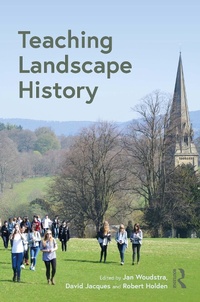
Teaching Landscape History
1st Edition
Published on 29. November 2023
256 pages
978-1-000-99149-9 (ISBN)
Description

Landscape history is changing in content and style to address the issues of today. Experienced teachers and authors on the history of gardens and landscapes come together in this new volume to share ideas on the future of teaching history in departments of landscape architecture, archaeology, geography and allied subjects.
Design history remains important, but this volume brings to the fore the increasing importance of environmental history, economic history, landscape history, cultural landscapes, environmental justice and decolonisation, ideas of sustainability and climate change amelioration, which may all be useful in serving the needs of a widening range of students in an increasingly complex world. The main themes include:
what history should we narrate in the education of landscape architects?
how can we recognise counter-narratives and our own bias?
how should we engage the students in the history of their chosen profession?
how can designers and researchers be persuaded of the relevance of history teaching to theory and practice? and
what resources do we need to develop teaching of landscape histories?
This book will be of interest to anyone teaching courses on landscape architecture, urban design, horticulture, garden design, architectural history, cultural geography and more.
Design history remains important, but this volume brings to the fore the increasing importance of environmental history, economic history, landscape history, cultural landscapes, environmental justice and decolonisation, ideas of sustainability and climate change amelioration, which may all be useful in serving the needs of a widening range of students in an increasingly complex world. The main themes include:
what history should we narrate in the education of landscape architects?
how can we recognise counter-narratives and our own bias?
how should we engage the students in the history of their chosen profession?
how can designers and researchers be persuaded of the relevance of history teaching to theory and practice? and
what resources do we need to develop teaching of landscape histories?
This book will be of interest to anyone teaching courses on landscape architecture, urban design, horticulture, garden design, architectural history, cultural geography and more.
Reviews / Votes
This publication is an important contribution to a global movement of scholarly reflection on how reframing landscape history could unlock new possibilities in teaching and learning about our shared global environmental legacy.Kofi Boone, Distinguished Professor and University Faculty Scholar, NC State University, USA
Profound knowledge of landscape history is indispensable for landscape architects. It provides valuable insights into the historical layering and narrative of a place which will inspire users, enlarge societal acceptance and prevents a design which denies the genius loci. This book is an excellent aid for this.
Theo Spek, Professor of Landscape History, University of Groningen, The Netherlands
Knowing landscape history is fundamental in understanding how the environment has been used, designed and transformed by human society. By bringing together a range of interdisciplinary and transnational understandings in teaching landscape history, this volume challenges historical and shifting perspectives of landscape in relation to race, class, gender, and politics.
Catharina Nolin, Professor of Art History, Department of Culture and Aesthetics, Stockholm University, Sweden
More details
Edition
1. Auflage
Language
English
Place of publication
London
United Kingdom
Publishing group
Taylor & Francis Ltd
Target group
College/higher education
Professional and scholarly
Illustrations
1 Tables, black and white; 4 Line drawings, black and white; 60 Halftones, black and white; 64 Illustrations, black and white
ISBN-13
978-1-000-99149-9 (9781000991499)
Copyright in bibliographic data and cover images is held by Nielsen Book Services Limited or by the publishers or by their respective licensors: all rights reserved.
Schweitzer Classification
Other editions
Additional editions
Jan Woudstra | David Jacques | Robert Holden
Teaching Landscape History
Book
11/2023
1st Edition
Routledge
€230.48
Shipment within 10-20 days
Jan Woudstra | David Jacques | Robert Holden
Teaching Landscape History
Book
11/2023
1st Edition
Routledge
€72.03
Shipment within 10-20 days
Persons
Jan Woudstra trained in landscape architecture and horticulture in the Netherlands and at Kew and completed an MA at the Institute of Advanced Architectural Studies at the University of York. His PhD in the Department of Geography at the University of London looked at modernism in twentieth-century landscape design. While working in private practice, he taught on the part-time landscape conservation course at the Architectural Association. He joined the Department of Landscape at the University of Sheffield in 1995, where he is Reader in Landscape History and Theory. He writes extensively and his publications include Jan Woudstra and Camilla Allen (eds.), The Politics of Street Trees (2022); Jonathan Finch and Jan Woudstra (eds.), Capability Brown, Royal Gardener: The Business of Place-Making in Northern Europe (2020); Jan Woudstra and Colin Roth (eds.), A History of Groves (2018).
David Jacques is an historian and conservationist of parks and gardens, and has been a prominent advocate of cultural landscapes. He lectured on the MA in Conservation Studies at the Institute of Advanced Architectural Studies at York, the Landscape Conservation MA at the Architectural Association and the Garden History MA at the Institute of Historical Research at the University of London, and was Visiting Professor at De Montfort University 1999-2002. He was the Inspector of Parks and Gardens at English Heritage 1987-93, and at other times was a consultant, for example, on the Privy Garden at Hampton Court. His publications include Georgian Gardens: The Reign of Nature (1983), The Gardens of William and Mary (1988), Landscape Modernism Renounced: The Career of Christopher Tunnard (1910-1979) (with Jan Woudstra) (2009), Gardens of Court and Country (2017), Landscape Appreciation: Theories since the Cultural Turn (2019) and Chiswick House Gardens: 300 Years of Creation and Recreation (2022).
Robert Holden is a British landscape architect educated at the University of Newcastle-upon-Tyne. His career has been half in practice, and he was known for work on European business parks in the 1980s and 1990s, and half in academia, where he was a lecturer at the University of Greenwich 1992 until 2013. In 1972-82 he was on the Committee of the (UK) Garden History Society. In the 2000s he was Education Chair, then Secretary General of EFLA (now IFLA Europe). He has contributed widely to the technical press. For FOLAR he organises an annual Symposium aiming to assist the Landscape Institute prior to its centenary in 2029.
David Jacques is an historian and conservationist of parks and gardens, and has been a prominent advocate of cultural landscapes. He lectured on the MA in Conservation Studies at the Institute of Advanced Architectural Studies at York, the Landscape Conservation MA at the Architectural Association and the Garden History MA at the Institute of Historical Research at the University of London, and was Visiting Professor at De Montfort University 1999-2002. He was the Inspector of Parks and Gardens at English Heritage 1987-93, and at other times was a consultant, for example, on the Privy Garden at Hampton Court. His publications include Georgian Gardens: The Reign of Nature (1983), The Gardens of William and Mary (1988), Landscape Modernism Renounced: The Career of Christopher Tunnard (1910-1979) (with Jan Woudstra) (2009), Gardens of Court and Country (2017), Landscape Appreciation: Theories since the Cultural Turn (2019) and Chiswick House Gardens: 300 Years of Creation and Recreation (2022).
Robert Holden is a British landscape architect educated at the University of Newcastle-upon-Tyne. His career has been half in practice, and he was known for work on European business parks in the 1980s and 1990s, and half in academia, where he was a lecturer at the University of Greenwich 1992 until 2013. In 1972-82 he was on the Committee of the (UK) Garden History Society. In the 2000s he was Education Chair, then Secretary General of EFLA (now IFLA Europe). He has contributed widely to the technical press. For FOLAR he organises an annual Symposium aiming to assist the Landscape Institute prior to its centenary in 2029.
Content
Authors
Abbreviations
Foreword
Preface: landscape history in crisis
Introduction
1. The necessity for landscape history
2. The shifting meanings of 'landscape'
3. The branches of landscape history
4. A cluster of subjects
5. Identity and dispossession
6. Whose history?
7. Present pedagogy
8. The possibilities from new technology
9. Reviewing the curriculum
10. Towards a manifesto
Abbreviations
Foreword
Preface: landscape history in crisis
Introduction
1. The necessity for landscape history
2. The shifting meanings of 'landscape'
3. The branches of landscape history
4. A cluster of subjects
5. Identity and dispossession
6. Whose history?
7. Present pedagogy
8. The possibilities from new technology
9. Reviewing the curriculum
10. Towards a manifesto
