

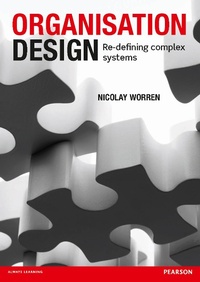
Organisation Design eBook
Description

Organization design is part of every manager and leader's job: attempting to understand and improve how organizations function through creating or adjusting of roles, processes, and structures. In fact, most managers are faced with organization design challenges on an almost daily basis.
Managers constantly design and redesign individual roles, define new projects (including their structure and reporting relationships), and contemplate better ways to co-ordinate organizational processes with multiple internal stakeholders. Periodically they may also make more fundamental changes to business structures, or adapt and implement high-level designs developed by others.
This textbook introduces concepts and frameworks for designing complex organizations. It starts by outlining some of the key concepts that serve as a foundation to understanding how the theory applies in practice. It also reviews the status of organisation design - as a field of research and as a practical discipline - both its achievements, and some of its challenges and limitations. It then discusses how the field can develop to ensure that it provides research-based and useful knowledge that contributes to enhancing the effectiveness of organizations.
"Nicolay Worren provides a much needed blend of organization design theory and practice as well as a rigorous approach to simplifying today's complex global enterprises. It is an essential read for any organizational designer"
Marc Gerstein, past president of the Organization Design Forum and author of Organizational Architecture and Flirting with Disaster
"...The message that organization design is a part of every managers' job, is a major determinant of effectiveness, but requires considerable skill, comes through load and clear from this book. With its use of challenges, key questions and proposed approaches the book explains complex concepts and provides a good blend academic insight andpractical relevance".
Paul R. Sparrow, Director, Centre for Performance-led HR,Lancaster University Management School
"In training the future leaders of the corporate world, business schools have historically placed little emphasis on organization design. Nicolay Worren's book on organization design demonstrates this is a huge mistake. How we design our corporations has an enormous impact on their performance! Worren develops a novel, complexity-oriented approach by advocating a 'design' rather than 'decision-making' attitude. Worren's book draws on organizational architecture as a key notion and also provides a clear, step-by-step process toward applying core ideas in organizational design and architecture. A must-read for today's (aspiring) managers."
Georges Romme, Dean of Industrial Engineering & Innovation Sciences, Eindhoven University of Technology, the Netherlands
"This clearly written book offers a contemporary and thoughtful presentation of the architectural options involved in organisational design. It candidly acknowledges the neglect of organisational design in much research (...). It emphasizes that the topic of organisational design must include processes of design (...) Overall, Nicolay Worren persuasively makes the argument that organizational design deserves to be a core topic in the modern business school.
Lex Donaldson, Professor of Management in Organisational Design, Australian School of Business, University of New South Wales
More details
Other editions
Additional editions
Person
Nicolay Worren is an organisation design consultant based in Norway. He has worked for PA Consulting, Aker Solution and Accenture and holds graduate degrees from Oxford, McGill and the Norwegian School of Management.
Content
- Cover
- Organisation Design
- Brief contents
- Contents
- Why design matters
- Overview
- Introduction
- Foundational concepts
- Key challenges facing the discipline
- The value of effective designs
- Design attitude
- Organisational architecture
- Axiomatic design theory
- 'Layers' of design parameters
- Design-oriented research
- Conclusion
- Design propositions
- Review questions
- Research questions
- Case study Procter & Gamble's Organisation 2005 initiative
- References
- Organisational complexity
- Overview
- Introduction
- Simplicity versus complexity
- How complexity affects organisational functioning
- Rising complexity
- Why is complexity allowed to grow?
- Developing a new agenda for managing and re-designing complex organisations
- Discussion
- Summary and conclusion
- Design propositions
- Review questions
- Research questions
- Case Study The functions and structure of a hospital
- References
- Managing the organisation design process
- Overview
- Introduction
- Requirements to design processes
- Sequence of activities in re-design projects
- Summary and discussion
- Design propositions
- Review questions
- Research questions
- Case Study: PowerCo
- References
- Designing multidimensional organisations
- Overview
- Introduction
- The matrix
- The front-back model
- The modular organisation
- Discussion
- Summary and conclusion
- Design propositions
- Review questions
- Research questions
- Case study: European School of Management
- References
- Designing sub-units
- Overview
- Introduction
- Defining the sub-unit mission and functional requirements
- Defining the sub-unit operating model (design parameters)
- Identifying and analysing interdependencies
- Locating sub-unit boundaries (interfaces)
- Evaluating alternative grouping criteria
- Alternative characterisation of interdependencies
- Determining group size
- Aligning formal structure with work process interdependencies
- Summary and conclusion
- Design propositions
- Review questions
- Research questions
- Case Study: Merger between Atlantic Life and Dutch Mutual
- References
- Structuring vertical layers
- Overview
- Introduction
- The ideal hierarchy
- The requisite organisation approach
- Application of requisite organisation concepts in re-design processes
- The applicability of requisite organisation concepts in modern organisations
- Discussion
- Summary and conclusion
- Design propositions
- Review questions
- Research questions
- Case Study:The staff function in Scandic Consult
- References
- Configuring interfaces
- Overview
- Introduction
- Case example: ProTech
- Degrees of work process interdependency
- Interdependency types
- Activity interdependencies
- Commitment interdependencies
- Governance interdependencies
- Resource interdependencies
- Social network interdependencies
- Discussion and conclusion
- Overall design propositions
- Design propositions
- Review questions
- Research questions
- Case study: TowerTech
- References
- Rooting out complexity
- Overview
- Introduction
- Responsibility overlaps
- Role inconsistencies in horizontal processes
- Excessive interfaces - 'Everybody connected to everybody'
- Conflicting requirements due to resource dependency
- Misalignment of interdependencies
- Conclusion
- Design propositions
- Review questions
- Research questions
- Case study: Defining EVP responsibilities in Royal Bank
- References
- Index
