

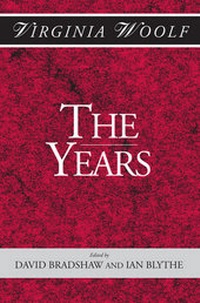
The Years
Description

Reviews / Votes
"Scholars such as David Bradshaw and Ian Blyth remind us that The Years is so much more than just a family saga, and to them we must be grateful for their shared insights." Virginia Woolf Bulletin (May 2013)More details
Other editions
Additional editions
Persons
Content
Introduction
1
By the time The Years appeared in British and American bookshops (on 15 March and 8 April 1937 respectively) it had taken its toll on Woolf. No other novel had absorbed so much of her time and creative energy and none had involved so much frustration and mutation during the course of its emergence. She must have been all too acutely aware that its title reflected its protracted gestation as well as its portrait of an epoch. Woolf was all the more delighted, therefore, when it was generally well received by critics and became an immediate best seller, especially in America, while the long-standing tendency within the academy to underrate it as an over-long and retrograde exercise in conventional realism has been superseded during the last decade or so by a more nuanced appreciation of its depth, intricacy, ambition and patterning.
The twin source of both The Years and Three Guineas (1938) is a speech Woolf gave on 21 January 1931 to the London branch of the National Society for Women's Service, an abridged version of which was subsequently published as 'Professions for Women'.1 The day before she delivered it she wrote in her diary: 'I have this moment, while having my bath, conceived an entire new book - a sequel to a Room of One's Own - about the sexual life of women: to be called Professions for Women perhaps - Lord how exciting!'2 In the event, it would be a further six years until this 'new book' saw the light of day and by that time it bore little resemblance to the daring and uninhibited text Woolf had envisaged in her bath, and not least, we may presume, because she knew that such frankness was then impossible in her prudish literary culture, where inhibition, evasion and concealment were enforced by law, though Woolf did go on to speak her mind with considerable forthrightness (while still avoiding explicit discussion of 'the sexual life of women') in Three Guineas. Although the eight-volume holograph draft of The Years in the Berg Collection, New York Public Library (more than a thousand notebook pages in all), reveals some evidence of the openness about sexual matters to which Woolf aspired at this time, only a few, oblique instances of this spirit found their way into the published text, whereas squeamishness and revulsion of one kind or another are to be found on page after page. But it would be unwise to conclude that the absence of frankness in The Years reveals a loss of nerve on Woolf's part, a meek acceptance of what was and was not permissible: the unspeakable and the unspoken; the marginalized, the concealed and the excluded; the malignant, obligatory reticence of the patriarchal system, would become the driving concerns of her ninth novel. The inherent limitations of her women characters in particular, their struggles to leave behind the traits and prejudices of their families, are indicative of how domestic environments and domestic values leave indelible blots in The Years.
At the beginning of 1931 Woolf visualized her book as a kind of portal into new fictional territory and she was strongly tempted to make headway with it even as she struggled to finish The Waves. 'Too much excited, alas, to get on with The Waves', she wrote in her diary on 23 January. 'One goes on making up The Open Door,3 or whatever it is to be called. The didactive demonstrative style conflicts with the dramatic: I find it hard to get back inside Bernard again.'4 She writes in the same diary entry of the 'Open Door sucking at my brain',5 recording with almost audible relief three days later: 'Heaven be praised, I can truthfully say on this first day of being 49 that I have shaken off the obsession of Opening the Door, & have returned to the Waves'. Nevertheless, she aimed to have a 'rough sketch of the Open Door'6 by 1 April. But this hope was not fulfilled, and by 28 May 1931 she noted that she was 'much interrupted again by my wish to write A Knock on the door. For some weeks I have not thought of it. It suddenly forces itself on me, & I go on making up sentences, arguments, jokes &c.'7 By the beginning of the following year 'the Tap on the Door'8 still hovered tantalizingly before her and 16 February 1932 found Woolf 'quivering & itching to write my - whats it to be called? - "Men are like that?" - no thats too patently feminist: the sequel then, for which I have collected enough powder to blow up St Pauls.'9 By 1 April she mentions in a letter to Ethel Smyth that she has 'invented the skeleton of another novel: but it must wait, buried, at least a year.'10
One of the most significant dates in the evolution of The Years is 11 October 1932. It was on this day that Woolf began 'The Pargiters: An Essay Based upon a paper read to the London/National Society for Women's Service'. By 2 November this 'Essay' had morphed into 'an Essay-Novel, called the Pargiters', reflecting Woolf's intention to intercalate 'extracts' from the story of a family from 1880 to 202311 with interpretative essays on those extracts and more generally on the condition of women. This ground-breaking 'Essay-Novel' would, she hoped:
take in everything, sex, education, life &c; & come, with the most powerful & agile leaps, like a chamois across precipices from 1880 to here and now - Thats the notion anyhow, & I have been in such a haze & dream & intoxication, declaiming phrases, seeing scenes, as I walk up Southampton Row that I can hardly say that I have been alive at all, since the 10th Oct. . What has happened of course is that after abstaining from the novel of fact all these years - since 1919 - & N[ight]. & D[ay]. indeed, I find myself infinitely delighting in facts for a change, & in possession of quantities beyond counting: though I feel now & then the tug to vision, but resist it. This is the true line, I am sure, after The Waves - The Pargiters - this is what leads naturally on to the next stage - the essay-novel.12
Woolf's conceit was that both essays and extracts were the work of a woman novelist invited to give a speech to an audience of professional women, the extracts being from The Pargiters, her novel in progress, and designed to be illustrative of the points she makes in her talk.
At this point in the novel's development words flowed from her pen and the project's imaginative and documentary elements seemed to meld without difficulty. By 10 November Woolf had finished the 'child scene - the man exposing himself - in the Pargiters.'13 The following day she began the third essay of The Pargiters and she commenced the third chapter a week after that; she was working on the fourth essay and the fourth chapter towards the end of the month and on 30 November she began the fifth essay. 'I've almost written out my first fury', she wrote in her diary on 17 December 1932, '- 234 typewritten pages since Oct. 10th . But the fun of the book is to come, with Magdalena & Elvira.'14 Two days later, on 19 December 1932, she noted that she had 'written 60,320 words since Oct. 11th. I think this must be far the quickest going of any of my books: comes far ahead of Orlando or The Lighthouse. But then those 60 thousand will have to be sweated & dried into 30 or 40 thousand - a great grind to come. Never mind. I have secured the outline & fixed a shape for the rest.'15 At some point the following month, January 1933, she finished the opening section of her book, comprising six factual essays and five fictional 'extracts'. (In time, this material, representing the whole of the first volume and 84 pages of the second volume of the eight holograph notebooks in the Berg Collection, would be transformed into the '1880' chapter of The Years and published in its own right in 1977 as The Pargiters: The Novel-Essay Portion of 'The Years', ed. Mitchell A. Leaska.16) Woolf now saw the book ahead of her 'as a curiously uneven time sequence - a series of great balloons, linked by straight narrow passages of narrative.'17
However, to extrapolate the modus operandi of The Pargiters as far forward as 1900, never mind 2023, must have seemed a daunting prospect to Woolf, while in the same month, January 1933, she also confessed that she had become 'afraid of the didactic'.18 A week later, on 2 February, she decided to leave out 'the interchapters - compacting them in the text',19 so great was her worry that her book would end up being too polemical, too propagandist, too artless and too long, if she continued with the 'Essay-Novel' method. Woolf had long objected to fiction being used for the promotion of personal hobby-horses or the airing of bugbears and the most surprising aspect of her change of attitude is that she had seriously contemplated placing pure fact and pure fiction side by side in the first place, as opposed to subsuming 'fact' into fiction with all the imaginative subtlety at her command: few novelists, as she recognized in her near contemporaneous essay on Turgenev, are able to 'combine the fact and the vision'.20 In October 1932 she had said of D. H. Lawrence (on reading his Letters, published that year), 'its the preaching that rasps me . Art is being rid of all...
