

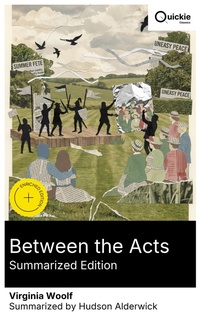
Between the Acts (Summarized Edition)
Enriched edition. A stream-of-consciousness portrait of an English village's summer pageant, exploring identity, art, and pre-war society.
Published on 3. April 2026
96 pages
8596547893035 (EAN)
Description

Over a single June day at Pointz Hall, Between the Acts presents a village pageant by Miss La Trobe, through which English history refracts while Isa and Giles Oliver's marriage strains at the margins. Woolf builds a modernist collage: choric voices, rough stage cues, gramophone snatches, and interruptions of weather and birdsong entangle spectators and actors until a mirror turns on the audience. Written on the eve of war and published posthumously in 1941, the book fuses pastoral with experiment to test art, memory, and nationhood. Woolf, a central figure of Bloomsbury, drafted the novel in Sussex amid wartime anxiety and recurrent illness. Her diaries and essays show a sustained interest in amateur theatricals, village fêtes near Monk's House, and the fragile bonds of local life; these feed Miss La Trobe's uncompromising vision. The stream-of-consciousness experiments of Mrs Dalloway and The Waves here assume a collective, theatrical shape. Recommended to readers of modernism, performance studies, and social history, Between the Acts offers a lucid meditation on how art convenes a fraying public. Lyrical yet unsparing, it rewards close study and will deepen conversations in seminars, book clubs, and solitary reading alike.
Quickie Classics summarizes timeless works with precision, preserving the author's voice and keeping the prose clear, fast, and readable-distilled, never diluted. Enriched Edition extras: Introduction · Synopsis · Historical Context · Author Biography · Brief Analysis · 4 Reflection Q&As · Editorial Footnotes.
More details
Persons
Virginia Woolf (1882-1941) was an emblematic figure of modernist literature and a central part of the Bloomsbury Group, which revolutionized artistic and literary thinking during the early 20th century. Woolf's narrative style was distinguished by her stream of consciousness technique, a literary method characterized by the representation of an individual's inner thoughts and emotions in a flow reminiscent of natural thought processes, devoid of implied logic or chronological order. Her contributions to literary form and feminist discourse are evident in her extensive body of work, which includes novels, essays, and criticism. Among her most celebrated works are 'Mrs Dalloway' (1925), 'To the Lighthouse' (1927), and 'Orlando' (1928). 'Between the Acts' (1941), Woolf's last novel published posthumously, encapsulates her thematic exploration of the interconnectedness of life and art, within the backdrop of an English village before World War II, portraying the subtle fabric of society through the staging of a play. With an impressive oeuvre that delves deep into the complexities of human consciousness and societal norms, Woolf's literary achievements continue to influence writers and scholars. Her introspective and poetic prose has not only shaped the trajectory of English literature but has also provided a platform for progressive discussions on gender roles and the psyche.
