

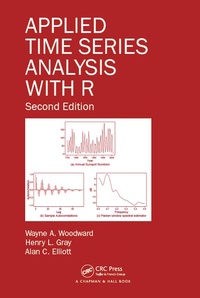
Applied Time Series Analysis with R
2nd Edition
Published on 17. February 2017
634 pages
978-1-4987-3427-1 (ISBN)
Description

Virtually any random process developing chronologically can be viewed as a time series. In economics closing prices of stocks, the cost of money, the jobless rate, and retail sales are just a few examples of many. Developed from course notes and extensively classroom-tested, Applied Time Series Analysis with R, Second Edition includes examples across a variety of fields, develops theory, and provides an R-based software package to aid in addressing time series problems in a broad spectrum of fields. The material is organized in an optimal format for graduate students in statistics as well as in the natural and social sciences to learn to use and understand the tools of applied time series analysis.
Features
Gives readers the ability to actually solve significant real-world problems
Addresses many types of nonstationary time series and cutting-edge methodologies
Promotes understanding of the data and associated models rather than viewing it as the output of a "black box"
Provides the R package tswge available on CRAN which contains functions and over 100 real and simulated data sets to accompany the book. Extensive help regarding the use of tswge functions is provided in appendices and on an associated website.
Over 150 exercises and extensive support for instructors
The second edition includes additional real-data examples, uses R-based code that helps students easily analyze data, generate realizations from models, and explore the associated characteristics. It also adds discussion of new advances in the analysis of long memory data and data with time-varying frequencies (TVF).
Features
Gives readers the ability to actually solve significant real-world problems
Addresses many types of nonstationary time series and cutting-edge methodologies
Promotes understanding of the data and associated models rather than viewing it as the output of a "black box"
Provides the R package tswge available on CRAN which contains functions and over 100 real and simulated data sets to accompany the book. Extensive help regarding the use of tswge functions is provided in appendices and on an associated website.
Over 150 exercises and extensive support for instructors
The second edition includes additional real-data examples, uses R-based code that helps students easily analyze data, generate realizations from models, and explore the associated characteristics. It also adds discussion of new advances in the analysis of long memory data and data with time-varying frequencies (TVF).
Reviews / Votes
"What an extraordinary range of topics this book covers, all very insightfully. I like [the authors'] innovations very much, including the AR factor table." -David Findley, Senior Mathematical Statistician, US Census Bureau (retired)"... impressive coverage of the scope of time series analysis in both frequency and time domain ... ... I commend the authors for having included a number of topics on nonstationary processes (e.g., time-varying spectrum, wavelets), ...an excellent textbook ..." -Hernando Ombao, Journal of the American Statistical Association
". . . the book is a good introductory or reference text for practitioners or those new to time series analysis. The chapters are easy to read, and the distinction between applied and theoretical examples throughout helps to cement knowledge for these two distinct groups." -Rebecca Killick, Mathematics & Statistics Department, Lancaster University
" . . . this book has much to recommend it for that audience. Coverage is quite thorough and up to date. There is an emphasis on the selection and evaluation of models which is very welcome, and not always found in statistics textbooks directed at non-statisticians." -Robert W. Hayden, Mathematical Association of America
"I find the structure of the book very convincing: First, the more basic models are spelled out, second, the forecasting purpose is dealt with, third, estimation and related inferential issues are covered, before an extension (to the multivariate case and more demanding models) is tackled. Each chapter concludes with an exercise section, typically containing theoretical problems as well as applied problems, where the latter build on R; moreover, R commands are explained in separate sections. Further, the book contains over 100 examples." -Uwe Hassler, Stat Papers "What an extraordinary range of topics this book covers, all very insightfully. I like [the authors'] innovations very much, including the AR factor table." -David Findley, Senior Mathematical Statistician, US Census Bureau (retired)
"... impressive coverage of the scope of time series analysis in both frequency and time domain ... ... I commend the authors for having included a number of topics on nonstationary processes (e.g., time-varying spectrum, wavelets), ...an excellent textbook ..." -Hernando Ombao, Journal of the American Statistical Association
". . . the book is a good introductory or reference text for practitioners or those new to time series analysis. The chapters are easy to read, and the distinction between applied and theoretical examples throughout helps to cement knowledge for these two distinct groups." -Rebecca Killick, Mathematics & Statistics Department, Lancaster University
" . . . this book has much to recommend it for that audience. Coverage is quite thorough and up to date. There is an emphasis on the selection and evaluation of models which is very welcome, and not always found in statistics textbooks directed at non-statisticians." -Robert W. Hayden, Mathematical Association of America
"I find the structure of the book very convincing: First, the more basic models are spelled out, second, the forecasting purpose is dealt with, third, estimation and related inferential issues are covered, before an extension (to the multivariate case and more demanding models) is tackled. Each chapter concludes with an exercise section, typically containing theoretical problems as well as applied problems, where the latter build on R; moreover, R commands are explained in separate sections. Further, the book contains over 100 examples." -Uwe Hassler, Stat Papers
More details
Edition
2nd edition
Language
English
Place of publication
London
United Kingdom
Publishing group
Taylor & Francis Ltd
Target group
College/higher education
Illustrations
200 Illustrations, black and white
File size
25,42 MB
ISBN-13
978-1-4987-3427-1 (9781498734271)
Copyright in bibliographic data and cover images is held by Nielsen Book Services Limited or by the publishers or by their respective licensors: all rights reserved.
Schweitzer Classification
Other editions
Additional editions
Wayne A. Woodward | Henry L. Gray | Alan C. Elliott
Applied Time Series Analysis with R
Book
06/2021
2nd Edition
CRC Press
€77.20
Shipment within 10-20 days
Wayne A. Woodward | Henry L. Gray | Alan C. Elliott
Applied Time Series Analysis with R
Book
12/2016
2nd Edition
CRC Press
€173.70
Shipment within 15-20 days
Persons
Wayne A. Woodward is a professor and chair of the Department of Statistical Science at Southern Methodist University in Dallas,
Texas.
Henry L. Gray is a C.F. Frensley Professor Emeritus in the Department of Statistical Science at Southern Methodist University in
Dallas, Texas.
Alan C. Elliott is a biostatistician in the Department of Statistical Science at Southern Methodist University in Dallas, Texas.
Texas.
Henry L. Gray is a C.F. Frensley Professor Emeritus in the Department of Statistical Science at Southern Methodist University in
Dallas, Texas.
Alan C. Elliott is a biostatistician in the Department of Statistical Science at Southern Methodist University in Dallas, Texas.
Content
Stationary Time Series. Linear Filters. ARMA Time Series Models. Other Stationary Time Series Models. Nonstationary Time Series Models. Forecasting. Parameter Estimation. Model Identification. Model Building. Vector-Valued (Multivariate) Time Series. Long-Memory Processes. Wavelets. G-Stationary Processes.
