

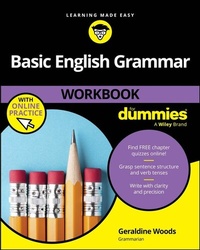
Basic English Grammar Workbook For Dummies with Online Practice Quizzes
Description

Simple explanations and plenty of grammar practice-for native speakers and learners alike
Basic English Grammar Workbook For Dummies is full of examples and practice questions that make it easy to master English grammar. You can learn the rules-and exceptions to those rules-with hands-on exercises and clear explanations of the answers.
With the help of this easy-to-understand guide, you'll be an expert at pronouns, word order, passive voice, verb tenses, and punctuation. By the end, you'll be speaking clearly, writing correctly, and impressing bosses, teachers, and even the pickiest grammarian.
- Work your way through the most important topics in English grammar, with hands-on exercises, answers, and explanations
- Practice using formal and informal English, choosing the correct expressions for any situation
- Learn about pronouns and inclusive language, including the changing rules about "they" and "them"
- Access free online chapter quizzes for even more practice, so you can solidify what you've learned
If you're studying English grammar in school or on your own-or if you're looking for resources to teach grammar-this is the Dummies guide for you.
More details
Other editions
Additional editions
Person
Geraldine Woods is a grammarian and the author of more than 50 books. An experienced educator with a gift for helping students realize their potential and learn difficult subjects, Woods' friendly style and humor make learning easy for everyone.
Content
Introduction 1
Part 1: Mastering the Basics 7
Chapter 1: Tailoring Language to Suit Your Audience and Purpose 9
Chapter 2: Noticing Nouns and Perfecting Pronouns 17
Chapter 3: Getting Acquainted with Verbs 31
Chapter 4: Writing Good or Well: Adjectives and Adverbs 47
Chapter 5: Packing Plenty of Power: Prepositions, Conjunctions, and Interjections 63
Part 2: Creating Correct Sentences 73
Chapter 6: Digging Deeper into Verb Tense 75
Chapter 7: Tackling Subjects, Objects, and Complements 85
Chapter 8: Having It All: Writing Complete Sentences 99
Part 3: Perfecting Punctuation and Capitalization 113
Chapter 9: Catching Up on Apostrophes, Hyphens, and Dashes 115
Chapter 10: Pausing to Consider the Comma 129
Chapter 11: "Can I Quote You on That?" Quotation Marks 145
Chapter 12: Hitting the Big Time: Capital Letters 155
Part 4: Grammar in Action 165
Chapter 13: Texting, Emailing, and Posting 167
Chapter 14: Stacking Ideas: Numbered Steps and Bulleted Lists 179
Chapter 15: Writing at School and at Work 191
Part 5: Getting the Details Right 201
Chapter 16: Taming Tricky Words 203
Chapter 17: Avoiding Common Mistakes 215
Chapter 18: Sharpening Your Verb Skills 231
Chapter 19: Mastering Picky Pronouns and Avoiding Confusing Comparisons 245
Chapter 20: Putting the Right Letters in the Right Place: Spelling 255
Index 269
Introduction
John leaves a note for his dad:
I had to write a report for school. I sat at your desk because your chair is more comfortable than mine. I typed the report on your computer. Everything was fine for the first ten minutes. Then it broke! I'm sorry.
What does John's dad think?
- Where's my toolbox? I can fix that chair.
- or
- That desk is an antique. Only an expert can repair it.
- or
- I hate when my computer breaks.
Here's what I think: John needs to sharpen his grammar skills. Surprised? Many people believe that grammar is a set of meaningless rules. In fact, grammar is the structure of language. It comes from traditions, from the way people speak and write. If you obey commonly accepted grammar rules, more people will understand your message. By the way, I don't know what broke - the chair, the desk, or the computer. I do know that the pronoun it is unclear. That's the grammar rule that John broke. Basic English Grammar Workbook For Dummies can help John. It can help you, too, whether you have spoken English all your life or you're learning the language now.
About This Book
In Basic English Grammar Workbook For Dummies, I focus on the information you need to improve your grasp of Standard English. That's the version of the language that educated people use when they're in formal situations. I explain the rules of Standard English, but I also tell you when you can bend or break them in casual situations.
For the most part, I stay away from technical vocabulary. You can speak and write perfectly well without labeling everything in a sentence! I provide grammar terms only when you need them to understand a rule. Don't worry: I define every grammar term I use and give examples.
Each topic begins with a short explanation of the rules. Then, a set of questions prompts you to apply the rules. The final section of each chapter is "Calling All Overachievers." Its questions cover all the rules in the chapter. Once you've answered the questions, you can check your work. The answer key at the end of the chapter tells you what's correct and explains why it's correct. For even more practice, take an online quiz. (See "Beyond the Book" later in this introduction for details on how to access online material.)
Basic English Grammar Workbook For Dummies is divided into five parts:
- Part 1 explains how to tailor your writing style to fit your audience and purpose. This part also introduces you to the building blocks of language - the parts of speech - and explains what you need to know in order to use them correctly.
- Part 2 explores three important elements of a sentence: verbs, subjects, and complements. In this part, you also practice recognizing and writing complete sentences.
- Part 3 covers capitalization and punctuation (periods, commas, question marks, and so forth).
- Part 4 connects grammar to modern life. You apply your grammar knowledge to texts, emails, online posts, presentation slides, and bulleted lists. One chapter takes grammar to work and to school, with questions about reports, memos, letters, and other such tasks.
- Part 5 covers common mistakes so you can avoid making them. Questions direct your attention to words that sound alike but have different meanings, nonstandard expressions, confusing comparisons and descriptions, spelling, and more.
A NOTE ABOUT PRONOUNS
A pronoun is a word that stands in for a noun or another pronoun. Because of pronouns, you can write "George said that he forgot his phone" instead of "George said that George forgot George's phone." The pronouns he and his make the sentence flow more smoothly.
A pronoun should match the word it refers to. A singular pronoun (referring to one) pairs with a singular noun or another singular pronoun. A plural pronoun (referring to more than one) pairs with a plural noun or another plural pronoun. Gender matters, too. Some pronouns are masculine (he, him, his), some are feminine (she, her, hers), and others are neuter (it and they when referring to objects, ideas, or places). The rules for these pronouns have stayed the same. So have the rules for pronouns referring to a group of people (they, them, their, theirs).
The rules have changed, though, when a pronoun refers to a person whose gender is unknown or not accurately described as "male" or "female." For these situations, many grammarians (including me) select they, them, their, and theirs. Each of these pronouns may be either singular or plural, depending on the word it refers to. Take a look at some examples:
- The children ate their lunches. (The plural pronoun their pairs with the plural noun children.)
- If anyone forgot their lunch, the teacher will give them something to eat. (The singular pronouns their and them refer to the singular pronoun anyone.)
- Alix arrived late because they were stuck in traffic. (The singular pronoun they pairs with the singular noun Alix, the pronoun Alix prefers.)
The first two examples may look familiar to you. From the 14th century onward, they, them, and their have been used to refer to one person or a group, just as the pronoun you does. In the 18th century, though, a few grammarians decided that the pronouns they, them, their, and theirs were correct only for references to a group. According to these grammarians, the forms he, him, and his and she, her, and hers were the only appropriate references to one person. If the gender was unknown, he, him, and his were said to be the proper choice. You can imagine how popular this decision was with supporters of women's equality! In the late 20th century, many writers used pairs - he or she, him or her, and his or her - for singular references. That practice often resulted in awkward sentences like "Everyone must bring his or her gym suit with him or her." Paired pronouns also ignore people whose identity isn't described by a male or female label, such as the situation in the third example about Alix. The singular they/them/their/theirs solves these problems.
It may take a while to get used to they as a singular word. If you're expecting one dinner guest and hear "they're on the way," you may rush to cook more food before you remember that they is your guest's preferred pronoun. You may also find yourself writing for an authority figure who insists you use they, them, their, and theirs as plurals only. In that situation, you can reword the sentence to avoid using pronouns. You can find more examples and information about pronouns in Chapter 2.
Conventions Used in This Book
As you work your way through this book, I want your mind focused on grammar. I don't want you to spend time wondering why some words are in bold, some are in italics, and some are underlined. Here's the key:
- Bold calls your attention to the main idea of each item on a list.
- Underlining identifies the portion of a sentence I'm discussing.
- Italics signal a new term or a word I'm discussing. For example, I might tell you to examine signal, the second word in this bullet point.
Foolish Assumptions
I have never met you, but I have spent quite a bit of time with you - the reader, I imagine. When I write, you sit on the corner of my desk, asking questions and keeping me on track. This is how I see you:
- You know the English language, but you're open to learning more.
- You want to sharpen your grammar skills.
- You have a busy life.
The last idea on the list is the most important. I don't want this book to sit on the shelf or in the cloud. I want you to use it! You're more likely to do so if the explanations are clear, simple, and short. If you want more detailed explanations and additional examples, pick up a copy of the companion book, Basic English Grammar For Dummies, 2nd Edition.
Beyond the Book
As they say in late-night television commercials, "Wait! There's more!" Look online at www.dummies.com to find a cheat sheet for Basic English Grammar Workbook For Dummies, where you can zero in quickly on crucial information. Competitive? You can also test yourself with online quizzes oriented to a single chapter or to a heftier amount of information. To get this Cheat Sheet, simply go to www.dummies.com and search for "Basic English Grammar Workbook For Dummies Cheat Sheet" in the Search box.
You also get access to online practice tests. To gain access to the online practice, all you have to do is register. Just...
