

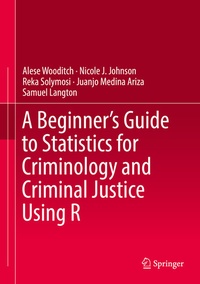
A Beginner's Guide to Statistics for Criminology and Criminal Justice Using R
Description

This book provides hands-on guidance for researchers and practitioners in criminal justice and criminology to perform statistical analyses and data visualization in the free and open-source software R. It offers a step-by-step guide for beginners to become familiar with the RStudio platform and tidyverse set of packages.
This volume will help users master the fundamentals of the R programming language, providing tutorials in each chapter that lay out research questions and hypotheses centering around a real criminal justice dataset, such as data from the National Survey on Drug Use and Health, National Crime Victimization Survey, Youth Risk Behavior Surveillance System, The Monitoring the Future Study, and The National Youth Survey. Users will also learn how to manipulate common sources of agency data, such as calls-for-service (CFS) data. The end of each chapter includes exercises that reinforce the R tutorial examples, designed to help master the software as well as to provide practice on statistical concepts, data analysis, and interpretation of results.The text can be used as a stand-alone guide to learning R or it can be used as a companion guide to an introductory statistics textbook, such as Basic Statistics in Criminal Justice (2020).
More details
Other editions
Additional editions
Persons
Nicole Johnson is a doctoral student in the Department of Criminal Justice at Temple University. Her research interests include understanding group- and community-level behavioral dynamics, particularly those related to crime and responses to crime.
Reka Solymosi is a lecturer in quantitative methods at the Department of Criminology at University of Manchester, and a member of the Software Sustainability Institute. Her research focuses on making use of new forms of data to gain insight into people's behaviour and subjective experiences, particularly focusing on crime, victimisation, transport, and spatial research.
Juanjo Medina is professor of quantitative criminology and Head of the Criminology Department at the University of Manchester. His research focuses on gender violence, gangs, crime prevention, and data science applications to criminal justice.Samuel Langton is a researcher in quantitative criminology at Manchester Metropolitan University. His research primarily focuses on describing and explaining the spatial and temporal patterning of known offender residences.
