

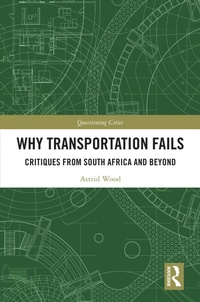
Why Transportation Fails
Critiques from South Africa and Beyond
1st Edition
Published on 29. July 2025
196 pages
978-1-040-39670-4 (ISBN)
Description

Why Transportation Fails offers an in-depth critique of transportation failures in South Africa and beyond. Minibus taxis are unreliable and overcrowded; buses and trains are old and poorly maintained; and new services are derailed by spiraling capital and operational costs, protracted and politicized rollouts, and unsolvable infrastructural challenges. Rather than focusing on these failures, the conceptual and practical analyses in this book develop a critical understanding of transportation and highlight the opportunities for transportation to be more inclusive, innovative, and sustainable.
This book applies cutting-edge scholarship from geography and urban studies - decolonial geographies, Black geographies, policy mobilities, walking geographies, animal geographies, art geographies, and health geographies - to reframe transportation failure. The interdisciplinarity of this scholarship builds an approach that not only tells the story of transportation in South Africa but also uncovers a range of conceptual interpretations and imaginations that stretch beyond urban mobilities and urban development. In decentering traditional geographies of knowledge production, Why Transportation Fails contributes to critical considerations of urban transportation in Africa and aspects of transportation justice within social and spatial transformation.
Given the never-ending financial and political investment in solving transportation, Why Transportation Fails is an essential reading for scholars of architecture, development, geography, politics, sociology, and urban planners and practitioners.
This book applies cutting-edge scholarship from geography and urban studies - decolonial geographies, Black geographies, policy mobilities, walking geographies, animal geographies, art geographies, and health geographies - to reframe transportation failure. The interdisciplinarity of this scholarship builds an approach that not only tells the story of transportation in South Africa but also uncovers a range of conceptual interpretations and imaginations that stretch beyond urban mobilities and urban development. In decentering traditional geographies of knowledge production, Why Transportation Fails contributes to critical considerations of urban transportation in Africa and aspects of transportation justice within social and spatial transformation.
Given the never-ending financial and political investment in solving transportation, Why Transportation Fails is an essential reading for scholars of architecture, development, geography, politics, sociology, and urban planners and practitioners.
Reviews / Votes
"Why Transportation Fails offers a much-needed and timely analysis of the multiple social and spatial injustices characterizing mobility systems and practices in South Africa's cities. By synthesizing thinking across disciplinary and theoretical traditions, the book begins to open up new ways of imagining more inclusive and just mobility futures in Africa and beyond. An essential read for social scientists, engineers and planners looking for thinking on urban transport in and from the Majority World."Tim Schwanen, Professor of Transport Geography and Director of the Transport Studies Unit, University of Oxford
"A captivating and insightful book that looks beyond standard tropes about state failure in Africa and instead asks why and how transportation in South Africa (and elsewhere) could be effective and just. Essential reading for anyone interested not just in how to navigate cities, but how to re-frame urban 'problems' from new perspectives."
Charlotte Lemanski, Professor of Urban Geography, University of Cambridge
"Why Transportation Fails is a cutting-edge exploration of urban disappointment. Launched with optimism, many transportation initiatives in post-apartheid South Africa have been let-downs. However, this analysis moves beyond negativity to show how using new frames of analysis provide the resources for rethinking urban transformation."
Philip Harrison, South African Research Chair in Spatial Analysis and City Planning, University of the Witwatersrand
"Transport geography is always in need of texts that not only critique existing praxis but also offer fresh conceptual and practical insights. Why Transportation Fails seeks to reimagine what successful transport systems can be by blending bold intellectual ambition with radical approaches, including animal geographies, decoloniality, and art geographies. Building on these approaches, Astrid Wood offers an empirically rich exploration of South Africa's transport system that critically addresses the entanglements of human-environment relations and urban mobilities. This enables Why Transportation Fails to challenge conventional narratives of failure while offering alternative approaches to transport and urban transformation, making it valuable reading for transport and urban planners, policymakers, and scholars across multiple disciplines."
James Esson, Professor of Geography, Queen Mary University of London
More details
Series
Edition
1. Auflage
Language
English
Place of publication
London
United Kingdom
Publishing group
Taylor & Francis Ltd
Target group
College/higher education
Illustrations
1 Tables, black and white; 1 Line drawings, black and white; 18 Halftones, black and white; 19 Illustrations, black and white
File size
12,95 MB
ISBN-13
978-1-040-39670-4 (9781040396704)
Copyright in bibliographic data and cover images is held by Nielsen Book Services Limited or by the publishers or by their respective licensors: all rights reserved.
Schweitzer Classification
Other editions
Additional editions
Book
07/2025
1st Edition
Routledge
€207.30
Shipment within 15-20 days
Person
Dr Astrid Wood is an Associate Professor in the School of Geography, Politics, and Sociology at Newcastle University in the United Kingdom. Astrid is an urban geographer specializing in governance, infrastructure, and transportation. She is the author of How Cities Learn: Tracing Bus Rapid Transit in South Africa (2022) as well as over 40 peer-reviewed book chapters and journal articles. She is an editor at Urban Studies and at the Journal of Transport Geography.
Content
1. Introduction i. Starting with Failure ii. Transportation in South Africa and Beyond iii. Conceptual Contributions iv. Methodologies of Failure v. Navigating This Book 2. Decolonizing Transportation i. Introduction ii. Decolonizing Geography iii. Decolonizing Geography in South Africa iv. Bringing Decolonizing Discourses into Transportation v. Decolonizing Transportation in South Africa vi. Conclusion 3. Black Transportation i. Introduction ii. The Whiteness of Geography iii. Defining Black Geographies iv. Bringing Black Geographies into Transportation v. Black Transportation in Johannesburg vi. Conclusion 4. People-Oriented Transportation i. Introduction ii. Problematizing Transit-Oriented Development iii. Bringing Policy Mobilities into Transportation iv. People-Oriented Transportation in Cape Town and Johannesburg v. A South African Approach to Transportation Planning vi. Conclusion 5. Walking-As-Transportation i. Introduction ii. Reconceptualizing Walkability iii. Walkability in African Cities iv. Walking-As-Transportation in Johannesburg v. The Failings of Walkability in Johannesburg vi. Conclusion 6. Trans-paw-tation i. Introduction ii. Finding the Animals in Human Geography iii. An Urban Paws iv. Bringing Animal Geographies into Transportation v. Trans-paw-tation in South African Cities vi. Conclusion 7. Transp-art-ation i. Introduction ii. Art in Postapartheid South Africa iii. Bringing Art into Transportation iv. Transp-art-ation in South Africa v. Conclusion 8. When Transportation Fails i. Introduction ii. Public Health, Epidemiology, and Urbanization iii. Disease and the South African City iv. Transportation and COVID-19 v. Impact of COVID-19 on Transportation in South Africa vi. Conclusion 9. Conclusion i. Introduction ii. Reflecting on Why Transportation Fails iii. Reflecting on Transportation in South Africa... iv. Reflecting on Transportation ... Beyond
