

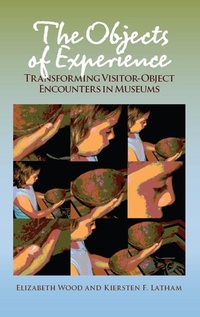
The Objects of Experience
Transforming Visitor-Object Encounters in Museums
Published on 16. June 2016
176 pages
978-1-315-41776-9 (ISBN)
Description

What if museums could harness the emotional and intellectual connections people have to personal and everyday objects to create richer visitor experiences? In this book, Elizabeth Wood and Kiersten Latham present the Object Knowledge Framework, a tool for using objects to connect museum visitors to themselves, to others, and to their world. They discuss the key concepts underpinning our lived experience of objects and how museums can learn from them. Then they walk readers through concrete methods for transforming visitor-object experiences, including exercises and strategies for teams developing exhibit themes, messages, and content, and participatory experiences.
Reviews / Votes
"A delight to read. In laying out the theoretical foundations, the Object Knowledge Framework, and the practical strategies, Wood and Latham have given us something brand new to cogitate in the field. I love the blend of scholarship and practical application. The authors have taken some difficult concepts and made them easy to understand. This book could be extremely useful for curators to think about the ways that visitors think about the objects in an easy and intriguing way."--Donna R. Braden, Curator of Public Life, The Henry Ford
"In this insightful and delightful volume, Wood and Latham present a well-researched and clearly written argument for the importance of the object to the purpose of museums. The authors' multi-disciplinary study is both theoretical and practical, beginning with their phenomenological approach to studying human experience and their resulting Object Knowledge Framework, which is a groundbreaking evaluation of how humans interact with objects. The authors offer excellent explanations of the application of the Object Knowledge Framework to museum practice that will ensure that visitors fully benefit from their encounter with objects."--John Simmons, Museologica
"Wood and Latham move beyond defending or bemoaning the place of objects in our museums to exploring how objects are the nexus for what both museums and museum-goers care about most: human connections. Shifting easily between broad theory and practical exercises, The Objects of Experience will be the centerpiece for many useful conversations among museum staffs looking to move forward together."--Benjamin Filene, Director of Public History, UNC Greensboro
"The authors present us with an excellent new template to inform our thinking as we work to develop future interpretative programming that is more likely to generate the "Eureka!" moments we all crave."
-Karen Whitehair, AASLH History News
More details
Language
English
Place of publication
London
United Kingdom
Publishing group
Taylor & Francis Ltd
Target group
College/higher education
Illustrations
black & white illustrations, black & white tables, figures
File size
17,24 MB
ISBN-13
978-1-315-41776-9 (9781315417769)
Copyright in bibliographic data and cover images is held by Nielsen Book Services Limited or by the publishers or by their respective licensors: all rights reserved.
Schweitzer Classification
Other editions
Additional editions
Elizabeth Wood | Kiersten F. Latham
The Objects of Experience
Transforming Visitor-Object Encounters in Museums
Book
10/2013
1st Edition
Left Coast Press Inc
€230.27
Shipment within 3-4 weeks
Elizabeth Wood | Kiersten F. Latham
The Objects of Experience
Transforming Visitor-Object Encounters in Museums
Book
10/2013
1st Edition
Left Coast Press Inc
€54.00
Shipment within 3-4 weeks
Persons
Elizabeth Wood, Kiersten F. Latham
Content
Introduction
Part 1: The Object
Chapter 1: Object Knowledge
Chapter 2: Origins of the Object Knowledge Framework
Part 2: Object Relationships
Chapter 3: Objects as Identity
Chapter 4: Objects as Revelation
Chapter 5: Objects as Reverence
Part 3: Object Transformations
Chapter 6: Using the Object Knowledge Framework
Chapter 7: Transformation through Design
Chapter 8: Transformation through Content
Chapter 9: Transformation through Participation
Chapter 10: The End is the Beginning
References
Index
Part 1: The Object
Chapter 1: Object Knowledge
Chapter 2: Origins of the Object Knowledge Framework
Part 2: Object Relationships
Chapter 3: Objects as Identity
Chapter 4: Objects as Revelation
Chapter 5: Objects as Reverence
Part 3: Object Transformations
Chapter 6: Using the Object Knowledge Framework
Chapter 7: Transformation through Design
Chapter 8: Transformation through Content
Chapter 9: Transformation through Participation
Chapter 10: The End is the Beginning
References
Index
