

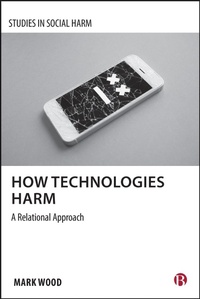
How Technologies Harm
A Relational Approach
1st Edition
Published on 30. October 2025
266 pages
978-1-5292-4709-1 (ISBN)
Description

Technologies contribute to harms in a variety of ways, but can we ever say they are harmful in-and-of-themselves?
This book offers a new way to understand how technologies, while not intrinsically harmful, are laden with values and dispositions that can contribute to negative outcomes. Building on insights from postphenomenology, realist social theory and the philosophy of action, it provides a framework for examining technology-harm relations: relations with technology that are harmful by virtue of what they contribute to bringing about. It is for anyone seeking to design, regulate, research or simply use technology in a way that prioritizes well-being.
This book offers a new way to understand how technologies, while not intrinsically harmful, are laden with values and dispositions that can contribute to negative outcomes. Building on insights from postphenomenology, realist social theory and the philosophy of action, it provides a framework for examining technology-harm relations: relations with technology that are harmful by virtue of what they contribute to bringing about. It is for anyone seeking to design, regulate, research or simply use technology in a way that prioritizes well-being.
Reviews / Votes
'Compelling, thought-provoking and beautifully written, "How Technologies Harm" is a must-read for anyone who, across disciplines, has an interest in the technology-harm nexus.' Anita Lavorgna, University of Bologna 'This is a timely and masterful analysis of technology and social harm. While the book avoids reductionist determinism by emphasising the embeddedness of technology in society and vice versa, it presents an innovative pluralistic analysis that considers various processes of technological harm production. It stands as a unique resource for policy makers, researchers, practitioners, technology designers, civil society organisations and other key stakeholders interested in a well-researched, in-depth and clear exploration of the intersection between technology and harm.' Pamela Ugwudike, University of Southampton 'Brilliant - a significant framework. Rejecting both technological determinism (which attributes societal changes solely to technology) and social determinism (which dismisses technology's role), Wood proposes a nuanced technology-harm relations framework. His framework allows for a comprehensive analysis of how technologies mediate human perception and behaviour, foster systemic inequalities and produce harms at both micro and macro levels. The next challenge for us is to mobilise this theory into action - not only a relational reset but a methodological one too.' Victoria Knight, De Montfort University'Insight-driven, well-structured and comprehensive. Wood offers a skillful analysis and a fresh perspective on the complex relationships between technology and harm that pervade human civilization. A subject matter that concerns us all.' Mareile Kaufmann, University of Oslo
'How technologies harm' is an intellectually rigorous journey into the ripple effects of our codependent human-technology relationship. From brain-rotting doomscrolling through to postphenomenology, Wood traverses the technology-harm nexus and, in so doing, provides a compelling account of how technologies may contribute to social harms. According to Wood, technologies are neither neutral nor intrinsically harmful. Instead, Wood's relational approach demonstrates how technologies have the potential to harm through specific interactions and circumstances. Importantly, this is not a work filled with dystopic visions; rather it is one that simultaneously acknowledges technologies' positive affordances, and their power to mitigate harm and benefit humans.' Carolyn McKay, University of Sydney
More details
Series
Edition
First Edition
Language
English
Place of publication
Bristol
United Kingdom
Target group
Professional and scholarly
Product notice
Reflowable
Illustrations
3 s/w Abbildungen, 2 s/w Tabellen
2 Tables, black and white; 3 Illustrations, black and white
File size
0,97 MB
ISBN-13
978-1-5292-4709-1 (9781529247091)
Copyright in bibliographic data and cover images is held by Nielsen Book Services Limited or by the publishers or by their respective licensors: all rights reserved.
Schweitzer Classification
Other editions
Additional editions
Book
10/2025
1st Edition
Bristol University Press
€105.50
Shipment within 3-4 weeks
Person
Content
Introduction
PART I: Understanding Harm
1. What Is Social Harm?
2. The Nature of Harm
PART II: Understanding Technology
3. Instruments, Extensions, Affordances
4. Technology as Practice and Actant
5. Postphenomenology and Technological Mediation
PART III: The Technology-Harm Relations Framework
6. An Overview of the Framework
7. Design Modes
8. Translation, Infusion, Zemiosis
9. Doing Harm with Things
10. Harms Beyond Use
11. Higher-order Harm Relations
Conclusion: Pulling at the Threads of Enmeshment
PART I: Understanding Harm
1. What Is Social Harm?
2. The Nature of Harm
PART II: Understanding Technology
3. Instruments, Extensions, Affordances
4. Technology as Practice and Actant
5. Postphenomenology and Technological Mediation
PART III: The Technology-Harm Relations Framework
6. An Overview of the Framework
7. Design Modes
8. Translation, Infusion, Zemiosis
9. Doing Harm with Things
10. Harms Beyond Use
11. Higher-order Harm Relations
Conclusion: Pulling at the Threads of Enmeshment
