

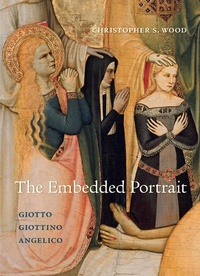
The Embedded Portrait
Giotto, Giottino, Angelico
1st Edition
Published on 22. November 2023
376 pages
978-0-691-25460-9 (ISBN)
Description

A new study of the early Renaissance portrait
In fourteenth-century Italy, ever more women and men-not only clergy but also laity-introduced their own portraits into sacred paintings. Images of modern supplicants, submissive and prayerful, shared space with the holy narratives. The portraits mimicked the first worshippers of Christ: Mary, the Three Magi, Mary Magdalene. At the same time, they modeled, for modern viewers, ideal involvement in the emotion-laden stories. In The Embedded Portrait, Christopher S. Wood traces these incursions of the real and profane into Florentine sacred painting between Giotto and Fra Angelico.
The portraits not only intruded upon a sacred space, but also intervened in an artwork. The pressure exerted by the modern interlopers-their lives and experiences, implied by their portraits-threatened the formal closure that had served as a powerful symbolic form of the pact between God and humans. The Embedded Portrait reconstructs this art historical drama from the point of view of the artists rather than the patrons. Following clues left by Vasari, the book assigns a leading role to the painter Giottino, or "little Giotto." Little-known today but highly regarded in his lifetime, Giottino proposed a new manner of painting that was later realized by Fra Angelico through his own innovative approach to the problem of the embedded portrait.
Seeking not to stabilize the artworks but to extend their reach, the interpretations offered in The Embedded Portrait re-create and update the psychic and libidinal energies that gave rise to these works in the first place.
In fourteenth-century Italy, ever more women and men-not only clergy but also laity-introduced their own portraits into sacred paintings. Images of modern supplicants, submissive and prayerful, shared space with the holy narratives. The portraits mimicked the first worshippers of Christ: Mary, the Three Magi, Mary Magdalene. At the same time, they modeled, for modern viewers, ideal involvement in the emotion-laden stories. In The Embedded Portrait, Christopher S. Wood traces these incursions of the real and profane into Florentine sacred painting between Giotto and Fra Angelico.
The portraits not only intruded upon a sacred space, but also intervened in an artwork. The pressure exerted by the modern interlopers-their lives and experiences, implied by their portraits-threatened the formal closure that had served as a powerful symbolic form of the pact between God and humans. The Embedded Portrait reconstructs this art historical drama from the point of view of the artists rather than the patrons. Following clues left by Vasari, the book assigns a leading role to the painter Giottino, or "little Giotto." Little-known today but highly regarded in his lifetime, Giottino proposed a new manner of painting that was later realized by Fra Angelico through his own innovative approach to the problem of the embedded portrait.
Seeking not to stabilize the artworks but to extend their reach, the interpretations offered in The Embedded Portrait re-create and update the psychic and libidinal energies that gave rise to these works in the first place.
More details
Other editions
Additional editions
Book
11/2023
Princeton University Press
€68.50
Shipment within 10-20 days
Person
Christopher S. Wood is professor in the Department of German at New York University. He is the author of A History of Art History (Princeton); Albrecht Altdorfer and the Origins of Landscape; and Forgery, Replica, Fiction: Temporalities of German Renaissance Art. He is also the author, with Alexander Nagel, of Anachronic Renaissance.
Content
- Cover
- Contents
- Introduction
- I. Franciscanism, the Laity, and Portraits
- The Munich Crucifixion
- Giotto and the portrait
- The Franciscan impulse
- On Francis and self-loss
- Incommensurability of human and divine spheres
- II. The Democratization of the Portrait, 1270-1320
- Varieties of supplicant portrait
- Hegel on embedded portraits
- III. Historiography and Method
- Rumohr and Burckhardt on Giotto
- Twentieth-century views of Giotto
- Sociologies and anthropologies of art
- The art of praise
- Art and beauty
- Allegories and narratives
- Sacred art and secular modernity
- IV. Witnesses
- The Presentation of Christ in the Temple
- Witnessing and recognition
- Witnessing and the portrait
- The midwives
- The Lamentation over the Body of Christ
- Proto-portraits
- V. Interlopers
- Vasari on the Trecento
- Stefano Fiorentino and Giotto di Maestro Stefano
- The San Remigio Pietà
- The Ponce Annunciation
- The Lamentation on panel
- Vasari on the three manners of Trecento painting
- Giottino and compagnia
- The mourners
- I Niccodemi
- The original installation of the panels
- The funerary image
- Harmony and discord
- Doublings and merisms
- The superimposed chessboards
- Unity of person and unity of picture
- Opacity of the embedded portrait
- Open and closed form
- VI. The Classic Art History of the Portrait
- Erwin Panofsky, 1953
- Bridget of Sweden and iconography
- Alois Riegl, 1902
- Erich Auerbach on realism
- Aby Warburg, 1902
- VII. Fra Angelico and the Portrait
- Giotto, Giottino . . .
- Fra Angelico and Rogier van der Weyden
- Vasari's "Giottino romance"
- Last remarks on the modern sacred art
- Excursus: Reference and Likeness
- Acknowledgments
- Notes
- Index
- Credits
