

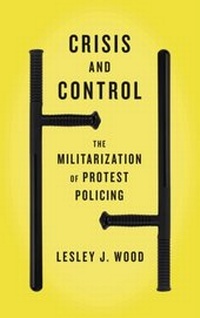
Crisis and Control
The Militarization of Protest Policing
1st Edition
Published on 20. May 2014
216 pages
978-1-78371-210-6 (ISBN)
Description

Crisis and Control explains how neoliberal transformations of political and economic systems are militarising the policing of protest, based on a compelling empirical study of police agencies and practices from 1995 until the present.
Lesley J. Wood shows that the increasing role of the security and defense industries, professional police associations, anti-terrorism initiatives and 'best practices' in policing networks have accelerated the use of less lethal weapons, pre-emptive arrests, infiltration and barricading strategies against protesters.
The book uses Bourdieu and Boltanski to analyse court transcripts, police reports, policy, training materials and the conference programs of professional police organisations to argue that police agencies are neither omnipotent strategists, nor simple tools of the elite, but institutions struggling to maintain legitimacy, resources and autonomy in a changing field.
Lesley J. Wood shows that the increasing role of the security and defense industries, professional police associations, anti-terrorism initiatives and 'best practices' in policing networks have accelerated the use of less lethal weapons, pre-emptive arrests, infiltration and barricading strategies against protesters.
The book uses Bourdieu and Boltanski to analyse court transcripts, police reports, policy, training materials and the conference programs of professional police organisations to argue that police agencies are neither omnipotent strategists, nor simple tools of the elite, but institutions struggling to maintain legitimacy, resources and autonomy in a changing field.
Reviews / Votes
'A welcome contribution to the literature on the sociology of policing more generally. Smart, erudite, and empirically grounded, Wood's perspective on policing protest exposes deeper, often under-explored, theoretical dimensions of the politics of policing' -- James Sheptycki, Professor of Criminology, York University 'Sheds light on the economic and political roots of police brutality against legitimate social movements. Unfortunately, this is what our 'democracy' looks like' -- Francis Dupuis-Deri, professor of political science, Universite du Quebec a Montreal, and member of the Observatory on racial, social, and political profiling in the public space. 'An engaging and sophisticated study of protest policing, which exposes the threat such policing poses to democracy and the neoliberal dynamics that have made it a preferred strategy for repressing the 99% whenever they challenge the 1%' -- William K. Carroll, professor of sociology, University of Victoria 'A hard-hitting, insightful, and well-researched analysis of the changing forms of protest policing' -- Willem de Lint, professor of criminal justice, Flinders University 'Shows clearly that the police wing of the state takes very seriously its task of understanding and defeating social resistance to austerity. Those engaged in that resistance would do well to return the favour. This book provides an excellent source of knowledge and insight into how the not-so-thin blue line thinks and operates' -- John Clarke, Organizer, Ontario Coalition Against Poverty 'A must-read for all who care about freedom of speech and see protest and public demonstration as a necessary and legitimate means of protecting democracy' -- Howard F Morton. QC., Barrister 'A powerful dissection of the ways that the policing of protests have been transformed over the last decade' -- The BulletMore details
Edition
1. Auflage
Language
English
Place of publication
London
United Kingdom
Target group
Professional and scholarly
Illustrations
3 b&w tables, 1 b&w figure
File size
0,67 MB
ISBN-13
978-1-78371-210-6 (9781783712106)
Copyright in bibliographic data and cover images is held by Nielsen Book Services Limited or by the publishers or by their respective licensors: all rights reserved.
Schweitzer Classification
Other editions
Additional editions
Book
05/2014
Pluto Press
€39.60
Article exhausted; check different version
Person
Lesley Wood is Associate Professor of Sociology at York University in Toronto, Canada. She is the author of Crisis and Control (Pluto, 2014), Direct Action, Deliberation and Diffusion (2012) and co-author of the third edition of Social Movements 1768-2012 (Pluto, 2012). She is an activist in the global justice and anti-poverty movements.
Content
Acknowledgements
List of Acronyms
1. Introduction
2. Policing Waves of Protest 1995-2013
3. To Serve and Protect Who? Policing Trends and Best Practices
4. Local Legitimacy and Struggles for Control
5. Officers Under Attack: The Thin Blue Line, Pepper Spray and Police Identity
6. Experts, Agencies, the Private Security Sector and Integration
7. Protest as Threat
8. Urine-Filled Supersoakers
9. Crisis and Control
Notes
References
Index
List of Acronyms
1. Introduction
2. Policing Waves of Protest 1995-2013
3. To Serve and Protect Who? Policing Trends and Best Practices
4. Local Legitimacy and Struggles for Control
5. Officers Under Attack: The Thin Blue Line, Pepper Spray and Police Identity
6. Experts, Agencies, the Private Security Sector and Integration
7. Protest as Threat
8. Urine-Filled Supersoakers
9. Crisis and Control
Notes
References
Index
