

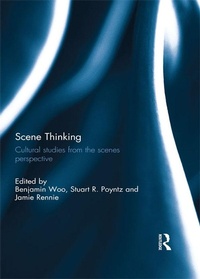
Scene Thinking
Cultural Studies from the Scenes Perspective
1st Edition
Published on 19. April 2018
214 pages
978-1-134-84359-6 (ISBN)
Description

How is cultural activity shaped by the places where it unfolds? One answer has been found in the 'scenes perspective', a development within popular music studies that explains change and transformation within musical practices in terms of the social and institutional histories of scenes. Scene Thinking: Cultural Studies from the Scenes Perspective takes up this framework - and the mode of analysis that goes with it - as an important contribution to cultural analysis and social research more generally.
In a series of focused case studies - ranging across practices like drag kinging, Bangladeshi underground music, urban arts interventions and sites like single performance venues, urban neighbourhoods in various states of gentrification, and virtual networks of game consoles in countless living rooms - the authors demonstrate how 'scene thinking' can enrich cultural studies inquiry. As a humanistic, empirically oriented alternative to network-based social ontologies, thinking in terms of scenes sensitizes researchers to complex, fluid processes that are nonetheless anchored and made meaningful at the level of lived experience. This book was originally published as a special issue of Cultural Studies.
In a series of focused case studies - ranging across practices like drag kinging, Bangladeshi underground music, urban arts interventions and sites like single performance venues, urban neighbourhoods in various states of gentrification, and virtual networks of game consoles in countless living rooms - the authors demonstrate how 'scene thinking' can enrich cultural studies inquiry. As a humanistic, empirically oriented alternative to network-based social ontologies, thinking in terms of scenes sensitizes researchers to complex, fluid processes that are nonetheless anchored and made meaningful at the level of lived experience. This book was originally published as a special issue of Cultural Studies.
More details
Edition
1. Auflage
Language
English
Place of publication
London
United Kingdom
Publishing group
Taylor & Francis Ltd
Target group
College/higher education
ISBN-13
978-1-134-84359-6 (9781134843596)
Copyright in bibliographic data and cover images is held by Nielsen Book Services Limited or by the publishers or by their respective licensors: all rights reserved.
Schweitzer Classification
Other editions
Additional editions
Benjamin Woo | Stuart Poyntz | Jamie Rennie
Scene Thinking
Cultural Studies from the Scenes Perspective
Book
01/2019
1st Edition
Routledge
€45.90
Shipment within 15-20 days
Benjamin Woo | Stuart Poyntz | Jamie Rennie
Scene Thinking
Cultural Studies from the Scenes Perspective
Book
09/2016
1st Edition
Routledge
€132.30
Shipment within 10-20 days
Persons
Benjamin Woo is Assistant Professor in the School of Journalism and Communication Studies at Carleton University, Ottawa, Canada. He studies the social worlds of contemporary 'geek culture', with a particular focus on the producers, intermediaries, and audiences oriented to comic books and graphic novels.
Stuart R. Poyntz is Associate Professor in the School of Communication at Simon Fraser University, Vancouver, Canada. His research addresses children's media cultures, theories of public life, and urban youth media production. He is President of the Association for Research in the Cultures of Young People.
Jamie Rennie is an instructor in the Communications Department at Douglas College, Vancouver, Canada. His research focuses on media literacy in Canadian schools and the various pedagogical approaches to teaching about and through contemporary media.
Stuart R. Poyntz is Associate Professor in the School of Communication at Simon Fraser University, Vancouver, Canada. His research addresses children's media cultures, theories of public life, and urban youth media production. He is President of the Association for Research in the Cultures of Young People.
Jamie Rennie is an instructor in the Communications Department at Douglas College, Vancouver, Canada. His research focuses on media literacy in Canadian schools and the various pedagogical approaches to teaching about and through contemporary media.
Content
Scene Thinking: Introduction 1. Border Scenes: Detroit +/- Windsor 2. 'We Weren't Hip, Downtown People': The Kids in the Hall, the Rivoli and the Nostalgia of the Queen West Scene 3. When Scenes Fade: Methodological Lessons from Sydney's Drag King Culture 4. Copy Machines and Downtown Scenes: Deterritorializing Urban Culture in a Pre-Digital Era 5. Little Big Scene: Making and Playing Culture in Media Molecule's Little Big Planet 6. Approaching the Underground: The Production of Alternatives in the Bangladeshi Metal Scene 7. The Power of Scenes: Quantities of Amenities and Qualities of Places 8. Bodies that Remember: Gleaning Scenic Fragments of a Brothel District in Yokohama 9. Some things a Scene might be: Postface
