

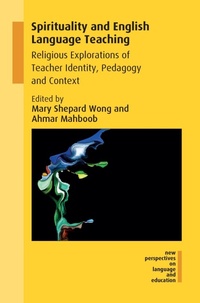
Spirituality and English Language Teaching
Religious Explorations of Teacher Identity, Pedagogy and Context
Published on 9. August 2018
248 pages
978-1-78892-155-8 (ISBN)
Description

This collection of 16 reflective accounts and data-driven studies explores the interrelationship of religious identity and English Language Teaching (ELT). The chapters broaden a topic which has traditionally focused on Christianity by including Buddhist, Hindu, Muslim and non-religious perspectives. They address the ways in which faith and ELT intersect in the realms of teacher identity, pedagogy and the context and content of ELT, and explore a diverse range of geographical contexts, making use of a number of different research methodologies. The book will be of particular interest to researchers in TESOL and EFL, as well as teachers and teacher trainers.
Reviews / Votes
This much-needed collection provides abundant and valuable support for English teachers thinking through the significance of their spirituality in their professional practice. The authors illuminate ways teachers' belief systems - whether under the guise of formal religion, ethically informed value system, political or ideological stance, or philosophy explicitly detached from organized religion - weave themselves intractably into every corner of their pedagogical lives. * Suhanthie Motha, University of Washington, USA * This anthology is a relevant and insightful guide, addressing concerns about teacher identity, critical pedagogy and classroom practices. It is a useful pedagogical resource and provides encouragement to those of us who promote interfaith dialogue and understanding in our classes. * Tom Scovel, Professor Emeritus, San Francisco State University, USA * Spirituality and English Language Teaching will benefit any language teacher or researcher by helping them to better understand the impact that faith has on language teaching. This text will challenge readers' perceptions of the benefits or dangers of faith in language teaching and will motivate them to consider the possibility that their faith can have a positive impact on their teacher identity and pedagogy. Highly recommended! -- International Journal of Christianity and English Language Teaching, Volume 6 (2019) * Frank Tuzi, Liberty University, USA * I am grateful for all I learned through this collection about Buddhism, Hinduism, Islam, and Christianity as they relate to TESOL, and, while there are obvious differences, I was encouraged by how much religious or spiritual language teachers and teacher trainers actually have in common. This book is highly recommended and should be in the library of every CCCU institution with a TESOL program. -- Michael Lessard-Clouston, Biola University, USA * Christian Scholar's Review, 2020 *More details
Series
Language
English
Place of publication
Bristol
United Kingdom
Target group
College/higher education
ISBN-13
978-1-78892-155-8 (9781788921558)
Copyright in bibliographic data and cover images is held by Nielsen Book Services Limited or by the publishers or by their respective licensors: all rights reserved.
Schweitzer Classification
Other editions
Additional editions
Mary Shepard Wong | Ahmar Mahboob
Spirituality and English Language Teaching
Religious Explorations of Teacher Identity, Pedagogy and Context
Book
08/2018
Multilingual Matters
€56.00
Shipment within 3-4 weeks
Persons
Mary Shepard Wong is a Professor in the Global Studies, Sociology and TESOL Department, Azusa Pacific University, USA. She is the co-editor of Christian Faith and English Language Teaching and Learning (with C. Kristjansson and Z. Doernyei, 2013, Routledge) and Christian and Critical English Language Educators in Dialogue (with A.S. Canagarajah, 2009, Routledge).
Ahmar Mahboob is Associate Professor at the University of Sydney, Australia. He is the co-editor of Language and Identity across Modes of Communication (with D.N. Djenar and K. Cruickshank, 2015, Mouton De Gruyter) and English in Multilingual Contexts (with L. Barratt, 2014, Springer).
Ahmar Mahboob is Associate Professor at the University of Sydney, Australia. He is the co-editor of Language and Identity across Modes of Communication (with D.N. Djenar and K. Cruickshank, 2015, Mouton De Gruyter) and English in Multilingual Contexts (with L. Barratt, 2014, Springer).
Content
List of Contributors
Acknowledgements
Foreword: Suresh Canagarajah: Complexifying Our Understanding of Spirituality
Chapter 1. Mary Shepard Wong: Introduction: Why A Book on Spirituality and Language Teaching?
Part I. Religious Faith and Teacher Identity
Chapter 2. Mary Shepard Wong: The Dangers and Delights of Teacher Spiritual Identity as Pedagogy
Chapter 3. MaryAnn Christison: Buddhist Principles and the Development Leadership Skills in English Language Program Administration and Teaching
Chapter 4. Joel Heng Hartse and Saeed Nazari: Attempting Interfaith Dialogue in TESOL: A Duoethnography
Chapter 5. Ryuko Kubota: Response to Part I: Possibilities For Nonattachment: Investigating the Affective Dimension of Imposition
Part II. Religious Faith and Pedagogical Practice
Chapter 6. Sid Brown: A Buddhist in the Classroom Revisited
Chapter 7. Bal Krishna Sharma: The Relevance of Hinduism to English Language Teaching and Learning
Chapter 8. Stephanie Vandrick: Multiple, Complex and Fluid Religious and Spiritual Influences on English Language Educators
Chapter 9. David Smith: Response to Part II: 'Religious Faith' and 'Pedagogical Practice' - Extending the Map: A Response to Brown, Sharma and Vandrick
Part III. Religious Faith and the Language Learning Context
Chapter 10. Kassim Shaaban: Language and Religion in the Construction of the Lebanese Identity
Chapter 11. Deena Boraie, Atta Gebril and Raafat Gabriel: Teachers' Perceptions of the Interface between Religious Values and Language Pedagogy in Egypt
Chapter 12. Carolyn Kristjansson: Church-Sponsored ESL in Western Canada: Grassroots Expressions of Spiritual and Social Practice
Chapter 13. Brian Morgan: Response to Part III: Religious Faith and the Language Learning Context: Exploring the Interface
Chapter 14. Ahmar Mahboob and Eve Courtney: Spirituality and English Language Teaching: Moving Forward
Afterword: Henry Widdowson: Spirituality in Language Teaching
Acknowledgements
Foreword: Suresh Canagarajah: Complexifying Our Understanding of Spirituality
Chapter 1. Mary Shepard Wong: Introduction: Why A Book on Spirituality and Language Teaching?
Part I. Religious Faith and Teacher Identity
Chapter 2. Mary Shepard Wong: The Dangers and Delights of Teacher Spiritual Identity as Pedagogy
Chapter 3. MaryAnn Christison: Buddhist Principles and the Development Leadership Skills in English Language Program Administration and Teaching
Chapter 4. Joel Heng Hartse and Saeed Nazari: Attempting Interfaith Dialogue in TESOL: A Duoethnography
Chapter 5. Ryuko Kubota: Response to Part I: Possibilities For Nonattachment: Investigating the Affective Dimension of Imposition
Part II. Religious Faith and Pedagogical Practice
Chapter 6. Sid Brown: A Buddhist in the Classroom Revisited
Chapter 7. Bal Krishna Sharma: The Relevance of Hinduism to English Language Teaching and Learning
Chapter 8. Stephanie Vandrick: Multiple, Complex and Fluid Religious and Spiritual Influences on English Language Educators
Chapter 9. David Smith: Response to Part II: 'Religious Faith' and 'Pedagogical Practice' - Extending the Map: A Response to Brown, Sharma and Vandrick
Part III. Religious Faith and the Language Learning Context
Chapter 10. Kassim Shaaban: Language and Religion in the Construction of the Lebanese Identity
Chapter 11. Deena Boraie, Atta Gebril and Raafat Gabriel: Teachers' Perceptions of the Interface between Religious Values and Language Pedagogy in Egypt
Chapter 12. Carolyn Kristjansson: Church-Sponsored ESL in Western Canada: Grassroots Expressions of Spiritual and Social Practice
Chapter 13. Brian Morgan: Response to Part III: Religious Faith and the Language Learning Context: Exploring the Interface
Chapter 14. Ahmar Mahboob and Eve Courtney: Spirituality and English Language Teaching: Moving Forward
Afterword: Henry Widdowson: Spirituality in Language Teaching
