

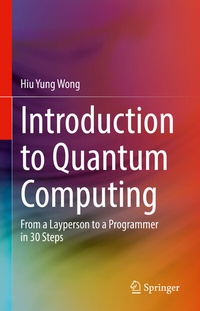
Introduction to Quantum Computing
Description

- Encourages students to embrace uncertainty over the daily classical experience, when encountering quantum phenomena;
- Uses narrative to start each section with analogies that help students to grasp the critical concept quickly;
- Uses numerical substitutions, accompanied by Python programming and IBM-Q quantum computer programming, as examplesin teaching all critical concepts.
More details
Other editions
New editions
Additional editions
Person
Hiu Yung Wong is an Assistant Professor and Silicon Valley AMDT Endowed Chair in Electrical Engineering, San Jose State University. He received his Ph.D. degree in Electrical Engineering and Computer Science from the University of California, Berkeley in 2006. From 2006 to 2009, he worked as a Technology Integration Engineer in Spansion. From 2009 to 2018, he was a TCAD Senior Staff Application Engineer in Synopsys, during which he received Synopsys Excellence Award in 2010. In 2021, he received the NSF CAREER award and the Newnan Brothers Award for Faculty Excellence.
His research interests include the applications of machine learning in simulation and manufacturing, cryogenic electronics, quantum computing, reliability simulations, wide bandgap devices (such as GaN, SiC, Ga2O3, and diamond) simulations, novel semiconductor devices design, and Design Technology Co-Optimization (DTCO). His work has produced 80 papers and 10 issued patents.Dr. Wong is a co-PIof an NSF NRT grant for quantum computing education and research, including the creation of a Quantum Technology Master Program at San Jose State University.
Content
The Most Important Step to Understand Quantum Computing.- First Impression.- Basis, Basis Vectors, and Inner Product.- Orthonormal Basis, Bra-Ket Notation, and Measurement.- Changing Basis, Uncertainty Principle, and Bra-ket Operations.- Observables, Operators, Eigenvectors, and Eigenvalues.- Pauli Spin Matrices, Adjoint Matrix, and Hermitian Matrix.- Operator Rules, Real Eigenvalues, and Projection Operator.- Eigenvalue and Matrix Diagonalization; Unitary Matrix.- Unitary Transformation, Completeness, and Construction of Operator.- Hilbert Space, Tensor Product, and Multi-Qubit.- Tensor Product of Operators, Partial Measurement, and Matrix Representation in a Given Basis.- Quantum Register and Data Processing, Entanglement and the Bell States.- Concepts Review, Density Matrix, and Entanglement Entropy.- Quantum Gate Introduction; NOT and C-NOT Gates.- SWAP, Phase Shift and CC-NOT (Toffoli) Gates.- Walsh-Hadamard Gate and its Properties.- 13 more chapters.
