

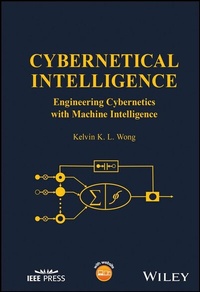
Cybernetical Intelligence
Description

Highly comprehensive, detailed, and up-to-date overview of artificial intelligence and cybernetics, with practical examples and supplementary learning resources
Cybernetical Intelligence: Engineering Cybernetics with Machine Intelligence is a comprehensive guide to the field of cybernetics and neural networks, as well as the mathematical foundations of these technologies. The book provides a detailed explanation of various types of neural networks, including feedforward networks, recurrent neural networks, and convolutional neural networks as well as their applications to different real-world problems. This groundbreaking book presents a pioneering exploration of machine learning within the framework of cybernetics. It marks a significant milestone in the field's history, as it is the first book to describe the development of machine learning from a cybernetics perspective. The introduction of the concept of "Cybernetical Intelligence" and the generation of new terminology within this context propel new lines of thought in the historical development of artificial intelligence. With its profound implications and contributions, this book holds immense importance and is poised to become a definitive resource for scholars and researchers in this field of study.
Each chapter is specifically designed to introduce the theory with several examples. This comprehensive book includes exercise questions at the end of each chapter, providing readers with valuable opportunities to apply and strengthen their understanding of cybernetical intelligence. To further support the learning journey, solutions to these questions are readily accessible on the book's companion site. Additionally, the companion site offers programming practice exercises and assignments, enabling readers to delve deeper into the practical aspects of the subject matter.
Cybernetical Intelligence includes information on:
* The history and development of cybernetics and its influence on the development of neural networks
* Developments and innovations in artificial intelligence and machine learning, such as deep reinforcement learning, generative adversarial networks, and transfer learning
* Mathematical foundations of artificial intelligence and cybernetics, including linear algebra, calculus, and probability theory
* Ethical implications of artificial intelligence and cybernetics as well as responsible and transparent development and deployment of AI systems
Presenting a highly detailed and comprehensive overview of the field, with modern developments thoroughly discussed, Cybernetical Intelligence is an essential textbook that helps students make connections with real-life engineering problems by providing both theory and practice, along with a myriad of helpful learning aids.
More details
Other editions
Additional editions
Person
Prof. Dr. Kelvin K. L. Wong, is a distinguished expert in medical image processing and computational science, earning his Ph.D. from The University of Adelaide. With a strong academic background from Nanyang Technological University and The University of Sydney, he has been at the forefront of merging the fields of cybernetics and artificial intelligence (AI). He is renowned for coining the term "Cybernetical Intelligence" and is the inventor and founder of Deep Red AI.
Content
1
Artificial Intelligence and Cybernetical Learning
Artificial intelligence (AI) is a field of engineering cybernetics that focuses on the development of intelligent machines that can simulate human-like behaviors such as learning, problem-solving, reasoning, and decision-making. AI technology involves the use of algorithms and computational models to analyze vast amounts of data, recognize patterns and make predictions, and interact with humans through natural language processing (NLP) and other forms of communication.
This chapter will comprehensively explore various aspects of AI, including its relation to cybernetics and the fundamental principles governing it. Additionally, it will delve into the nuances of parametric and nonparametric algorithms and core concepts of cybernetical intelligence (CI). Through a systematic and rigorous exposition, readers will acquire a robust understanding of the key principles and algorithms that underlie AI. Consequently, they will be well equipped with the requisite knowledge to develop their own AI applications, leveraging the insights gained from this chapter.
1.1 Artificial Intelligence Initiative
Intelligence includes the capacity for abstraction, logic, learning, reasoning, communication, and inference. It can learn from the environment both actively and passively and use the knowledge to obtain adaptive ability. AI can be defined as a human-made machine with human-like intelligence. The use of AI in education has produced effective pedagogical effects in addition to technical advancements and theoretical developments. Automated target identification, automatic medical diagnosis, and audio recording are a few interesting uses. AI may be utilized to provide customized assistance and increase knowledge-gap awareness, allowing educators to deliver individualized and adaptable education with efficiency and effectiveness. Enabling computers to simulate intelligent behavior using prestored world models is the main goal of AI. The AI simulates human cognitive processes such as reasoning, learning, pattern recognition, knowledge reasoning, and machine learning (ML). ML refers to the creation of automated systems capable of processing massive volumes of data for data mining and is one of the more traditional fields of computing intelligence.
ML is a part of AI that allows machines to obtain intelligence from data without being explicitly programmed. Therefore, it often associates ML with data mining. ML enables a cyber system to possess intelligence by using massive data. Based on that data, ML models or algorithms can mine the knowledge, rules, and laws behind the data. ML identifies underlying functional links in systems between sets of variables and individual variables. The goal of combining the fields of ML and cybernetics is to identify different ways that systems interact with one another through various methods for learning from data. Equation (1.1) illustrates how ML may be summed up as learning a function (f) that maps input variables (x) to output variables (y).
(1.1)The configuration of the function is unknown, but the ML algorithms learn to map the target function from the training data. It is necessary to assess many algorithms to determine which one is best at modeling the underlying function because they all reach different conclusions or exhibit biases on the function's structure. In theory, there are two types of ML algorithms: parametric algorithms and nonparametric algorithms. Additionally, three well-known techniques are used to train ML algorithms. Supervised learning, unsupervised learning, and reinforcement learning are the three categories of ML.
The most significant methodology in ML is supervised learning, which is especially crucial in the processing of multimedia data. This kind of learning is comparable to how humans learn from their past experiences to obtain new information and improve their capacity to carry out activities in the actual world. Models for supervised learning are designed to predict the appropriate label for newly presented data. Unsupervised learning is typically used to identify patterns in the input data that propose candidate features prior to the application of supervised learning, and feature engineering changes these candidate features to make them more appropriate for supervised learning. It is quite time-consuming to identify the correct category or response for every observation in the training set in addition to the characteristics. With the help of semi-supervised learning, one may train models with very little labeled data, which will reduce the labeling work.
Unsupervised learning can be motivated from information-theoretic and Bayesian principles. It empowers the model to work independently to identify previously unnoticed patterns and information. Take into account a device (or living thing) that gets a series of inputs, such as x1, x2, ., xt, where xt is the sensory input at time t. This input, which is known as sensory data, can be a representation of a retinal image, a camera's pixels, or a sound waveform. The most famous technique is clustering in which each observation belongs to at least one of the k clusters, while i and j belong to centroid of each cluster. Furthermore, variation within each cluster is achieved by minimizing the sum of the squared Euclidean distance between each observation within a cluster, as shown in Equation (1.2).
(1.2)where µk represents the centroid of the kth cluster, Xi is the ith data point in the kth cluster, and Ck represents the set of indices of data points assigned to the kth cluster. Reinforcement learning, on the other hand, is heavily influenced by the theory of Markov decision processes and deals with the ability to learn the associations between stimuli, actions, and the occurrence of positive events. The agents are taught a reward and punishment scheme in reinforcement learning. For wise actions, the agent is rewarded, and for poor ones, they are penalized. While doing this, the agent tries to minimize the undesirable motions while maximizing the desirable ones. It is hardly unexpected that reinforcement learning has been noticed in the really distant past given its clear adaptive benefit. A few cybernetics experiments have made use of reinforcement learning. Robots can learn skills that a human instructor is unable to teach, adapt a learned ability to a new task, and accomplish optimization even in the absence of an analytical formulation with the help of this sort of ML. The predicted total of the immediate reward and the long-term reward under the best feasible policy (Max Policies), as given in Equation (1.3), is utility u (over a limited agent lifespan):
(1.3)where st is the state at time step t, R (st, a) is the immediate reward of executing an action in state st, N is the number of steps in the lifetime of the agent, and R is the reward time step t. The operator stands for taking an expectation over all sources of randomness in the system. Here, st denotes the state at time step t, R(st, a) is the instantaneous benefit of carrying out an action in state st, and N denotes the total number of steps the agent will take throughout its lifespan. Taking an expectation across all system randomness sources is what the operator. The configuration of the function is unknown, but the ML algorithms learn to map the target function from the training data. It is necessary to compare multiple algorithms to determine which one is the best successful at modeling the underlying function since different algorithms reach different conclusions or have different biases on the structure of the function. As a result, ML algorithms may be divided into parametric and nonparametric varieties, which will be covered in the following subsections.
1.2 Intelligent Automation Initiative
Intelligent automation initiative (IAI) is an emerging technology-driven approach to optimize business processes and decision-making through a combination of AI, robotic process automation (RPA), and other advanced technologies. It aims to streamline repetitive and mundane tasks, improve productivity, reduce errors, and enable employees to focus on higher-value-added activities. The IAI strategy involves the integration of different technologies to automate various aspects of the business, including customer service, supply chain management, finance, human resources, and more. The main components of IAI include:
- Artificial intelligence (AI): A subset of computer science that focuses on developing algorithms that can mimic human intelligence, such as speech recognition, NLP, ML, and computer vision. AI helps organizations to make sense of vast amounts of data, predict trends, and make informed decisions.
- Robotic process automation (RPA): A software tool that uses bots to automate repetitive and rule-based tasks, such as data entry, invoice processing, and report generation. RPA can reduce operational costs, improve accuracy, and increase efficiency.
- Advanced analytics: It involves the use of statistical models, data mining, and predictive analytics to analyze data and extract insights. This...
