

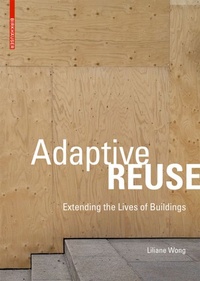
Adaptive Reuse
Description

Building in existing fabric requires more than practical solutions and stylistic skills. The adaptive reuse of buildings, where changes in the structure go along with new programs and functions, poses the fundamental question of how the past should be included in the design for the future.
On the background of long years of teaching and publishing, and using vivid imagery from Frankenstein to Rem Koolhaas and beyond, the author provides a comprehensive introduction to architectural design for adaptive reuse projects. History and theory, building typology, questions of materials and construction, aspects of preservation, urban as well as interior design are dealt with in ways that allow to approach adaptive reuse as a design practice field of its own right.
More details
Other editions
New editions
Additional editions
Person
Liliane Wong , Head of Interior Architecture Dept., Rhode Island School of Design
Content
- Intro
- Contents
- Preface
- 00. Babel
- 01. New Order: The Frankenstein Syndrome
- 02. Plunder: Erasure & Redemption
- 03. The Quest for Immortality
- 04. Battle of the Immortals
- 05. Immortality Redefined
- 06. Immortality Codified
- 07. Hosts [and Guests]
- 08. Considering DNA
- 09. Ghosts
- 10. Fitting In
- 11. The Impassive Host
- 12. Sited Interventions
- 13. The Mathematics of Reuse
- 14. A New and Distant Frontier
- 15. Second Violin
- Illustration Credits
- About the Author
- Index
