

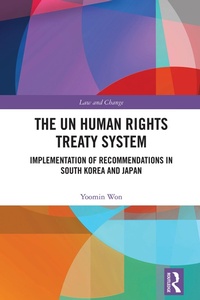
The UN Human Rights Treaty System
Implementation of Recommendations in South Korea and Japan
1st Edition
Published on 30. September 2025
228 pages
978-1-040-44532-7 (ISBN)
Description

Through a use of both qualitative and quantitative methodologies, Won provides a nuanced analysis and discussion of the factors and domestic processes influencing the implementation of United Nations Human Rights Committee (UNHRC) recommendations in South Korea and Japan, as well as across the globe.
Won's research entangles the theoretical debate on whether the UN human rights treaty system is effective in prompting the implementation of HRC recommendations. Based on interviews with activists, lawyers, scholars, judges, and other practitioners in South Korea and Japan, her findings reveal contrasting domestic dynamics: South Korea's vibrant institutional landscape enables more active implementation, while Japan's stable but centralized political system leads to more incremental change. In addition, Won creates a novel empirical dataset to assess the key variables associated with improvement in human rights action across 103 countries. The findings suggest that institutional mechanisms enhance implementation in new democracies, while civil society plays a crucial role even in authoritarian regimes. Ultimately, frequent and constructive dialogue between states, treaty bodies, and civil society, supported by institutional protections, is key to turning recommendations into human rights change.
A unique empirical analysis of international human rights action as driven by UN recommendations, this book will be of interest to scholars and students of international law, human rights, and international relations, as well as human rights lawyers and the NGO Human Rights Communities.
Won's research entangles the theoretical debate on whether the UN human rights treaty system is effective in prompting the implementation of HRC recommendations. Based on interviews with activists, lawyers, scholars, judges, and other practitioners in South Korea and Japan, her findings reveal contrasting domestic dynamics: South Korea's vibrant institutional landscape enables more active implementation, while Japan's stable but centralized political system leads to more incremental change. In addition, Won creates a novel empirical dataset to assess the key variables associated with improvement in human rights action across 103 countries. The findings suggest that institutional mechanisms enhance implementation in new democracies, while civil society plays a crucial role even in authoritarian regimes. Ultimately, frequent and constructive dialogue between states, treaty bodies, and civil society, supported by institutional protections, is key to turning recommendations into human rights change.
A unique empirical analysis of international human rights action as driven by UN recommendations, this book will be of interest to scholars and students of international law, human rights, and international relations, as well as human rights lawyers and the NGO Human Rights Communities.
More details
Series
Edition
1. Auflage
Language
English
Place of publication
London
United Kingdom
Publishing group
Taylor & Francis Ltd
Target group
College/higher education
Illustrations
10 Tables, black and white; 22 Line drawings, black and white; 22 Illustrations, black and white
File size
2,19 MB
ISBN-13
978-1-040-44532-7 (9781040445327)
Copyright in bibliographic data and cover images is held by Nielsen Book Services Limited or by the publishers or by their respective licensors: all rights reserved.
Schweitzer Classification
Other editions
Additional editions
Yoomin Won
The UN Human Rights Treaty System
Implementation of Recommendations in South Korea and Japan
Book
09/2025
1st Edition
Routledge
€206.30
Shipment within 10-20 days
Person
Yoomin Won is Associate Professor at Seoul National University. Her research interests include international human rights law and domestic application.
Content
About the Author
List of Figures
List of Tables
Preface
List of Abbreviations
Part I: Overview
Chapter 1. Introduction
Chapter 2. Do Human Rights Treaties Work?
Chapter 3. Human Rights Recommendations
Chapter 4. Did States Implement Recommendations?
Part II: Stories from Japan and South Korea
Chapter 5. Human Rights Issues in Japan
Chapter 6. Human Rights Issues in South Korea
Chapter 7. Comparing Japan and South Korea
Part III: Global Data Analysis
Chapter 8. Testing Statistically
Chapter 9. Conclusion
Bibliography
Appendix I. Recommendations for South Korea and Japan
Appendix II. Codebook
Appendix III. Result of ordinal logistic regression
List of Figures
List of Tables
Preface
List of Abbreviations
Part I: Overview
Chapter 1. Introduction
Chapter 2. Do Human Rights Treaties Work?
Chapter 3. Human Rights Recommendations
Chapter 4. Did States Implement Recommendations?
Part II: Stories from Japan and South Korea
Chapter 5. Human Rights Issues in Japan
Chapter 6. Human Rights Issues in South Korea
Chapter 7. Comparing Japan and South Korea
Part III: Global Data Analysis
Chapter 8. Testing Statistically
Chapter 9. Conclusion
Bibliography
Appendix I. Recommendations for South Korea and Japan
Appendix II. Codebook
Appendix III. Result of ordinal logistic regression
