

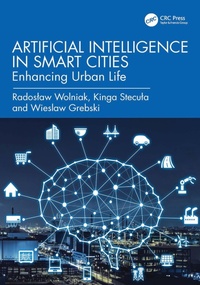
Artificial Intelligence in Smart Cities
Enhancing Urban Life
Published on 19. February 2026
150 pages
978-1-040-67051-4 (ISBN)
Description

Artificial Intelligence in Smart Cities presents an interdisciplinary and comprehensive analysis of how AI reengineers urban life, governance, and infrastructure. The book explores key thematic areas, including smart government, economy, environment, living, people, cybersecurity, and innovation, complemented by Central European empirical case studies. Each chapter examines the impact of AI technologies-machine learning, natural language processing, and IoT integration-on augmented decision-making, sustainability, health, education, urban resilience, and social inclusiveness.
The book integrates empirical evidence, conceptual reflection, and practical deployment to illuminate how AI can be harnessed for inclusive urban growth. It guides readers through the complex landscape of ethics, economics, and privacy concerns while offering insights on algorithmic fairness, data protection, public trust, and AI innovation. This thoughtful examination advocates for a human-centered and ethical approach to Smart City development, balancing technological advancement with societal needs.
Addressed at researchers, urban planners, policymakers, technologists, and graduate students, this resource provides both policy-driven expertise and analytical capability. Readers will gain valuable perspectives on the convergence of urban futures and Artificial Intelligence, equipping them with the knowledge to navigate the challenges and opportunities of AI-enhanced urban environments while ensuring technology serves the public good.
The book provides a thorough and systematic examination of the role of AI in Smart Cities, covering its applications, benefits, and challenges in various aspects of urban development, including governance, economy, environment, mobility, living, and people.
Offers an in-depth analysis of the key principles and technologies of AI, as well as its applications in Smart Cities, providing readers with a detailed understanding of the potential of AI to transform urban environments
Presents case studies of successful AI implementations in Central European cities, providing practical insights and lessons learned for policymakers, urban planners, and business leaders seeking to harness the power of AI to create more liveable, sustainable, and resilient cities
Adopts an interdisciplinary approach, drawing on insights from urban planning, computer science, engineering, economics, and social sciences to provide a comprehensive understanding of the role of AI in Smart Cities
Provides a vision for a future where AI is used to create a better life for all citizens and inspires a new wave of innovation and collaboration in the development of Smart Cities
The book integrates empirical evidence, conceptual reflection, and practical deployment to illuminate how AI can be harnessed for inclusive urban growth. It guides readers through the complex landscape of ethics, economics, and privacy concerns while offering insights on algorithmic fairness, data protection, public trust, and AI innovation. This thoughtful examination advocates for a human-centered and ethical approach to Smart City development, balancing technological advancement with societal needs.
Addressed at researchers, urban planners, policymakers, technologists, and graduate students, this resource provides both policy-driven expertise and analytical capability. Readers will gain valuable perspectives on the convergence of urban futures and Artificial Intelligence, equipping them with the knowledge to navigate the challenges and opportunities of AI-enhanced urban environments while ensuring technology serves the public good.
The book provides a thorough and systematic examination of the role of AI in Smart Cities, covering its applications, benefits, and challenges in various aspects of urban development, including governance, economy, environment, mobility, living, and people.
Offers an in-depth analysis of the key principles and technologies of AI, as well as its applications in Smart Cities, providing readers with a detailed understanding of the potential of AI to transform urban environments
Presents case studies of successful AI implementations in Central European cities, providing practical insights and lessons learned for policymakers, urban planners, and business leaders seeking to harness the power of AI to create more liveable, sustainable, and resilient cities
Adopts an interdisciplinary approach, drawing on insights from urban planning, computer science, engineering, economics, and social sciences to provide a comprehensive understanding of the role of AI in Smart Cities
Provides a vision for a future where AI is used to create a better life for all citizens and inspires a new wave of innovation and collaboration in the development of Smart Cities
More details
Language
English
Place of publication
London
United Kingdom
Publishing group
Taylor & Francis Ltd
Target group
College/higher education
Professional and scholarly
Product notice
Reflowable
Illustrations
29 Tables, black and white
File size
1,83 MB
ISBN-13
978-1-040-67051-4 (9781040670514)
Copyright in bibliographic data and cover images is held by Nielsen Book Services Limited or by the publishers or by their respective licensors: all rights reserved.
Schweitzer Classification
Other editions
Additional editions
Radoslaw Wolniak | Kinga Stecula | Wieslaw Grebski
Artificial Intelligence in Smart Cities
Enhancing Urban Life
Book
approx. 02/2026
1st Edition
CRC Press
€189.10
Not yet published
Radoslaw Wolniak | Kinga Stecula | Wieslaw Grebski
Artificial Intelligence in Smart Cities
Enhancing Urban Life
Book
approx. 02/2026
1st Edition
CRC Press
€74.10
Not yet published
Persons
Radoslaw Wolniak is a full professor at the Department of Economics and Informatics at the Silesian University of Technology (Poland). For over 20 years he has been dealing with the issues of management, including Industry 4.0, Smart Cities, digitalization and Artificial Intelligence. His achievements include over 500 publications issued by national and international publishers, as well as many undertakings and projects implemented in cooperation with the business environment. Scopus indicators: citations-1321, Hirsh index = 21. He's on the Stanford list of Top 2% scientists most cited across the globe for 2023.
Kinga Stecula earned a PhD in mechanical engineering at Silesian University of Technology (SUT), Faculty of Organization and Management, Poland, in 2021. Currently, she works in Department of Production Engineering at SUT in the Faculty of Organization and Management. Dr Stecula deals with research in the field of technical sciences connected with production engineering, but she is also interested in examining human-machine/human-computer interaction and communication. Currently, she is interested in the human-machine relation in the context of virtual reality, augmented reality, and different means of technology. Her interests also include Smart Cities, Industry 4.0, and management. Scopus indicators: citations-250, Hirsh index = 12.
Wieslaw Grebski is Professor Emeritus at the Pennsylvania State University, USA. He was a member of the Engineering Faculty and Coordinator of the Engineering Program at Penn State Hazleton. His research interests evolved from computer-aided manufacturing to sustainable forms of energy. Professor Grebski has always promoted a close cooperation between universities and industry. Under his leadership a new engineering program focusing on renewable energy was developed. He has coauthored 200 publications and 9 books. Professor Grebski promoted unconventional methods for teaching and learning. He received the Milton S. Eisenhower Award, one of the highest recognitions at Penn State. Professor Grebski received 11 other awards for teaching and advising. He has also taught a dual-enrollment class, Introduction to Engineering Design, to promote the engineering profession and recruit students for the engineering program. He was a 15 Information Classification and a general member of the Pennsylvania Academy of Science, the American Society of University Professors, the American Society of Mechanical Engineers, and the American Association of Engineering Educators.
Kinga Stecula earned a PhD in mechanical engineering at Silesian University of Technology (SUT), Faculty of Organization and Management, Poland, in 2021. Currently, she works in Department of Production Engineering at SUT in the Faculty of Organization and Management. Dr Stecula deals with research in the field of technical sciences connected with production engineering, but she is also interested in examining human-machine/human-computer interaction and communication. Currently, she is interested in the human-machine relation in the context of virtual reality, augmented reality, and different means of technology. Her interests also include Smart Cities, Industry 4.0, and management. Scopus indicators: citations-250, Hirsh index = 12.
Wieslaw Grebski is Professor Emeritus at the Pennsylvania State University, USA. He was a member of the Engineering Faculty and Coordinator of the Engineering Program at Penn State Hazleton. His research interests evolved from computer-aided manufacturing to sustainable forms of energy. Professor Grebski has always promoted a close cooperation between universities and industry. Under his leadership a new engineering program focusing on renewable energy was developed. He has coauthored 200 publications and 9 books. Professor Grebski promoted unconventional methods for teaching and learning. He received the Milton S. Eisenhower Award, one of the highest recognitions at Penn State. Professor Grebski received 11 other awards for teaching and advising. He has also taught a dual-enrollment class, Introduction to Engineering Design, to promote the engineering profession and recruit students for the engineering program. He was a 15 Information Classification and a general member of the Pennsylvania Academy of Science, the American Society of University Professors, the American Society of Mechanical Engineers, and the American Association of Engineering Educators.
Content
1. The Role of Artificial Intelligence in Smart Cities. 2. AI in Smart Governance. 3. AI in Smart Economy. 4. AI in Smart Environment. 5. AI in Smart Mobility. 6. AI in Smart Living. 7. AI in Smart People. 8. Cybersecurity and Privacy in Smart Cities. 9. Case Studies of AI Usage in Smart Cities in Central Europe. 10. AI as a Catalyst for Innovation. 11. Future Prospects.
