

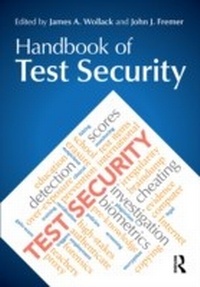
Handbook of Test Security
1st Edition
Published on 2. September 2013
376 pages
978-1-136-74792-2 (ISBN)
Description

High stakes tests are the gatekeepers to many educational and professional goals. As such, the incentive to cheat is high. This Handbook is the first to offer insights from experts within the testing community, psychometricians, and policymakers to identify and develop best practice guidelines for the design of test security systems for a variety of testing genres. Until now this information was scattered and often resided inside testing companies. As a result, rather than being able to learn from each other's experiences, each testing entity was left to re-create their own test security wheel.
As a whole the book provides invaluable insight into the prevalence of cheating and "best practices" for designing security plans, training personnel, and detecting and investigating misconduct, to help develop more secure testing systems and reduce the likelihood of future security breaches. Actual case studies from a variety of settings bring to life how security systems really work. Examples from both domestic and international programs are provided. Highlights of coverage include:* Best practices for designing secure tests
* Analysis of security vulnerabilities for all genres of testing
* Practical cheating prevention and detection strategies
* Lessons learned in actual security violations in high profile testing programs.
Part I focuses on how tests are delivered for paper-and-pencil, technology-based, and classroom testing and writing assessment. Each chapter addresses the prevalence of the problem and threats to security, prevention, and detection. Part II addresses issues essential to maintaining a secure testing program such as planning and monitoring, physical security, the detection of group-based cheating, investigating misconduct, and communicating about security-related issues. Part III examines actual examples of cheating-- how the cheating was done, how it was detected, and the lessons learned. Part III provides insight into security issues within each of the Association of Test Publishers' four divisions: certification/licensure, clinical, educational, and industrial/organizational testing. Part III's conclusion revisits the issues addressed in the case studies and identifies common themes.
Intended for organizations, professionals, educators, policy makers, researchers, and advanced students that design, develop, or use high stakes tests, this book is also ideal for graduate level courses on test development, educational measurement, or educational policy.
As a whole the book provides invaluable insight into the prevalence of cheating and "best practices" for designing security plans, training personnel, and detecting and investigating misconduct, to help develop more secure testing systems and reduce the likelihood of future security breaches. Actual case studies from a variety of settings bring to life how security systems really work. Examples from both domestic and international programs are provided. Highlights of coverage include:* Best practices for designing secure tests
* Analysis of security vulnerabilities for all genres of testing
* Practical cheating prevention and detection strategies
* Lessons learned in actual security violations in high profile testing programs.
Part I focuses on how tests are delivered for paper-and-pencil, technology-based, and classroom testing and writing assessment. Each chapter addresses the prevalence of the problem and threats to security, prevention, and detection. Part II addresses issues essential to maintaining a secure testing program such as planning and monitoring, physical security, the detection of group-based cheating, investigating misconduct, and communicating about security-related issues. Part III examines actual examples of cheating-- how the cheating was done, how it was detected, and the lessons learned. Part III provides insight into security issues within each of the Association of Test Publishers' four divisions: certification/licensure, clinical, educational, and industrial/organizational testing. Part III's conclusion revisits the issues addressed in the case studies and identifies common themes.
Intended for organizations, professionals, educators, policy makers, researchers, and advanced students that design, develop, or use high stakes tests, this book is also ideal for graduate level courses on test development, educational measurement, or educational policy.
Reviews / Votes
"Test security is now widely recognized as a fundamental aspect of ensuring the validity and defensibility of scores on tests in education, licensure, and certification. The Handbook of Test Security brings attention to the integrity of test scores and reflects the critical importance of this topic in a timely, comprehensive, and authoritative way."- Gregory J. Cizek, University of North Carolina at Chapel Hill, USA"This Handbook provides insights into the nature and importance of test security, some techniques to avoid test taker dishonesty, and statistical and other formulations for catching it. It is a must for all testing professionals." Kurt F. Geisinger, The University of Nebraska-Lincoln, USA
"Security is vital to fair and valid testing. Finally there is a handbook that will be a reference for all aspects of test security, at home and abroad. Written and edited by the leading experts in the world." - Marten Roorda, CEO Cito, the Netherlands
"This book will make a significant contribution to the literature and hopefully to practice. .... [It] addresses an ... important need in the testing industry. ...This is a practical book offering insights from those that are either involved with security or have written about the field. ... I see test publishers buying this to improve their work." - Lawrence M. Rudner, Graduate Management Admission Council, USA"A book such as this ...scholarly but ... with practical recommendations ... is much needed in our field. ... All testing agencies ... will need this handbook. Licensure and certification agencies in the professions (medicine, nursing, law) ... will eagerly await this volume."- Steven M. Downing, University of Illinois at Chicago, USA
More details
Language
English
Place of publication
London
United Kingdom
Publishing group
Taylor & Francis Ltd
Target group
College/higher education
Illustrations
9 s/w Tabellen, 5 s/w Photographien bzw. Rasterbilder, 17 s/w Zeichnungen
9 Tables, black and white; 17 Line drawings, black and white; 5 Halftones, black and white
File size
3,02 MB
ISBN-13
978-1-136-74792-2 (9781136747922)
Copyright in bibliographic data and cover images is held by Nielsen Book Services Limited or by the publishers or by their respective licensors: all rights reserved.
Schweitzer Classification
Other editions
Additional editions
James A. Wollack | John J. Fremer
Handbook of Test Security
Book
03/2013
1st Edition
Routledge
€430.82
Shipment within 15-20 days
James A. Wollack | John J. Fremer
Handbook of Test Security
Book
03/2013
1st Edition
Routledge
€215.40
Shipment within 15-20 days
Persons
James A. Wollack is an Associate Professor of Educational Psychology at the University of Wisconsin-Madison, where he serves as the Director of Testing & Evaluation Services and the University of Wisconsin Center for Placement Testing, and as the Research Director for the General Education Assessment. Wollack has published numerous journal articles and book chapters and is a frequent presenter at national conferences on topics such as detection of answer copying, test security, score scale stability, test construction, and test speededness, including having co-authored the chapter on test administration, security, scoring, and reporting for the 4th edition of Educational Measurement. Wollack frequently serves as a consultant or expert witness on cases involving suspected cheating on high-stakes exams, and has presided over many cases of alleged student academic misconduct at the University of Wisconsin. He currently sits on the Board of Directors for the National Council on Measurement in Education (NCME), and is very active in the American Educational Research Association (AERA), the Measurement Services Special Interest Group of AERA, the Association of Test Publishers (ATP), and the National College Testing Association (NCTA).
Wollack earned a B. S. with honors in Psychology from the University of California at Davis, and a M.S. and Ph.D. in Educational Psychology from the University of Wisconsin-Madison.
John J. Fremer is currently President, Caveon Consulting Services, and a Founder of Caveon Test Security, a company that helps prevent and detect test fraud, including cheating and test piracy. Fremer has held management level positions in test and test program development at Educational Testing Service and The Psychological Corporation/Harcourt.
Fremer is a Past President of the National Council on Measurement in Education (NCME) and a former editor of the NCME journal Educational Measurement: Issues and Practice. Fremer also served as President of the Association of Test Publishers (ATP) and the Association for Assessment in Counseling (AAC). He was co-chair of the Joint Committee on Testing Practices (JCTP) and of the JCTP work group that developed the testing-industry-wide Code of Fair Testing Practices in Education. .Fremer received the 2007 Association of Test Publishers Career Award for Contributions to Measurement and a Career Recognition Award in 2012 from the National Association of Test Directors. Fremer has been a frequent presenter and writer on issues related to test security.
John has a B.A. from Brooklyn College, City University of New York, where he graduated Phi Beta Kappa and Magna Cum Laude, and a Ph.D. from Teachers College, Columbia University. John counts among his most important life accomplishments his marriage for over 50 years to water-color artist Judith A. Fremer.
Wollack earned a B. S. with honors in Psychology from the University of California at Davis, and a M.S. and Ph.D. in Educational Psychology from the University of Wisconsin-Madison.
John J. Fremer is currently President, Caveon Consulting Services, and a Founder of Caveon Test Security, a company that helps prevent and detect test fraud, including cheating and test piracy. Fremer has held management level positions in test and test program development at Educational Testing Service and The Psychological Corporation/Harcourt.
Fremer is a Past President of the National Council on Measurement in Education (NCME) and a former editor of the NCME journal Educational Measurement: Issues and Practice. Fremer also served as President of the Association of Test Publishers (ATP) and the Association for Assessment in Counseling (AAC). He was co-chair of the Joint Committee on Testing Practices (JCTP) and of the JCTP work group that developed the testing-industry-wide Code of Fair Testing Practices in Education. .Fremer received the 2007 Association of Test Publishers Career Award for Contributions to Measurement and a Career Recognition Award in 2012 from the National Association of Test Directors. Fremer has been a frequent presenter and writer on issues related to test security.
John has a B.A. from Brooklyn College, City University of New York, where he graduated Phi Beta Kappa and Magna Cum Laude, and a Ph.D. from Teachers College, Columbia University. John counts among his most important life accomplishments his marriage for over 50 years to water-color artist Judith A. Fremer.
Content
J. A. Wollack, J.J. Fremer, Introduction: The Test Security Threat. Part I. Designing Secure Delivery Systems.J.J. Fremer, S. Ferrara, Security in Large-Scale, Paper and Pencil Testing. D. Foster, Security Issues in Technology-Based Testing. L. Woodruff, Security Issues in Classroom Testing. S. Lane, Security Issues in Writing Assessment. Part II. Important Issues In Test Security.C. T. Fitzgerald, J. R. Mulkey, Security Planning, Training, and Monitoring. A. R. Scicchitano, R. D. Meade. Physical Security at Test Centers and The Testing Company. D. Maynes, Educator Cheating and the Statistical Detection of Group-Based Test Security Threats. D. J. Harris, R. R. Watkins Schoenig, Conducting Investigations of Misconduct. S. M. Case, B. E. Donahue, Security-Related Communications. J. A. Semko, R. Hunt, Legal Matters in Test Security. Part III. Lessons Learned From Practice: Case Studies From A Variety Of Disciplines.J. D. Carson, Certification/Licensure Testing Case Studies. K. M. Williams, S. Rzepa, G. Sitarenios, H. Wheldon, Clinical Testing Case Studies: Prevention, Detection, and Management of Falsified Test Development Data. N. Kingston, Educational Testing Case Studies. D. Bartram, E. Burke, Industrial/Organizational Testing Case Studies. W. A. Hatherill, Commentary on Case Studies. J. J. Fremer, James A. Wollack, Conclusion: The Future of Test Security.
