

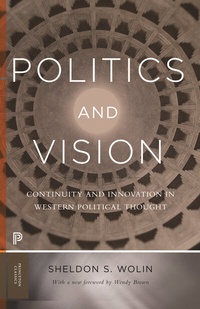
Politics and Vision
Continuity and Innovation in Western Political Thought - Expanded Edition
1st Edition
Published on 18. November 2019
792 pages
978-1-4008-8353-0 (ISBN)
Description

Politics and Vision is a landmark work by one of the great thinkers of the twentieth century. This is a significantly expanded edition of one of the greatest works of modern political theory. Sheldon Wolin's Politics and Vision inspired and instructed two generations of political theorists after its appearance in 1960. Substantially expanded for republication in 2004, it is both a sweeping survey of Western political thought and a powerful account of contemporary predicaments of power and democracy. In lucid and compelling prose, Sheldon Wolin offers original, subtle, and often surprising interpretations of political theorists from Plato to Rawls. Situating them historically while sounding their depths, he critically engages their diverse accounts of politics, theory, power, justice, citizenship, and institutions. The new chapters, which show how thinkers have grappled with the immense possibilities and dangers of modern power, are themselves a major theoretical statement. They culminate in Wolin's remarkable argument that the United States has invented a new political form, "inverted totalitarianism," in which economic rather than political power is dangerously dominant. In this expanded edition, the book that helped to define political theory in the late twentieth century should energize, enlighten, and provoke generations of scholars to come.
Wolin originally wrote Politics and Vision to challenge the idea that political analysis should consist simply of the neutral observation of objective reality. He argues that political thinkers must also rely on creative vision. Wolin shows that great theorists have been driven to shape politics to some vision of the Good that lies outside the existing political order. As he tells it, the history of theory is thus, in part, the story of changing assumptions about the Good.
Acclaimed as a tour de force when it was first published, and a major scholarly event when the expanded edition appeared, Politics and Vision will instruct, inspire, and provoke for generations to come.
Wolin originally wrote Politics and Vision to challenge the idea that political analysis should consist simply of the neutral observation of objective reality. He argues that political thinkers must also rely on creative vision. Wolin shows that great theorists have been driven to shape politics to some vision of the Good that lies outside the existing political order. As he tells it, the history of theory is thus, in part, the story of changing assumptions about the Good.
Acclaimed as a tour de force when it was first published, and a major scholarly event when the expanded edition appeared, Politics and Vision will instruct, inspire, and provoke for generations to come.
More details
Other editions
Additional editions
Sheldon S. Wolin
Politics and Vision
Continuity and Innovation in Western Political Thought - Expanded Edition
Book
09/2016
Princeton University Press
€31.50
Available immediately
Persons
Sheldon S. Wolin (1922-2015) was professor emeritus of politics at Princeton University. He taught political theory for forty years and was the founding editor of the journal Democracy. Wendy Brown is Class of 1936 First Chair of Political Science at the University of California, Berkeley.
Content
- Cover
- Title
- Copyright
- Dedication
- CONTENTS
- Foreword to the Princeton Classics Edition
- Preface to the 2004 Expanded Edition
- Preface
- PART ONE
- CHAPTER ONE Political Philosophy and Philosophy
- I Political Philosophy as a Form of Inquiry
- II Form and Substance
- III Political Thought and Political Institutions
- IV Political Philosophy and the Political
- V The Vocabulary of Political Philosophy
- VI Vision and Political Imagination
- VII Political Concepts and Political Phenomena
- VIII A Tradition of Discourse
- IX Tradition and Innovation
- CHAPTER TWO Plato: Political Philosophy versus Politics
- I The Invention of Political Philosophy
- II Philosophy and Society
- III Politics and Architectonics
- IV The Search for a Selfless Instrument
- V The Question of Power
- VI Political Knowledge and Political Participation
- VII The Limits of Unity
- VIII The Ambiguities of Plato
- CHAPTER THREE The Age of Empire: Space and Community
- I The Crisis in the Political
- II The New Dimensions of Space
- III Citizenship and Disengagement
- IV Politics and the Roman Republic
- V The Politics of Interest
- VI From Political Association to Power Organization
- VII The Decline of Political Philosophy
- CHAPTER FOUR The Early Christian Era: Time and Community
- I The Political Element in Early Christianity: The New Notion of Community
- II The Church as a Polity: The Challenge to the Political Order
- III Politics and Power in a Church-Society
- IV The Embarrassments of a Politicized Religion and the Task of Augustine
- V The Identity of the Church-Society Reasserted: Time and Destiny
- VI Political Society and Church-Society
- VII The Language of Religion and the Language of Politics: Footnote on Mediaeval Christian Thought
- CHAPTER FIVE Luther: The Theological and the Political
- I Political Theology
- II The Political Element in Luther's Thought
- III The Bias against Institutions
- IV The Status of the Political Order
- V The Political Order without Counterweight
- VI The Fruits of Simplicity
- CHAPTER SIX Calvin: The Political Education of Protestantism
- I The Crisis in Order and Civility
- II The Political Quality of Calvin's Thought
- III The Political Theory of Church Government
- IV The Restoration of the Political Order
- V Political Knowledge
- VI Political Office
- VII Power and Community
- CHAPTER SEVEN Machiavelli: Politics and the Economy of Violence
- I The Autonomy of Political Theory
- II The Commitments of the Political Theorist
- III The Nature of Politics and the Categories of the New Science
- IV Political Space and Political Action
- V The Economy of Violence
- VI Ethics: Political and Private
- VII The Discovery of the Mass
- VIII Politics and Souls
- CHAPTER EIGHT Hobbes: Political Society as a System of Rules
- I The Revival of Political Creativity
- II Political Philosophy and the Revolution in Science
- III The Promise of Political Philosophy
- IV The Language of Politics: The Problem of Constituency
- V Political Entropy: The State of Nature
- VI The Sovereign Definer
- VII Power without Community
- VIII Interests and Representation
- IX Politics as a Field of Forces
- CHAPTER NINE Liberalism and the Decline of Political Philosophy
- I The Political and the Social
- II Liberalism and the Sobrieties of Philosophy
- III The Political Claims of Economic Theory
- IV The Eclipse of Political Authority: The Discovery of Society
- V Society and Government: Spontaneity versus Coercion
- VI Liberalism and Anxiety
- VII Beyond the Pleasure Principle: The Problem of Pain
- VIII Liberalism and Moral Judgments: The Substitution of Interest for Conscience
- IX Liberalism and Conformity: The Socialized Conscience
- CHAPTER TEN The Age of Organization and the Sublimation of Politics
- I The Age of Organization
- II Identifying a Tradition of Discourse
- III Organization and Community
- IV Rousseau: The Idea of Community
- V Freedom and Impersonal Dependence
- VI Saint-Simon: The Idea of Organization
- VII Organization Theory and Methodology: Some Parallels
- VIII Organization, Method, and Constitutional Theory
- IX Communal Values in Organization
- X The Attack on Economic Rationalism
- XI Organization Theory: Rationalism versus Organicism
- XII The Attack on the Political
- XIII Elite and Mass: Action in the Age of Organization
- XIV Concluding Remarks
- PART TWO
- CHAPTER ELEVEN From Modern to Postmodern Power
- I Celebrating the Death of the Past
- II The Baconian Vision of Power
- III Cultivating Mind and Method
- IV Modern Power Realized
- V Modern Power and Its Constituent Elements
- VI Containing Power
- CHAPTER TWELVE Marx: Theorist of the Political Economy of the Proletariat or of Uncollapsed Capitalism?
- I Marx and Nietzsche: Economy or Culture?
- II Marx and the Theoretical Vocation
- III Marx and the Idea of a Political Economy
- IV Working through the Idea of Democracy
- V The Power of Theory
- VI The Politics of Economy: The 1844 Manuscripts
- VII The Historical Origins of Power
- VIII Power, Force, and Violence
- IX Modern Power Revealed
- X Marx and Locke: Parallel Narratives
- XI The Alienation of Power
- XII The Worker as Political Actor
- XIII Capitalism and the Political Shaping of the Working Class
- XIV Capital: Contradiction and Crisis
- XV Inheriting the Power-System of Capital
- XVI The Status of Politics
- XVII The Question of Dictatorship
- XVIII The Paris Commune
- XIX Anticipating the End of Politics
- XX Defending a Post-politics
- XXI Underestimating the Capitalist
- CHAPTER THIRTEEN Nietzsche: Pretotalitarian, Postmodern
- I From Economy to Culture
- II "Some are born posthumously"
- III The New Nietzsche
- IV Totalitarianism as a Form
- V Nietzsche: A Political Theorist?
- VI The Theorist as Immoralist
- VII The Politics of Critical Totalitarianism
- VIII The Extraordinary versus the Normal
- IX The Totalitarian Dynamic
- X The Extermination of Decadence
- XI Cultural Wars
- XII The Crisis of Nihilism
- XIII The Aesthete and the Herd
- XIV The Politics of Culture
- XV A New Elite
- XVI The Theorist of Anti-theory
- XVII Rediscovering Myth
- XVIII The Making of the Herd
- XIX Myth and Theory
- XX Looking for a New Dionysius
- XXI Nietzsche as Political Analyst
- XXII The Will-to-Power in the Twentieth Century
- CHAPTER FOURTEEN Liberalism and the Politics of Rationalism
- I Popper, Dewey, and Rawls: Playing Out Liberalism
- II The Closed Society
- III The Open Society
- IV Hints of an Emerging Ambiguity
- V Dewey: The Philosopher as Political Theorist
- VI Bacon Redivivus
- VII Educating for Power
- VIII Democracy's Means: Education
- IX Democracy and Economy
- X The Contest over Science
- XI The Idea of a Public
- XII Great Society and Great Community
- XIII The Scientific Community as Model Democracy
- XIV The Fading Aura of Science
- XV Totalitarianism and Technology
- XVI Totalitarianism and the Reaction against Democracy
- XVII Democratic Revival?
- CHAPTER FIFTEEN Liberal Justice and Political Democracy
- I Liberalism on the Defensive
- II Freedom and Equality: Liberal Dilemma
- III John Rawls and the Revival of Political Philosophy
- IV Economy and Political Economy
- V Justice and Inequality
- VI The "Original Position" and the Tradition of Contract Theory
- VII Liberalism and Its Political
- VIII Rawls's Genealogy of Liberalism
- IX The Reasonableness of Liberalism
- X The Threat of Comprehensive Doctrines
- XI Liberal Political Culture
- XII Liberalism and Governance
- XIII Neo-liberalism in the Cold War
- CHAPTER SIXTEEN Power and Forms
- I Old and New Political Forms
- II Superpower and Terror
- III Modern and Postmodern Power
- IV Political Economy: The New Public Philosophy
- V Collapsed Communism and Uncollapsed Capitalism
- VI Political Economy and Postmodernism
- VII The Political and Its Absent Carrier
- VIII The Demythologizing of Science
- IX Rational Political Science
- X Political Science and the Political Establishment
- XI The Odyssey of the State: From Welfare to Superpower
- XII Faltering Vision
- XIII Towards Totality
- CHAPTER SEVENTEEN Postmodern Democracy: Virtual or Fugitive?
- I Postmodern Culture and Postmodern Power
- II Nietzschean Pessimism Transformed
- III The Self as Microcosm
- IV Centrifugals and Centripetals
- V Centripetal Power
- VI The Political Evolution of the Corporation
- VII Empire and the Imperial Citizen
- VIII Superpower and Inverted Totalitarianism
- IX The Limits of Superpower?
- X A Land of Political Opportunity
- XI Capital and Democracy
- XII Democracy at Bay
- XIII Postrepresentative Politics
- XIV Fugitive Democracy
- Notes
- Index
