

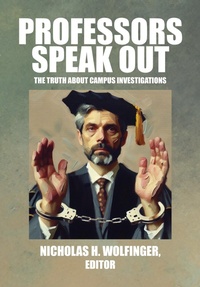
Professors Speak Out
Description

Professors Speak Out showcases the stories of 22 faculty members from various fields, all of whom have been investigated by their own colleges or universities. These disturbing narratives reflect the growing frequency of absurd campus investigations, which often result from the expression of disfavored opinions?opinions that should be protected by free speech rights and longstanding principles of academic freedom. Some of the contributors paid the ultimate price, the loss of a tenured faculty position. Many others learned that the investigation itself is the punishment, with chilled speech an inevitable byproduct. By providing a badly needed platform for persecuted voices in contemporary academia, this unique volume exposes the grave injustice that confronts faculty members today and calls into serious question the twisted bureaucratic processes that give rise to such investigations. Taken together, the stories told here show how a new campus McCarthyism is assailing academic freedom.
More details
Other editions
Additional editions

Person
NICHOLAS H. WOLFINGER is Professor of Family & Consumer Studies and Adjunct Professor of Sociology at the University of Utah.
Content
- Professors Speak Out:The Truth About Campus Investigations
- Nicholas H. Wolfinger,Editor
- Professors Speak Out:The Truth About Campus Investigations
- Nicholas H. Wolfinger,Editor
- Academica PressWashington~London
- Library of Congress Cataloging-in-Publication Data
- Names: Wolfinger, Nicholas H. (editor)
- Title: Professors speak out : the truth about campus investigations | Wolfinger, Nicholas H.
- Description: Washington : Academica Press, 2025. | Includes references.
- Identifiers: LCCN 2025930017 | ISBN 9781680535563 (hardcover) | 9781680535570 (paperback) | 9781680535587 (e-book)
- Copyright 2025 Nicholas H. Wolfinger
- Contents
- Acknowledgments ix
- Introduction 1
- Sex 31
- These are cases involving allegations of sexual misconduct of various kinds, most of which involve course content or off-color language.
- Patricia A. Adler and Peter Adler 33
- Teresa K. Buchanan 53
- Robert Frodeman 67
- Dennis Gouws 85
- Buddy Ullman 131
- David C. Wiley 149
- Race and Ethnicity 187
- These are cases involving allegations of racism or racial insensitivity.
- Lee Jussim and Nathan Honeycutt 189
- Patanjali Kambhampati 207
- Jason J. Kilborn 223
- Liam O'Mara IV 243
- Mark Mercer 257
- Stephen Porter 269
- Elizabeth Weiss 285
- Frances Widdowson 305
- Religion and Politics 325
- These cases involve allegations of religious insensitivity, including allegations of anti-Semitism or anti-Christian bias, or investigations fueled by political pressure.
- Fawzia Afzal-Khan 327
- Abdul Jabbar 349
- Deandre Poole 365
- Jaime Scholnick 379
- Postscript: How to Safeguard Your Academic Careerby Stephen Porter 387
- About the contributors 391
- Acknowledgments
- John F. Kennedy is generally credited with saying that victory has a thousand fathers but defeat is an orphan. Most non-fiction books, my own included, have lengthy lists of acknowledgements but little mention of setbacks.
- This book stands JFK's wisdom on its head. All the stories herein had their origins in defeat, instances when colleges and universities abused their power to investigate and sanction the contributors. The book had its own Bay of Pigs when the first publisher pulled out. Academica Press president Paul du Quenoy deserves great thanks for taking a chance on this book after so many publishers turned it down. Bob Frodeman started out as my co-editor before he, too, turned the book down. I thank him f
- The biggest thanks go out to the 21 academics who took the time to write about their experiences. For some of you, it wasn't easy to reopen old wounds, especially when your careers had been destroyed in the process. Thank you for taking the time to tell your stories. I appreciate your efforts, and I'm sure many readers will too.
- So this is an easy choice: this book is dedicated to you, the contributors, and all the other academics who have had their lives upended by unjust investigations.
- Introduction
- Our colleges find themselves caught in (take your pick) the cross hairs of the right, the tentacles of the left, the vise grip of bureaucracy, the cultural contradictions of capitalism. Or all of the above.
- A.O. Scott
- The professors are the enemy.
- JD Vance
- What's a good career choice for people who are both brilliant and prickly? Higher education was once the obvious answer. Academia has long been known as a refuge for oddballs, scholars with dazzling intellects but who struggled to wear matching socks, let alone play well with others. Research universities hired the people who did the best scholarship. Whether they could get along with their colleagues didn't matter so much. Many of us have had the experience of a college instructor who was awkwa
- This understanding of the professoriate, if once true, isn't true any longer. Professors are now routinely disciplined for all manner of infractions related to their speech, in and out of the classroom, and for their behavior on and off campus. What changed? In a word, everything. The campus bureaucracy changed, the student body changed, the bureaucracy's relationship to students changed, the composition of the professoriate changed, the media ecosystem changed, and government oversight of highe
- Professors are now investigated for every conceivable reason. To be sure, some investigations involve allegations of genuine misbehavior that is no longer swept under the rug. More often, faculty members are investigated to settle scores, or as a product of hyper-sensitivity to conduct that once would have passed unnoticed. And with increasing frequency, faculty members serve as proxies in the ideological conflicts that roil contemporary America.
- Fragile Customers
- Many disciplinary proceedings against faculty are initiated by students, perhaps responding to a brusque instructor or course material that rubs them the wrong way. In earlier years, a student might have groused to their friends, or perhaps confronted a professor directly. Now these complaints are more likely to be directed to a faculty member's department chair or a campus bureaucrat. In an era of cancel culture, professors are almost uniquely susceptible. What other workplace consists of an in
- Students have always taken issue with their professors, but there's been a sea change in how they register their grievances. Today's students are less inclined to view challenging course content as grounds for legitimate disagreement, instead taking moral offense and sometimes even seeing a controversial lecture as dangerous. A University of Sussex faculty member was assailed for the "harm" her work caused to trans and nonbinary students. Northwestern University students denounced an essay by a
- Put yourself in the position of these students. If you believed that your professors were causing grievous harm to vulnerable groups, wouldn't drastic forms of retaliation against these malefactors be justified? Students seem to think so, and increasingly lodge complaints against their instructors. Sometimes they're encouraged to do so by other faculty members, especially younger ones, who may agree about the putative harm their colleagues are causing. And while it's hard to measure the frequenc
- Why did students become so much more likely to complain about their professors? One plausible explanation is the "coddling" theory proposed by Jonathan Haidt and Greg Lukianoff:
- [T]he new problems on campus have their origins in three terrible ideas that have become increasingly woven into American childhood and education: What doesn't kill you makes you weaker
- always trust your feelings
- and life is a battle between good people and evil people.
- In previous generations, Haidt and Lukianoff note, aggrieved college students protested against their universities: for free speech, for divestment from apartheid-era South Africa, against American wars in Vietnam and Iraq. Until the recent spate of pro-Palestinian protests, modern students have sought the protection of their universities through trigger warnings and safe spaces. Sometimes students have even protested to demand the intercession of their colleges. Implicit in all these requests i
- At the root of all this lies a shift in metaphor that expresses a fundamental change in culture: the idea that students are customers. And, of course, the customer is always right. This inverts the traditional understanding of the role of the professor vis-à-vis students, which was long conceived in terms of mentor and pupil. Of course, there were problems with these metaphors too: the blind acceptance of the mentor's views, and sometimes the stifling of heterodox thinkers. But they were tokens
- The upshot of this cultural change has been a student body far more likely to complain about their professors. And unlike in years gone by, university administrators have been receptive to student complaints. As college costs soared and campus bureaucracies mushroomed, universities increasingly competed to recruit students. Ten years ago Forbes wrote of a "college amenities arms race" as universities raced to install climbing walls, lazy rivers, and other fun stuff to attract undergraduates.
- It's not a huge speculative leap of faith to suspect that these new funding imperatives might change how universities responded to student complaints, especially in an era when the faculty is increasingly composed of easily-fired contingent instructors. Student complaints, no matter how frivolous, have to be taken seriously. Universities need not always discipline the offending faculty member, but must at least give the appearance that complaints are being carefully considered.
- As this book will show, it's often the investigation itself that's the punishment. I endured a Zoom hearing that lasted over three hours, but I got off easy. The University of Central Florida subjected psychologist Charles Negy to nine hours of hearings as part of an inquest launched after a tweet, before firing him from his tenured professorship (he was reinstated after filing suit). Teresa Buchanan, a contributor to this volume, was fired from a tenured position after a hearing that lasted ele
- Twisting Title IX
- Even if the student body and its relationship to higher education hadn't changed, investigations against the faculty would have increased thanks to a sea change in how colleges think about sexual misconduct, and how they go about adjudicating allegations of rape and sexual harassment. This sea change arrived in the form of federal guidance issued in 2011 that greatly expanded the implications of Title IX.
- Some background is necessary. Title IX is the common name for the 1972 civil rights legislation now known as the Patsy T. Mink Equal Opportunity in Education Act. Most people think of Title IX in relation to women's participation in college sports, but it mandates gender equity in all aspects of higher education. Its main text is just 37 words:
- No person in the United States shall, on the basis of sex, be excluded from participation in, be denied the benefits of, or be subjected to discrimination under any education program or activity receiving Federal financial assistance.
- This was a laudable development in America's long arc towards justice. My 2013 book Do Babies Matter? Gender and Family in the Ivory Tower explored the barriers women face in becoming tenured professors, and made recommendations that have been implemented by numerous universities.
- As chronicled by political scientist R. Shep Melnick, a long, winding road connected Title IX to sexual misconduct on campus. Federal courts wrestled for years with the relationship between sexual misconduct and Title IX before the Clinton Department of Education issued the first guidelines in 1997. The guidelines operated under the theory that there were a few bad apples on campus, subject to sanction for misconduct that was "sufficiently severe, persistent, or pervasive to limit a student's ab
- All that was thrown overboard by the federal guidance issued in 2011. In response to concern from scholars and activists about campus sexual assault, the Department of Education's Office of Civil Rights issued new instructions to all American institutions of higher learning. Behind the 2011 Dear Colleague Letter to colleges and universities was a theory about the cause of sexual misconduct on campus. The Clinton-era notion of a few bad apples was discarded. Instead, the problem was deemed endemi
- First and most important, [the Department of Education's] OCR and the White House repeatedly insisted that campuses around the country were experiencing an "epidemic" of sexual assault so extensive that it could be adequately addressed only through a "sea change" in our attitudes about sex. According to a report issued by the White House Council on Women and Girls, "Sexual assault is pervasive because our culture still allows it to persist." Consequently, "violence prevention can't just focus on
- Never mind that campus sexual assault had fallen by 50 percent between 1997 and 2011, per federal statistics. What's more, female college students are less likely to be sexually assaulted than young women who aren't in college.
- The 2011 Dear Colleague Letter changed everything. The definition of sexual misconduct went from "severe, persistent, or pervasive" to "unwelcome conduct." Colleges and universities were directed to employ a minimal burden of proof when adjudicating allegations of misconduct, the "preponderance of evidence" standard, sometimes referred to as "50 percent and a feather." (Previously college investigations of sexual misconduct had relied on the more rigorous "clear and convincing evidence" standard
- Despite all this, the 2011 DCL was vague in how colleges should move forward on the new mandate. The Letter itself was only nineteen pages long. But far less vague were the compliance mechanisms: the threat of inclusion on a federal blacklist and, theoretically, the loss of federal funding (although this has never happened). This meant that colleges faced pricey compliance reviews if they showed insufficient vigor in investigating misconduct.
- The 2011 Dear Colleague Letter therefore created incentives for colleges to investigate every allegation of sexual misconduct, no matter how frivolous. Federal legislation originally intended to promote gender equity in higher education became a framework for punishing things like a faculty member's poorly conceived test question about bikini waxing. A married couple teaching at Arizona State University was targeted by a colleague competing for a professorship at a better school. Remorseful love
- It's for these reasons that there are many vocal critics of how campuses conduct Title IX investigations, including 28 faculty members at Harvard Law School, former ACLU head Nadine Strossen, former Virginia governor Douglas Wilder, United States senators Lamar Alexander (R-TN) and Sheldon Whitehouse (D-RI), and even the late Ruth Bader Ginsburg.
- We should applaud the fact that universities now crack down on bad behavior that used to be routinely tolerated. Sexual misconduct is still too common on college campuses, and universities still often fail in rooting it out. The unsuccessful Title IX investigation of former Michigan State University doctor Larry Nasser, now serving life in prison, makes this point painfully clear. At the same time, the 2011 federal guidance has given rise to large campus bureaucracies, part and parcel of a broad
- We know more about campus investigations for sexual misconduct than we do about other kinds of faculty investigations. They've been the focus of no less than four books. A well-researched depiction of a Title IX sex investigation even appeared in a novel, Scott Johnston's Campusland.
- Based on the cases that have been publicized, Title IX sex investigations have many unique qualities. The participants are enjoined to secrecy, but it's sometimes an open secret given how wide-ranging the investigations tend to be (in the course of my first inquest, the investigator interviewed every single one of my departmental colleagues). The investigation bureaucracy varies widely. Some schools rely on the single investigator model, in which a sole functionary serves as investigator, prosec
- Thanks to the work of Kipnis and others, we have a fairly good sense of how universities conduct misconduct investigations, and it's sharply at odds with legal proceedings. Generally you are not informed of the allegations against you. Instead, you're invited in for an interview, sometimes after months of quiet investigation, and given ample opportunity to incriminate yourself. Sometimes you aren't allowed to bring a lawyer with you, but may be allowed a "support person." Meanwhile, campus adjud
- The politics of Title IX continue to be topsy-turvy. The Trump Department of Education withdrew the 2011 Dear Colleague Letter and issued more balanced guidelines, a move that drew praise from liberal observers. The Biden Department of Education, in turn, released revised guidelines in April of 2024 that chart a middle course between the Obama and Trump guidelines. Some protections for accused students and faculty were left in place, but the new guidelines eliminate the requirement for all parti
- But does it matter? The 2011 guidelines are gone, but the college bureaucracies established in their wake remain-and it's not as though college tribunals were paragons of due process in the first place. After all, the rules instituted by Secretary DeVos, Trump's DoE secretary, were not met with the wholesale termination of college bureaucrats. Harvard still has its 50 Title IX coordinators. At a minimum, it would require repeated legal challenges for colleges to reform how they go about adjudica
- Academic Hit Lists
- Universities are politically progressive places. It has always been thus, but the leftward trend has accelerated in recent decades. Professors have long been in conservative crosshairs, but social media has transformed the landscape in a way that makes faculty members much more vulnerable. An army of digital soldiers now stands ready to target faculty members, and universities have often capitulated to public pressure and investigated faculty members who attract conservative animus.
- Conservative outrage towards lefty academics has long been mobilized via professor watchlists (At least three contributors to this volume have been named on these lists). Lists of faculty "radicals" date back to the 1930s, but went mainstream after activist David Horwitz published The Professors: The 101 Most Dangerous Academics in America in 2006. In 2016, influential conservative activist Charlie Kirk, head of Turning Point USA, launched professorwatchlist.org, a glossy website dedicated to "u
- Although the Watchlist is a good source for identifying faculty guaranteed to provoke conservative ire, other sites have been more influential in ginning up controversy about faculty members. Particularly important are campusreform.org and thecollegefix.com. The modus operandi of these sites is best captured by the journalist Kevin Drum's neologism, nut-picking. Historian David Boshko describes in colorful terms how campusreform.org and thecollegefix.com conduct business:
- They find something really dumb a fringe wackjob college professor said and share it all around and have a bunch of people freak out about how evil liberals are how they are about to bring in a reign of darkness upon the land and blah blah blah.
- These conservative websites are effective at mobilizing public opinion, especially when their stories are picked up by general interest conservative media like Fox News. Once a faculty member is mentioned, universities are flooded with complaints. Some colleges aggressively shield their faculty members from public outrage, but others succumb and investigate, or even terminate, targeted faculty members. Faculty are especially vulnerable to these onslaughts when they teach at smaller schools in co
- Unlike the other sorts of cases discussed here, investigations resulting from public pressure are easy to learn about. Two examples will suffice.
- Lora Burnett taught history at Collin College in Texas until 2020, when she was fired over tweets that criticized her school's COVID response and implored Vice President Mike Pence to "shut his little demon mouth up." She ultimately sued and received a golden parachute.
- Fresno State English professor Randa Jarrer waited less than an hour after the 2018 death of former First Lady Barbara Bush before tweeting "Barbara Bush was a generous and smart and amazing racist who, along with her husband, raised a war criminal." After a barrage of criticism, Fresno State President Joseph Castro sought to mollify protestors by intoning "this was beyond free speech" and promised a "long investigation" of Professor Jarrer. Castro apparently lacked faith in his school's ability
- Perhaps the different outcomes in the Burnett and Jarrer cases can be explained by politics: Burnett taught in Texas, Jarrer in California. It may also have mattered that Burnett taught at a community college, while Jarrer is a productive scholar at a four-year school. Both cases ultimately produced outcomes supporting the faculty: Jarrer kept her job, while Burnett got a payout. Nonetheless, the fact remains that in both cases the colleges bowed to publish pressure and launched investigations i
- Plenty of conservative faculty are targeted for their politics
- one example is the aforementioned Charles Negy, from the University of Central Florida. The tweet that landed him in hot water was about "Black privilege." But the impetus for Negy's investigation originated from within his university, as investigations from the political left almost invariably do. There are no established left-leaning counterparts to conservative sites like the one maintained by Turning Point USA, no notable libera
- The examples shown here demonstrate that the modern media ecosystem is effective in ginning up outrage against faculty members. Given the political polarization in America and conservative denunciations of colleges as indoctrination factories-consider the recent fuss about "critical race theory"-these attacks may well escalate in the years to come. Universities, especially in red states, won't always shield their faculty members. Even when they do, investigations will be the norm.
- The Hothouse
- A final explanation for the uptick in faculty investigations requires a short detour into recent American politics. As we'll see, ideological trends coupled with the unique features of the academic workplace led to a spate of investigations over the past few years.
- The Democrats, the center-left party in a two-party system, has long been more of a coalition party than its conservative counterpart, counting in its ranks non-white voters, educated professionals, and less well-off working class whites. Starting around 2011, about half the white progressives in America acquired far more left-leaning attitudes about topics related to race, gender, and immigration. In many instances, these white progressives came to have more left-wing attitudes about race than
- And then Donald Trump was elected president. The progressive angst was instantly visible in the estimated four million people who participated in the national Women's March immediately following Trump's inauguration. This public display was met with both soul-searching and inquiry, but soon gave way in the popular imagination to the trope of reporters (or social scientists) talking to white working class voters in Iowa diners. Meanwhile, left-leaning organizations roiled and churned in their pow
- This was the state of affairs depicted by Ryan Grim in a widely publicized analysis written for the Intercept in 2022. Right-wing takedowns of liberals are easily ignored by progressives, but Grim was a liberal writer at a liberal publication. His article told of organizations paralyzed by internal allegations of racism, sexism, and myriad other -isms, with countless hours spent in struggle sessions, anti-racism trainings, and nonstop identitarian backbiting. If there was any good news
- How did these dynamics play out in colleges and universities, replete with bereft progressives, subsequent to the election of Donald Trump in 2016? Seething at their impotence when it came to national politics, progressives could act closer to home. Professors may have felt alienated from their countrymen, but they could fight perceived manifestations of Trumpism in their own universities. "That is a big part of the reason why, from 2016 to 2020, some of the most intense energy on the left was d
- The broader social and political environment was conducive to an atmosphere where allegations of racism, sexism, homophobia, and other forms of prejudice would be aggressively pursued, but why should higher education have spawned so many investigations in the past few years? In The Canceling of the American Mind: How Cancel Culture Undermines Trust, Destroys Institutions, and Threatens Us All, Greg Lukianoff and Rikki Schlott lay the blame entirely on Herbert Marcuse, a Nazi refugee philosopher
- It seems implausible that a single long-dead scholar is entirely responsible for the surge of faculty investigations, or cancel culture more broadly. He's hardly the only prophet of illiberalism on either the left or the right, and it's hard to identify any modern political discourse that pays him heed (or even knows who he is). His work appeared 60 years ago, in an era of considerable ideological tumult, but long before the modern wave of faculty investigations. Why did it only become relevant
- A more plausible explanation should acknowledge the political composition of the modern academy, as well as its unique features as a workplace. Academic departments, the primary employment unit in higher education, offer an unusually stable workplace. Tenure guarantees lifetime employment, and it is difficult to change universities as a tenured faculty member. As a result, the same people are often working together for decades, which allows minor disputes to fester and the narcissism of small di
- Of course the dynamic fueling Sayre's law have persisted since scholars were first organized into academic faculties, but the context has changed. The Great Awokening brought identitarian concerns about race (and to a lesser extent gender and sexual orientation) to the fore for a number of progressives-and as we have noted, by the 2010s progressives comprised the vast majority of academics. These new racial attitudes were duly abetted by high profile books by Ibram X. Kendi and his peers. Profes
- And this didn't happen in an institutional vacuum. At the same time, students were suddenly filing a lot more complaints about their teachers. University administrators were newly empowered, and, thanks especially to the 2011 reappraisal of Title IX, had new resources for conducting investigations. In such an environment, it's hardly surprising that some faculty disputes were now continued by other means. If you really want to sideline a colleague in a departmental power struggle, what better wa
- Finally, it's not a surprise that the surge in faculty investigations comes at a time when the professoriate is increasingly comprised of contingent faculty: almost two-thirds of faculty positions are now non-tenure track. Universities are to blame here in two separate ways. First, they've sought to save money by replacing career employees with a fungible workforce of gig workers. Second, they've perpetuated what's been called elite overproduction: universities have churned out far too many Ph.D
- The result is a lot of frustrated doctorate recipients, people who spent up to a decade in graduate school and can't find the tenure-track jobs they were promised. Many hang around academia in contingent faculty positions. These academic sharecroppers-in the memorable words of long-term adjunct professor Wendell Fountain-are poorly paid and lack job security compared to tenure-track faculty. Consequently it's easier to replace them in response to a student complaint-or, really, for any other rea
- About this book
- The following twenty chapters consist of faculty members recounting their experience of being investigated by the universities where they teach. As we've seen, these investigations have become a routine feature of modern higher education. Some of these investigations concern alleged sexual misconduct. These cases range from professors swept up by rapidly changing norms to bad faith accusations used to settle personal conflicts. Many other chapters involve a professor voicing an unpopular opinion
- This book reveals an academy under siege, with the attacks coming from across the political spectrum. In conservative states, lawmakers are targeting professors with content restrictions, exemplified by the recent spate of laws purporting to ban "critical race theory." Professors have long been a favorite target for conservative activists, and these attacks have exploded in the social media era. On the left, criticism often comes from within the academy itself, as professors find themselves deno
- Universities have responded by developing Byzantine bureaucracies for investigating and punishing academic misconduct, often though muddled and opaque disciplinary proceedings. Investigations can last for years, with a professor's reputation besmirched whether or not he or she is formally exonerated. Long accustomed to the norms of free speech and open inquiry, academics now fear being punished for the slightest transgression, punishment that may entail dismissal from a tenured position. This is
- Professors deserve the opportunity to tell their side of the story. All university stakeholders and society at large should be interested in what they have to say. University disciplinary procedures have high stakes-a tenured professorship and millions of dollars of grant money may hang in the balance-but all too frequently make a mockery of the due process that's the hallmark of a liberal society. Academics will want to learn how to safeguard their careers. Campus bureaucrats want fairer proces
- There are numerous critiques of the contemporary university as intolerant and censorious. This book is different in two ways. First, it offers professors the opportunity to speak for themselves. Second, to the extent possible there is no ideological agenda. I'm not a conservative who seeks to undermine American higher education, nor am I a progressive who views universities as engines of social justice. This book is devoted to chronicling miscarriages of justice against faculty members no matter
- Broadly speaking, all of the faculty stories in this book involve identity: sex, race and ethnicity, or religion. Coming on the heels of the Great Awokening and the 2020 racial reckoning, it's not a surprise that a plurality of chapters speak to allegations of racism, broadly construed. The next largest bloc involves allegations of sexual misconduct, a natural outgrowth of the radically revised guidelines on campus sexual misconduct issued by the U.S. Department of Education in 2011. Finally the
- This range of topics reflects what I believe to be one of the book's great strengths: its diversity. To be sure, the book is diverse on traditional metrics like the race and sex of the authorship. But the book is also diverse in ways that are often ignored by the academy. Its chapters depict conservative scholars being attacked for their politics, and left-leaning authors being attacked for theirs. Some of the left-leaning authors were assailed by conservatives
- others were assailed by scholars
- Perhaps most important are the consequences of the investigations described herein. One contributor was visited by the FBI. Another was denounced by both his governor and his senator. At least three authors came to fear for their physical safety. More than one of us was denounced on national news. Some of us were mobbed on social media and received thousands of threats. In many cases our deans and administrators were flooded with demands that we be punished. In others, (in)justice was meted out
- The career implications of our investigations run the gamut. Some of us escaped with the proverbial warning to straighten out and fly right, usually with the suggestion that the punishment would be worse next time. For these scholars, the consequences of investigation were limited to the time and energy these inquests inevitably entail-and the chilling of individual expression that comes from being under institutional scrutiny. And the other end of the spectrum, some of us were fired from our jo
- I should note that several colleges and universities successfully prevented faculty members from telling their stories here. Of the many scholars I solicited for this book, three expressed an interest in contributing but said they were muzzled by non-disclosure agreements. Two of the three had left their universities, so violating their NDAs presumably meant the loss of retirement benefits, or perhaps legal action. A fourth scholar penned a chapter for this volume, then withdrew it on the advice
- The goal of this book is to draw attention to the proliferation of unjust faculty investigations. In theory, I could have screened contributors to ensure only the most outrageous investigations of the most sympathetic professors. Yet cherry-picking a roster of contributors wouldn't seem intellectually honest. Professors aren't categorically lovable and beneficent like Albert Einstein, or whimsical oddballs like the Nobel Laureate physicist Richard Feynman. Many are stubborn, dogmatic, or cantank
- So it is with the 22 contributors to this volume. Some will seem entirely sympathetic, others less so. Some were investigated for what will strike most readers as bullshit allegations. Others were doggedly defending unpopular opinions. Indeed, some of the things the contributors did and said don't sit well with me. Some of them take political positions that are far from mine.
- And that's the point: academic freedom is similar to freedom of speech in one key respect. It's easy to defend higher education, academic freedom, and open inquiry when we like the results of that inquiry. True academic freedom also demands accepting the results we don't like.
- All of the consequences described here and elsewhere in the book have one thing in common: they undermine academic freedom and freedom of expression. No matter how small a price some of us paid, going forward we'll be more careful about what we say and what we study-provided we're still able to teach and do research after the investigations finally end. This is a sanction that's inimical to the basic mission of higher education in a free society.
- Sex
- The 'Skittish' University
- Patricia A. Adler and Peter Adler
- "Curiouser and curiouser!" cried Alice, in Lewis Carroll's 1865 Alice in Wonderland classic. This observation is apt today. Colleges and universities around the world are undergoing a period of turbulence and turmoil, battered from both the Right and the Left, from within and without. How they are transformed and weather this storm remains is an open question. We write today to discuss, from the inside, one particular incident that occurred to the lead author, Patti Adler, at the University of C
- As some readers will know, I have joined the ranks of an elite group: the tiny number of tenured faculty members terminated or "asked to leave" their jobs. A 2005 Wall Street Journal article estimated that only 50 to 75 tenured professors out of 280,000 are fired each year. My exit from academia resulted from a controversial decision made by my University in December of 2013 that rebounded globally, concerning a pedagogical device I had used in my class for over 25 years that, in the climate at
- Peter and I moved to Boulder, Colorado in 1987 when I started working at the University of Colorado. I began teaching "Deviance in U.S. Society" that first semester and it quickly grew into the most popular class on campus, specifically mentioned in several college guide books. It enrolled 500 people every semester, so that over 27 years, I've taught this class to around 25,000 students. In one lecture I used a role play exercise ("the skit") to outline the eight features of a deviant subculture
- To personalize my mass class, I used both TAs (grad students) and Assistant TAs (ATAs). The latter were outstanding undergraduate students who I recruited from the previous semester to help me write and, with the TAs, grade non-standardized exams. They also enabled me to personalize the class beyond what the TAs could offer since they were stretched so thin with so many students. The ATAs were offered the first right of refusal to play roles in the skit, and after that I opened it up to voluntee
- In the fall of 2013 the skit ran on November 5. The next day I heard that one of my second-year TAs, Vanessa Roberts, had been badmouthing me after the skit in her discussion section. On November 7, after our weekly TA meeting, I asked Vanessa if she could stay afterwards to talk for a few minutes. She had two concerns: (1) that evolving cellphone technology and social media might cause participants to worry about being embarrassed by students posting pictures of them
- and (2) that participants
- But five days later, on November 12, Vanessa sent me an email confessing that she had brought her concerns about the ATAs to the department chair earlier in the semester. She explained her motivation for this by saying that she was just trying to protect the ATAs from feeling uncomfortable. But as I later learned, this account was spurious because she had surreptitiously begun trying to usurp my role from the beginning of the semester, undermining me and empowering herself. She held a meeting wi
- Apparently, after hearing of Vanessa's concerns, chair Joanne Belknap immediately referred the case to the Office of Discrimination and Harassment (ODH). In so doing, she violated formal and informal department policies by failing to discuss it first either with me or with the Executive Committee. This raises the question of why chair Belknap took this case, a "concern" and not an actual "complaint" right away to ODH. Several possible explanations can be conjectured.
- First, as an ardent feminist, she had never liked the skit and saw this as her chance to do something about it. Perhaps that's because she has a degree in Criminal Justice and teaches courses on Violence Against Women, while I'm a Sociologist who teaches Deviance. Criminal Justice is an applied, ameliorative, and value-laden discipline, while I come from an ethnographic, inductive, value-neutral tradition. She told me that I should have infused the material with more of a victimization perspecti
- Second, it's hard to talk about a critique from the Left, but some Feminists view sex workers as victims of their traffickers, pimps, johns, the criminal justice system, and a patriarchal system more generally and want to save them. In contrast, there are people who view sex workers as women who have rights, free will, and agency and want to support their rights. My skit challenged the orthodoxy of both sides philosophically.
- Third, some people believe that political correctness, a vital concept, has over-reach. We all probably agree that words have power and should be wielded sensitively, but does that leave no room for role-play or for different pedagogical devices?
- Fourth, a new and inexperienced chair that semester, Belknap was apparently sending every concern she received to ODH in a knee-jerk manner. In her first three months on the job she referred a total of three cases to ODH. This contrasts with the 10-year tenure of the previous three chairs, during which no cases were referred. With the report filed, ODH opened their investigation. For one month, no one came forward. Vanessa did not qualify as a complainant herself because she had never been a ski
- Their investigation stalled, the investigators then decided to investigate the content of the skit. On November 5, uninvited and unannounced, the two ODH investigators violated their policies and procedures and attended the skit. This represents a key turning point, because they expanded their focus from the power imbalance issue (professor-staff) to one of classroom content, a violation of my academic freedom.
- After the skit, they tried more actively to drum up complainants from actual skit participants. Vanessa called each of my current ATAs, and the graduate (Janet Jacobs) and undergraduate (Hillary Potter) chairs, all ardent feminists, tried to solicit complaints from current and former (going back several years) TAs and ATAs. It was a witch hunt!
- In the meanwhile, I didn't know what to do. Should I contact ODH preemptively? Should I wait for them to finish their investigation and contact me? I wanted the opportunity to present the didactic value of the skit and to see what they thought. I figured I could always stop using ATAs or just drop the skit if they informed me that it was a problem. So I waited. I didn't worry too much about it, after all, what could they do to me? I headed off to Thanksgiving break thinking that maybe the whole
- Wrong! On December 5, the week after Thanksgiving and the second to last week of classes, the ODH investigators decided to take action. Without ever communicating with me, they called an emergency meeting with the dean and associate dean of arts and sciences, the chief University counsel, the head of ODH, and the chair of sociology. I was not invited to this meeting, and at this point I had still never been officially notified that there was an investigation. They presented a case to the adminis
- But apparently this was not enough. What else could they do to deal with this problem? How could they make it disappear? What if they could "convince" me to retire immediately? If this could happen, the lawyer and dean asked ODH, what would happen to the investigation? They do not investigate retired faculty, ODH said, and the investigation would go away. A plan was hatched.
- That afternoon chair Belknap called me into an emergency meeting. As she delivered the verdict she told me that she had "good news" and "bad news." The good news was that they were offering me an Early Retirement Buyout (known around campus as the "cash for clunkers deal," a term apparently referring to their using it to encourage the retirement of "deadwood" faculty). This deal, for which I had previously applied and been denied (because, they told me, of my outstanding value to the University)
- The next day (December 6) the contract appeared in my box. I was amazed! Normally the wheels of bureaucracy grind exceedingly slow, but in less than 24 hours this paperwork was issued and signed by the chair, the dean, and the associate vice chancellor for faculty affairs.
- What to do? On the advice of the faculty ombudsperson, I scheduled two meetings for Tuesday of the last week of school, December 10. In the morning, a colleague who sat on the ODH Board and I met with the ODH investigators. They first confirmed for us that this whole ruckus was completely confined to the skit. Despite their efforts, they had found no complainant and so they technically had no investigation and no case. But they pointed out three risk factors. First, the student portraying the sl
- Next, another colleague and I met with the dean and associate dean. They made the following points. First, I was in violation of the University's IRB because I had used students in a skit without institutional approval. Really, we thought? IRB for a classroom exercise? My colleague, who served on the IRB, pointed out that IRB approval is only required for research, which this classroom role play wasn't. My dean, an anthropologist by training, assured us three times that he knew better and that w
- Shell-shocked, I went back to my department and told my colleagues in the hall what had happened. I said goodbye. I cried. They were stunned. And scared. The situation resonated with them personally, having a chilling effect. Could ODH walk into any classroom unannounced and uninvited and, in the absence of a complaint, go to the administration and get a tenured faculty member pressured to resign? Every single person to whom I spoke brought up some topic they discussed or lecture they gave that
- On the last Thursday of the semester, December 12, I went to class. I said goodbye to my students, tearfully thanked them for being such an amazing group, and told them that this would be the last class I would teach, ever. Most of the 500 people stood up three times to give me standing ovations, and then 200 of them came down to the front to hug me, to cry with me, and to tell me how much they had loved the class. By the time I got back to my office the shit storm had begun. Students were rampa
- Then they went to the media. They began with the social media where they started a Change.Org petition that received over 3,500 signatures and comments as well as a Help Save Patti Adler's Job Facebook page that got over 500 postings and members. The mainstream media followed next. The first article came out in the local Boulder paper on December 13, the next day. Inside Higher Education published an article three days later (December 16). The Chronicle of Higher Education, carried the story on
- Back at CU, protests erupted. Even though classes had ended, students held a rally. Faculty members on my campus freaked out. My department held an emergency meeting on the 17th. The Boulder Faculty Assembly held an emergency meeting on the 18th.
- Support poured in from all over the country and the world, and numerous letters and emails were written to the chair, dean, provost, chancellor, and board of regents. Public letters and statements denouncing the University and supporting me were made by the state and national branches of the AAUP, the American Sociological Association, the Midwest Sociological Society, the Society for the Study of Symbolic Interaction and its European branch (the EU SSSI), the Society for the Study of Social Pro
- The University then tried to respond to the waves of negative publicity released. Each response seemed more bungled than the last. They first had to address queries about the dean's IRB allegation. Mark Miller, a University spokesman, responded to inquiries from the press by reiterating dean Leigh's statement that this classroom exercise violated the University's human subject's policy. But by the next day they backed off that explanation when members of the board and others pointed out that IRB
- Next, questions were raised about the post-Penn State allegation: How were volunteer students acting out roles in a classroom exercise equivalent to the forcible violation of underage boys by a retired coach in a locker room? The answer, I think, is that what the dean had in mind with regard to the Penn State affair was not the sexual abuse of young boys, but, instead, what happened to the university officials who covered up that abuse: the ex-athletic director, the former vice president, and th
- On December 16, provost Russell Moore sent out an email blast to all University of Colorado faculty, staff, and students. In it he suggested that I had violated the University's "sexual harassment" policy and possibly created a "hostile environment." He then said that CU had heard from "a number of concerned students" who said there would be retribution if they did not participate in the skit. He closed by saying that anyone found in violation of these policies was subject to "discipline up to a
- Then, several days into the controversy and shortly after a closed-door meeting with faculty representatives, the university suddenly raised a new issue, which it now said was the main concern: the "photo consent allegation" claiming that students were being photographed or filmed without their consent during the skit. "With any course involving something unusual, like photographing students, we ask for consent forms to be signed," dean Leigh said. By this time it was clear that they were clutch
- In response to attacks from the AAUP and other organizations about violations of academic freedom, the dean then lied, claiming that there had been ongoing concerns over the Deviance course for years, and that they had not been dealt with in an effective manner. To save face, given all of the negative publicity, the University had to reverse course about their insistence that I be removed from teaching the Deviance course. They deflected the decision by calling for a review of the course by the
- Over winter break things continued to churn, with accusations and allegations flying and being aired in the media. I had to hire a lawyer (at $400 per hour). The stress my husband and I were under was intense, and high blood pressure and palpitations drew him to the emergency room at one point. The sociology committee approved the course without change, except to suggest that I should consider using consent forms for skit participants. Because of all the support and the public relations debacle,
- Now I had a decision to make. I could just take the buyout and get out, or I could reject the buyout and stay. After all, I was still a tenured faculty member. And since I could still teach my class that made it a lot more attractive. If I were 45 I'd definitely have done that. But I wasn't 45 and I had been starting to think about retiring. Staying for the long term might not be good. Maybe I should take the modified buyout. My husband and I tossed and turned. Should I just take the retirement
- On the one hand, there were several reasons why I was afraid to return. First, the threats against me still stood that if anyone came forward to complain, I could be fired for cause and lose both the retirement deal and my future health insurance. And since the situation had gone viral and they had made fools of themselves, I thought CU would be motivated to pull people out of the woodwork to support their claims, even though they still hadn't found any actual complainant. Second, my department
- Despite this, I wanted to return. First, I didn't want to feel like I was being pushed out on a moment's notice. I thought that one more semester there would help me adjust my life and my identity. Second, I was devastated by the sadness I would feel of losing my classroom and my students. I wanted to experience the joy and passion I felt for teaching one more time. Third, many people and organizations had supported my rights of academic freedom and due process, and I felt that if I was given th
- In the end, I decided to come back, even though I knew it would be more stressful. I felt that whatever anxiety I had to undergo, it was important for me to fight. I ended up taking the early retirement deal, but on my own terms and on my own time. I retired at the end of this next semester, and my husband, shaken to the core by this stress as well, did the same.
- The last semester was as awful as I had imagined. I had to pass people in the hall who averted their eyes from me. The University's legal counsel told my colleagues not to talk to me for fear of a lawsuit, and so many of them were scared to interact with me. I got stalking and scary emails from creepy people who were religious fanatics, birthers, and right-wingers. I got anonymous notes of support passed under my office door from colleagues within and outside my department saying how scared they
- Conclusions
- What are some of the take-aways from all of this about developments in the academy for the 21st Century?
- The Culture of Fear
- There was a time when universities, in a free society, were ideally centers of learning, places to experiment with new ideas, and centers of exploration and growth. Universities existed to challenge people's beliefs and assumptions, including on controversial subjects such as sexuality. We have not always achieved that ideal, but threats to it are currently on the rise. That has changed. The corporatization of the academy is now well-known. Email missives hail the "business model" under which un
- Learning and Comfort
- Does a discussion of uncomfortable topics constitute harassment? Many students come to universities, especially large state institutions, from sheltered home environments where few challenges to the existing norms and values are present. Many disciplines, but especially sociology, have the potential to offer new and possibly disturbing perspectives. Sociology was, is, and always should be an unsettling field of research. My friends and colleagues, perhaps people reading this book, research some
- The trend among college campuses across the country, coming from the Left, especially from students, is pressure on faculty to give "trigger warnings" if they will be discussing sensitive topics in their classes. The trigger warning signals not only the growing precautionary approach to words and ideas in the university, but a wider cultural hypersensitivity to harm and paranoia about giving offense. Issuing caution on the basis of potential harm or insult doesn't help us negotiate our reactions
- Administrative Bloat and Overreach
- We have recently been witness to the greatest increase in administrative hiring in academia. This is well documented in the report by the Delta Cost Project on labor trends in higher education. Drawing on data collected between 2002 and 2010, Desrochers and Kirshstein found that the growth in administrative jobs has been widespread across higher education, but most of these jobs have gone to mid-level administrative management positions (business analysts, human resources staff, counseling, and
- Mission creep has become commonplace, as a number of entities within universities today can now be recognized to have expanded their domain beyond what was originally intended, including institutional review boards (IRBs), offices of discrimination and harassment, learning disabilities centers, athletic departments, and legal departments.
- IRBs
- In 2003 Peter and I wrote an article about IRBs in which we asked if university lawyers defined our research value system. This question is even more apt now. The reach of IRBs has grown every year since their inception. While they were once tasked with monitoring the exploitation of human subjects in medical research and protecting people from experimental research, they have extended their tentacles into the social sciences and humanities, applying an experimental/medical model of research tha
- Offices of Discrimination and Harassment
- Though founded with the ideal of protecting women and students from the exploitation of male privilege and power, these administrative units have continuously redefined their purpose, increasing their jurisdiction and power. They strike fear into the hearts of faculty and administrators alike. To be accused has come to be assumed guilty. Investigations have taken on a witch-hunt quality, with questions asked that lead respondents, presume unproven accusations, and distribute stigmatizing judgmen
- Offices of Disability Services
- Although established to level the learning environment for students with differential learning abilities, these entities have come to offer enhanced privileges for those whose parents can afford to acquire the expensive documentation required to support diagnoses of learning disabilities. Once students are accepted as clients of disability services units, they are often offered a laundry list of services for which they can ask, a menu that continues to grow each year. Initially, the required acc
- Athletic Departments
- Although athletic programs once struggled to gain the academic help necessary to aid their struggling student athletes, the educational services provided to athletes have similarly expanded. The academic support division of athletic departments are huge domains, employing several full-time coordinators and administrators. They hire undergraduate and graduate students to assist athletes with course preparation, exam preparation, and writing papers. They come to professors and ask for differential
- Legal Departments
- Finally, the offices of university counsel extend their tentacles into every corner of the university. They guide decision-making. They encourage administrators to cut more and more secret deals. They dispatch people with threats and intimidation. They silence people with gag orders and non-disclosure agreements. They represent an intractable force for bureaucracy.
- Ultimately there is a much bigger story to be told here. My case was not isolated
- it just received more publicity because of how ludicrous the decisions were, because I was a respected, internationally-recognized senior scholar with strong professional support, because I was a popular teacher on campus with enormous student support, and because I didn't shut up. Since my time the media has reported on many people whose stories are scarily similar, and the number of stories that go unreported ar
- This, sadly, has been the harbinger of things that continue to deteriorate. The academy in which many of us have fruitfully spent our careers is changing dramatically and rapidly all around us in frightening ways. Threats to academic freedom come not only from the Left and the Right, but also also from institutional authority, as university counsel is neither leftist nor rightist but institutionalist, in a very limiting, reactive sense. In many respects the greatest dangers come from "establishm
- We have arguged that issues that were initially well-intended, such as sensitivity to language, to students' abilities, their roles, and their identities, have a tendency to propel themselves to extremes where they become destructive and threaten both the integrity of education and academic freedom. It is dangerous to be lulled into complacency because something's original purpose appeared beneficial. If one little skit on one day of a class is going to get a full professor in effect fired with
- Classrooms have ebbed in their role as centers of exploration, and faculty find themselves increasingly fearful of being victims of student challenges, complaints, and lawsuits. Potentially sensitive topics are being eliminated from the curriculum, humor as a didactic device is under seige, and professors find themselves much more guarded in their self-expression. Faculty have become disposable, as administrators, guided by lawyers, do their cost-benefit analyses and realize that their financial
- Increasingly, conservative state legislatures are stepping in, implementing loyalty oaths, disciplinary committees, and subjecting faculty behavior and social media postings in individuals' private lives to scrutiny. Firings have occurred based on tweets, Facebook postings, civil disobedience, and political activism. The Wisconsin legislature (under republican governor Scott Walker) instituted policies that weakened tenure protections and gave administrators greater flexibility to close programs
- It is important to be sensitive to students, of course, but it is also imperative to be able to address important and diverse topics and to have freedom of expression. At stake are critical issues in the war against academic freedom. That is the purpose of tenure, and that is what is being ultimately threatened.
- These trends are tied to the increasing loss of power and autonomy of faculty in universities. We see this in the institutionalization of the lumpenprofessoriat, what Alan Greenspan lauded as the class of "insecure laborers" that would inject health into society by not asking for wage benefits or increases. We see this in the rise of Internet courses, which have been characterized by some as a means of replacing faculty with cheap online education. We see this in the plethora of "new rules" abou
- Faculty senates have become reticent about representing the voices of their faculty
- department chairs' role as advocates for their units has declined. They become lackeys, marionettes of the administration and not defenders of their colleagues. It is surprising how quickly many of them step over to the other side and leave their professorial perspective behind. They become the "office" and protect their institutions. They listen to lawyers whispering in their ears, they sidestep political contr
- While we were dozing, no one was paying attention. If we allow these trends to continue unchallenged, the power and position of faculty erode and due process and academic freedom die.
- The Scandal of Being Woman:The Ejection ofan Uppity Woman from a Southern University
- Teresa K. Buchanan
- You can't get fired when you have tenure. You have to work hard to get tenure. The college wants to ensure that you are doing notable scholarship before offering that sort of job security. Tenure ensures that professors who teach controversial material won't have to worry about the consequences of, say, introducing the theory of evolution to the innocent daughter of a wealthy, well-connected Christian family.
- That's what I heard in graduate school, and it might well be true. But when a couple of good old boys decide they want to get rid of an uppity woman, there are ways. Even if that woman is a tenured professor and about to be promoted to full professor, you can find a way around tenure protections. This is a story of how that happened to me. It is a strange story, and even ten years later, as I write this, it seems like the theater of the absurd. When possible, I've quoted documents that tell the
- My story starts with an invitation to lunch. I developed and ran a nationally recognized teacher certification program that prepared students to teach preschool, kindergarten, first-, second-, and third-grade. We called it the "PK-3 Program." A nearby school system superintendent asked if he could take me to lunch because he wanted to discuss partnering with my university. My faculty team and I met him for lunch at our faculty club. He brought along a high school principal and administrative ass
- Ours was a "teacher-leader" program. We were preparing teachers to be change agents, so this seemed like an excellent opportunity for them to learn skills they'd use after graduation. Also, the superintendent said he'd pay stipends for the student teachers to commute to his district. At that time, many students had to commute an hour to work in a different school system, one we considered exemplary. They student-taught for two full semesters in their senior year. So I decided to let them work in
- At about the same time, our college was assigned a new dean. I use this language intentionally. Some administrators in our institution were more political appointees than qualified academic administrators. This new dean came to the college with minimal experience. He knew next to nothing about teacher education, and it showed. During his first semester, he made some proposals that many faculty opposed. He wanted faculty to begin teaching in an online graduate program administered by an outside f
- In the meantime, our students were struggling in their new placements. We supported them as they tried to employ good pedagogical practices. To be considered "failing" as a district in a state with the lowest-performing educational system in the country is a remarkable accomplishment. The reason for this soon became apparent. The district administration had expectations that made it difficult for teachers to offer effective instruction. Our students were doing an outstanding job negotiating thos
- But the superintendent did not like what he was hearing-we said the curriculum his friend sold to the district didn't reflect sound educational practice. We said the new smart boards-touch-sensitive interactive whiteboards-they bought for their beautiful new magnet school might as well be overhead projectors because they weren't being used to enhance learning. He heard that our student teachers used Common Core, a national set of educational standards first implemented in 2010, to teach children
- The superintendent called me in for a one-on-one meeting in his office. It felt like I was being called into the principal's office. The tone of his request was so odd that I reached out to my department chair for guidance. My department chair had heard bad things about the superintendent from other people. He told me not to meet with the superintendent alone, advice I was happy to follow. I responded to the phone call from the superintendent with an email seeking clarifications of his concerns
- At the time, I was living out in the country in my grandmother's home. I'd moved there after I got divorced, and stayed there a year and a half. The internet and cell service were unreliable at home, so when I went to town I'd check my messages and catch up on digital tasks.
- It was early evening on the last day of the semester before the winter break and I wanted to catch up on work before Christmas. I had a grocery list with the ingredients to make my traditional cookies. I was feeling relaxed, and was anticipating a good holiday season. When I opened my email, one of the messages was from our new dean. That was unusual, but I thought it was notice news about my promotion to the rank of full professor. He had recommended me for promotion to full professor earlier i
- But my dean's email wasn't about my promotion. I sat stunned in my car, reading and rereading the document. This occurred over a decade ago, and I still have trouble reading this email. Unacceptable performance? What had I done? The memo came with no preceding meetings, memos, or notice. I had 19 years of good annual performance evaluations, had never been "written up" and was just recommended for promotion to full professor. It was bewildering. I did not know what he was referring to and becaus
- The Xmas Email from My Dean
- /
- The dean said I wasn't supposed to discuss this email with him, or anyone for that matter. First, I was concerned for the students in my spring courses. None of the faculty assigned to teach my courses reached out to me, as the dean had instructed them not to talk to me. I felt helpless. For the next 18 months, I didn't know what I was supposed to be doing. Was I allowed to continue serving on student committees? Was I supposed to continue my university service? What was I supposed to do for wor
- In mid-January, I received an email from the executive director of the Equal Employment Office from Human Resource Management that instructed me to meet with them the following day. A friend told me I shouldn't go alone, so I looked for someone to accompany me. I knew about the American Association for University Professors, and looked on their website for people who could help me. That night, I emailed another professor who had been treated poorly by my university and asked her for advice. She
- Looking back to try to find the answer to the baffling why question, I've come to the same conclusion my attorneys reached. It could have been administrative incompetence. It could have been a bad case of misogyny. It could have been a power play. But probably it was just this: I was a pain in the ass, and they were going to find a way to get rid of me, one way or the other. The faculty handbook said a tenured professor can only be fired for some grievous cause like sexual harassment. Perhaps th
- The dean's office and human resource department spent months building a case against me. They accused me of things that never happened, like being kicked out of schools and school districts. Once a principal had objected to my comments during a student evaluation and asked me not to do so in her school again. But no one banned me from their school.
- They accused me of true but irrelevant things, like cherry-picked negative student evaluations. I taught 100 students per semester, and some of them, usually low-performing students, did not like me, so they sometimes disparaged me in their course evaluations. The dean's office assigned a staff member to review my evaluations (almost 20 years of them) and highlight the negative comments. There were many more positive evaluations than negative evaluations and the majority of the negative comments
- I had high expectations of students, and some didn't like that. A few years before I lost my job I was trying to raise the grade point average required for admission to my teacher-education program to 2.5 (out of 4). An administrator asked, "What degree program would those students be able to go into if you have such high admission requirements?" High? How well can someone teach mathematics and history and science and literature if they haven't mastered the subjects? In my mind, educators should
- Last, they accused me of trivial but true things. For instance, I sometimes used profanity at work. The example my inquisitors provided was a time when I said "fuck no" to a colleague in the hall. I occasionally used profanity when teaching, but it was intentional, purposeful, and not directed toward anyone. Another example: in a discussion about clothing for student teaching, I joked that my children once told me not to wear brown pants because, in their words, "people might think you are gay."
- Another example they included was something that happened while I was teaching students how to prepare their classrooms for a new school year. I'd said it was a good idea to start fixing their rooms in the summer before they were required to be at school because it takes a lot of time to prepare a classroom for young children. A student interrupted me mid-sentence and said, "That won't be a problem for me because my fiancé will help." I said, admittedly irritated, "They might do that for a few y
- This was the nature of the evidence they gathered against me. The reporter who first wrote about my case, who read all the documentation produced by the university, kept asking me, "But how is this sexual harassment?" I just shrugged. The university subjected me to a few brief meetings during what was, for me, a 15-month sojourn in hell. They can be summarized as follows:
- May 26, 2014: I met with the Employee Relations Coordinator, Human Resource Management and the Academic Policy Consultant. They gave me a memo written by the Executive Director of the Equal Employment Office that said I was found guilty of sexual harassment and violating the Americans with Disabilities Act That was the first time I heard anything about a violation of the ADA, and I was given no details or information regarding such a violation.
- June 12, 2014: I met with the Dean, Assistant Dean of Finance and Administration, and the Faculty Senate Vice President, who was by then my peer advisor. I was given another memo at the beginning of the meeting, which said I had been found guilty of sexual harassment and violating A.D.A. The dean asked me for "my side." I tried to explain the context of the statements they found objectionable, but neither were listening. They gave me disapproving looks, and I could almost see the thought balloon
- July 24, 2014: I arrived at 1:00 for a meeting with the Provost, briefly preceded by our dean's office secretary delivering a packet of material to the Provost. The Provost's secretary frowned at me and said my meeting was not until 1:30. I showed her a copy of her email from my iPhone, which said 1:00. She said he was not ready for me, and told me to return at 1:30. At 1:30, I met with the Provost, the human resources executive director, and my peer advisor for approximately 30 minutes. The Pro
- Finally, in March 2015, we had a hearing in accordance with university procedures. It resembled a trial. My attorney and peer advisor sat next to me. I could ask them questions, but they were not allowed to speak on my behalf. I could call witnesses, and I did. I called undergraduate students from the classes my accusers were referring to, as well as a student who had nominated me for a teaching award. I called colleagues who co-taught those classes with me and a graduate student from one of the
- Since then, the American Association of University Professors (AAUP) and the university's faculty senate have thoroughly reviewed all the materials from my case, including the transcript from the eleven and a half hour hearing. Both came out with solid statements supporting me and censuring the university for its actions. Another organization, the Foundation for Individual Rights and Expression (FIRE), took up my case, and we went to court. FIRE argued that my speech was protected under the Firs
- You may have wondered why I mentioned the school superintendent at the beginning of this story. It turns out that he was a well-connected fellow who knew some influential people. He was on the college's advisory board. During their fall 2013 meeting, something interesting happened between the time the dean wrote his letter of support for my promotion and the time he wrote the email accusing me of unacceptable performance. The dean was reporting on the college's international work when he was sto
- After the board meeting, an attendee was surprised to see the dean cornered by that superintendent. As this person passed them, she heard my name being spoken. It's easy to picture two southern good old boys sitting cross-legged in an office and the dean, leaning back and saying in a soothing tone, "Now, don't you worry about a thing. I'll take care of that Buchanan woman." It's speculation on my part, but given how things work in Louisiana, something like that may well have happened. And what h
- As I write this, I'm listening to my former university's football team play a bowl game with a sense of detached and surreal nostalgia. That football team played an outsized role in my life for most of my adult years. The loyalty I still feel, and my love for my alma mater and former employer are bone deep. In the midst of all these events, I was desperately worried about the damage short-sighted outsider administrators seemed to be doing to my beloved school.
- I told my attorneys we would need to frame the lawsuit in a way that showed we were trying to protect this institution. That didn't happen, because they had a different agenda. They were, admirably, attempting to create a legal precedent related to free speech in higher education. I believe they will ultimately be successful. And if I had the resources to hire my own legal team and we had sued for discrimination and wrongful dismissal, we might well have won.
- With hindsight, I realize my connection to the university was probably not healthy. My physician says I have significant post-traumatic stress disorder, and there are times when I experience problematic cognitive distortions that have emerged from those events. But I have strong support networks that help me manage the symptoms. Maybe it is more important to focus on the fact that I've grown and learned since being forcibly ejected from what was, after all, just a job. I hope that growth has bee
- What did I learn? That life will crush everyone at some point. Maybe that's a good thing. An acorn has to break and come apart before it grows into a tree, and we, members of the human species, as a category of nature, also need to break and come apart at least once. As awful as this sounds, the sooner that happens, the better. My life path was reasonably smooth until this episode occurred. Unfortunately, because I was 50 years old, my experience generated a lot of collateral damage, impacting m
- Now I'm confident that things will be okay. Even when our most essential sense of self is destroyed, when we are utterly lost and floating in a sea of uncertainty and absolute despair, "all shall be well, and all shall be well, and all manner of things shall be well." We can live through the awful things that happen to us and come out stronger. It strikes me as interesting that before all of this occurred, one of my research projects concerned post-traumatic growth. The experiential lesson for m
- To live in this world
- you must be ableto do three things:to love what is mortal
- to hold it
- against your bones knowingyour own life depends on it
- and, when the time comes to let it go,to let it go.
- Committing Philosophy
- Robert Frodeman
- 1.
- I missed the call. But the fact that it came on a Saturday morning-September 29, 2018-was cause for concern. Why was the dean, who never phoned me, calling on a weekend? When I rang back his voice was tense. I was being removed from my classes "effective immediately." I was no longer allowed on campus, nor was I permitted to contact any faculty member, staff, or student "on pain of termination."
- I was given no explanation for any of this. I only knew this much: 12 days earlier I had received a letter from the University stating that I was the subject of a Title IX investigation. The letter said that an inquiry had begun three months earlier, in June of 2018, prompted by an anonymous complaint about two departments on campus, one of which was mine. That inquiry uncovered an allegation that I had sexually harassed a graduate student in 2006, some 12 years earlier. No information was given
- I've never discovered what prompted my sudden expulsion from campus. There was, however, a notable intervening event: on September 27th, 2018, Brett Kavanaugh and Christine Blasey Ford testified before the Senate Judiciary Committee. The country was in an uproar about sexual assault. I later learned that the chair of my department had been pulled out of a bar on the afternoon of Friday the 28th for an emergency meeting to sign the paperwork for my removal.
- Yanked from my classes, barred from campus, and disallowed from contacting anyone at my university except the dean-who would not talk to me. All I knew was that at some point I would be contacted by a law firm that had been retained to investigate me. Until then, silence. I was told that the investigation would take 40 days. Instead, I found myself in the midst of a 14-month odyssey. In the end, I-a tenured full professor, a former departmental chair, and the founding director of a million-dolla
- Given no real opportunity to defend myself throughout these proceedings, I resolved to write up an account of my experience. The result was 'Ordeal by Title IX,' published in Quillette in August of 2020. It described a process that was dishonest, shambolic, and without accountability, with rules applied without explanation and changed without warning. Every step of those proceedings-including that letter of September 17th-was filled with distortions. I was kept in the dark about the nature of th
- The Quillette piece was written in the aftermath of a searing experience. With time, however, I've realized that the essay missed part of the picture. I had been too close to the events. For now it is clear that it is not only the story of someone caught up in the contradictions of Title IX at a time of heightened cultural tensions. It is also a chronicle of the power of the oil and gas industry and its interference in higher education. Finally, it is also a case of score settling, where a colle
- 2.
- In retrospect, there were warning signs of what was to come. A year before my troubles began, my department met to discuss the two new faculty positions we were filling. Our new chair opened the meeting by announcing that "we will be in deep shit if we don't hire two women." I replied:
- We agree on the goal, but this can't be our sole criteria. Only 27 percent of new PhDs in philosophy are women, and many places want to hire them. If two candidates are close in our evaluation, let's hire the woman - or person of color. But our central goal has to be to hire the best candidates.
- The looks around the room made it clear that these remarks were not well received. Other attempts to introduce dissenting viewpoints drew a similar response. For instance, it was announced that an upcoming departmental workshop on feminism would only be open to female faculty and students. Was this desirable? I asked. Or even legal? Would it be acceptable to hold a workshop that was limited to men?
- Inconvenient inquiries have traditionally been central to the philosopher's trade. I put pointed questions to liberals and conservatives, believers and atheists. My colleagues, however, now viewed matters differently. A growing number of issues were now closed to debate. Rather than embodying a philosophical attitude, my questions stamped me as the defender of repudiated points of view.
- Departmental life was becoming less congenial. But professors largely operate on their own, and I had a sabbatical coming up. The department met as a group on only a couple of occasions in the fall of 2017, and I would be out of town for nine months beginning in December. Perhaps things would be better by the fall of 2018.
- It turned out that other plans were afoot. Seven months into my sabbatical, in June of 2018, I was contacted by the University Office of Equal Opportunity (OEO). Someone in the department had filed a sexual harassment complaint against me. Since I was out of town the interview would be conducted over the phone. I wasn't allowed to see the complaint, but I was expected to answer a series of questions.
- The interviewer began by asking if two years before I had invited a newly hired departmental lecturer to a local coffee shop. Yes, I had. Why? To welcome her to the department, as senior people are supposed to do with new colleagues. The interviewer then asked if we had discussed why she had been hired in the department, and if I had replied "I have no idea." Correct on both accounts. What had I meant by my statement? I was perplexed: I told the interviewer what I had told her-that I hadn't been
- The questions continued. Some months later, had I asked this same lecturer for recommendations for readings on feminist approaches to film noir? Yes I had: I was teaching aesthetics and wanted feminist perspectives on movies like Double Indemnity. She had recommended a couple of essays and I had used one in class. The interviewer somehow saw this interaction as nefarious. The interviewer had nine such questions: in each case, innocuous interactions were interpreted suspiciously.
- I spent the summer waiting for the result of the investigation. It arrived in August-the OEO had reached a determination of "no violation." Good news! Except an allegation of sexual harassment was now a permanent part of my record. I would eventually learn that three such charges were on my record, all of which had been filed within days of one another in late May, 2018 while I was out of town. I had not been contacted about the two other complaints. I only learned about them months later, after
- These other complaints involved another of our new faculty members, who claimed that I had made her feel "potentially unsafe." This was curious, since we had only met a couple of times, at faculty meetings and at her job interview. Her complaint was that a year and a half earlier, during the faculty dinner for her on-campus job interview, I had asked what her husband did for a living and how her parents were employed. The third complaint had been filed by a male colleague, after another faculty
- Even though all of these cases were dismissed, they implied a pattern of harassment. The other possible interpretation that the investigators could have drawn-that this was an organized campaign to damage my reputation for reasons that had nothing to do with sexual harassment-was not considered.
- 3.
- In the meantime, matters were also proceeding on another timeline. In 2008 the university approved my proposal to create the nation's first center for the study of interdisciplinarity. The provost declared the center to be her top new priority, and as director I was given a three year budget of over a million dollars to identify best practices in inter- and transdisciplinarity. For the first few years the work went well. In 2010 much of the administration attended the celebration of our publishi
- The center's focus on concrete outcomes meant that most of our research was done via interdisciplinary projects and case studies. Thus when a local town councilman came to us in 2011 with concerns about fracking we embraced the idea of a local case study. The community was troubled by the 250 fracking wells sited within city limits, many of which were near playgrounds and schools. Positioning ourselves as honest brokers, I and a colleague convened a series of public meetings where all parties (i
- Here is where our troubles began. My colleague and I took no position on fracking. Nonetheless, the meetings soon became an occasion where scientists and environmentalists exposed the misrepresentations of the fracking industry. Other presentations by parents described the health problems of their children-unexplained nose bleeds and other illnesses, seemingly caused by proximity to fracking sites.
- I soon received a call from a vice provost. She suggested that the center and university logos be taken off the posters advertising these public meetings. Treating these as suggestions made in good faith, rather than as a warning, I argued the opposite: this was precisely the role that the center and the university should play in the community. We kept the center and university logos on the poster.
- Over the next few months the troubles mounted. The local Republican Party posted a letter on its website accusing us of being communists and followers of the radical activist Saul Alinsky. And the vice provost was now questioning the relevance of our center. Why do we need to study interdisciplinarity? Doesn't everyone already know how to do it? The center was put through a program review, after which its budget was cut. We were also moved out of our spacious offices to a smaller location across
- A few months later I received a call from the provost on Friday afternoon. I was asked to attend a meeting with the university president at nine a.m. the next Monday morning. The president had just come from his semi-annual meeting with the university board of regents. That hour-long meeting was mostly taken up with complaints concerning the center's work on fracking in Denton. Some of the regents demanded that my untenured colleague be fired. We were assured by the president that no such thing
- At this point, however, the local fracking debate had taken on a life of its own. A referendum to ban fracking within cities limits was placed on the ballot. Despite being outspent 10-1 by industry groups the ban passed in November 2014 by a 59-41% margin. The victory, however, was short-lived: the very next day the Texas State legislature introduced House Bill 40, which gave the state government sole jurisdiction over the oil and gas industry. In other words, the State was instituting preemptio
- Things continued to go downhill with the center. Our funding was cut again, and then eliminated entirely. We still had support coming from federal grants that allowed us to keep the center open. But this was not enough to sustain us: the university initiated another review, the result of which was the decision to close the center as of September 1, 2014. In my last posting on our soon-to-be defunct website, I speculated on the possible reasons for its elimination. I mentioned our work on frackin
- 4.
- The OEO investigation into the charge of sexual harassment was completed in August of 2018. I thus had only a one-month respite before the September 17th Notice of Investigation. The Notice described "an anonymous complaint of sexual harassment by faculty members in the Department of Biological Sciences and the Department of Philosophy and Religion. Based on the investigation to date, you have been identified as a Respondent based upon an alleged inappropriate relationship with former graduate s
- The Notice was incorrect. The next spring I received the original complaint, heavily redacted, after the investigation was over. It's clear that it was a complaint against an individual, not two departments. The redacted names are short, only allowing for a person's name or pronoun (e.g., "he") rather than the name of a department. And the details that were legible matched details of my career.
- The challenge I faced was to prove a negative, demonstrating that I hadn't done something 12 years earlier, when I did not even know the specifics of the charges. I would have no information about the allegations until being interviewed by the university's lawyers. During the six weeks until that interview I was unable to contact or reply to colleagues and students-leaving projects hanging, student questions ignored, and letters of recommendation unwritten. I was forbidden to even tell people th
- I spent this time learning about Title IX. I found that I had no right to see the specifics of the allegations against me. Nor would I be allowed to confront my accusers. I would walk into the October 30th interview blind, to be asked questions on unknown subjects for an unknown amount of time. I would not have access to files in my office to check dates or refresh memories, opening myself to charges that I had lied. Finally, the university ombudsman position was empty and requests to the facult
- I learned that my experiences were far from unique. Laura Kipnis, Nick Wolfinger, and later Sarah Viren had detailed how faculty across the nation have been swept up in arbitrary investigations that were ruining careers. I sought legal representation. Even a city as large as mine had no attorneys specializing in Title IX law, so I hired a New York firm that had made the front cover of the New York Times Magazine, and who had represented both students and faculty. The firm estimated that their re
- The October 30th interview with the university-hired law firm began with the two lawyers stating that they were simply seeking the truth. But their neutrality did not last through the first question: had I ever been charged with sexual misconduct in my time at previous universities? I had not, but how was this relevant to allegations concerning my time at this University? I was asked questions about my marriage: did your wife know about your relationship with a graduate student? This was a compl
- Eventually the lawyers focused on my relationship with a particular graduate student. The outlines of the charges became apparent as they zeroed in on events in March of 2006 in New Orleans. I was there to run a National Science Foundation-funded workshop that examined the Hurricane Katrina disaster from an interdisciplinary point of view. Thirty researchers from around the world came for three days of work, with our meetings running from morning into the evening.
- The federal grant supporting this work included money for a research assistant. The lawyers asked whether I had shared a hotel room with my assistant (no), and whether I had held hands with her during the meeting (no
- in the midst of a professional meeting?). I was asked whether I'd had a sexual relationship with the student during the meeting. All these allegations were false. But because I had not been informed of the allegations ahead of time, I wasn't able to call upon workshop participants
- The questioning then moved from the March 2006 workshop into 2007 and beyond, after the student had graduated. They continued up through 2018. The interview lasted nearly two hours. I returned home to wait for the results of the investigation.
- On October 21st, 2018, nine days prior to my interview, I had written the Title IX officer asking for the details of the allegations against me. I received no reply. I sent follow-up requests on October 24th and 29th, November 27th, 28th, and 29th. No reply. On December 3rd, my attorney contacted the University's General Counsel demanding a response. On December 6th, I finally received an answer: The University now claimed there was no complainant:
- The current investigation in which you are a Respondent was initiated by the University in response to information collected during the investigation of a separate matter. As such, there is no complainant, nor is there a specific person who identified you as a Respondent. Title IX requires postsecondary institutions to promptly investigate incidences of suspected sexual harassment. The University therefore initiated this investigation without a complainant.
- Set to one side that this is an inaccurate account of the original (redacted) September 17th Notice of Investigation, which I would later discover had made specific claims about me. I was charged with sexual harassment, but no one was doing the charging, for there was no one claiming that they had been harassed. The investigation was generated by hearsay: someone was claiming that someone else had been harassed by me 12 years earlier. I was removed from the classroom and campus and suffered grav
- 5.
- In September I had been told that the investigation would take approximately 40 days, but it took that long just to be interviewed by the University's hired lawyers. I heard nothing in November. On December 6th, 75 days in - or 160 days, counting from the June OEO interview - I was interviewed again. The investigation would not be completed until the end of February, 265 days from its inception the previous June. The final resolution-my resignation-occurred in August of 2019, 14 months from the
- In the second interview (conducted over the phone), the lawyers broke little new ground. But I changed my approach. I now acknowledged a relationship with the graduate student, which had begun in the fall of 2007 - a year and a half after the March 2006 workshop, and several months after she had finished her thesis, left the area, and had begun a PhD program in another state.
- I revealed this now because in the meantime I had uncovered an email the 33-year-old former student had written to her parents years later, in 2009, which she had shared with me. It described the history of our relationship, which had begun at a conference in Canada in October of 2007. Her letter emphasized that there had been no romantic involvement with me during her time at the University, and that she had initiated the relationship. I sent the letter to the law firm, hoping that it would set
- My lawyers expected the investigation to conclude by the end of the fall semester. Instead, in mid-December the dean wrote that the investigation was ongoing, and I would not be teaching in the spring. The taxpayers of the state were now paying me to stay out of the classroom for nearly an entire year on the basis of an anonymous rumor contradicted by the alleged victim.
- It was by chance that I looked at my campus email account on the night of December 30th. That's the least likely time to get an email from a university, since universities shut down between Christmas and New Year's. Nevertheless, at 5pm that evening an email arrived from the Title IX officer. The law firm had completed a draft report
- I had until end of business on January 2nd, 2019 to say if I wanted to respond. The timing seemed chosen in the hope that I would miss the deadline.
- Yes, I wanted to respond. The Title IX officer said that I would have to come to her office to see the draft. I was out of town for the break. She refused to send me the draft, but after some haggling, she said that the report would be made available to me on a secured website for 24 hours. I asked why I was not being given a copy of the draft, and why I had only a limited amount of time to review it. I was told that I was being belligerent. When I asked if university officials would also be sim
- In mid-January I was given access to the draft report. It was nine single-spaced pages. I used my phone to snap pictures of the document. Now I had access to, if not the original charges, at least some of the evidence and a summary of the conclusions being drawn. This was when I learned of the two other complaints of May 2018.
- The draft report hid identities by using locutions (e.g., "Faculty 10"), but I was able to identify the source of some of the allegations. I had invited only one of my departmental colleagues to the New Orleans workshop, someone with whom I had difficult relations. In fact, the invitation was an attempt at rapprochement. My efforts were unsuccessful, and over the years the relationship had been strained. Matters had gotten worse two years earlier when I was on the departmental committee evaluati
- I eventually learned more about this person's role in my case. In March, at the conclusion of the Title IX investigation, I was sent a batch of documents concerning my case. One was seemingly sent in error-a video of her testifying about alleged Title IX violations in our department. Time-stamped August of 2018 and fourteen minutes in length, it was mostly concerned with faculty other than me. Providing no evidence, she accused the male members of the department of sexual harassment, comparing t
- In my response to the draft report, I complained that it buried the central outcome of the investigation-that I had been exonerated. No evidence was found to support the allegations against me, and the supposed victim had testified that I had always acted appropriately with her. Instead, the draft slandered me. It claimed that "numerous individuals raised concerns" about issues unrelated to the investigation, that I was:
- Combative, abusive, harassing, and generally difficult to work with. Although these additional allegations do not rise to the level of sexual harassment and are not the subject of this investigation, we felt it important to communicate in this Report that many of the Respondent's colleagues share these concerns.
- It was a classic case of poisoning the well. I had been asked to provide the names of faculty and graduate students who could describe my behavior. Three of them had reported to me that when interviewed they had emphasized my collegiality, integrity, and propriety. None of these comments made it into the report.
- 6.
- The law firm turned in their final report on February 25th, 2019. The slanders remained, and while the report noted that I had been cleared of sexual harassment, it did its best to bury the point in the middle of the document. Rather, and to my perplexity, the document now shifted its focus to events after the graduate student had left campus.
- In early March I received a letter from the dean. He noted that the outside investigation was now complete, and said nothing about me being cleared. He then added that the University's own internal investigation "was only beginning." This was news-there had been no prior mention of another internal investigation. Up until now the law firm's investigation was the investigation. Attention would now concentrate on whether I had violated the University policy on consensual relations. This policy sta
- A. Instruction to the parties to terminate the relationship
- B. Transfer of one of the parties to a new department or job responsibility
- or
- C. Other disciplinary actions, including demotion or termination in severe cases.
- Since the graduate student had left campus six months before our relationship had begun, and the entire matter was now 13 years in the past, I was at a loss as to what there was to investigate.
- On March 7th, I received a letter from my department chair. It stated that he was considering recommending revocation of my tenure and termination of employment. The reason: I had a relationship with a graduate student while I "served as the student's thesis advisor, including submitting her degree plan and providing her a grade in her thesis course." The ostensible seriousness of this violation was compounded by the fact that I was departmental chair at the time.
- He was in error. The student's degree plan (the final document recording that all work had been completed for the Masters) had been turned in months before the relationship began. But eventually the real point became clear. Even though the former student had moved out of town in May, only returning to defend the Masters in July, had matriculated in a PhD program at another university in August-which was only possible because she had completed her Masters-and had turned in her revised thesis and
- The law firm's own investigation had demonstrated that by the time our relationship began in October 2007 there had been no supervision of the student for some months. The chair focused on the fact that I had given her a grade that fall for thesis hours. This was true, but he knew that this was merely an administrative requirement required by the graduate school until a student "walked." At my grievance hearing, the graduate school confirmed that such grades were pro forma, involving no assignme
- When I made these points to my chair, I was told that I was not taking my violation seriously, thereby compounding the gravity of the offense. I now faced a dilemma: should I treat talk of my violation as sincere, and address the details of documents and timelines in a logical manner? Or should I call out this whole business for the absurdity that it was? For it seemed clear that when the administration couldn't find justification for firing me via the Title IX process, they were now pursuing th
- I met with my department chair on March 13th. I expressed remorse for not being more attentive to policy guidelines in 2006 while pointing out the marginal nature of my violation. To no avail-the chair's March 19th letter to the dean and provost recommended my firing. The matter now sat on the dean's desk. On April 5th, I received the dean's letter saying that he was considering his own set of penalties. He noted that my violation did not merit firing. He called instead for a $5,000 reduction of
- I thought that I had escaped the worst. But on April 25th, I received a letter from the provost in which she stated her intention to revoke my tenure and terminate me. We met in her office on May 3rd. I brought documents, charts, and timelines that showed that by the time the relationship began neither I nor anyone else could have affected the student's Masters degree. The next day the provost sent me a letter saying she was recommending to the president that I be fired.
- Now only the faculty senate, the president, and the board of regents could prevent me from losing my job. I asked for a senate grievance hearing. I had been assured by the previous provost (who thought the whole business outrageous but was unwilling to say so publicly) that the faculty senate was biased toward protecting the rights of faculty. I found a professor to serve as my advocate at the hearing, and we met several times to strategize.
- The hearing was held in June 2019. I discovered that the provost herself would be prosecuting my case. Members of the grievance committee said this was unprecedented, and noted that it placed committee members in the position of standing in judgment of their own supervisor. I had also been told that both I and the provost would have to turn in our presentations a week beforehand so that the arguments would be available to all. I sent in my PowerPoint presentation, but when I asked for the provos
- It became clear that the provost had studied my PowerPoint: her argument was now different from the rationale for firing she had offered in the letter of May 4. Rather than discussing the minutia of thesis hours, she now focused on events in late May of 2008. This is when the former student had gone to Chile to participate in a field class run by the University. She transferred the credits back to her new university in Arizona to count as work toward her PhD.
- I was also in Chile at the time. I was there to do my own research and had no involvement in the class she was attending. And in any case, her presence in the class was irrelevant to my case, for in the meantime she had "walked," ending her last association with the University that was in any way connected to me. The provost, however, claimed that my presence there was outrageous, for it had made other faculty uncomfortable (although she produced no evidence of this). Nor did she explain how thi
- At the first break a committee member pulled me aside. "This is a bunch of bullshit. You're being railroaded." He was also angry about being asked to stand in judgment of his superior the provost, even though he had the protection of tenure. In the next session the provost called the lawyer from the firm that had investigated me to attest to the seriousness of my transgressions. After the lawyer had summarized his investigation, the provost asked: "Did you hear of any other rumors that you didn'
- When it was my turn, my advocate and I pointed out the marginal nature of the allegation, and noted that the offense, 12 years ago, had not been repeated. We also pointed out that there were faculty currently employed at the University who had broken the consensual relations policy. Finally, we noted that University disciplinary policy listed 13 levels of sanction, beginning with an oral reprimand, the loss of summer teaching, etc. Only the last of the 13 called from revocation of tenure and ter
- I returned home that night shaken but believing that at least one person on the committee would rebel at the proceedings. Two days later I received the notice: the committee had supported the provost's call for revocation of tenure and termination.
- The university president was well aware of the events of the previous 12 months. I had contacted him on a couple of occasions, asking if we could meet. He had replied that we should hold off meeting until the entire process was over. Now, however, he refused to meet with me, and simply deferred to the recommendation of the provost.
- I had a last opportunity of appeal-going to the next meeting of the board of regents. They had final say on firing in the case of tenured faculty. But at this point the writing was on the wall. After all, it was the board of regents who had complained to the university president about the activities of my center concerning fracking. Finally, even if I were successful in keeping my position I would be persona non grata. And I hoped that by resigning I might preserve some viability for future empl
- 7.
- Cleared of the Title IX charge of sexual harassment, I was driven from my job because of a supposed violation of the university consensual relations policy. But the fact that my violations were either minimal or non-existent suggests that there was more going on.
- So did the prejudicial nature of the investigations. The university-hired lawyers were obviously biased, and profited by their pursuit of me. The administration refused to explain the details of the allegations and denied me an opportunity for a timely response. My accusers were allowed to remain anonymous, generating rumor and innuendo with no obligation to defend their words. I was simply a bad actor who had to go.
- Surely there were parties to this process who thought it correct to pursue these allegations. 2018 was the height of the #MeToo movement, itself an understandable response to the election of a president charged with (and now convicted of) serial cases of sexual assault. But the enormous gap in time, as well as between the nature of the possible infractions and the severity of the punishment, makes it clear that more was involved.
- There are two additional explanations to add to this. One is the personal animas shown by a senior member of my department. I was told by a colleague that she had visited the provost's office on several occasions with younger female faculty during my investigation to press the case against me. The other is the criticisms that the university administration had received concerning my center from the board of regents and from elected officials in the state capital. 'Academic' is often used as a pej
- Five years on I have now reconstructed my life. I still have some contact with academia, publish some, and receive invitations to speak. I have also become a member of a vibrant community in the American West. I use my background and training to help improve the quality of my community. I still bear my scars, but in the end, things have worked out.
- The Perils of Teaching while Male
- Dennis Gouws
- This chapter examines three occasions when some faculty members and administrators at my college took exception to me because I disagree with the current women-centered orthodoxy in higher education. The first concerns a December, 2013 meeting with senior administrators upset about my teaching on men and masculinity
- the second, an October, 2017 petition critical of me, composed and circulated by some of my coworkers after my hostile workplace treatment was widely publicized
- and the third, the
- My 2013 began well: I was tenured, recently promoted, and I had been asked to join the editorial board of New Male Studies: An International Journal, founded by John A. Ashfield and Miles Groth. Ashfield is the author of Doing Psychotherapy with Men: Practicing Ethical Psychotherapy and Counseling with Men (2011), the first book I read that uncompromisingly dignified men's experiences (and remains the best book on the subject)
- Groth is the coauthor of Engaging College Men: Discovering What Work
- I had heard from a few coworkers that some of the women on campus were unhappy about what I was doing. The dean of students had contacted me to let me know that some people were concerned about our men's group and its social media page. When I told him that we had done nothing wrong and that I had no intention of changing what we were doing, he complained to the student leader of the men's group. (He once told the student leader that our group aimed "to keep women in chains.") The director of hu
- The meeting was a serial monologue: the administrators took turns telling me that they and other unnamed people at the college were not happy about my teaching and my men's group. I remember being unsure and afraid: ours is a private institution with no union representing the faculty. Who knew what these administrators would do now they had voiced their disapproval? What they did was write me a letter, dated December 17, 2013. On behalf of the administrators present at the meeting, the director
- On a few occasions after my abovementioned meeting with the director of HR, I had shown her some pictures that I had intended to post. I was hopeful that in the spirit of open academic inquiry, we would be able to introduce heterodox ideas on campus without upsetting anyone. The December 17 letter stated: "You agreed [with the administration] and subsequently removed posters" and "we encouraged you to seek clarification from myself for any poster you wish to post going forward but have questions
- The letter also asked me to remove a non-student from the Men's Group Facebook page and to add, on the recommendation of the student dean, "two additional members of [the college] community who would like to join the group." These additional members-both college administrators-had no prior interest in the men's group. In the letter I was encouraged to speak with the dean of students or his subordinate-a man who subsequently warned me that the senior administrators had placed "a target on my back
- Most troubling, I was informed that the provost and the dean discussed my "responsibilities as a faculty member " and my "responsibility to present data and research results in a balanced manner with the highest critical standards." I was "encouraged to consult with trained Sociology faculty, for example, on this campus [if I was] involved in the assessment of research results outside of [my] academic training as an English professor." This suggestion infringed on my right to free inquiry
- moreo
- The letter ended thus: "We look forward to working together to resolve any concerns moving forward." I did happen to have concerns, and after consulting friends I wrote a January 23, 2014 letter that asked for "written confirmation that [the college] is responsible for providing me a safe working environment that is free from harassment and bullying." Given my prior interactions with the dean of students and the HR director, and my concern about the letter's stifling directives, I wanted the col
- During our meeting I'd been alarmed that the dean mentioned a partisan special-interest group, the Southern Poverty Law Center, as a reliable source for information concerning men's issues, so in my letter I cited a November, 2013 Forbes magazine article that criticized the Center's false "hate-group logic"-summarized as "I disagree with you. You hate me"-when discussing men's groups. I wasn't destined for fair treatment if the SLPC is where my dean learned about men's groups. I asked the dean "
- The college was obviously surprised by my letter. On January 30, 2014, they send a brief response assuring me that the college would follow its own rules. The text of their letter left little doubt that lawyers had been involved: "[A]ll conduct of the College directed toward [me] or any other employee of the College, has been and will be, administered in a similar manner and will be consistent with the College's legal obligations, its policies and procedures and the . . . philosophy of the Colle
- Many of the questions I raised in the letter were not addressed in your reply and surely must be dealt with if the conversation is to go on upon a steady foundation and with absolute clarity and transparency. I am sure you would agree that precisely that is necessary to resolve the proximate and underlying issues.
- They, however, disagreed, noting in a brief February 24, 2014 letter that "The College understands your requests and has responded in a manner that it believes is appropriate for the circumstances. The College will not be responding further to these or similar requests." I had pressed them for specifics, and they had declined to engage.
- My department chair, who was sent a copy of the December 17 letter, offered me no support. In retrospect, I should have expected her to sit on her hands: she had offered no support to an untenured male colleague who was fired (instead she went around urging us not to talk about the matter), yet when the provost expressed reservations about granting tenure to a female colleague because of concerns about her teaching (more on her later), the chair strongly advocated for her. When the chips were do
- Soon after this incident she stepped down and was replaced by another woman. My new chair was a former high school teacher. Her years in the trenches teaching in a public high school had instilled in her uncritical obedience, so I imagined she too would raise no objection to any mistreatment I experienced. Not long afterwards, the college welcomed a woman president, who promptly replaced the woman provost-and hired (you guessed it) a woman to replace her. One of many "inclusion" gestures that fo
- The dean had her underlings distribute an article, "This is a Trigger Warning," to all faculty in the school of arts and sciences. Our obedient department chair wrote to us that "some context for the article would be helpful," that the dean "felt the article offered useful information-a reminder to faculty that when choosing readings and assignments, sensitive topics could create a 'trigger' effect for some students 'with invisible disabilities' and those who 'come to our class with severe traum
- In this censorious environment I submitted my application for a sabbatical to prepare for publication a collection of essays by various contributors to New Male Studies. My application received lukewarm support from my department chair and no support from the dean. I appealed the denial of my sabbatical via the college's grievance procedure, but the grievance-committee chair refused to answer my request for an explanation of their decision to deny my appeal. I was informed, "We now "terminate al
- My Men in Literature course was cancelled because of complaints the dean claimed she received about it, but did not disclose. The materials on my office door were twice vandalized in October of 2015. When I reported this incident, the college's lawyer predictably suggested that I report it to the college department of public safety, and that there was no need to notify the city police department. The lawyer also advised me against speaking out publicly about my treatment, saying it was "unclear
- The compliant language arts chair retreated into retirement from the cluster-foutre she had made of our department, and the woman coworker whose tenure decision concerned the provost was made department chair. She had once committed an act of workplace violence that was hushed up by HR, so she knew she would likely face no unpleasant consequences for her conduct as chair. She and the dean became an abusive tag team, making it very difficult for me to do my job. Sometimes their abuse was absurd.
- After my workplace treatment had received extensive media attention, a petition denouncing me-identified as a "statement of concern" by its original signatories-was circulated among my coworkers in the fall of 2017. The December 10, 2013 meeting had apparently been occasioned by concerns expressed by some members of the college community, and the petition included similar criticism of my work about men.
- Friends told me that a link to the petition had been sent from a college administrator's email account to the college faculty. The pretext for the petition was a video sympathetic to my situation made by Professor Janice Fiamengo for her Fiamengo File series
- the petition expressed concern about my work and the possible public exposure those who opposed it might face. The cover letter to the petition, authored by one of the college's two female sociology professors (the partner of the administra
- . . .the [college] faculty member highlighted in this video is part of a small so-called academic field that calls themselves 'male studies.' 'Male studies' is NOT the same as 'men's studies.' The field of men's studies involves a substantial number of scholars (of all genders) who study men and masculinity within the context of the larger field of gender and women's studies.
- The distinction the petitioners draw between the two fields might seem trivial, but it accurately describes the problem they have with my approach to discussing men. Male studies and gender studies represent two distinct schools of research. Male-studies scholars do not defer to those feminist assumptions about men that inform gender studies (assumptions about male privilege and toxic masculinity, for example)
- instead, they build on the male-oriented research by people like John Ashfield, Miles
- "There is a group of concerned faculty" the cover letter continues, "who have drafted a statement of concern we will present to the Provost and President of [the college] because the problem goes beyond the video." How so? "The faculty member's public airing of his grievances has motivated some of us to generate a statement to express our concerns." The cover letter then states its purpose: "In short, we are asking [the college] to address the troubling affiliation of this faulty member with a m
- The petition itself was more strident:
- As faculty at [the college], we are concerned that another member of the College's faculty, Professor Dennis Gouws, has been a party to a YouTube video titled 'Professor Dennis Gouws: A Case Study in Feminist Harassment,' in which [the college] is depicted as restricting his academic freedom..We find the video's public attack on [college] administrators and another faculty colleague, all of whom are female, and, ultimately, the College, to be a form of intimidation and harassment by the video pr
- There are four noteworthy points here: first, the tacit acknowledgment that female employees at the college were primarily responsible for what was done to me (the actors and their actions mentioned in the video are not disputed)
- second, the absurd claim that I had "been an active member" of A Voice for Men (websites don't have members)
- third, the claim that A Voice for Men had been identified as a misogynist hate group by the SPLC (it had not)
- fourth, the fact that the whole petition was a c
- The reasons fall under three headings: students, college, and workplace environment. Here are the highlights from each:
- 1) Students
- We are concerned that the anti-female propaganda informing Professor Gouws's teaching and scholarship creates a hostile climate for women in his classes, curtails students' rights, discourages a plurality of viewpoints, presents a poor model of intellectual integrity and academic responsibility, and contradicts [the college's] . . . philosophy and mission.
- As in the cover letter, the petitioners provide no description of what I was actually teaching
- they give no examples of what made the class a hostile environment
- they don't explain how I supposedly curtail students' rights
- they present no evidence of how my teaching goes against the college's mission. The petitioners merely resort to smearing me using hate-group logic to suggest I was creating a classroom climate that was perilous to students.
- The paragraph concludes,
- Further, some of the statements made by Professor Gouws are widely disputed by the majority of research findings in behavioral and social science. His continued dissemination of unsubstantiated claims in the classroom and online sends the message to students that the overall research findings that they learn in other classes or sources are inaccurate.
- Once again, no details are given
- the same smear tactic is used. The concern that students might question the "behavioral and social science" research they encounter in "sources" taught in "other classes" at the college seems odd. Surely the whole goal of taking college classes is to learn to question what you hear in college classes. Why are the petitioners against that? Moreover, they're demeaning their own students in the process, assuming that the students are too dumb or impressionable to d
- 2) College
- We are concerned that the YouTube video, the articles posted on National Association of Scholars website, including entire folders of internal correspondence and documents, and Professor Gouws's advocacy of misogynist propaganda presents a distorted view of the College, which can harm the future recruitment and retention of students and faculty particularly women and people of color.
- For the first time the petitioners provide evidence of what upsets them: the mention of "internal correspondence and documents" confirms their concern about public exposure of their conduct. Their characterization of what I do merely rehearses their tired hate-group logic trope
- however, their assumption that all "people of color" and women are similarly impacted by so-called "misogynist propaganda" defies logical explanation.
- Chillingly, the paragraph continues, "We are also concerned that College resources-administrators' time and energy-are diverted from the main focus of the College in order to monitor and document the online presence of Professor Gouws." I knew that administrators and faculty members were visiting my pages, but I was unaware that this was being done when they should have been attending to their work. The petitioners' claim of college-sponsored monitoring and documenting was perhaps a lie intended
- The climax of this paragraph is startling: "We are concerned that Professor Gouws's public support for ideas and groups promoting such reprehensible ideas as rape denial leaves the College vulnerable to accusations of gender discrimination and possible legal action." A "rape denial" smear? This outrageous claim, presented without evidence, suggests that in my case, the perils of teaching while male were experienced by the teacher-that is, myself-rather than the taught. This claim, written in a d
- 3) Work Environment
- Four points are made here:
- 1. "We are concerned that professor Gouws's affiliation with A Voice for Men and his continued public smearing of the College and his colleagues and women administrators creates an atmosphere of intimidation and fear on campus. The YouTube video creates an atmosphere in which colleagues may be publicly attacked without prior contact or invitation to a civil dialogue." Once again the petitioners falsely state that I am affiliated with A Voice for Men. Their use of "may" demonstrates the flimsines
- 2. "We are concerned that some faculty have been asked to take on workload that would normally have been undertaken by Professor Gouws, i.e., search committees, advisee meetings, and even course assignments, but is not assigned to him out of concern for his impact on students and the effective running of the . department." I had noticed my attempts to volunteer for service on college committees was routinely denied. Presumably, the administrators thought my ideas rendered me untrustworthy for he
- 3. "Given that Professor Gouws has decided to pursue his grievances against the College through social media and the internet, we are vulnerable to the actions of unknown consumers of these media, potentially in real life as well as on line." Of course, I had tried pursuing my grievance through official college channels, but that had not worked out. What's more, the petitioners disingenuously suggest I am somehow responsible for the conduct of others.
- 4. "While we recognize the need for confidentiality related to personal matters, we are concerned that we may not be aware of any change to Professor Gouws's employment status at the College and we fear the possibility of retribution should that status change." This sentence implies that the idea of firing me had been raised. My insecure employment status and the possible grounds for dismissing me were also established in this document: the suggestion that my decision to publicize my treatment s
- The ten original signatories of the petition included three English professors, three sociology professors, two psychology professors, one history professor, and one music professor. The petition was sent to all faculty members at my college. On January 17, 2018 I emailed the three signatories who taught in my department, asking for a copy of the petition and its cover letter. Having received no reply from them I renewed my request in a February 11, 2018 email, adding the following to the origin
- By this time the dean and the department-chair had settled into the aforementioned tag-team routine of harassing me. My chair claimed in her review of my annual report that my teaching was unsatisfactory and needed remediation-whereupon I pointed out to her that my quantitative and qualitative teaching evaluations indicated I was a good teacher. In March of 2017, the dean had put me on official warning status-what normal people call probation-a step possibly leading to my termination. After I qu
- Not long after I was removed from probation, my chair demanded I meet with her about a student complaint, I declined to meet because she refused to tell me in advance, in writing, what the meeting was about. I had tried to defend myself against the college by routinely asking my chair and my dean to justify their disciplinary actions in writing and to heed the academic grievance policy (the protocol for dealing with student complaints, which that the chair and the dean had ignored) and those pol
- In a November, 2018 letter, the dean notified me that I once again was "being placed on 'Official Warning Status' [sic]" for "substantial and manifest neglect of professional duties associated with" my role as a faculty member. In the letter the dean demanded that I "desist from sending e-mails that refer to the Academic Grievance Policy as justification for my "refusal to meet
- "" that I "desist from sending accusatory e-mails to [my] chair that express [my] judgments of her behavior"
- and that
- The provost asserts, "you have been intellectually dishonest and you have fostered harassing behavior of colleagues." Where was this going? Here:
- On multiple occasions you have made baseless claims knowing that your actions could harm the status and reputation of campus citizens. You have purposefully threatened to and followed through on, providing incomplete and misleading materials to cause others to publicly criticize, discredit, harass and intimidate members of the campus community. You have omitted relevant facts and information that, to a reasonable person, would provide a more complete and unbiased perspective.
- I had let the dean know I was going to talk to the media. And, of course, the article that appeared in The Federalist on December 4, 2018 was a problem for the provost. My prior contact with the media resulted in much negative commentary about the college. She continued, "As a result and while under official warning status for substantial and manifest neglect of professional duties [declining to attend the abovementioned mystery meeting with the chair], your actions caused concern of harm to cam
- There's more: "The Federalist blog that references materials you provided portrays your supervisors in a negative light and caused a firestorm of vitriolic responses and actions that have further heightened concern about the safety of individuals on this campus." Note the change in the provost's language: now her concern is no longer harm-it's safety. She was suggesting that I was somehow responsible for people on campus feeling unsafe because of what someone wrote about how I was treated. Some
- There's even more from the provost:
- I have counseled you that the faculty grievance policy is the appropriate means for adjudicating your concerns regarding actions taken by College administrators. Your recent threat to the dean to knowingly present biased views of her publicly to the world, your follow-through after being told again that the appropriate avenue to pursue your concerns was the faculty grievance policy, your subsequent follow-through to cause misleading information to be made public via an internet blog, and the res
- I was once again being offered the faculty grievance policy as a remedy for what had been done to me. This policy had successfully insulated my detractors in the past
- I had no doubt that it would do so this time. Apart from that, the provost was turning up the tonal heat, but not shedding much light-until the final paragraph of her letter:
- Although I believe your continued actions and violations of the above policies warrant your immediate dismissal under Article 11, Section C. 1 of the Faculty Personnel Policy, I am choosing not to exercise that option at this time. Rather, I am placing you on a one-week unpaid suspension. . . . Additionally, I am placing you on official warning that any future violation of institutional policies will likely result in termination of your employment with the College.
- Yes, dear reader, that's how your employer screws you. But there was an added twist: "I am hopeful that our discussion and this intermediate action will cause you to reflect on your behavior and conform your actions in the future to the expectations of the College." According to her, I had been a very bad professor. As with the petition, there are no specific allegations, just vague aspersions. Would the people who created the petition also be punished by the university for taking extra-administ
- The following excerpt from my March 4, 2019 response to the provost's letter, along with her response, suggests that filing a grievance in this instance would not have been a good idea:
- You said that "the faculty grievance policy is the appropriate means for adjudicating [my] concerns regarding actions taken by College administrators
- " however, during both our January 28, 2019 and February 20, 2019 meetings you conceded that this policy deals with procedural matters only and would be of no use in my case. This concession of yours accords with what I was told by your predecessor. . . about the limited scope of the faculty grievance policy when I was preparing a grievance of [the
- Here is her March 13, 2019 response:
- I have repeatedly encouraged you to use the grievance policy. While I agree that the policy deals primarily with procedural issues, I gave you one example of where it would not. The example I gave you was that if you believe that an administrator (including me) has been arbitrary or capricious in their treatment of you, then that would be considered under the policy. I have no recollection of saying the policy would be of no use in your case.
- The written policy does not stipulate what she claims, and of course she has no recollection of any actions or utterances of hers that are not in writing. That's how plausible deniability works. This did not really surprise me: she had done something similar before. In 2017, the provost gave a convocation address strongly defending free speech , and I emailed her asking for a transcript of it. Just over a week later she replied, "Public speaking is not my forte and it is not my practice to share
- What became of the people mentioned in this chapter? The provost left rather unexpectedly halfway through the 2021-2022 academic year. Her legacy achievement was allowing one of the sociology professors mentioned in this chapter to oversee the radical reorganization of the college's curriculum during the summer when most of us were away and off contract. The dean left to become the provost of a remote state-university campus
- she stepped down from that role after three years. My department chair
- That was my perilous experience of teaching while male. There is much more to this story, and I will tell the rest of it in the book I am currently writing. A scholar-friend astutely observed of my experience, "all of this happened because you simply wanted to discuss men's issues on men's terms."
- A colonel of truth by Dave Porter
- Prelude
- In 2000, after 34 years of military service, I was considering retirement. The academic department I headed at the Air Force Academy was packed with excellent educators. The Academy's approach to assessing learning outcomes had received national acclaim. My work with others in establishing Western Governors University's "competency-based" approach to higher education was nearing inter-regional accreditation. I had been invited to speak about assessment at a national conference.
- My Air Force career had been a success. Had I stayed at the Air Force Academy another five years, I would have been promoted to Brigadier General upon retirement. However, the officer corps of the military was becoming increasingly conservative, and as a life-long liberal, I was weary of swimming against the current. It irritated my colleagues when I suggested it was unfair to blame cadets for "playing the game" we, as faculty members, created. My dedication to the educational mission as well as
- I confided my uncertainty about retirement to a vice president of the American Association of Higher Education (AAHE). She told me she knew a college looking for a provost where I would be a good fit: Berea College. It had great students and a unique mission, she said, but cautioned that it also had a rather "bombastic" president and a "beleaguered" faculty. I didn't tell her I was born in Berea while my father was a sophomore at the college.
- In 2001, I retired from the Air Force and accepted Berea College's offer to become their Academic Vice President and Provost. Berea College is an extraordinary institution
- the first school south of the Mason-Dixon to educate Black and White, men and women, together. It charges no tuition and has an income cap for eligibility. All students work for the college for at least 10 hours a week throughout their enrollment. Its unique mission, distinctive history, and the extraordinary contributions of
- An incident occurring soon after my arrival as the new provost captures the ambivalence of my relationship with the College president. At the end of one of our private conversations, he asked me to oversee a short documentary about the college. He opened his Faculty and Staff Directory, and it was decorated with hundreds of red and green felt tip tick marks next to nearly every picture. He explained that the green marks were instances of support and the red marks were negative. He wanted the doc
- Complying with the President's wishes was easy: the film crew was only on campus for a day and had a clear idea of the scenes they wanted. The President's directory provided quick solutions. Nonetheless, I was stunned he was keeping score. I would later learn that he had a network of informants who regularly provided inputs for his color-coded catalog. He was proud of maintaining a continuous evaluation of Berea's entire faculty and staff of nearly 500. As I would later learn, some individuals r
- My approach to leadership involved decentralization, diversity, and development. The President's was just the opposite: centralized authority, "viewpoint alignment," and continuous competitive selection. Despite our different approaches, our administrative efforts were often complementary
- during my first four years at Berea, the graduation rate increased from 45% to just over 60%, a progressive program of providing each student with their own laptop was successfully implemented, the Entrepreneu
- In 2005, because of our different leadership styles, the president and I parted ways. He asked that I relinquish my administrative position to become a tenured professor of psychology and general studies. This was an appealing prospect-spending my time in the classroom rather than endless administrative meetings was well worth a reduction in salary.
- Back in the Classroom: Educational & Organizational Contexts & Pedagogical Propensities
- I loved Berea's students and I loved teaching. I developed two new courses: Questioning Authority
- Skepticism & Science as Antidotes for Oppression and An Introduction to the Behavioral Sciences. In my first few years back in the classroom, I was recognized as the college's Outstanding Academic Advisor and, the following year, the Outstanding Student Labor Supervisor. My post-tenure review showed that my student ratings were consistently in the top 10% of our faculty. Having developed a distinct
- I focused on my own courses, striving to improve my students' learning by revising my syllabi and finding new ways to pique their interest and increase their engagement. I took responsibility for overseeing the development of the department's adjunct faculty members we relied on pending approval to replace several tenure-track positions. These worked out well. In fact, one of my teaching protégés went on to win the Teacher of the Year award at a nearby public university.
- The President retired following a period of campus conflict, and a new, somewhat less aggressive, president was hired. Calm and patient, the new president was a good listener
- if he had opinions, he seemed less inclined to impose them on others. He asked me to co-facilitate a faculty book group examining Derek Bok's Higher Education in America (2013). In the following years, I was invited to join several academic assessment committees and I developed seemingly cordial relations with the administ
- Nonetheless, in 2018, my development of a survey of perceptions and judgments relating to hostile environment protection and academic freedom for my Industrial/Organizational Psychology class, evoked an impassioned response from grievants in a prior Title IX case. The administration sided with the grievants, removing me from my classes, banishing me from campus, and prohibiting me from communicating with students. Following my 10-week suspension and without any formal investigation, a Faculty Ap
- How did this happen? This question has vexed me for the past six years. Being branded as "dangerous," "unprofessional," and "incompetent" by colleagues and administrators was painful. In discussing a settlement, the college demanded I agree to never "enter any College building that contains a classroom." Given my high ratings from students, numerous publications, and other professional successes, the surprise attack for apparent political and personal reasons ending my academic career felt like
- I know that I am not alone. As Lukianoff and Schlott (2023) wrote in The Canceling of the American Mind, in the past 13 years, there have been more than a thousand attempts to censor, discipline, or punish college professors for perceived speech infractions. A national survey of students rated Berea College's free speech environment as being about average among 251 colleges and universities. Unfortunately, I am one of over two hundred faculty members, mostly old white guys, whose cancellation me
- Let's come back to my departure from administration, when I returned to classroom teaching. I spent a sabbatical year developing two new general studies courses. I saw this as an opportunity to use what I had learned about teaching and learning to develop student-centered courses that would enhance motivation and achievement and provide a foundation for students' academic success. What follows is not an argument for "how good was I as a classroom teacher?"
- it is an inquiry into the question of
- Questioning Authority: Skepticism and Science as Antidotes for Oppression was a first-year course designed to be challenging and enlightening. There would be daily quizzes, weekly interactive postings of personal insights, and a final reflection. Students considered three types of oppression: intrapersonal, interpersonal, and systemic. The basics of cognitive behavioral therapy were introduced to acquaint students with beliefs related to anxiety, depression, and self-censorship. A simple version
- The other general studies course was Introduction to the Behavioral Sciences
- Anthropology, Sociology, and Psychology. This course used a Venn diagram as a framework to examine these three overlapping behavioral sciences, what they had in common, and distinctions among them. The course began with the claim that the scientific method and evolution were the two core concepts from which the scientific study of human behavior in each discipline advanced. Psychology studied individuals and relationsh
- We also identified portions of each discipline that were not scientific. In psychology, psychodynamic therapies involving recovered memories, facilitated-communication, or eye-tracker training lay beyond the pale due to their lack of supportive objective evidence. Similarly, portions of sociology and cultural anthropology relying heavily on conflict theories, and ideologically motivated scholarship involving political and social grievances and activism deviate from the strictures of the scientif
- The psychology department, already with an unfilled faculty position, had lost its two most senior faculty members shortly after my return. About half the departmental teaching load involved general psychology classes, but there were also over a dozen specialized courses offered to accommodate the 100 undergraduates majoring in psychology. Departmental faculty members' advising loads were about twice the campus average. The research capstone course was where I was most needed, but laboratory cou
- I was excited by the opportunity to teach these courses. My doctorate was in experimental cognitive psychology and the field was exploding with new insights and discoveries after a decade of focused examination of the brain had transformed many areas of inquiry. As for industrial/organizational psychology, my Air Force Academy experiences as an equal opportunity and treatment officer, supervisory and command experiences in a variety of leadership positions, as well as my role as Berea's academic
- I had learned how assessing and adjusting administrative processes could enhance organizational effectiveness. The aircraft maintenance unit in which I served as an organizational maintenance officer and chief of quality control had earned the Daedalian Award for the best aircraft maintenance in the Air Force in the mid-1970s. The rescue squadron where I'd served as a rescue helicopter pilot and executive officer earned the distinction of "best in rescue" in 1983. The Department of Behavioral Sc
- Students at Berea were very receptive to research and assessment activities that addressed topics they found to be personally relevant. I developed and refined capstone activities for courses as I learned about students' interests. Our senior capstone course required each student to identify an important research question, then design and conduct an experiment and report the results.9 The class was very collaborative
- I wanted students to learn that research was a team sport. In addition to rese
- The first such project involved the question of predicting student retention. At Berea College, SAT, GPA, and family income did not predict retention (i.e., students returning for their 3rd semester.) Thus, my first summer research team used available first semester information to predict retention and GPA in students' third semester. Much of the information we used was confidential due to FERPA restrictions, but I carefully scrubbed the data base to prevent disclosure.
- Since nearly all first-year students took an introductory course in composition and critical thinking, we wondered if this course might contain predictors of retention. With relatively few constraints, each faculty member designed and taught their own section(s). Some teachers required extensive reading and writing while others made only minimal demands. Some courses had daily quizzes, others had only a mid-term and a final. We collected syllabi and, after developing qualitative rubrics, assesse
- Our hope of finding "the one best way" to structure this course was unsuccessful: none of the dimensions we guessed might be important predicted students' retention or GPA. What mattered was the grades the students received in the course. Somewhat surprisingly, the actual grades were a better predictor of student retention and subsequent GPA than were the student's relative grades within his/her section. While we didn't identify course characteristics predicting success, we found a potent predic
- I did not share the identity of these sections with the student researchers, but I accessed the information. Three of the four sections without syllabi had been taught by faculty of color. One of them was a first-year teacher who would leave the faculty at the end of the semester, having decided that college teaching was not for him. The other minority faculty member, someone notoriously disorganized and often unprepared for class, also did not continue her duties in the classroom
- she was "prom
- We presented our retention study at James Madison University's (JMU) Center for Assessment and Research Studies (CARS) as well as the Kentucky Academy of Sciences and the Mid-America Undergraduate Psychology Research Conference. One of these students, after earning her doctorate in quantitative psychology at JMU and serving as Auburn University's director of academic assessment for several years, became the executive director of CARS. Another student in this research group also earned his doctor
- Several experiments in my senior research course also addressed academic questions. Stereotype threat is a phenomenon identified by Claude Steele & Josh Aronson. Reminding minority individuals of their membership in groups that perform poorly can depress their performance. While most experiments of this phenomenon have focused on race and/or gender, Berea College's distinctive student body containing only financially disadvantaged students might also suffer from this phenomenon.
- Poor kids are not expected to excel academically (and they know it). Some past administrators have exaggerated their own contributions to the academic success of Berea College graduates by accentuating our students' deficiencies. One of my senior students used these administrators' words as an independent variable to examine stereotype threat.
- As predicted, students who read administrators' lamentations about poor students' deficits performed worse on a subsequent GRE practice math test, than those who reviewed a brief article on the academic success of Berea College graduates. Even more interesting was the significant interaction between subjects' own EFC (a measure of family income) and the effect of stereotype threat. The performance of the most impoverished students was hurt the most by reading the negative messages. I shared this
- Earlier, I referenced my participation on committees assessing organizational effectiveness and learning outcomes. Despite expert advice cautioning against reorganizing the faculty (especially by adding an additional layer of administration between the academic dean and department chairs), the former president had pushed this change through with promises of budgetary savings and increased faculty engagement. The implementation resolution passed by the faculty stipulated that after five years, th
- I was a part of this assessment committee
- we developed a survey of faculty members' perceptions of our academic administration. Of those who had experienced both academic structures, there was a slight preference for the prior organization. It was also apparent that the promised budgetary savings never occurred and interactions among faculty were unchanged. The Dean was disappointed in these results, but since they were equivocal, he resisted calls to return to the former, less hierarchical (an
- Shortly after this committee concluded its work, new faculty committees were assigned to assess Berea's eight Great Commitments. I had argued that the College needed a mission statement. As great as its Eight Commitments were, in promising to be all things to all constituencies (e.g., championing interracial education, gender equality, Appalachian regional commitment, plain living, environmental awareness, and providing a top-quality liberal arts education), they did not constitute a succinct in
- Course grades were related to educational quality. The committee was pleased that the rate of grade inflation over the previous 20 years was less than one third the national average for private colleges. However, looking at these data more closely revealed some awkward facts. Considering all the grades given in upper division courses over the previous 10 semesters, the overall college average percentage of A grades was about 33%. However, when results were compared across academic departments, l
- Many students who come to Berea have limited educational experience-many did not expect to attend college, especially not a private liberal arts college like Berea. As first and second year students consider their choice of academic major, they are warned by classmates and some faculty members against playing "GPA roulette" (i.e., enrolling in a rigorous major might jeopardize one's GPA). Students of color and those with the greatest financial needs are the most susceptible to these warnings. Co
- In 2011, the AAUP's Journal of Academic Freedom featured several articles demonizing outcomes assessment as a threat to academic freedom. Along with these essays was a challenge daring anyone to argue for academic assessment. My essay the next year, "Assessment as a Subversive Activity" accepted this challenge:
- We cannot improve unless we are willing to accept the fact that we are imperfect-and our blots and blemishes are what assessment, when done well, can show us. Used in this way, assessment has power
- one might even consider it the ultimate subversive activity. It provides a mechanism through which the authority of the institution might even contribute to the kind of transformation and liberation most valued in the liberal arts tradition. . . .
- My most recent essay submitted to the AAUP, "We have met the enemy, and they is us!" was not selected for publication but posted on Lawrence Krauss' Substack, Critical Mass. I argue that by suppressing viewpoint diversity, the faculty itself has created a culture more inclined toward cancellations and is facilitating its own demise.
- Madeleine Albright distinguishes fascism, with a small "f," from the National Fascist Party of Italian dictator, Benito Mussolini. In Fascism, A Warning, (2018) she suggests the danger of fascism is not its alignment with a political extreme but rather the propensity of autocrats to suppress the critical speech of others. The illiberalism we witness on campus is often benign
- however, Albright warns that normalizing the suppression of divergent viewpoints is a harbinger of dire consequences.
- Woodie Guthrie famously painted a warning on his guitar in the 1930s: This Machine Kills Fascists. I think of academic assessment similarly: it kills organizational oppression. As a subversive activity, assessment provides the evidence needed to hold autocratic administrators accountable. Administrative politics without principle and no evidentiary constraint inclines toward authoritarianism and institutional oppression, fascism's handmaidens. This is not unique to Berea College. Comedian Bill M
- [H]igher education has become indoctrination into a stew of bad ideas, among them the notion that the world is a binary place where everyone is either an oppressor or oppressed. . . . [Students] don't know much of anything actually, but it doesn't deter them from having opinions. . . . If ignorance is a disease, Harvard Yard is the Wu Han wet market. . . . Elite colleges are the mouth of the river from which radical left and illiberal, yes illiberal, nonsense flows. . . . [expressing divergent v
- "No good deed goes unpunished."Berea College General Counsel & Secretary
- In 2012 our Psychology Department contained three male professors. We relied on postdoctoral teaching positions and adjuncts to accommodate growing student enrollments. Eventually, we were allowed to fill three tenure-track positions. We hired with a desire to increase our diversity: all three new hires were women, two of them openly lesbian.
- Unfortunately, performance issues with the new faculty members soon emerged. Despite his efforts to provide support, the department chair was blamed by our new female faculty for their classroom difficulties and less than glowing tenure reviews that had been written by the academic division chair. Consequently, they filed a formal Title IX complaint against him for discrimination in hiring, discrimination in promotion, and retaliation, and enumerated ten incidents allegedly creating a hostile wo
- There was no evidence of discrimination, retaliation, or that the incidents cited were either serious or pervasive. However, after a cursory investigation and sham hearing which selectively excluded contrary evidence, the department chair was found guilty of having created a hostile environment (based on the validation of three of ten alleged events), removed as department chair, and relocated to a newly created basement office near to the college herpetarium-a punishment that seemed rather bibl
- I served as the "faculty advisor" for the chair during his hearing but was prohibited from speaking during the proceedings. I was appalled by the lack of due process. Several false claims and exaggerations by the grievants were simply ignored by the administration, as was the defendant's subsequent ADHD diagnosis. I expressed my concerns in an essay I sent to the Dean, the President, the college counsel, a visiting Title IX investigator, and several other senior faculty members and administrator
- Despite a clear obligation to provide education and training relating to Title IX standards and nothing prohibiting disclosure of Title IX proceedings, the administration released no information about this case. In the absence of any official word, the grievants filled social media with their version of events. The former chair was labeled as being so racist, homophobic, and misogynistic that faculty in a nearby department concluded that he should be prohibited from entering their departmental a
- In the Spring of 2018, I engaged students in my Industrial Organizational Psychology course in the development of a survey to examine the college community members' perceptions about academic freedom and Title IX protections from hostile workplace environments. The survey contained approximately 20 realistic (and ecologically valid) scenarios and asked the respondents to decide whether the behavior described created a hostile environment, then whether the behavior described would be protected by
- I sent drafts of the survey to a dozen senior faculty members, and received written feedback from half of them. None of them expressed concerns about breaches of confidentiality or privacy. None of them suggested the survey should be reviewed by the IRB, including the current IRB chair. The Institutional Review Board is the college's human subjects committee. I addressed concerns two of the six colleagues raised about potential campus backlash against the survey, and adjusted the survey items to
- Some of the scenarios presented classroom situations in which teachers suppressed student speech, even just asking questions. In my opinion, in classrooms where anyone's freedom of expression is abridged, everyone suffers.
- Two of the three incidents for which the chair had been convicted of creating a hostile environment were included in the survey. This is one:
- 37. A department chair, greatly distressed by the repeated disruptive behavior of a student in one of his classes, discusses the issue at a department meeting. Frustrated by his colleagues' repeated efforts to suggest that his own behavior was part of the problem, he blurts out that he thinks "militant lesbianism" is the basis of the difficulty since the disruptive student had privately accused him of "not being an ally to the LGBT community." Two junior faculty members who identify with the LGB
- Here is the other scenario that related to the hostile environment charges in the Title IX case:
- 43. In an interview on National Public Radio, Chrissie Hynde, a former rock star, suggested that getting drunk and showing up at a biker party in her underwear contributed to her gang rape 20 years earlier. Many feminists decried the interview and harshly criticized Hynde, claiming that expressing her views contributed to "rape culture." A male department chair sought to find out what a junior female faculty member thought about this issue. When it became apparent to him that their conversation
- The survey responses to these items were interesting. For the first scenario, two thirds of the respondents agreed that this behavior contributed to a hostile environment and that the behavior would not be protected by academic freedom. The hearing committee's decision reflected this view. However, in the second case, the result was just the opposite: 85% of respondents did not feel that the chair's action created a hostile environment and 77% believed academic freedom protection was appropriate
- I did not anticipate that the survey would become the instrument of my termination. Even if I had, I'm not sure what I would have done differently. Although unaware of a need to defend my decisions concerning the survey, I wanted the survey to show my students how a behavioral scientist might collect relevant data in an emotionally and politically fraught situation. The scenarios were objective descriptions focused on the behaviors relating to academic freedom and hostile environment protection.
- In the past, similar surveys in this course were praised by both students and administrations. It was only when the Berea College administration felt threatened, that they decided to grant a heckler's veto to protect themselves and past grievants from potential criticism. I am a pretty good classroom teacher and researcher
- however, I'll confess to my deficiencies as a politician
- I was no match for what was about to transpire.
- Soon after the survey was posted, one of the Title IX grievants posted a hyperbolic condemnation of the survey falsely claiming it was devoid of any academic purpose and simply retaliation against her and the other grievants in the previous Title IX case. A few students enthusiastically joined the ensuing social media melee. The administrative response was swift: I was removed from my classes and banished from campus, forbidden from communicating with students, and prohibited from using or shari
- In our initial conversation about the survey, the Dean promised to forward me the complaints about the survey he'd received from several faculty members and identify particularly problematic items. However, a short time later, he posted a public announcement condemning the survey and calling on me to take it down and apologize to the campus community for the harm I'd done. I drafted a three-page apology and sent it to the President and Dean, but the President rejected it almost immediately, clai
- The Dean met with the Faculty Status Council to gain their support for my dismissal. When one of the council members asked if a less severe consequence might be considered, the Dean claimed that I was "unrepentant and unapologetic." Two of the female council members, allies of the grievant, chimed in that they feared for their physical safety, suggesting I might come to their homes and "get in their faces." (There was never any evidence to support these bizarre claims.) A member of the Council w
- Several of my students rushed to my defense. Inspired by The Hunger Games, they began referring to the Dean as "Dean Snowberry." They printed small stickers with the three-finger salute of the 12th District Resistance with the inscription #FreeDave (see below). However, two of the instigators of these activities were identified and summoned to appear before the dean of students. They were told that their activities constituted "retaliation," and would be investigated and subject to expulsion if
- /
- During my suspension, several students nominated me for the annual Student Service Award. I was selected to receive the award by the Student Government Association (SGA) executive committee and subsequently endorsed by the SGA student senate. However, when a faculty advisor to the SGA learned of this, he composed a vicious attack on my competence and character, echoing the false claims from social media postings. His message was presented to the SGA House of Residents by the SGA VP but no one wa
- After my dismissal, I sued this SGA advisor for defamation, and the court affirmed that his e-mails contained potentially defamatory statements. However, the court also accepted the College's assertion that his was an individual act and did not reflect the College's position. Thus, the court rejected my defamation claim against the College under the doctrine of respondeat superior. Nonetheless, the court would later accept this individual's defense of qualified immunity because he claimed he was
- I have heard there was considerable administrative conversation about my case during this period. However, since any message relating to the case was copied to college counsel, all of these messages were excluded from our subsequent discovery as being privileged communication. However, one message from the Dean to the Chair of the IRB with the subject of "Mea Culpa" (the title of my draft apology that was rejected) was produced
- it was simply a notice that an encrypted message had been sent earl
- The case against me presented to the Faculty Appeals Committee was composed of a parade of faculty members asserting that the survey itself was "a dismissable (sic) offense." Other than two sobbing sociologists, who falsely claimed that using any actual events in organizational assessment surveys was inherently unethical, none of the College's witnesses had conducted or published research relating to perceptions or attitudes. As the survey results might have predicted, all those who testified ag
- Although several counts against me were for the negative impact my survey had on my students, no students testified against me. A recent graduate, a non-traditional student who had also served time in prison, testified that the scenarios depicted in the survey were so transparent "even Ray Charles could see the participants' identifies." He then identified two scenarios in particular, claiming they referred to students and faculty he knew well. However, he was mistaken: both scenarios were based
- The Faculty Appeals Committee recommended I be dismissed and the President accepted this recommendation. I appealed this decision to the Board of Trustee's Executive Committee who unanimously supported the President's decision. I've taken the case to court and have two able attorneys who accepted my case on a contingency basis. Nonetheless, Berea College, with its nearly 2-billion-dollar endowment, is a formidable foe.
- Post Traumatic Recovery Efforts
- I was naïve to think that Berea College would not be affected by national trends, or to expect it to keep its promises concerning academic freedom. Yet, I should have realized that Berea College was not the Air Force Academy, and assumptions I had made in my past academic life were no longer tenable. As I would discover, all that was needed to end my tenure and dismiss me were the claims that: 1) I was dangerous and incompetent and 2) the survey was an instrument of retaliation rather than a val
- I requested that my suspension be lifted while I awaited my faculty hearing
- however, the president made a "plenary decision" that the suspension would continue because my presence on campus was "a danger to the well-being of faculty and students." A more detailed account of the ways in which my treatment deviated from AAUP guidelines (and the College's own Faculty Manual) can be found in an article I published later in Minding the Campus. The results of a subsequent independent investigation by
- [M]any of Porter's peers believed the survey was academically sound and in no way contributed to a hostile environment. Porter's work is publicly available and clearly is academically sound. . . . I would unhesitatingly affirm Porter's professional competence. . . . Berea College's judgment that Porter engaged in "unprofessional" behavior was plainly unfounded. Moreover, the ensemble of evidence strongly suggests that Dr. Porter was harassed rather than harassing, and that the claims that he was
- Within weeks of my dismissal, I had contacted state and federal government civil rights offices and received permission to sue the college for discrimination and violation of their promises of academic freedom and due process. Two local attorneys accepted my case and filed suit, first in state, then in federal court. Finding lawyers was difficult
- over time, the College had engaged most local law firms and practices with small matters which nonetheless posed conflict of interest exclusions again
- The process for bringing a civil suit in federal court is complex and expensive. Despite two lawyers' taking my case on contingency, my personal legal expenses have exceeded $65,000 and I recently learned that the court is awarding the college an additional $11,000 in copying costs. The process of discovery provided literally tens of thousands of pages of the college's disorganized and often mislabeled documents, and I was deposed by the college's attorney for nearly 30 hours over six days. In a
- Most of the primary participants in my case have now left the college. The original Title IX coordinator was replaced by a well-qualified lawyer
- to the best of my knowledge, there have been no more hostile environment prosecutions. Despite having been granted tenure, the two primary grievants in the initial Title IX and ghost grievants in my case subsequently left the college due to what students described as classroom behavior concerns. The defendant of the Title IX complaint was removed from
- Despite Berea College's efforts to suppress the results of my study, it has been presented more widely than any research I've ever done. Our analysis of the survey data contained several noteworthy results: there was considerable disagreement among respondents concerning which scenarios reflected hostile environments and deserved academic freedom protection
- gender, sexual orientation, and political identity and beliefs influenced the perception of hostile environments
- the perception of a situa
- The real victims in this debacle were our students. I regret not meeting and engaging the hundreds of students I would have encountered had my tenure continued over the last six years. More importantly, one of Berea's most effective academic departments has been destroyed. Enrollments are down
- faculty searches for adjuncts as well as tenure-track positions have ended in repeated disappointments. Departmental chair duties are sometimes assigned to faculty in other departments. Almost no undergra
- In Rodriguez v. Maricopa County Community College System (2010), a Federal Circuit Court, which included the former Supreme Court Justice Sandra Day O'Connor, asserted:
- Without the right to stand against society's most strongly-held convictions, the marketplace of ideas would decline into a boutique of the banal. . . . The right to provoke, offend, and shock lies at the core of the First Amendment. This is particularly so on college campuses . . . [T]he desire to maintain a sedate academic environment does not justify limitations on a teacher's freedom to express himself on political issues in vigorous, argumentative, unmeasured, and even distinctly unpleasant
- This decision by a federal circuit court did not distinguish between public and private colleges. All educational institutions exist to discover and disseminate the truth. Freedom of speech, academic freedom, and due process are essential in higher education
- hopefully greater judicial support for higher learning will yet emerge as my appeal is considered.
- Postscript: The Words Out aboutMy Study and My Firing from Berea College
- Despite Berea College's efforts to suppress the results of this study, it has been disseminated more widely than any study I've ever done. A student undergraduate research poster at the MidAmerica Undergraduate Psychology Research Conference received a dozen "thumbs up" ratings in 2019. In 2021, I spoke at an open hearing conducted by the federal Department of Education regarding the implementation of Title IX on college campuses. Two presentations to the Social Sciences Division of the Kentucky
- Weaponizing Title IXat the Oregon Health & Science University
- Buddy Ullman
- This is a story about the weaponization of Title IX, the transformative federal civil rights law that prohibits gender discrimination in federally funded educational institutions. Enacted in 1972, Title IX has provided opportunity, fairness, and justice for the powerless and vulnerable among us, particularly for girls and women, whose access to educational programs and activities had been traditionally hindered because of gender. Unfortunately, the application of Title IX has become distorted, e
- Let me be clear: there was plenty of wrongdoing and misconduct-but just not on my part. Faced with multiple frivolous and false charges, all formulated surreptitiously by OHSU administrators and their minions, I endured five investigations over the course of three years, and lost them all. The upshot of my ordeal was suspension from the university, the destruction of my academic career, the loss of all my professional files, and a coerced involuntary resignation from a faculty position that I ha
- This is also a story of retaliation, harassment, and abuse, of me and a thousand others. These experiences provided an impetus for the 2020 federal reforms on how Title IX is enforced on college and university campuses. Throughout this chapter, I will allude to past, present, and potential future federal regulations that govern the enforcement of Title IX on college and university campuses.
- About Me
- I was hired as an assistant professor in the Department of Biochemistry (eventually renamed the Department of Biochemistry and Molecular Biology) in the School of Medicine at OHSU in 1985. As a faculty member at OHSU, I headed a laboratory-based research program in molecular parasitology that was continuously funded for 34 years by the National Institutes of Health. My research focused on the dissection of unique transport, metabolic, and organellar targeting pathways in protozoan parasites that
- Context
- I was a major contributor to OHSU's many instructional programs, for which I was accorded 51 teaching awards and honors over 29 years. I was devoted to my students-there were several thousand of them over the years-and nearly all were appreciative of me. Of course, there were exceptions. Most of my educational efforts were directed toward the first-year medical education program, where I taught metabolic biochemistry, enzymology, molecular biology, genetics, nutrition, and parasitology.
- In 2004, I was appointed to be the course director for the first-year medical curriculum course called Cell Structure and Function (CSF). CSF was widely considered to be the most taxing course of the entire medical curriculum, and my job was to shepherd students of diverse academic backgrounds through the gauntlet. The CSF directorship required hundreds of individual meetings with students annually, many of which were both tense and intense. The meetings were typically held in my office, and my
- Almost all the students completed CSF, but every year there were stragglers, generally students who were ill-prepared for medical school because of poor undergraduate training. Those few students who failed to pass CSF were required by the School of Medicine to pass a comprehensive summer remediation exam.
- At OHSU, I was perceived as a faculty leader because of my vocal advocacy for students and faculty, and for my outspoken views about academic policy. This brought me into occasional conflict with some of the deans and associate deans in the School of Medicine. I would come to pay a price for championing students and faculty.
- One incident was particularly noteworthy: my vigorous defense of six first- and second-year medical students who had been threatened with expulsion and forced to plead to save their academic careers by the recently appointed Associate Dean of Undergraduate Medical Education (AssocDean) and the new Senior Associate Dean of Education in the School of Medicine (SrAssocDean), just because of their participation in a video skit that had been presented at the annual Medical School Follies in 2014. The
- It was clear to both faculty members and other students that the threat of expulsion was unjust. The SrAssocDean, who was not my administrative superior, demanded a meeting with me for my cameo in the skit. I declined to take the meeting. The whole imbroglio was brought to a close a few days later by OHSU's top administrators. I had played a vocal role in defending the six students, and I have always suspected that the root of this entire episode was due to my participation.
- In 2014, after the aforementioned SrAssocDean and AssocDean had been hired, a new medical school curriculum was implemented. This curriculum excluded my Cell Structure and Function course, and henceforth the Biochemistry and Molecular Biology Department would play only a minor role in training medical students. My own participation was minimal, perhaps a couple of lectures or small group discussions per year.
- That same year, I had the misfortune of becoming a Title IX respondent. I was investigated, presumably under the vague and imprecise Title IX guidance that the Obama-era Department of Education issued in 2011. This guidance was, thankfully, rescinded in 2017 by the Trump Department of Education, and replaced in 2020 as noted above by Education Secretary DeVos. Unfortunately, the Biden administration plans to replace the DeVos rules with new guidance that is much worse. Full disclosure: I am a li
- The following pages describe my Title IX ordeal. Because OHSU administration has denied me access to my professional files, this account is based on my recollections and hard copies of documents that I made throughout the ordeal.
- My Title IX Experience
- The details of the five investigations that destroyed my career and cost me my job are myriad, convoluted, and complex. Because these investigations involved multiple campus administrative units, voluminous written and recorded materials, and profoundly compromised logic, I can only outline the adversities that I faced over a three year period. There is documentation for everything that I assert, much of which also ended up at the Office for Civil Rights in the U.S. Department of Education. The
- The initial investigation for which I was named respondent was a fraudulent sexual harassment complaint that was launched on May 16th, 2014 by the AssocDean on behalf of one single medical student out of a class of 135 who had failed CSF and, therefore, faced a remediation examination and potential expulsion from the medical program. Thus this student had ample motive to retaliate against me. The student had falsely claimed in an email to the AssocDean written earlier that day, 3 ½ months after
- The alleged kiss was a fabrication, later embellished by additional mendacious accusations that I had put my arms around her and touched her with a "weird romantic energy disguised as paternal like in a sugar-coated way." To be clear, I never touched the student. She and I did have two uncomfortable conversations in my office during CSF, each lasting about 5-10 minutes, about her academic struggles. I would only learn about her emails to AssocDean over a year later, nine months after the case ag
- The Facebook comment this student alluded to was warm and sentimental, but not of a sexual nature. None of the ten students pictured in the screen shot were aware of the student's email to the AssocDean, and they would have been mortified to have been included as unintended participants in a sexual harassment complaint against me. The student had taken the liberty to represent her classmates in what would become a formal sexual harassment complaint about which these ten students and I knew nothi
- The student's motives were obviously retaliatory, as were those of the OHSU administrators. Whether she hoped to sidestep her obligation to take her remediation examination, or to complain that she was a victim of sexual harassment in case she failed to pass the exam, I cannot know. Motives aside, her email was the excuse that OHSU administrators were seeking to launch an investigation against me. Over the next three years, OHSU administrators would lob many more grenades from its armamentarium.
- A few hours after receiving the student's email, AssocDean forwarded it to the Affirmative Action and Equal Opportunity (AAEO) office, which handled discrimination, harassment, and Title IX complaints at OHSU. The AAEO investigator christened the complaint a sexual harassment complaint and designated the student as the complainant-although this was a third-party grievance launched by the AssocDean. I was named the respondent. Neither the complainant nor I, the two parties in the Title IX dispute
- By the next business day, the SrAssocDean, the AssocDean's immediate administrative superior, had expanded the scope of the investigation. Multiple emails in my possession establish complicity between the Dean's and AAEO Offices at the inception of the investigation. The SrAssocDean's two allegations were pure retaliation, and completely irrelevant to the complainant's accusations. The first pertained to my ten second cameo in the aforementioned Student Follies skit. The second concerned a humor
- A couple of weeks later the SrAssocDean consulted with the Dean of the School of Medicine about summoning the human resources and the information technology offices to join in the crusade against me. I remain unaware whether the dean responded, but he and representatives of HR and InfoTech would all join the fray at later dates. This was going to be an unconventional Title IX complaint.
- I first learned about the existence of the harassment/discrimination complaint against me from an email that the investigator sent me on August 14th, 2014, three months after the investigation had been initiated (although there were nebulous leaks emanating from the Dean's Office). Federal Title IX guidelines, as well as OHSU policy, are unambiguous that Title IX investigations, and in particular sexual harassment complaints, must be conducted and completed promptly, usually within 60 days, and
- The university's failure to comply with this directive is obvious. Of course OHSU couldn't substantiate any inculpatory harassment, discrimination, or offending behavior on my part, but OHSU had a complainant, two other female medical students to provided "testimony," and a cadre of powerful administrators with a lot of tools in their arsenal-and zero oversight. The two student witnesses merit further mention. First, their identities were kept from me throughout the investigation. Second, both w
- The investigator would follow her email with telephone calls, one to me and one to my department chairman, who at the same time was being harassed out of the university around by the Dean and his minions. The investigator reiterated to both of us that I was a respondent in a harassment/discrimination complaint but refused to provide details. She also informed me that I would be interviewed, and she issued a gag order: I was not allowed to talk about the case.
- I was fully aware that discrimination and harassment were extremely serious accusations, especially in an academic setting, but I also knew that I had never harassed or discriminated against anyone in my life. Because I did not deal with OHSU administration on a regular basis, I was unaware of the machinations behind the scenes, and naively believed that the investigation would be fair. My chair was more than familiar with the intrigues in the Dean's Office and would have defended me had he not
- Since I could not consult with colleagues for advice, I sought legal assistance. I hired a prominent Oregon employment lawyer who charged around $500 an hour to represent me. She proved to be less than useful.
- Prior to my so-called interview with the university's "civil rights" investigator, I had received written instructions to be honest, open, and forthright. That is my nature, but it would prove to be a huge tactical mistake, especially with a disingenuous university gumshoe on the case. Although the Title IX investigators and coordinators masquerade as fair, dispassionate arbiters, they are functionaries primarily tasked with protecting academic institutions and their administrators from personal
- I met with the investigator on September 5th, 2014 for 90 agonizing minutes. Also present were my attorney, who never said a word and did not defend me, and OHSU's Legal Counsel. Unbeknownst to me, September 5th, 2014 was also the date that the investigator would close the investigation, ensuring that I would never be able to respond adequately to the allegations against me (which I was never informed of anyway).
- The interrogation did not go well. I was completely unprepared, because I lacked knowledge of the charges, and the investigator harangued me with salacious questions about everyday academic activities. She also seethed with hostility. I beseeched her multiple times to disclose the specific allegations against me and to tell me names of the complainant or witnesses, but she refused. It was obvious that the investigator had no interest in fact-finding. Despite my naïveté, I sensed a trap.
- I was particularly devastated that my attorney made no effort to support me during the harangue. She urged me after the interrogation to beseech OHSU for mercy in exchange for a promise to reform. The problem was there was nothing to reform and no bad behavior to ameliorate. The lawyer was not interested in advocacy, and we had no further contact. I suspect that the high-powered attorney just didn't see enough dollar signs in defending me.
- There was a total lack of fairness and due process in the proceedings. Here is a summary of the procedural lapses in my ordeal. Vladimir Putin would have been proud.
- 1) The charges against me were never discussed in my presence, precluding any semblance of a defense.
- 2) The named complainant appears to have been unaware of the filing of the civil rights complaint with the Affirmative Action and Equal Opportunity office at the time the complaint was filed. The Title IX complaint against me was initiated by a third-party surrogate, the AssocDean, who had her own agenda.
- 3) There was no formal or written complaint. I asked to see the formal complaint multiple times, and was never informed that it did not exist.
- 4) The scope of the complaint shifted and expanded throughout the investigation.
- 5) I was not allowed to know the identities of the complainant or the witnesses (i.e., the Associate Deans and other students). OHSU wanted to conduct its accusation under anonymity for understandable reasons-but also because I would have immediately recognized the retaliatory nature of the Associate Deans' and specific students' allegations.
- 6) I was not offered any opportunity to present evidence on my behalf, while the "prosecutors" were given four months to collect and submit evidence.
- 7) I was not offered an occasion to bring forth witnesses, of whom I would have had thousands. The complainant side had four witnesses: the two Associate Deans and the complainant's two friends/housemates, each of whom had concocted novel untruths.
- 8) Witness testimony was taken over the telephone.
- 9) All exculpatory evidence collected by the AAEO investigator was withheld from me.
- 10) The inculpatory "evidence" that the investigator collected (or made up) did not involve wrongdoing and was, without exception, frivolous or baseless.
- 11) The investigative report, identified as the "Closure Memo," was not provided to me. I only became aware of the Closure Memo's existence ten months after the case against me was concluded. It was replete with falsehoods and distortions, and lacked context throughout. There was no opportunity provided to rebut the Closure Memo, as is currently mandated by federal Title IX regulations.
- 12) I was not informed in a timely matter about any aspect of the investigation against me. Every step of the investigation was a revelation.
- 13) I was muzzled throughout the proceedings (and presumably afterwards). The gag order prevented me from recruiting witnesses, getting help within the institution, and otherwise organizing a defense.
- 14) I was continually threatened with termination. This was intimidating, to say the least.
- 15) The outcome of the "investigation" was seemingly predetermined, but it took me a while to arrive at this conclusion.
- After the meeting with the investigator, I would wait almost four months for her findings. She then produced the Closure Memo (see point 11 above), which summarized the "allegations" and "findings." The "allegations" weren't actual allegations of wrongdoing, and the "findings" were without exception both untrue and out of context. I could have made this clear to her if she had bothered to share the allegations and findings with me.
- I received a summary of the investigator's findings, designated the Letter of Closure (different from the Closure Memo) on November 25, 2014. The Letter of Closure was both prejudicial and farcical. The investigator concluded that I had engaged in sexual harassment of female medical students for the entire 29 years I had been teaching at OHSU. Although the case against me had already been ongoing for six moths, this was the first time that I had any inkling that I was being "investigated" for se
- The Dean of the School of Medicine stated in a separate Letter of Caution to me, also dated November 25, 2014, that I had "violated OHSU's Code of Conduct, the Equal Opportunity Policy, and the Sexual Harassment Policy through unwelcome hugging, wrist-grabbing, cheek kissing and forehead kissing of female students." This was news to me, because I had never engaged in unwelcome hugging, wrist-grabbing, cheek kissing, or forehead kissing of female students. What's more, these allegations were neve
- The Title IX investigation was not fair, impartial, nor legitimate, and it was most certainly not well-intentioned. Not only had the investigator functioned as a prosecutor throughout the inquiry, but she also served the roles of investigator, plaintiff (it was she who made the specific sexual harassment accusation), judge, jury, and executioner. Because there was not one iota of legitimacy to any of the investigator's or the Dean's conclusions, it was obvious that the OHSU administration had hi
- My subsequent request for an appeal based on erroneous conclusions and lack of due process was denied by OHSU's legal counsel, the same person who played a role in the original AAEO investigation. But I was granted an internal grievance procedure, effectively a second investigation, that was distorted almost beyond recognition by the university's legal council. It was a sham. The grievance panel, consisting mostly of bureaucrats beholden to the university's top administrators, concluded that my
- After losing the initial Title IX case and the consequent internal grievance, I filed an appeal with the Seattle branch of the Office for Civil Rights (OCR) of the federal Department of Education. The OCR took the case, investigated OHSU's AAEO office, and apparently compelled substantial changes: the AAEO Director was subsequently fired. Still, OCR concluded that OHSU had adhered sufficiently to the Obama-era Title IX guidelines, noting that OHSU's grievance process constituted an adequate resp
- Once the OCR had completed its review of OHSU's AAEO Office and Title IX compliance, the OHSU administration, blasting through any OCR whistleblower protections, retaliated against me repeatedly. The administration filed at least five more frivolous charges against me, most of which were Title IX-related. The Title IX Office punted on these, but it didn't matter. Thereafter the administration launched two new investigations, the fourth and fifth overall. The outcomes were predetermined, and ulti
- The first of these latter two investigations was filed with OHSU's Integrity Office by the SrAssocDean and AssocDean. It arrived on the heels of their vindictive last-minute attempt to cancel my upcoming medical school lecture. Their plans were foiled by the new Interim Dean of the School of Medicine, and their subsequent attempt to bar me permanently from the med school teaching faculty was forcefully rejected by a faculty committee that the SrAssocDean had appointed.
- Human Resources was tasked with this investigation. The Human Resources investigator initially refused to inform me of the accusation or the names of the complainants, but considering that this wasn't my first rodeo, I informed her that I would not participate in her inquiry unless she provided the information that I requested. She duly relented and informed me that the SrAssocDean and AssocDean were the complainants, and the accusation was retaliation. This is a grave offense in academia, but t
- During the 30 minute interview with the Human Resources investigator, I explained that there was no basis to the Associate Dean's charge. I easily refuted the retaliation allegation. However, she must have had her marching orders, so the allegation was revised after our discussion. She would conclude that I violated the institutional Code of Conduct's "professionalism and respect" expectations because I had used the exclamation "yuck" in an email to a colleague. I mocked her for this conclusion,
- The administration continued to retaliate me in other ways. I was banished from the medical school classroom on three separate occasions for no reason except the deans' animosity. This denied me access to the institution's other educational activities. I was then made the subject of a nasty, disparaging email sent by the SrAssocDean and AssocDean to the entire 600-person medical student body, many of whom did not know me, in response to my cameo at the 2017 Medical Student Follies. This email de
- I had been invited by the medical school class of 2019 to give the "keynote" address at the 2017 Medical Student Follies in which students (and selected faculty) have an opportunity to poke fun at themselves, their professors, and the curriculum. A week later, the SrAssocDean and AssocDean sent an email to the entire student body that began like this:
- We write to you today with heavy hearts and a great sense of disappointment. This past Monday, we learned that Professor Buddy Ullman addressed the students, staff and faculty who attended the Follies on June 17, 2017, making derogatory remarks about the MD curriculum and program, and boasting that he blatantly disregards the OHSU Code of Conduct. While we know the event is designed to be light-hearted and entertaining, joking about and showing pride in unprofessional behavior is not something w
- Although the intent of the email was to humiliate me in front of the students, the email backfired: the students went ballistic. Let me be clear: neither the SrAssocDean, AssocDean, nor any of their staff were present at the Follies, and their email was factually incorrect. I did not make "derogatory remarks about the MD curriculum and program," did not boast that I "disregard the OHSU Code of Conduct," and did not "attack the tenets that underlie the medical profession," all of which were cover
- A few days later, I was placed on administrative leave, exiled from campus, and had my email deactivated and my access to my work computer barred permanently. These actions effectively ended my 47 year career in biomedical research. Furthermore, when the Interim Dean of the School of Medicine and the Vice President of Human Resources came to my office to place me on administrative leave, it was because of three new charges that had been filed against me. They removed me from campus, even though
- Another sham investigation was about to ensue, this one organized by the OHSU legal department. I was well aware that the outcome was inevitable, and that OHSU was going to fire me. There were now four charges, one of which, that nonsense about the Follies, was eventually dropped. The names of the complainants, obviously senior administrators abetted by subordinates, would never be divulged. This last investigation was conducted by an outside investigator, an attorney in Portland who proudly adv
- After the outside lawyer had finished his witch hunt, I was given a letter on plain paper (not on letterhead) initialed by the new permanent Dean telling me that she was initiating termination proceedings against me. I officially resigned a few days later with the administration's loaded gun pointed at my head.
- Epilogue
- Many of my colleagues, friends, and family members have inquired over the years why I refrained from filing a lawsuit. There were many reasons. First, I am not litigious by nature, and I wouldn't accept remuneration that I didn't earn. Second, when I was axed I was close to retirement and had no desire to remain at OHSU because of the way I (and others) had been treated. Third, I signed a termination agreement, clearly under duress, that would provide me with a salary equivalent and medical insu
- Me Too Far: A Title IX Story
- David C. Wiley
- I was fired from my tenured professor position at Texas State University after nearly 30 years for "violations of the sexual misconduct policy." As I will recount below, these charges were either baseless or complete misunderstandings of the situations and context of relationships between the parties. One key element should be noted: I was terminated based on "violations of the sexual misconduct policy," yet all parties agreed that at no point was sexual misconduct actually involved.
- I spent most of my professional life as a faculty member at Texas State University. My research was focused on adolescent health, specifically in sex education and teenage pregnancy prevention programs. Personally, I am opinionated and often spoke up regarding academic standards, rigor and other issues facing the department and the University at large. I also admit to having a dry sense of humor and a sarcastic streak. Such a personality attracts supporters and critics alike, and I know that my
- The Beginning of the End
- In August of 2017 a new chair of my department was named. Our problems began within two weeks after she assumed her new position. Though she and I had been friends for almost ten years, she embarrassed me at a faculty meeting in August. In October she falsely accused me, in writing, of violating Texas State University System Regents Rules (and included some colleagues and staff members in her email) and notified me in December that she was removing me as a program coordinator. It was at the Dece
- I filed a grievance against her, and we agreed to an informal mediation session on January 9. 2018. At this meeting she began crying and admitted that she had "mishandled" the situation and I was being reinstated as a program coordinator. She later followed with an email in which she said she looked forward to continuing our work together and learning how to be a better supervisor. That afternoon I stopped by her office about another matter, and she came from behind her desk, initiated a full ch
- Initial Notification
- On Friday, February 2, 2018, I received a phone call and an email from the Texas State Interim Title IX Coordinator, asking to see me later that afternoon. When I arrived, I was told that "several of my colleagues" had complained about my behavior. Given that I had no idea what he was talking about, I actually thought he had summoned the wrong person. He assured me I was the correct person and showed me the names of two of the four complainants. I had considered these two women to be good friend
- The Title IX Coordinator told me that he did not think the complainants were after my job, but they just wanted the behavior to stop. When I asked him "what specific behaviors?" he said "I don't know, but we will try to have a quick investigation to try to resolve this issue." He closed with, "I don't think this is serious."
- He then told me I could no longer maintain an office in the building, Jowers Center, I had been in for almost 30 years, because the complainants were "scared" of me. I was mystified at why anyone would be scared of me. I had never threatened anyone in my department and, in fact, had helped some of the complainants with work issues over the years. I was given until that Sunday night-one weekend-to vacate my office, even though I already had plans to be out of town that weekend. I was told I could
- That evening, February 2, 2018, I wrote a detailed email to the Interim Title IX Coordinator asking for guidance on several issues. For example, could I still meet with colleagues in the building? Could I still manage my seven graduate assistants in the building? Could I still attend faculty meetings? My goal was to avoid adding any fuel to the situation and to honor the spirit and intent of the "do not contact" orders. He never responded to my queries, which eventually resulted in my being bann
- Being banned from the building alerted my colleagues and graduate assistants that I was now under investigation. Even if I survived the allegations and investigation, my reputation was irreparably damaged. My ban from the building also facilitated the complainants' ability to meet and coordinate their stories. In addition, one complainant reported during her interview with the Title IX investigator that she went to every female faculty and staff member in the building to learn if anyone else had
- Texas State Title IX Protocol
- At Texas State, Title IX complaints are investigated by the Title IX office and a final report is issued to the dean of the college where the faculty member works. The dean decides (with input from the department chairperson) and the decision is delivered to the faculty member.
- The lowest level of evidentiary burden ("more likely than not") is used to determine guilt in a campus hearing/ proceeding. A 50.01% undefined finding of "more likely than not" can result in severe sanctions while the 49.99% of "not likely" finding is ignored. The administration then has an array of punishments available ranging from a private reprimand to termination. At no point is a faculty committee involved in determining the original guilt or innocence. The only way to have any faculty inv
- I was also not allowed to see the final report or question any witness statement before the final decision was made. My attorneys were not allowed to cross-examine the complainants or witnesses prior to a decision being reached. In short, I was not allowed to face my accusers before being terminated. This process would be analogous to a trial where the prosecutors present their case to a judge without revealing all evidence to the accused person (i.e., respondent) and a decision is rendered. Thi
- I reached out to the American Association of University Professors to notify them of my situation, and they contacted the President and Provost of Texas State to alert them that their procedures were not considered best practices. Both letters were ignored.
- The Title IX Interview
- On February 20, 2018, I was interviewed for three hours by a Title IX investigator about the allegations. Per Texas State University rules, I had my attorney present, but she could not speak, or address the investigator in any way. In a cartoonish twist, she was allowed to whisper to me what she wanted to ask, which I could repeat verbatim. Also in attendance was the university's general counsel, who listened quietly for approximately three-fourths of the interview. I later learned she was meeti
- I was asked about several incidents, some of which I remembered and others I did not. One constant was that all the incidents were presented without context or understanding of the situation and relationships. On virtually every comment that I remember making it would be plainly obvious to an observer that I was joking or being sarcastic. For example, I was personal friends with the university provost, and we would meet once a semester for happy hour to shoot the breeze about a number of subject
- In addition, it was not uncommon for one of the complainants to joke around with me. Any comment presented without context, tone/facial expression of the speaker, or understanding of the relationship between two persons can be presented as being sinister and menacing. For example, the full, chest-to-chest hug the Department Chairperson gave me on January 9, 2018, could have been interpreted as sexual harassment and I could have filed a complaint against her. She also once gave me a kiss on the c
- The incidents were reported without full and explanatory details. For example, I invited one complainant to a faculty happy hour in 2009 and she claimed in 2018 (yes, nine years later) that she felt harassed because of that incident. This person was the Department's instructional support specialist and failed to note that she had been in my office approximately once a week for the past nine years and never asked me to leave the office while she worked, and never asked for a witness to be present
- Throughout this entire episode, not once was any documentary evidence ever presented. There were no inappropriate text messages, emails, photographs, or voicemails in the record. All that was presented were their beliefs, perceptions, and opinions about our interactions, interactions that often occurred in open hallways and with witnesses present. Imagine trying to defend yourself from beliefs and perceptions that were never spoken about and with no hard evidence to explain or refute. It is impo
- Some of the information marshaled against me was both false and unsubstantiated. For example, one complainant testified that I had told a colleague that "I am guilty of everything they are accusing me of." That colleague was interviewed by my attorneys and reported that statement was "absolutely false and did not occur," yet the Title IX investigator never followed up with that colleague or the complainant to research this false statement. The complainants all agreed that I had never asked any o
- Regardless of how the Title IX officer made his case, I had considered all the complainants to be friends and was upset they had felt harassed. That was certainly not my intent, and I wanted the opportunity to apologize to each of them individually. I asked if we could participate in mediation, but all four refused. The case against me then escalated. The Title IX investigator's documents were initially being withheld from me, so it was only ten months later that I learned that all four complain
- The Title IX investigator did note in her final report that I was "credible" in my claim to be unaware that I had done anything offensive. Her conclusion matches exactly my claims from the very start of the investigation. I had no idea the complainants felt harassed, and I wanted to apologize and find a path forward to continue working together. Unfortunately, I was never given that opportunity.
- The Termination Meeting
- I continued to teach my classes in the new classrooms and remained absent from Jowers Center while the investigation continued and a final report was prepared. I was contacted by the Dean of the College of Education and told to report to a meeting in his office on March 20, 2018. This meeting was scheduled to discuss "internal College of Education matters." I asked to bring my lawyer and was told that she could not attend. This order by my Dean violated the university's rules regarding Title IX
- The HHP Chair attended this meeting and sat quietly while the Dean spoke. He told me the final report "wasn't ready yet, but he was going to recommend termination." He gave me until the following Monday at 5:00 pm to resign and "all of this goes away." I refused to resign and noted that the entire investigation came after the problems I had experienced with the Chair. The Dean then said that I was being placed on paid administrative leave, but I was not given any indication as to what that meant
- I was asked to resign before being shown the evidence against me and the deadline for my resignation (March 26, 2018) occurred one day before we were given a copy of the final report. We were shocked when we read it. Approximately 40% of the report contained information I was never asked about. It included various witness statements and hearsay that I could have easily impeached had I been asked about. However, the greatest shock was the fact that the Chairperson had served as a hostile witness
- We later learned the Chair's original report to the Title IX office on January 29, 2018, asked that I be fired. University policy notes that the Chair "advises the Dean in employment decisions" and she remained in that role even though she wanted me fired before I was even notified of the complaint (February 2, 2018) and before the investigation had begun. Her conflict was real and convincing. It was at this point I began to realize that these complaints were being used to remove a faculty membe
- It was in reading the final report that I first became aware that rules for evidence in Title IX cases are nothing like those in civil or criminal proceedings. For example, witnesses really do not have to witness anything. They were allowed to report second and third-hand information and speculate without any proof of what they were reporting. It soon became clear that my case had started somewhat of a feeding frenzy in the department in which anyone with whom I had ever had a cross word or disp
- The Appeals Process
- At Texas State there are two appeals permitted in cases involving tenured faculty. The first is considered a "due process hearing" in which a five-member faculty panel hears testimony to determine if due process was provided. This form of due process should not be confused with the legal definition of due process. This first hearing was designed to determine if Texas State followed their definition of due process. The second hearing also considers due process but is in essence a tenure revocatio
- In the Texas State protocol, no one could be compelled to attend hearings. Unlike legal proceedings where witnesses can be subpoenaed, participation was voluntary. In addition, the witnesses would be "sworn in" by a court reporter, but there was no penalty for perjury.
- "Due Process" Hearing #1: Off to State Court, Twice
- Once the University was informed that I was appealing, they required me to file requests for documents using the Texas Public Information Act (TPIA), the state's law mirroring the Freedom of Information Act (FOIA). This quickly became cumbersome and costly. They also began withholding documents, claiming legal privilege between the university attorneys and the complainants, while also making a conflicting claim that they were not serving as legal counsel for the complainants. As an example, they
- By law, the University has ten business days to provide documents to a requestor (with some exceptions). The pattern was for the University to wait until the tenth day to respond or ask for additional information. In one instance we asked for 32 separate documents, and the University requested a legal opinion on one document from the Texas Attorney General's office but withheld the other 31 documents until receiving the approval from the AG's office. The other 31 documents could have been releas
- It is important to note that once a state university is sued in Texas, the Texas AG's office takes over the case and represents the university in all legal matters. The result is that plaintiffs are now fighting the multibillion-dollar entity known as the State of Texas. The State's resources are unlimited and can outlast most any private citizen seeking legal remedies from the court. As an example, each of these court appearances cost me thousands of dollars while we waited to be seen by the ju
- The original hearing date was scheduled for early March of 2018, but we were still lacking so many documents to prepare for the hearing. So I sought a temporary restraining order (TRO) against the University in state district court to postpone the hearing. State District Court Judge Bruce Boyer granted the TRO and commented from the bench that he was "concerned this gentleman is being railroaded." The University rescheduled the hearing for August of 2018.
- Over the late spring and summer of 2018, requested documents would be provided periodically, but I still lacked the documents to hold a hearing that August. As a result, I returned to state district court and Judge Bill Henry granted a second TRO against the University. Judge Henry questioned the University about providing free legal counsel to the complainants but not me and was told by an attorney representing the AG's office they were not providing free legal counsel, but "the interests of th
- After I won two legal proceedings against the University in state court, the State of Texas successfully moved all future litigation to federal court. They were able to do this unilaterally because they are the State of Texas and have the power to determine the venue for legal action. The respondent has no ability to impact these decisions as the State of Texas determines the playing field.
- Appeals Hearing #1: Off to Federal Court
- In October of 2018 I filed suit against the University in federal court in Austin, TX, asserting the University's appeals procedures were unfair and were designed to support the decisions of the University and were, in essence, a waste of time. Judge Robert Pitman dismissed the case but "without prejudice," meaning I had to participate in the Texas State University appeals process but could re-file my case in the federal system if I felt my constitutional rights had been abridged. During the ora
- December Document Dump
- At the beginning of December of 2018, my attorneys received a letter from the AG's office that did not clearly acknowledge that the University's legal office had been providing free legal advice to the complainants but noted that if there "was that perception" that any and all claims of attorney/client privilege were being waived. After that letter was received, the University began providing a great deal more documents that we had been requesting for months. Specifically, we were able to see mu
- In January of 2019 (one full year later) we finally received copies of the original Title IX complaint forms from the four complainants and my department chair. They were all dated January 28 or 29 of 2018 and all of them indicated "termination" as the "remedy sought." None of them were willing to mediate and all wanted me terminated before an investigation had begun. However, they all later testified in depositions they did not discuss or collude with each other regarding their respective compl
- "Due Process" Hearing
- Once documents began arriving the first hearing was held on March 5, 2019. A five-member faculty panel was selected to hear the case and render judgment. These hearings are not considered legal proceedings, and therefore no one involved in the case can be required to attend. Witnesses were "sworn" by a court stenographer, who has no legal standing. In addition, my attorneys were not allowed to conduct live cross-examination but instead had to submit written questions in advance based on guesses
- The complainants and all the witnesses also claimed to be scared of me. Therefore, I was forced to watch from another room via a closed-circuit video feed. I had never threatened anyone, never made any disparaging comments about any of them, and no evidence was ever provided as to why they were scared, but they were allowed to poison the process and possibly taint the committee's judgment by having me excluded from my own defense. As was the pattern throughout this case, the complainants have su
- The testimony of several witnesses focused on my bullying, with no mention of sexual harassment. Each person was allowed to decide what his/her definition of bullying was, but my attorneys were not allowed to cross-examine. As an example, one person said she felt bullied because I made a joking comment ("Don't we pay you enough to buy a Texas State shirt?") to her about wearing a shirt with the logo of another college to a faculty meeting. As had been the case from the beginning, all information
- One complainant's stepfather had been the HHP department chairperson for seven or eight years and she admitted she had never said a word to him about my behavior, even though he and I were close friends. She said that she never said anything to him because she thought she "wouldn't be believed" and didn't want to "ruin our friendship." She also said she sent an RSVP to my wedding eight days before filing charges against me because she was afraid I would "get her fired" if she didn't come to the
- One administrative assistant testified he was concerned because I always learned the student workers' names each semester. Most of the faculty never took the time to learn their names, but I did to be polite and avoid awkward situations by saying "hey, student worker." Somehow that was turned around on me in that I was potentially "recruiting" these students for sex when all I was trying to do was be kind. Every single exchange between me and the student workers occurred in the main office in th
- The committee's task was to determine whether any significant procedural errors or omissions occurred during the investigation as defined by Texas State. The judgment was not whether Texas State's protocols were fair or reflected due process, but whether they followed their rules, no matter how flawed or insufficient. To no one's surprise, the committee found in the University's favor by a 5-0 vote.
- Within weeks of the ruling by the committee, I was notified that I had been suspended without pay (May 3, 2019) even though I was still appealing my termination and had not yet completed the process. The American Association of University Professors (AAUP) contacted the President of Texas State to inform her that I deserved to continue to be paid because I was still technically employed by the University and suspending me without pay was not in line with their best practices. That letter went ig
- Each of these court hearings and due process appeal hearings cost me thousands of dollars a day, and I now was forced to find a way to continue paying my legal team while no longer receiving a salary. Such practices are common when faculty appeal rulings against them. Most universities have effectively unlimited resources, and control faculty access to salary to limit legal action. In fact, during a 2023 deposition of the university president (now retired) she admitted there was no policy or bud
- Tenure Revocation Hearing
- Because I was a tenured professor, the University had to revoke my tenure to terminate my employment. This hearing took a full two and a half days and was the most excruciating experience of my life. The rules for this hearing were different than the first hearing in that my attorneys could cross-examine the complainants and witnesses. However, just like the first hearing, no one could be required or compelled to attend and there were no penalties for those who were not honest in their testimony
- Both sides exchanged witness lists, but many on the University's list did not show for the hearing. A few of the no-shows were notable because they could have shed light on many of the claims by the complainants and witnesses. As an example, one complainant was a staff person who was often difficult to find during the workday, so she gave me her cell phone number to text her. When I told her that I really didn't want to make her use her personal phone, her response was "It's not a problem." At t
- I was able to recruit four people to speak on my behalf. But it is very difficult to garner much support from my colleagues because a) I was banned from the building
- b) I was hesitant to contact too many people because I did not want to be accused of trying to intimidate my colleagues
- and c) the handwriting was on the wall about my termination, and not many people want to join a losing team. In addition, I did not want to put people in the position of possibly being harassed for supporting me.
- At the same time, the complainants had easy access to work colleagues and all the time needed to gin up whatever support they could secure. Several former students were willing to testify on my behalf, but all of them worked full-time and lived out of town. I chose not to upend their lives to testify in the fruitless Texas State appeals process, but they did provide supportive statements to our investigator early in the case.
- For the most part, this second hearing was primarily focused on painting me as a bully. Because the legal definition of sexual harassment includes "unwanted" comments, language, or touch, the complainants/ university attorneys had to develop a strategy to explain why no one ever said a word about my conduct until they filed charges against me. They decided to make me out to be a bully to explain why the complainants had never mentioned any concerns to me whatsoever.
- Much like the first hearing, "witnesses" were allowed to report first, second, or third-hand information that may or may not have had any relevance. Without providing context, most of their reports about me painted me as someone to fear. The most minor and insignificant interactions were now being presented as major conflicts. The building manager testified that I was seen in the building after the initial meeting with the Title IX office and that I had been "banned" from Jowers during that meet
- This is when I learned that my assertive personality was seen as "leadership" when I was helping people but was recast as "bullying" when I wasn't. For example, the handwritten thank you notes referenced earlier were referring to my assistance to one of the complainants in having her job upgraded from lecturer to clinical professor, a significant upgrade in pay and job security However, within two years this person was now "terrified" of me, although she didn't provide single example or reason f
- There were several inconsistencies in the complainants' respective testimonies. Their stories changed or facts were altered from their original statements. When cross-examined by my attorneys, they claimed not to remember details or became frustrated with being questioned. One complainant perfectly summed up the entire case by saying in an agitated tone, "I don't know what I said
- I just know how I feel." Imagine having to defend oneself against shifting facts based on people's feelings.
- The complainants told their stories selectively and left out any details that might create questions about their own behavior. One complainant had the habit of wearing black outfits to work and we had a running joke that black was her "uniform." When she didn't wear black, I would comment that she was "out of uniform" or she would come by my office to jokingly show me what she was wearing. However, the story changed when she testified by noting that I would "comment on what she was wearing" with
- Another complainant sobbed throughout her testimony and said that she still thought I was "going to have her fired." Her husband is a staff member at the University in an office that has nothing to do with academics and she testified she was concerned I was going to have them both fired. All of this occurred at a hearing where I was being fired. All the complainants returned to the "he was going to have me fired" defense when asked why they never mentioned any concerns to me. However, not a sing
- There was one consistent element in their statements: they all agreed that I had never asked any of them for sex, to meet for sex, and so on. In short, I was being fired for "violations of the sexual misconduct policy" when all parties agreed sex was not involved. Imagine sitting in a room for 2 ½ days listening to people who you thought were your life-long friends completely trash you personally and professionally. It was the most disheartening experience of my adult life.
- Much like the first hearing, the committee voted 5-0 to support the revocation of my tenure. Absent unexpected intervention from the Board of Regents, my 30-year career at Texas State had ended.
- Unwanted Publicity
- I went through the cursory process of appealing to the board of regents and as expected, they unanimously supported the decision of the University, and I was formally terminated in February 2020. The good news about the university process being over is that we could return to federal court and file a lawsuit, since Judge Pitman had dismissed our earlier case without prejudice.
- As anticipated, the case made local and national news outlets like Inside Higher Education, so my humiliation was no longer contained. I had tried to talk to as many friends as I could in advance to let them know this was coming, but it was impossible to reach out to everyone. Of course, my immediate family had been aware of everything since the beginning of the case, but they were still subjected to seeing someone they loved publicly embarrassed.
- I had secured a part-time consulting job with a local healthcare provider, and I was immediately suspended when the news became public. The CEO knew of the situation from the beginning, but the publicity of the case was now creating an issue for him and his leadership team. I was eventually released from that contract in March of 2020. I had never been fired before in my life, but now had been terminated twice in four weeks.
- With all that happened, I still feel as if I had to challenge the university's decision. I could have skulked away in silence by resigning and saved myself embarrassment and hundreds of thousands of dollars in legal fees, but that would be a de facto admission of guilt. I just could not walk away, and my friends and family supported my decision without wavering.
- Final Legal Steps
- My case file was assigned to Magistrate Mark Lane for review. Like judges, magistrates preside over trials, rule on objections, consider the evidence, and make decisions on a case. Despite being a court authority, magistrates are not judges, and therefore cannot sign court orders. At the end of January 2021, we received the magistrate's recommendation to Judge Pitman. The magistrate upheld most of the major claims in my lawsuit and rejected the state's motion to dismiss. Thus it was recommended
- Once Judge Pitman had denied the motion to dismiss, we reached out to the Attorney General's Office to gauge Texas State's interest in discussing settlement options. We were told "those overtures would be welcomed." Per their request, we developed a "demand letter" which would serve as a starting point for settlement negotiations. After two weeks of silence from Texas State, we were contacted and told the University had "decided not to make a counteroffer." They added, "because we feel that we h
- The trial was set for a date in 2024, but the deposition of the former university president took place on January 23, 2023. The former president was deposed for almost eight hours and revealed a few interesting facts. In particular, she had no answers as to why three other people who we learned had committed Title IX violations (including one faculty member who committed a sex crime) were still employed by the University. The recorded deposition could have been quite damaging to their case.
- Three weeks before the former president's deposition, the State of Texas subpoenaed me, my doctor, and my wife to be deposed. My doctor knew nothing of the case, and I tried my best to keep my wife out of the situation. The only reason they subpoenaed her was to try to embarrass me and scare her. We ultimately decided to drop the case on January 27, 2023, because I refused to put her through that nightmare.
- In addition, the State never proposed mediation or offered a settlement. They also made it clear that they would appeal any negative finding from the trial in the Fifth Circuit Court of Appeals, adding hundreds of thousands more dollars to my expenses, as well as another 5-10 years of litigation. When we formally dropped the lawsuit, we were five days short of five years in fighting the University and State of Texas.
- Closing
- I would not wish this experience on my worst enemy. And even if I were to have survived the allegations and remained in my job, I would have been painted with the scarlet letter of being an accused bully and sexual harasser by my colleagues.
- I was fortunate to have the ceaseless support of my family, and, in some respects, they were more outraged than I was. Many people accused of sexual harassment do not enjoy the same familial support that I have and, as a result, end up quietly resigning to avoid embarrassment to the family.
- I am very saddened that people who I thought were my friends felt as if filing formal complaints were the only way to address their issues. All any one person had to do was mention their concerns to me and everything would have changed instantly. I was never given a chance to address their concerns and I feel a great sense of loss over losing their friendship and the respect of my colleagues. There is no court that can return friendship and the respect that I spent a lifetime developing and cult
- I am also grieving over the way my career ended and the loss of my relationship with Texas State University. I was a loyal employee for 30 years who was very proud to represent the University in any way possible. To have everything cave in around me in a matter of six weeks is still beyond belief, and very sad to think about. I loved the University, my job, and colleagues and to have it end like it did was never in my wildest nightmares. There were so many other ways this situation could have be
- Dreams from My Father
- Nicholas H. Wolfinger,
- University of Utah
- 1
- I was a late bloomer, with mediocre grades and few discernible interests when I started graduate school in 1990. It was a less competitive era, and you could squeak by with a comparably weak academic record. I didn't quite know what I wanted to do with my life, but if college is a four-year vacation, grad school might be good for a ten-year vacation. A four-year college degree had taken me six years, so I was already off to a good start. And it was clear that a Ph.D. in sociology would prepare m
- I knew little about either scholarship or academia but was familiar with the lifestyle: my late father, Raymond Wolfinger, taught political science at Stanford and UC Berkeley for 45 years. I didn't quite know what he did, but he was home all the time and didn't seem to work very much. He also seemed happy with his job, at least once he moved to Berkeley in 1971. This all looked good to me, so I was sold on academia as a career choice.
- As I progressed through graduate school, I was motivated to learn from my dad what a career in academia entailed. He was one of those scholars who'd been anointed, deemed to be smart and relevant by his peers. He taught me that the only thing that mattered was producing quality science, unimpeachable and consequential findings about how the world worked. No theory, no speculation, no bullshit, just rigorous empirical scholarship. Teaching was just something you had to do well enough that you cou
- This is the understanding I took in 1998 to my assistant professorship at the University of Utah (my graduate vacation turned out to last eight years). My job, I thought, was to do research and teach. I also hoped to have colleagues. This last point was appealing: many of my parents' lifelong friends were my father's fellow assistant professors at Stanford in the early 1960s. So I socialized with my peers, but it wasn't a great fit. They all had young children, while I never had kids. They were
- All of this mitigated against close social relationships with many of my colleagues, while my received understanding of academia would soon cause decades of professional problems. I knew it was better to be on good terms with my colleagues, but I didn't think it was a prerequisite for a good academic career. For this I looked to my experience in grad school: most of my professors, while good scholars, could best be described as bastards. So it was my understanding that you didn't have to be lika
- Things got better when I helped recruit a new professor to my department. Let's call her Portia. She and I were to become about as close as platonic friends could be. She was my "work wife," especially when we attended conferences together. We jogged together. My then-wife and I socialized with her and her husband. And since Portia and I were about the same age and at the same career stage, she brought to mind all those enduring friendships my parents formed in the early 1960s.
- Does this sound like a troubled tenure case in the making? What I failed to understand were the local professional norms. For instance, my department had a culture of publicly fretting about your tenure prospects. I'd witnessed Portia abasing herself in a faculty meeting as she voiced her unfounded fears about a negative tenure decision. Why would she do this? Why would I do this? I'd published more than any tenure candidate in my department's history, with a book and many articles in well regar
- I also questioned the frequency of faculty meetings. Through my decades in academia and my research on higher education, I've learned there's an inverse relationship between the quality of an academic unit and how many meetings it holds. Top faculties don't meet a lot, because most of the time the only reason to meet is to hire and fire people (that is, deciding whether to grant them tenure). It's also understood at good schools that bureaucratic make-work takes people away from their research.
- But I hadn't thought any of this mattered too much in the big picture. It was therefore a considerable surprise when I received the seventeen-page, single-spaced evaluation of my tenure bid in 2004, hashed out over an astonishing nine meetings between my senior colleagues. My research record was deemed impeccable, but in evaluating my teaching I ran into trouble. My department had a lot of dead wood, faculty who'd gotten tenure and stopped doing research. At one point, I had six colleagues (out
- And to judge me on a whole lot more. One of my colleagues obtained my emails via a Freedom of Information Act request, then added them to my file after the official close date, when no new information was to be added. A University of Utah vice president was dragged to two of those nine meetings to consult about the rule violation and decided factum valet to keep the emails in my tenure file. Another colleague complained about my inappropriate language (remember this one, as it pops up more than
- The report can easily summed up: some of my colleagues just didn't like me very much, and lobbied hard against me. I was to learn later that only three of them were actively opposing me.
- My senior colleagues voted six-to-five in favor of tenure, but three-to-six with two abstentions against promotion to the rank of associate professor. This is a virtually unheard of determination in higher education, where tenure and promotion go hand in hand. The presumed intent was to retain me at Utah, but still inflict punishment (promotion to the rank of associate professor generally comes with a decent pay bump).
- None of this stuck, as my colleagues' vote was reversed at every stage up the food chain: department chair, dean, college committee, provost, university president. I received tenure and promotion, but at a cost: any disputed tenure-and-promotion case is tremendously time-consuming. At each stage of the process, I had to write a response memo. When your career is on the line, these memos take a lot of time. As of this writing, the University of Utah has inflicted over 50 pages of memos on me.
- 2
- Many positive tenure decisions are unanimous. Some faculty members are tormented for years about the identity behind a solitary no vote. I had. . . more than that. Perhaps I could have moved past the tenure ordeal, but the next decade produced more frustrations. I was offered a tenured professorship at another university for a much higher salary, and Utah didn't make a counteroffer (The outside offer had its own problems.) I was denied promotion to the rank of full professor the first time I sou
- Finally in 2014 I was promoted to full professor and given the commensurate raise. I was now a senior faculty member, and beyond the reach of my colleagues. Or so I thought.
- 3
- Between 2016 and 2021 I was investigated three times by my university. Each time I wrote about the experience for a popular audience.
- Since I've already recounted my investigations in some detail, I won't fully recapitulate them here. Instead, I'll touch on the lowlights, and how they accord with the whole-the whole of my 25 years at the University of Utah, and faculty investigations as a whole.
- My first visit to the star chamber was the product of a Title IX sexual misconduct case. When this episode started, I figured that the university had just found an innovative new way to torment me. I had no inkling that my case was part of a national trend until a friend told me about Laura Kipnis's accounts of her own investigation.
- I remind readers of a couple of details I'd shared about my early years at Utah. Upon arriving in 1998, I socialized with the other assistant professors in my department, most often at the Pie Pizzeria over slices and beers (or Diet Cokes, in my case). One of these colleagues took a dislike to me and was the instigator of both my difficult tenure case and my Title IX case.
- The story I always repeat about the Title IX case is the one about the strip club, which is where I proposed to my ex-wife. I had no other answer to give about where my wedding proposal took place, because it indeed occurred at the Crazy Horse in Las Vegas. Yet somehow this was one of the allegations against me in the complaint: that I'd told my accuser that I'd popped the question at a strip club (true) during a lap dance (false). My accuser just didn't think this sounded "very romantic" (which
- Adult entertainment was very much on the mind of my accuser. Here's another of the allegations against me, in the words of my Title IX inquisitor:
- Witness One says that on at least one occasion, also in the "early 2000" [sic] Wolfinger requested that [Portia] meet him at his home to collaborate with him on a project. Witness One says that Wolfinger used the desktop computer located in his bedroom/office, and when he turned the computer on to work, pornographic images appeared on the display.
- The true part of this allegation is that Portia, a frequent collaborator in those days, and I sometimes worked together at my house. This wasn't particularly strange
- Portia and her husband sometimes came over for dinner, or vice versa. But she and I worked in the living room, and I don't have a computer in my bedroom.
- The question, of course, is how Witness One knew about the porn on my home computer. It almost sounds like she was part of a ménage à trois with me and Portia that went bad. But I've never slept with any of my colleagues, serially or in parallel, and I suspect she only knew Portia and I sometimes worked at my house because Portia or I told her in passing. The legal name for Witness One's allegation is hearsay, since she wasn't at my purported porn house, but such evidentiary concerns don't matte
- This was also true for what I saw as the most disturbing allegation: a reporter contacted the University of Utah to say I'd been "inappropriate" with her. What reporter? I study marriage and divorce, and have done hundreds of interviews for newspapers, magazines, blogs, TV, podcasts, and radio. What had I said to her? Was it potty mouth? In heavily Mormon Utah, it's easy to offend someone with the d-word, the f-word, or even the s-word (in class I've issued trigger warnings for the most innocuou
- And on the allegations went in this vein. Since I'd long been attuned to trouble from the university, I was instantly cautious when first informed about the complaint against me. I retained a lawyer right away. I refused to come in for a meeting, since I was already out-of-state indefinitely. I demanded to see the allegation in writing, ignoring the protestations of my inquisitor that written allegations weren't part of the process. I never even talked to the Title IX investigator after the init
- These turned out to be good choices. I later learned that most accused faculty members are invited to open-ended meetings, where they're encouraged to talk freely and thereby handed the rope to hang themselves. As it was, my Torquemada had more than enough data to go on: he interviewed every one of my colleagues. He also tried to interview our grad students, although none of them could be bothered to talk to him. The same holds true for the aggrieved "reporter." It took the investigator four mon
- But I wasn't out of the woods. Perhaps I wasn't guilty of sexual misconduct, but the investigator's report went out of its way to depict me as a troublesome colleague. Most of his maledictions had a grain of truth to them but were exaggerated in ways that didn't flatter me. I'd once said "fuck" in a faculty meeting
- on another occasion I'd theatrically rested my head on the table for a moment. Here's how the report had it: "When other faculty members wanted to discuss the issue further, he cut t
- Another theme was the high status I accorded to being an active researcher. Apparently I hadn't learned from my tenure review that I should refrain from articulating this fact. More than one colleague attributed to me statements like this: "[Wolfinger] look[s] down on anyone who he sees as doing more teaching/service and less research." It's indeed true: I'd articulated this as a standard for personnel decisions. Is it so wrong to think that faculty at research universities should do their jobs
- If you, reader, are wondering what any of this has to do with strip club wedding proposals, colleagues laboring together in porn houses, and other allegations of sexual misconduct, you're not alone. I protested to my Title IX magistrate, but it was no use.
- The other shoe dropped three months later. On the basis of the Title IX report, my new dean informed me that she was initiating her own sanctions, this time for violating university standards of "professionalism." Let's call her Dean Ratched. Her report reprised the fucks, the head-on-the-table incident, and so on. "[H]ostile body language . . . [is] unacceptable in a professional setting," she said. For these transgressions, Dean Ratched informed me that she would be fining me a month's salary-
- Part of me wanted to pay Ratched her $2,500 and be done with it. After all, I was already out almost $15,000 in attorney bills, so the proposed fine didn't seem like as much money as it otherwise would. But the louder voice in my head wanted to fight back, so I explored how I might contest my dean's dictate. At this point I was used to tussling with my university, and I was offended by both the investigation and the penalty.
- Hadn't I just been exonerated of sexual misbehavior? It turns out that Dean Ratched was following a common playbook: the Title IX complaint just opened a door to more arbitrary disciplinary torment. Along with a generation of academics, I learned that "collegiality" and "professionalism" are bits of academic code that let universities punish faculty at will. Indeed, the exact same thing happened to a long-time friend at a university in North Carolina about the same time it was happening to me: s
- A fine from a dean was outrageous on its own merits. I've never heard of such a thing in higher education. Nor had any of my friends in the professoriate. Having had one of the roughest tenure cases among my academic friends, I wasn't prepared to be the only one fined.
- I've been a member of the American Association of University Professors my entire career. One of the things the AAUP has long done was to shine a spotlight on institutions that undermine academic freedom, via its "censured institutions" list. AAUP model guidelines stipulate that academics facing disciplinary action are entitled to a jury of their peers. At Utah, this is known-for reasons that defy both institutional memory and common sense-as the Consolidated Hearing Committee. I duly called the
- At this point the vice president for faculty, who outranked my dean in the academic food chain, recognized that fining me thousands of dollars for "hostile body language" was nuts, and made the whole thing go away. I agreed to de jure half-time status, which was fine by me as I was already on de facto half-time status (mostly on the basis of grant money).
- Like Richard Nixon in 1960, my dean had lost the battle but not the war. She disappeared, also like Nixon, into several years of quiescence, at least as far as I was concerned. I imagine she wasn't happy when my accounts of the two investigations appeared in Quillette later that year. The Wall Street Journal helped to rub it in a little more when it reprinted part of my second Quillette article, and the world learned that the University of Utah was the kind of place that tried to fine faculty th
- By this point I'd learned that I wasn't unique, that an untold number of faculty members across the country had been subjected to investigations like mine. I started volunteering for Families Advocating for Campus Equality, a nonprofit that provides peer counseling for students and faculty falsely accused of sexual misconduct, and lobbies for better policies at the state and federal level. I became FACE's faculty coordinator, the person who talked to all the faculty who reached out to us. Twice
- To its credit, my university never responded to the five or so articles I'd written about my first two investigations. I'm not surprised at this, as objecting to a piece of written work cuts to the core of academic freedom. Yet it happens, as scholars like Laura Kipnis can attest to (her Title IX investigation resulted from an article she wrote).
- 4
- A twice-investigated professor with decades of conflict with his university. The year 2020, with its surging ideological passions and lockdown-inspired flurry of social media activity. What could go wrong? Viewed in these terms, my third and last investigation seemed inevitable. And it started the way trouble often started in 2020, with a tweet.
- As with my first two trips to the star chamber, I've published a detailed account of how my third and last investigation unfolded. Here are the basics. What distinguished this go-around were the new lows in institutional bad faith.
- I'd disparaged an article whose authors happened to be women. In response, someone said that I was more or less a sexual predator. This someone turned out to be a masters student in another department at my university. I took the bait, tweeting about my research on gender equity in higher education, research that's produced real changes in how universities treat their female faculty. I then suggested that students shouldn't speak of their professors in the way this masters student had: "Finally,
- Two days later I received an email signed by both my department chair and Dean Ratched (i.e., the scourge of hostile body language). Replete with passive voice-"have been interpreted as threatening a student with retaliation"-I was informed that I had misbehaved. Without admitting to anything, I promised to do better. In a normal world, that would have been the end of it. Certainly I wasn't given any indication at the time that matters hadn't been resolved.
- Based on the history I've described, I should have known better. The very same day I posted my tweet, Dean Ratched had sent the "threatened" student this email:
- I have just been made aware that you were the subject of a threatening exchange on twitter with Nick Wolfinger. I wanted to check in with you to make sure that you are OK and also let you know that I am happy to talk with you over the weekend or next week (your choice) about this matter. My cell # is 801-XXX-XXX and I'm happy to talk at any time.
- I'm the one who'd been mobbed, with scores of people threatening my career, but subsequent emails indeed confirmed that the student was OK, albeit "stressed" over her upcoming exams. I suppose I could be reassured that Dean Ratched was concerned with at least one of her charges.
- Two months later, a formal complaint arrived. Once more I was to be reprimanded for my "unprofessionalism." Termination would follow if I didn't straighten up and fly right. As before, I instantly secured an attorney. Last time I'd gone with a local recommended by a lawyer friend
- this time I retained out-of-state counsel who specialized in higher education cases, Samantha Harris. She and I had become acquainted through my Title IX advocacy. It was immaterial that she wasn't a member of the Utah
- Samantha and I began by poring over the relevant university documentation. One of the things we learned is that the rules stipulate informal mediation. Dean Ratched had skipped over this part. When I protested, the vice president for faculty proposed to mediate. Unfortunately, it wasn't the same VP who had saved my bacon back in 2017. I had two Zooms with the new VP, where I proposed several specific suggestions for reconciliation and restitution. The VP made no counteroffers, and most of the se
- Sometime after the second Zoom, I was informed that informal mediation had failed. What's more, the VP for Faculty, who had presented herself as a neutral arbiter, had added her name to the complaint against me. I was headed for the Consolidated Hearing Committee, apparently being convened for the first time in living memory.
- The CHC rules, once the university finally figured out what they were, turned out to be advantageous to me. Aside from a carefully rehearsed three-minute opening statement, my attorney could do all the talking on my behalf. This was especially beneficial given that Dean Ratched's strategy was to lure me into an intemperate outburst in order to confirm to the jury of my peers what a bad colleague I was. And the hearing went on for over three hours, demonstrating something I already knew: for facu
- Ponder that one for a moment. Because of an intemperate tweet, I spent $10,000 more on counsel, had a hearing that lasted over three hours, and eventually received an official reprimand. Just whose speech was being chilled?
- In the end, the Consolidated Hearing Committee failed to deliver a consolidated verdict on my case, instead deciding to reprimand me by a split vote. The official report made no mention of a threatening tweet, instead deciding I had failed to be collegial. It's in the spirit of the book you're reading that I was accused of one thing and then "convicted" of something else.
- Even as the Committee was reprimanding me, it didn't hold back about what it saw to be Dean Ratched's true motivation:
- During the hearing, the complainants indicated that their goals were to change behavior and have Dr. Wolfinger take responsibility for his actions
- however, their apparent unwillingness to negotiate toward informal resolution suggest that their true objective is to set the stage for termination rather than seek to change Dr. Wolfinger's behavior.
- That was in 2021. Four years later, I remain a tenured faculty member at the University of Utah. And those four years offer some perspective: my case began in 2020, during COVID, just after the murder of George Floyd, in a moment of madness in which twitter mobs, investigations, cancellations, and firings seemed ubiquitous. Sitting at home, Dean Ratched and her collaborators had time on their hands to work up a case against me. It must have been a welcome respite from wiping down their groceries
- Finally, it's worth considering the position of the student I purportedly threatened. Assume she really was intimidated by my tweet, even though she gave no indication of such a reaction in her email response to Dean Ratched. If we accept this premise, is a $10,000 legal bill, a three-hour hearing, and an official reprimand really a commensurate punishment? Perhaps a more fitting response would have been an informal meeting and an apology.
- 5
- Things have been quiet for the past four years. I have a new chair and a new dean, neither of whom has shown any inclination to cause trouble for me. And for over a decade, I've lived out of state and commuted to teach. It turns out that living out of state is a great way to avoid your colleagues. Three years ago, I took a couple of new professors out to lunch
- otherwise, I haven't been in a room with one of my colleagues for five years. My mother once told me that people become academics becaus
- My only contact with my new dean was exceedingly propitious: ten years ago, long before she came to the University of Utah, I'd autographed her copy of my 2013 book on gender equity in higher education. It would be hard to think of another small thing that would leave a dean better predisposed to, um, not investigate you. As for my new department chair, it helps that she lived through the Cultural Revolution in her native China. This experience has left her unusually suspicious of moral panics a
- Several years after campus discipline, I continue to uphold my father's legacy by spending most of my time sitting around the house. Like dad, I'm free to conduct rigorous empirical research on things that interest me. I'll continue to do so until I get tired of commuting to work. Maybe I'll never have to see my colleagues again?
- Including Portia. She was department chair during my three investigations, and our friendship didn't survive them. By the third investigation, the one over the tweet, she was one of the complainants, participating in the marathon Zoom hearing. I'm pretty sure my father, who died in 2015, couldn't have made sense of, let alone foreseen, any part of that.
- 6
- It is a privilege to be editing this volume and contributing a chapter to it. For all its faults, academia is the only profession that allows its members to publicly criticize their employers with virtual impunity. This is part and parcel of the rightful objective of the social sciences, which is to make sense of the world human beings have created. It's what I've done in my scholarship, relying primarily on national data to better understand trends in sex, marriage, and divorce, and how these b
- The experiences of my fellow authors, many of whom suffered far more than I have at the hands of their institutions, strike at the heart at the academic ideal of open inquiry. I can imagine our best and our brightest forsaking academia as a career choice if they anticipate only star chambers and intellectual blinkers. What kind of universities will we have when our faculty can't speak, write, or teach the truth? Who would want to work at universities like that?
- Let's not find out.
- Raceand Ethnicity
- Weaponizing the Academic Bureaucracy
- Lee Jussim and Nathan Honeycutt
- Rutgers University
- 6/14/24
- American universities have ostensibly robust protections for academic freedom. Free speech is supposedly protected by the First Amendment at public institutions. Nevertheless, academic bureaucracies have increasingly been enlisted to silence academics speaking out on a variety of controversies, as well as those who offend the sensibilities of special interest groups. Academics have been punished for advocating students take personal responsibility for their Halloween costumes, criticizing the no
- In this essay, we describe two encounters with academic discipline we've had, neither of which would ever have been disclosed had the editor of this volume not invited us to share them. We can only wonder how many more stories like these there are out there.
- Part I: White Women White Womening
- Lee Jussim
- Back in 2019, someone I regularly interact with on Twitter, a blogger named Gretchen Mullen (@SkepticReview1989), posted a tweet that deplored the impulse to coddle working women (indeed, a recent meta-analysis shows that since 2009 there has been more job discrimination against men than against women, so Gretchen's assertion had some merit).
- This was retweeted by someone named Abeba Birhane, whose Twitter profile states that she now works for Mozilla and is an adjunct professor at Trinity College Dublin. Back in 2019, she was either a grad student or postdoc somewhere in Ireland. Her commentary when retweeting Gretchen was this:
- "White woman white womening in action."
- /
- I then referred to Birhane's (misspelled here as Burhane) tweet as a "racist sneer:"
- /
- Birhane then took to Twitter accusing me of "harassing" her, and denounced me as a "real danger" to women of color, diversity, and so on:
- /
- These tweets unleashed a Twitter mob, my first experience with such a thing. Hundreds, maybe thousands of people were denouncing me and calling for my head. These next tweets are just a small sample of the endless accusations, denunciations, and attempts to report me to Rutgers.
- /
- /
- Then there was the gaslighting. Before accusing me of harassing her, Birhane seemed to seek out a discussion (see the Birhane tweet below that begins "What exactly do you want from me?"). I replied, "an apology for the racist "White women white womening tweet."" Shown below is Lisa DeBruine, a psychology professor at University of Glasgow, who then accused me of harassing and bullying Birhane, and of being an online troll.
- Perhaps these wild accusations make sense upon learning that Professor DeBruine, a neuroscientist, received a graduate certificate in women's studies from the University of Michigan. Women's studies programs often teach an ideology that reduces interactions to identity characteristics and Manichean power relations.
- /
- The mind-boggling thing here is that for any of these denunciatory tweets to be at all coherent they require believing that referring to @SkepticReview89 as a "white woman white womaning" is just fine and dandy but calling "white women white womening" a racist slur constitutes harassment.
- But then it escalated beyond a mere mobbing on Twitter. People started calling on Rutgers to investigate me for this incident. Here are two examples.
- /
- /
- /
- /
- In the "Andrew & Sabina" (@PsychScientists) and "Dr. T" (@scisSwany) tweets above, they contacted Rutgers by including @RutgersU in their tweets. This was probably little more than moral grandstanding and virtue-signaling because most academics know that tweeting to a university is not likely to produce a response. Jackson and "Dr. Bat" (@bat_go), however, reported having contacted Rutgers directly. In the Andrew and Sabina sub-tweet, Abeba Birhane (@Abebab) has simply lied about me. To this day
- Many people denounced me on Twitter and called for my head. Some claimed to have contacted my dean. It was my first time experiencing such an online attack. One of the rules that I later learned for coping with Twitter mobs was to document everything, for use later in either defense or counterattack. But at the time these things didn't occur to me. I was naive to how online mobs worked. I wasn't aware of the twisted nature of some people on the far left, especially but not exclusively academics.
- Everything I've described so far is consistent with broader sociopolitical developments. Innovative psychological research has documented that there are White far-left extremists who endorse Hitler's rhetoric if applied to White people rather than Jews. The twitter posts presented thus far show how vile statements about White people are acceptable to some on the far left, perhaps because Whites are seen as oppressors. But pointing out that vile rhetoric is, indeed, vile, will itself be interpret
- The complaints about me to Rutgers registered with my deans. At the time, I was chair of the Psychology Department. A few days into my mobbing, the associate dean for the Social and Behavioral Sciences contacted me for a meeting. After some regular business, he brought up the complaints from the Twitter mob. After first assuring me that neither he nor anyone in the dean's office saw anything racist in my posts, he said that the Rutgers administration really preferred not to be drawn into these s
- The "does not need to keep you on as Chair" comment was an obvious threat. I began to get angry about it, and I almost pushed back. What stopped me was the Associate Dean's final question. He made a good point. I really did not need the nonsense and was not accomplishing anything worthwhile by engaging with toxic academics on social media. In hindsight, I realize I had two blind spots that had created a vulnerability to these types of attacks: 1. I did not at first really understand that these i
- Returning to the conversation with my associate dean, I concluded that I did not need the Sturm und Drang of Twitter wars, and agreed to avoid these types of confrontations in the future. That settled things down with the Deans, and I completed my term as Chair without further incidents involving social media controversies.
- Where are They Now?
- My denouncers have had an interesting array of experiences after the mobbing. Abeba Birhane has proven herself to be a serial mob instigator. Petra Boynton is the author of a book titled Being Well in Academia: Ways to Feel Stronger, Safer and More Connected. Andrew & Sabina fled Twitter after Elon Musk bought it. Lisa DeBruine is prominent in the movement to improve the methods and practices of psychological scientists-presumably because making claims that are actually true is important. Jim Th
- Epilogue
- It wasn't an easy way to learn how to deal with social media mobs, and I'm a slow learner, but learn I did. White Women White Womening was my first exposure to toxic academics seeking to impose their "values" through public shaming and punishment. But it was not my last. I had learned how to fend off online mobs, and how to come through with my professional life actually improved by the experience. What's more, I turned the experience into a productive area of scholarship on academic illiberalis
- Some might find it hard to believe how good life can be after being mobbed, but it's true if you play your cards right, I say this not to brag, but for the benefit of others who might otherwise be intimidated into silence by social media mobs. Here is the short version of what happened to me: I was subject to a second mob in 2022, instigated by different people but with the same ideological components. In the aftermath of this attack, my work was reported by the New York Times and the Washington
- Part II: Wrestling With the IRB
- Nathan Honeycutt and Lee Jussim
- In the White Women White Womening mobbing, it was the dean's office that sought to silence Lee, through a threat of punishment. In a second series of incidents, the Rutgers Institutional Review Board (IRB
- sometimes also called the human subjects committee) was weaponized. From 2016-2022, when Nathan was Lee's graduate student, we collaborated on many projects, including some surveys of university faculty. This work was connected to Lee's Twitter mobbing, because it addressed manifestations of p
- In most survey research conducted by psychologists, participants are given a general sense of what the study is about. The descriptions are often broad and vague, to avoid biasing the survey responses. That said, it isn't always possible to disguise a study's purpose. That we were studying aspects of campus climate, or of the far left and its dysfunctions, may have been apparent to some survey respondents.
- In 2022 on three separate occasions, we were subjected to audits initiated by the Rutgers Institutional Review Board. This involved an outside investigator appointed by the Rutgers IRB, who was charged with performing a for-cause review of our research. As we understand it, "for-cause" means the IRB received at least one complaint about the study. We were told the audits entailed reviewing study processes and their administration to provide appropriate study oversight, as well as looking to see
- This may all sound technical and bureaucratic to non-academics, so here is a brief explanation of what the IRB is supposed to do. All colleges and universities that have faculty conducting research on human or animal subjects have an IRB. Typically, an IRB is a committee made up of seasoned scholars. The committee is charged with reviewing all proposals for research involving human or animal subjects to ensure that research is conducted in an ethical manner, in accordance with voluminously docum
- Back to the audits of our studies. For the first audit, we were caught by surprise-neither of us had experienced, let alone even knew, that IRBs ever retained outside investigators to conduct reviews. We complied with the audit, even though the IRB largely kept us in the dark about the precise nature of the complaint(s) lodged against us. We knew we had nothing to hide because everything in our studies was done completely by the book.
- Upon notification of a second audit, concerning a completely different study, warning bells went off. And when we learned of the third audit of yet another one of our studies, alarm bells rang loud. How, for the first time in both of our careers, over the course of only a few months, could three separate research projects we were conducting be subjected to audits? Was the IRB grossly incompetent, or were they potentially complicit in targeting us, using frivolous complaints as a means of impugni
- It sure seemed like someone had weaponized the Rutgers IRB against us. Of course, we can't know this for certain. But if one knows about how IRBs often work at large universities, we can certainly make a strong case.
- What does it mean to weaponize an IRB? Our IRB, we came to find out, received some bizarre complaints about the scientific validity of our survey designs, and about our survey questions being "biased" or "offensive" or being used to "draw conclusions or to support a political agenda." All complaints and allegations were anonymous to us-the complaints were either submitted anonymously to the IRB, or the IRB masked the complainants' identities. Furthermore, we were never told which questions in ou
- At Rutgers, formal complaints such as these always trigger a full investigation. Although we never saw the rule mandating such investigations in writing, we were repeatedly assured by the Rutgers IRB Chair that such a rule indeed existed. But that's not the point. Rather, the rule is ridiculous. Some complaints should be dismissed out of hand, with no investigation because even if they are true, they constitute no ethical violation.
- More importantly, researchers have every right to ask biased questions. For example, some of the most trusted and widely used measures of political extremism are, in some sense, inherently "biased" because they're designed to measure extremist beliefs. The social sciences are filled with questionnaires assessing people's endorsement of conspiracy theories, derogatory views of various social groups, and political violence. Furthermore, even "biased" or "offensive" questions violate no known stand
- All study participants are provided with a form asking for their consent to complete questionnaires. Academics are not permitted to field surveys without first soliciting respondent consent. Obviously, because the Rutgers IRB had approved the study, our questionnaire been had already deemed ethical. Complaints about it should have been simply ignored.
- For each of the three different audits, the outside investigator required us to produce documentation for everything. Specifically, we first had to provide all materials, including research protocol documents, informed consent forms, recruitment materials, survey instruments and questionnaires, and anything else used in our data analysis. For some materials, explainer documents also had to be generated. Then we had to provide access to any data we had collected. Next, we had to produce records o
- In addition to generating reams of documentation, many phone calls ensued. Over five hours of meetings to discuss the work and review some of the documents took place. All in all, the audits-which started in February 2022 and concluded in July 2022-comprised hours upon hours of mind-numbing effort for no constructive purpose that we could ascertain. By the time the second audit started, it felt like a witch-hunt, though not a witch-hunt initiated by the auditor-the auditor was always cordial and
- The outcome of all this time, work, and effort was zilch: all three "investigations" turned up nothing. Each time, the auditor reported that, "there were no regulatory findings discovered during this review, as the study followed the approved protocol." After six months of being under a microscope we were finally done, or so we thought.
- Despite the clean bills of health from the auditor for all three of the audited projects, the Rutgers IRB was still not satisfied. For one project, the IRB initiated a review to evaluate the validity of the study design and the methodology of the study. And for all three audited projects, the IRB changed the review classifications from "exempt" to "expedited" to formalize mandated annual IRB reviews and thus perpetual oversight-thereby creating additional administrative work for us. Despite our
- Looking at the big picture of what we experienced, it was bizarre that there is seemingly no mechanism in our IRB to dismiss frivolous complaints out of hand. Instead, there was a serious consideration of whether we were guilty, though guilty of what is to this day unclear. Perhaps guilty of conducting research that some participants didn't like? Such a dynamic permits malevolent actors who know how this system works to game it in order to cause consequential problems. If we had not kept meticul
- From the standpoint of the malevolent actor(s) filing the complaints, it was worth taking a shot at us because there was nothing to lose. There is no system for punishing people for completely spurious complaints. Our research projects were at risk, not to mention our standing with the IRB for conducting human subjects research in the future. An inability to conduct research would have jeopardized Nathan's ability to complete his Ph.D.
- This didn't happen, but the costs to us were still substantial. The time and productivity burden each of the audits created meant that countless hours were lost that could have been put toward other research projects, getting papers published in academic journals to enhance Nathan's CV in preparation for the academic job market, or literally anything else. Plus half a year's worth of unease fretting over the potential consequences to our scholarly research-the lifeblood of success in academia.
- The Rutgers IRB is, from what we have heard, not necessarily more intrusive than other IRBs. We have heard other stories like ours from our colleagues. The original mandate for IRBs was to ensure ethical treatment of research subjects. This mandate is appropriate and justified: researchers should not be allowed to do harmful or risky things to participants without their consent. But, with rare exceptions, for the type of social science research we conduct-which mainly involves asking questions i
- Conclusion
- There are some simple solutions to the type of bureaucracy weaponization described here:
- 1. Faculty expression as private citizens, whether in op-eds or social media, should be beyond the jurisdiction of academic bureaucracies.
- 2. IRBs need an "off ramp," a system for summarily dismissing frivolous complaints, without burdening the researchers with "investigations."
- This is not hard, or, at least, it need not be.
- How Does a ChemistryProfessor Nearly Get Canceled?
- Patanjali Kambhampati,
- Professor of Chemistry, McGill University
- Introduction
- "I am not against free speech, but." Those comical words appeared in my teaching evaluations. They're from an undergraduate student taking my course on physical chemistry, thermodynamics, for non-chemistry majors. It was a required course for students majoring in biology but intimidated by physical chemistry. The content was often a tough sell to the students, but there was never any room for politics or social thought. Or so I assumed.
- The only exception to the rule of not discussing politics in the classroom was made for the Trump election and presidency, even though I teach at a Canadian university. I know about this "rule" from undergraduates who have informed me. I am proud of the fact that students have found me to be open to discussion and dissent outside of classroom content in physical chemistry. Indeed, this impression is an accurate rendition of reality, as I have demonstrated in my outreach on social thought in the
- On one such instance I exhorted the students to join in the great adventures of the day by working hard and contributing their acquired knowledge, rather than expressing grievance and complaint with moralistic posturing. Today's strident and shrill protests were in stark contrast to the sober scientists I know who have worked on this issue for decades. Much to my surprise and pleasure, my students gave me a standing ovation. Perhaps due to that exhortation, my teaching evaluations that year (201
- When I saw the phrase "I believe in free speech, but. . ." I knew it was about to get bad. I had this sinking feeling before, which is partly why I'm contributing to this volume. Having seen much hatred levied at me on social media, and then having much of that come back to me on campus, I knew to be alarmed by this student comment. In 2024, students wield much power over their professors. According to the student evaluation, this student was looking me up on the internet, where I am easy to fin
- I was easily found on Instagram where I maintain a low-profile account only to archive photos for myself, mostly of my pets. On my Instagram account I also had memes saved. In previous years I had participated in online debates between libertarians, classical liberals, and modern Anglophone leftists. Apparently, this student was so offended by the fact that I posted memes to a nearly private account, an account that never mentions my professorship, that she suggested in her evaluation that I sho
- My great transgressions were that I mocked modern Anglophone leftists and had the gall to question feminism as a man, and a "colored" man at that. It was as if a caste system inhabited this student's mind that ranked the importance of one's feelings and of different people's value as human beings. That idea hit home with me, as hard as the physical violence and name-calling that I used to experience as the rare brown boy in Minnesota in the 1970s. This was the familiar terrain of being dehumaniz
- As a chemistry professor, why did Iget involved in cultural commentary?
- Independent of my employment as a chemistry professor, I maintain a longstanding interest in politics, culture, and social thought. Having been interested in politics and culture in addition to chemistry and physics in my day job, why would these worlds ever collide? In teaching undergraduates their basic science courses, there is absolutely no role for politics or social commentary in the classroom. That is a policy that I have strictly maintained in my twenty years as a professor. So how does
- In 2010 I first heard the phrase "check your privilege." It had taken root among the student group leaders who tend to be leftist activists at all universities. This term of "checking" implied some moralistic posturing. And this term of "privilege" immediately implied some level of both grievance and human hierarchy. Both terms were very troubling to me, and I had a bad feeling that things were about to get much worse. I could immediately tell that the students in 2010 were aping the words of my
- Cancel culture warning bells
- I had lived through the rise of political correctness around 1990, and I could tell that that culture had festered for years and had emerged as a powerful new force. I vigorously debated these ideas on Facebook. I especially debated internet feminists/genderists as a long-standing egalitarian libertarian across all possible axes in life.
- In particular, I refused to let human equality and rights and responsibilities be a topic to be discussed only by wealthy white women. I wanted the voices of people like my father and my sons to be heard, for the first time. How often do you hear Asian men who do STEM (science, technology, engineering, math) discussing their thoughts about race and gender?
- To borrow from my understand of the Hindu caste system, there now seemed to be a universal caste system based upon a matrix of race and gender and class. And it was clear that in this caste system, I and my father and my sons were low in status or privilege, to use the parlance of our times. There is an anthology of chapters written by regular men called Sons of Feminism, edited by Janice Fiamengo. I contributed the opening chapter, and my experiences inspired her to produce a video on the "empa
- In 2014, it seemed as though people all over Facebook and the internet were all of a sudden questioning feminism/genderism. That year, I saw the YouTube videos of Warren Farrell and Janice Fiamengo discussing both gender from a male perspective, and feminism from a critical perspective that was rigorous and intellectual. At the same time, speakers and events, and sometimes even attendees were being canceled, and a few university lectures ended in what we now know to be student-led riots. By 2024
- Those riots of 2014 very much reminded me of the experiences I had as a Carleton College freshman in 1988, with people actually hissing when they encountered ideas or people they disliked. Based upon my experiences with early political correctness and my lifelong involvement with both debate and the internet, I was naturally headed towards a conflict. And those conflicts would result in numerous cancellation threats on social media, cancellation attempts by students, and formal procedures levied
- What did I do to trigger the ire of the university administration?
- What did I say that so "problematic," to use the language of our times? As a student of history, human behavior, and evolutionary psychology, I like to observe patterns and to draw meaning from them. One such pattern I see is the conviction of one's virtue. Everyone is a hero in their own narrative. I always imagined what it might be to be an aspiring young Fascisti studying in Milan a century ago. Or to be a young Communist anywhere a century ago. Or to be an academic eugenicist a century ago.
- One aims to learn from history. So I compared critical race theory, efforts to "decolonize STEM," and especially women's/gender studies to the academic racists of the late nineteenth and early twentieth centuries. And those racist scholars informed the Ku Klux Klan of the 1920s, the Nazis, and eventually Maoist China. In hindsight everything is clear. I compared women's/gender studies to the academic racism of the Progressive Era, and considered what feminism/genderism had in common with racism
- On social media between 2014 and 2019 I had shared my thoughts and experiences on the topics of race and gender. It may sound trivial, but I believe men and women should have equal rights and responsibilities and freedoms and liberties. The same holds true for race or social class or caste or sexual orientation. Based upon my personal "lived experience" as well as my intellectual understanding, I saw many parallels between a century of racism and a century of feminism/genderism. For doing so as
- Professors who get canceled or survive cancellation attempts are often severely traumatized by the experience. I have unfortunately experienced this trauma as a brown boy bullied in Minnesota in the 1970s. I have drawn on this experience to strive for tolerance of others, in the spirit of Martin Luther King Jr. and Gandhi. Being called terrible things on the Internet did hurt, especially from friends, but it did suggest to me that I was onto something.
- Having survived both sticks and stones, I could survive people calling me names on social media. The problem arose when they looked up my name and found out that I was a professor of chemistry at McGill University. Then the threats came to my livelihood and what defines me as a person: being a scientist. Some people, all women, would not just take offense at my ideas and data, they would not just insult me or threaten me, but they would threaten to report me to my employer. That scared me and ca
- Between 2015 and 2023 I have been contacted by many members of the McGill administration from chemistry department chairs to the dean of science, to the dean of diversity, to the provost, to the principal (what Americans would call the provost), to the acting principal regarding my discussions about women's/gender studies and feminism/genderism as analogues of racism. It is notable that these administrators have never received objections from people regarding critical race theory, "decolonizatio
- The Dean of Science takes it upon himself to "fix" me
- According to McGill University records, many professors have contacted the dean of sciences and have asked how can I still be a professor after I have questioned feminism/genderism as an egalitarian man of color and a father of sons? All of these contacts come from people complaining about what I said as a private citizen, with no mention of my status as a McGill faculty member. I am not pleased to have to live with the fact that all this correspondence is documented in university records, due t
- In addition to my forays into public debate as a private citizen, and my invitations to other academics to discuss their historic intellectual parallels, I have openly questioned women's/gender studies professors who were lecturing at the McGill University physics department, and the dean of diversity that lectured to the entire McGill science faculty. On my personal record, it is noted that I had the gall the question the very ideas of the dean of diversity. I thought questioning ideas is what
- What has happened to me as a result of these efforts to cancel me? I have had my normally staid chemistry department chair ask me, "is everything OK," which is something of a kiss of death. It got far worse once university deans were involved. The dean of science had conducted a years-long campaign to harass me, seemingly on account of political motivations.
- From 2014 to 2019, I had meetings with the Dean where he would say that he would get asked about me and complaints about me due to my questioning feminism and genderism as a private citizen on the internet. In all, I have had a half dozen formal letters and meetings with the dean of science. I have never refrained from questioning feminism and genderism, and I have been vocal on the Internet since its pre-1995 beginnings. Why should I stop now, at this point, when it seems my ideas are gaining b
- The dean also mentioned that the dean of diversity had complained about me. This dean had presented to the faculty a seminar on hiring "best practices" and commenced with a discussion of the implicit association test (IAT). The IAT has been questioned in both scientific and public writing. I sat there with my arms crossed, just as I did in 1976 at age six with the United States Pledge of Allegiance.
- Apparently, the Dean of Diversity was so bothered by me that she refused to speak to me after the meeting, and then reported me to the dean of science for "questioning her ideas." I was talked about behind my back for having "incorrect" thoughts. I did not even aggressively attack her ideas as I would in a science conference. I merely disagreed with her in public. And indeed, the complaint was duly included by the Dean of Science in his allegations against me over the past five years.
- Our physics department had an EDI presentation on women in physics. The presenter was a caricature of a women's studies professor. Her presentation was a collection of anecdotes. Some of those anecdotes included girls complaining about all the Asians present. That seemed racist to me. The professor was also very misandrist and gynocentric. So, I decided to engage with this professor as a colleague, and challenged her talking points. In addition to questioning the field of women's studies, I ques
- Perhaps the clearest demonstration of the ideological biases espoused by the Dean of Sciences concerned his reaction to a handwritten note I'd posted on my office door. The picture on the right shows the note. I had written that note in a moment of frustration in having to write a diversity statement for a grant proposal in 2019. I was asked about how I would address things like "microaggressions," a point which deeply offended me as someone who experienced actual aggressions in my youth in Minn
- The attentive reader might note that I changed the EDI acronym to DIE, not just for obvious humor but to reference a gag from the Simpsons.
- Things soon got worse for me. The story of my refusing to play along with the request for a diversity statement in my grant proposal and then not even making it to scientific peer review made the national news. Since then, I have become more vocal about my opposition to EDI/DIE/ DEI. I decided that DEI might really stand for "Didn't Earn It."
- My opposition to EDI/DIE is merely one more thing that sets the stage for the witch hunt by the Dean of Science. He once complained me about some statement of mine as being "against EDI," as if this presented a problem. Indeed, I struggled to understand why a single faculty member's opinions about EDI was part of his job description.
- /
- The day I had posted the DEI DIE! note outside my office was the anniversary of a 1989 mass shooting in Montreal. As a college student in the United States at the time, I didn't know about it. Apparently this day of remembrance looms large in the Canadian psyche. I only learned this from the Dean's actions.
- It was already known that I was a critic of modern feminism, instead favoring classical liberal-based egalitarianism. When the DEI DIE! note was posted outside my office on the anniversary of the Montréal Massacre, McGill University concluded that I was somehow a "threat." So the Department Chair took a photo of the note on my door and sent it to the Dean of Science, who immediately told me to have it removed. The Dean of Science then began a furtive campaign of harassment against me.
- When the Dean met with me, he discussed the Montreal Massacre and how I was a "credible threat" (his words) given my views (a threat to what, exactly?). I truthfully informed him that I had barely heard of the Massacre, and I certainly did not remember the date (I can barely remember a handful of birthdays and Christmas.) He said he did not believe me, that I was lying. He said that to me in person, and in formal reports in my personnel file. The Dean of Science also thought I view the loss of l
- This interaction during the anniversary of the Montreal Massacre became much more inflamed, again by his seeming need to protect women from me-as he has intimated to me in a handful of meetings. My newest transgression was that I had hurt the feelings of a woman, a white woman. And me, a colored man!
- McGill gets involved in an email flame war
- I was on a Heterodox Academy email group, and a garden variety flame war ensued. A woman that I had only met once in real life wanted to be removed from the email list and sent a rude reply-all. So, I called out her shortfall of etiquette and suggested she should have emailed me directly as the sender, or the admin of the group. I did the thing one cannot do on the Internet in modern times: as a Colored man, I scolded a White woman. This caused a handful of other women to join in the fray and pi
- The reader may be taken aback at my reference to "White women." The Dean of Science and the HR lawyer were taken aback. My view is that we have spoken of the racism of White men ad nauseam and have paid less attention to racism and xenophobia from White women, especially upper-caste White women. Indeed, the majority of racism I experienced as an adult was from White women. Rather than let it go, the woman on the listserv, who occasionally writes for outlets in the heterodox space, proceeded to r
- The Dean of Science claimed that I had a history of bad behavior that culminated in my insulting some woman in an email. The woman in question is neither a McGill employee, nor a professor anywhere else. This random woman with negligible connection to McGill had hurt feelings after she'd lashed out at me in an email group unrelated to McGill. Yet with this tenuous connection to McGill activities, the Dean of Science decided to go into action against me.
- The Dean concluded that I should be suspended from McGill for two weeks, without pay. What's more, there should be some permanent letter in my file describing my transgressions. The Dean sent this recommendation to the university Provost , along with confidential details I was not permitted to see. The Provost then met with me to hear my side of the story. The Provost immediately sided with me, stating that academic freedom was paramount. I remain unpunished for my perceived transgressions per t
- After the dust had settled from the Dean's effort to bar me from work for two weeks, I wanted to meet with him. During the meeting he became flustered and defensive and began to yell at me. He once again defended his assertion that I was a liar for saying I did not know about the Montreal Massacre. He was simultaneously defensive and aggressive throughout the meeting. I told him I have needs that were not being met, not the least of which was my not being harassed. The meeting ended without him
- The Dean replied to my letter, stating that there is nothing he could do for me despite my documentation of rampant mistreatment. If I want to be "left alone," then fine. Is his admission to "leave me alone" an admission of guilt? The Dean did not in fact leave me alone, and continued to harass me.
- The Dean of Science remains my administrative dean. Hence all my concerns and grievances go upstream to this office. I think it is unlikely to find sympathetic ears in the Dean's office, and suspect that he won't assist in my professional advancement. All these dealings with this Dean been very stressful and unpleasant. Academia is a place of intellectual wars, but it is supposed to be collegial. Now my intellectual home was anything but collegial. In fact, it was outright hostile.
- Conclusions
- What sins did I commit? I spoke out about culture on the internet as a private citizen, never mentioning my McGill professorship. I did act as a professor in emails to other professors, in which I explained that I vigorously disagreed with them. While I have broadly criticized a wide variety of modern cultural phenomena, including Black Lives Matter, critical race theory, decolonization, and modern leftism, the only serious problems arose when I questioned feminism/genderism. That was the founda
- What I experienced from 2014 to 2019 resulted from the rise of cancel culture in Anglophone society. It is not purely American, as some mistakenly believe. One sees more of this culture in Australia than in Quebec, for example. These modern ideas seemed to emerge from academia decades ago but lay dormant for years, only to return in young people's social media feeds from 2010 onward. It also appears that there is a gendered quality to this modern day witch hunting, just like there is a gendered
- I first experienced so-called hate speech from my classmates and former friends. It then expanded to civilians on social media. Then the civilians found out that I was a university professor and reported me to the university for Wrong Think. Many members of the university administration saw me as a problem to solve, rather than supporting me in the spirit of academic freedom. Members of the university administration tried to punish me for my protected speech about human freedom and equality as a
- All of these experiences were painful to the point of being traumatizing. Having said that, I have experienced many traumas and much hatred in my life from boyhood to adulthood, and what I expected from the dean of science was no different. It was merely par for the course. Perhaps that made it easier for me.
- I defer to other public intellectuals who have written extensively on this phenomenon, from Jonathan Haidt and Greg Lukianoff in their more broadly palatable work, to Jordan Peterson and Gad Saad in their deeper and harder-hitting work found on YouTube.
- In the process of directly emailing professors with whom I vigorously disagreed on intellectual grounds, I also took the trouble to email professors who I thought were on the right track and living up to the spirit of my intellectual heroes, like Bertrand Russell and Carl Sagan.
- I contacted Jordan Peterson, thanking him for his stand on behalf of free speech (and against compelled speech) when he first burst onto the public scene in Canada. I have sent similar letters to other academics who I thought were brilliant and courageous thinkers, including Gad Saad and Janice Fiamengo. Interestingly Peterson, Saad, and Fiamengo are all Canadian, notable given that Canada seems even more woke than the United States. I offer this comparison as someone who has been a citizen of I
- Peterson, Saad, and Fiamengo were bravely leading the charge to criticize cancel culture and wokeness. As a result of all this emailing, I created an email salon. After some discussion we agreed on the name Dissident Herd of Cats (DHOC), because whilst we are all dissidents from the prevailing orthodoxy, we are all independent thinkers who embrace free speech. We aim for freedom of thought and human freedom-and it's impossible to herd cats.
- Jordan Peterson has written about the virtues of stopping to pet a cat when you see one in the street. I can strongly attest to this practice. Another member of the DHOC is the Ukrainian-American chemist Anna Krylov, who has written brilliantly against DIE (She's also an avowed fan of cats.) The DHOC continues to discuss ideas in a free and unfettered way among a group of people who perceive no value in collectivism or shaming or moralization. The DHOC is also a group of people for whom cancel c
- Expurgated Slurs, Heart Palpitations, and Gaslighting: My Journey Throughthe "Access and Equity" Meat Grinder
- Jason J. Kilborn,
- Professor of Law,University of Illinois Chicago School of Law
- On Sunday, December 20, 2020, at 8:54 p.m., my dean emailed me, "A couple of issues regarding your fall courses have come up over the weekend, and we would like to discuss those with you." She wanted to talk at noon the very next day, Monday, four days before Christmas. I thought my fall courses had gone exceptionally well, so I was taken aback by the suggestion to the contrary, let alone the urgency of a conversation.
- I had been among a handful of faculty who had agreed to come physically to campus in fall 2020, the first full semester of the COVID-19 pandemic, to try to maintain some sense of normalcy for the students. At the same time, I constructed an entirely new hybrid-remote-electronic approach to serve those students who preferred to stay at home. I thought the effort had succeeded marvelously, so I couldn't imagine what these "couple of issues" might be.
- Little did I know how my life would be upended over the next several years in the long-lingering aftermath of a sham investigation of a contrived transgression. My dean, associate dean, and I met electronically (due to COVID restrictions, all meetings at this time were held by Zoom) on Monday, December 21, 2020. At this meeting, my dean revealed that she had been told I had "used a racial slur" on one of my exams, upsetting some students. I was actually relieved, as this seemed to indicate a ser
- The Infamous Exam
- Earlier that month, I had administered the final examination in my Civil Procedure II course at the University of Illinois Chicago (UIC) School of Law. The course explores the rules for how lawyers guide cases through the court process. Because anti-discrimination law is among the most frequent substantive bases for federal litigation, the course had frequently explored civil rights and race discrimination in the civil litigation process. I therefore included on this exam a hypothetical employme
- One question challenged students to put themselves in the position of the employer's lawyer who at great effort and expense had discovered a devastating piece of evidence: an account from a former manager that she had "quit her job at Employer after she attended a meeting in which other managers expressed their anger at Plaintiff, calling her a 'n____' and 'b____' (profane expressions for African Americans and women) and vowed to get rid of her." The question appeared exactly like this, with res
- The question asked if this former manager's identity and location must be disclosed in response to a formal "discovery" request from plaintiff. This question was designed to test the rule that, no matter how damning the evidence might be, and no matter how expensive it was for the employer-defendant to find it, this manager's identity and location are not "work product" that generally can be shielded from the opponent, but must be revealed precisely because they are so directly relevant to the p
- This same question had appeared on my Civil Procedure II exam for the previous ten years, administered to at least a dozen classes (averaging between 50 and 90 students each) that included numerous African American students. No one had ever suggested the question was objectionable. So it came as quite a shock that, in late December 2020, my law school's Black Law Students Association (BLSA) initiated a campaign of petitions and protests of this question and its expurgated references to racial an
- I explained to my dean that I had not, in fact, used the word, as she and many others had mistakenly understood from BLSA's petition
- rather, I had simply included a respectfully expurgated reference in the context of an employment discrimination litigation hypothetical. Nonetheless, I spontaneously offered to send a note of regret to my class if those oblique references had caused anyone any distress. My dean agreed, and I sent such a message to my class, additionally offering to talk to anyone
- No Good Deed Goes Unpunished:My Ill-Fated Meeting with the BLSA Student
- While many students in the class who took the examination (including Black students and members of BLSA) responded to me to express that the exam question was unobjectionable, only one student-who was not in the class-eventually arranged to speak with me about BLSA's concerns. A friend and colleague, who's Black himself, had heard the misleading story, and when I explained things to him, he suggested I speak with a member of BLSA to set the record straight and assuage concerns about the exam. Th
- To set the stage, I shared with the student recent correspondence I had had with a reporter from the legal education commentary website AboveTheLaw, in which the reporter had explained, "When I initially read the student petition, I thought the exam had written out the full word when the reality was very different. . . . I do intend to write a story about it, though my take will very much be that using the euphemism for the slur is exactly what we've asked professors (who have used the full word
- With both of us comfortably seated before our computers in our respective homes, the conversation proceeded in a generally cordial and constructive manner. It rambled and ranged among various tenuously connected topics, one of which, I distinctly recall, was an extended conversation about the fact that I resembled the student's pastor, and we wondered aloud what Jesus would do in a situation like the one we found ourselves in. When the hour mark approached, and the student seemed disappointed to
- At one point a little more than an hour into the conversation, the student asked why the law school dean had not shown me the BLSA petition criticizing my exam question (I had heard about but had not seen the petition at this point). Having developed what I thought was a friendly rapport with this student after an hour into our Friday evening conversation, I let my guard down and said something that would turn my life upside down. I responded that perhaps my dean had not shared the petition with
- I later learned that, during a planned meeting the following Monday, January 11, 2021, between several BLSA students and the law school dean and other UIC administrators, the student with whom I had spoken on Friday misreported that I had exclaimed that I "was feeling homicidal" or "would become homicidal." In light of this politically charged situation, the dean and university officials used this purported threat as a pretext to invoke UIC's Violence Prevention Plan to convene a Behavioral Thre
- I Enter the Rabbit Hole: Summary Suspension #1
- The next day, at 6:39 am on Tuesday, January 12, 2021, my dean summoned me to yet another electronic meeting at 8:15 am. This was the first morning of the spring semester, and I was preparing for another pair of large classes. At this point, the COVID pandemic had reached a new peak, so no classes or other university activities were being held on campus. Neither students nor faculty were coming onto campus for the foreseeable future, and none of the BLSA students in particular was required to co
- Shocked, I asked what the basis could possibly be for such a rash action. I was told only that the basis was "additional complaints and concerns brought forth by students regarding possible violations of University policies, including the nondiscrimination statement," and that UIC's Office for Access and Equity (OAE) would explain more "in a few days." The entire electronic meeting lasted only a few minutes.
- I was dumbfounded. For the next hour, I walked feverishly through my neighborhood, repeating over and over the mantra, Let It Go. I was trying to convince myself to abandon my usual fight reaction and instead, for once, opt instead for flight. But I was not about to let this go. I fired off dozens of emails to various people and listservs, describing my unbelievable predicament and asking folks what they thought I should do. A member of one of the listservs suggested I contact FIRE, which I late
- Meeting with OAE
- After several agonizing days with no answers, I hastened to meet electronically with OAE on January 15, 2021. At the very outset of this meeting, the OAE Associate Chancellor asked me if I recalled having a conversation with a student about my exam question and BLSA's petition. Of course I did-it was just a few days prior. I was further asked if I recalled the student asking me why my dean had not shared that petition with me, and how I had responded. Without hesitation, I reported the story rec
- I immediately suggested that this outrageous ordeal could have been avoided had anyone taken a few minutes to discuss the situation with me. I obviously did not represent a threat of physical violence of any kind to any person, especially in light of the COVID lockdown. I offered to work with OAE to modify its approach to UIC's Violence Prevention Policy, which clearly called for a more incremental, common-sense approach involving communication and compassion for all involved.
- In retrospect, it is fairly clear that the purported threat was a mere pretext, offering UIC officials cover for their politically motivated actions. In one of a series of articles published by Northwestern University law professor Andrew Koppelman in the Chronicle of Higher Education, Prof. Koppelman posits, "It is hard to believe that [the dean] would have reacted the same way if Kilborn's exam had not already provoked controversy. The complaints about the exam were apparently not sufficient t
- I immediately reached out to my dean and offered to resume my university duties and get my classes back on track for the benefit of the more than 70 registered students, as I clearly represented no threat of any kind to anyone, especially in light of the fully-electronic remote teaching environment at the time. This offer was summarily rejected. All my students were curtly instructed to quickly rearrange their class schedules.
- To be cleared of this "indefinite administrative leave," I was required to meet physically, on campus, with university health officials. Recall that the world was then in the throes of a horrific pandemic, so coming to campus-to the health center in particular-represented a serious threat to one's health and safety. Nonetheless, I capitulated. In anticipation of the meeting with health officials, I sent them one of the Koppelman articles mentioned above. In it, Prof. Koppelman observed, "The uni
- Ignoring these neutral third-party perspectives, on January 21, 2021, UIC health officials forced me to come physically to campus and sit for two hours of examination regarding my Civil Procedure II exam, the ensuing outcry from BLSA, and the electronic conversation with the BLSA student. They subjected me to drug testing and extended meetings with a nurse, a social worker, and a doctor. It was one of the most surreal experiences of my life. It was around this time that I truly and deeply learne
- On February 1, 2021, my dean approved my final return to unrestricted duty, just in time for me to undertake several days of service as a member of the university Promotion and Tenure Committee. I had no other duties to return to, however, as my classes had been cancelled, and no one would consider revisiting that decision. I would soon have other things to occupy my attention.
- Further Gaslighting via an Official Investigation
- Two weeks later, on February 17, 2021, another phase of the inquiry began. OAE notified me that it had commenced an investigation into "allegations of race based discrimination and harassment" in that I had allegedly "created a racially hostile environment for . non-white students between January 2020 and January 2021, particularly during your Civil Procedure II course." OAE's notice of investigation indicated a list of vague allegations from unidentified sources, offering virtually no detail or
- The other allegations were so vague as to make it impossible for me to respond meaningfully:
- Making racially insensitive comments during lectures including: referring to racial minorities as 'cockroaches,' metaphorically referring to media stories that expose the negative behavior of White men as 'being lynched' or are 'lynchings' and denouncing racial minorities' participation in civil rights claims
- Engaging in dismissive and demeaning conduct toward non-White students during the Spring 2020 Civil Procedure II course
- [and] engaging in racially biased conduct toward non-White students
- I objected that expecting me to respond to such vague allegations from unknown sources violated any fair sense of due process, but I attempted as best I could to respond, at first in writing, and eventually at an electronic "investigative interview" on February 26, 2021. The sole instigator of this complaint was a male African American student whom I had been forced to drop from my spring 2020 Civil Procedure II course due to his excessive absences. I personally oppose this childish policy and w
- I offered OAE a long chain of email communications to respond to the most disturbing allegations of race-based discrimination. My extended correspondence with the chronically truant student ultimately satisfied OAE that I had committed no racial discrimination. As for "harassment" from my teaching and exam-related speech, I communicated to OAE a letter to UIC from FIRE pointing out UIC's obligations under the First Amendment and calling for no discipline and an immediate end to UIC's investigati
- Three months later, on May 28, 2021, with no further attempt at clarification or any opportunity for me to respond, OAE delivered its "findings letter." In a vague and ambiguous four-page letter, the original allegations were enumerated again, now for the first time with a specific date for a specific class in which several of the allegedly problematic comments had allegedly been made: January 23, 2020, now more than 16 months prior, and almost an entire year before the infamous "n_____ b____" e
- After determining that the single student complainant's allegations of racial discrimination had not been substantiated, OAE concluded that I had nonetheless violated the "harassment" aspect of UIC policy because of my final exam question referencing a racial slur. What's more, my "responses to criticism of the final exam question" had "interfered with Black students' participation in the University's academic program and therefore constituted harassing conduct. . . ." This statement was all but
- Indeed, the details of OAE's findings remained obscure, hidden behind this four-page letter, until six months later. In November 2021, UIC released, for the first time, a 24-page OAE "investigative report" dated May 28, 2021, in response to a Freedom of Information Act request to UIC from a newspaper reporter. I received this investigation report "as a courtesy" from UIC counsel's office on November 11, 2021. The UIC Chancellor also posted the document on the internet and emailed it to the tens
- The investigation report revealed substantial new information about OAE's investigation and findings which had never been provided to me and to which I never had an opportunity to respond. It made clear that OAE expressly did not find any evidence that I had targeted non-white students "when discussing topics about Black, Latinx, or Middle Eastern culture," nor did I "diminish or dismiss the perspectives of an African female student because of her race as a Black woman and based on her accent."
- Cockroaches
- The most incendiary assertion from the findings letter was that I had "referred to racial minorities as 'cockroaches' and denounced racial minorities' participation in civil rights claims as part of a discussion of modern-day extortion theory. . . ." The letter went on to find that the allegations referring to "cockroaches" had been "substantiated." OAE never offered me any explanation of the basis for the obviously ludicrous allegation that I had "referred to racial minorities as cockroaches."
- OAE conceded that I "did not explicitly call a racial minority a 'cockroach.'" Nonetheless, it stretched to preserve its preconceived notion of a racial slight by asserting that I "referred to plaintiffs who file egregious claims as 'cockroaches' in the context of discussing a legal case that involved a racial minority plaintiff." This description of the remark is wildly inaccurate, but OAE made no attempt to clarify its misimpression with me.
- The audio recording of my January 23, 2020, class session reveals that the remark arose in a discussion related to my attempt to get the students to place themselves in the unfamiliar mindset of defendants who were company directors making a cost-benefit assessment of settling what they considered frivolous litigation. A student asked if it wouldn't generally be more cost effective, over time, to maintain litigation teams to defend, and wouldn't plaintiffs with frivolous cases be deterred if any
- The fact that other plaintiffs see that one other plaintiff lost isn't a disincentive. If it were, frivolous litigation would have ended long ago, because lots of plaintiffs have been pushed to the wall and lost. You don't hear about those stories in the media. You hear about idiot people winning $1 million verdict against Subway for having 11.5"-long sandwiches. That's what makes the press, right, that Subway lost. Not that they win against this ridiculously frivolous case. That wasn't in the m
- The Subway litigation had been in the popular and legal press in recent weeks, and it was of special interest in our region. The U.S. Court of Appeals for the Seventh Circuit is immediately across the street from our law school, and that court had recently held that Subway's settlement agreement, conceding a loss to the plaintiffs, should be rejected and the case dismissed as frivolous. That report appeared only in the legal press, however
- the popular press had reported only on Subway's origina
- The proper context of my reference to cockroaches was not only ignored but concealed in both OAE's meeting with me and in its investigation report and findings letter. First, the reference to cockroaches arose in the context of the Subway litigation, which involved no identified minority parties. Second, the discussion was about someone else's mindset about settlement strategy, not my own. I was simply putting the students in the mindset of a company, like Subway, facing frivolous litigation, su
- African American Vernacular English
- Another of OAE's recriminations even more clearly reveals the bias within the investigation. Recall that OAE offered me no factual detail or context for any of the allegations against me, either in its original notice to me or in a meeting we had in February 2021. They did not allow me to confront their purported evidence against me, and did not even disclose some of their allegations that eventually became their "findings."
- The OAE investigator claimed to have listened to an audio recording of my 23 January 2020 class. But she never confronted me with the evidence she thought she had found, and she never allowed me to mount or present a defense. My favorite example of this is in the findings letter, asserting for the first and only time my alleged "using African-American Vernacular English ('AAVE') accent when referencing a Black artist's lyrics.'"
- In our discussion of the U.S. Supreme Court case of Ashcroft v. Iqbal, I tried to distinguish the case (involving a Pakistani Muslim who claimed discriminatory treatment in prison) from the common social problem of racial profiling stops of young African American men by police on the South Side of Chicago. I thought it would make the discussion more vivid and acknowledge the ongoing struggles of African Americans in a similar yet distinct context, and I had heard a particularly apt line in a son
- The class tittered with delight when I quoted this line, in a context that recognized the injustice of police profiling. I remember that even the student who submitted the February 2021 complaint to OAE laughed. OAE made no attempt to understand any of this. That this phrase was now for the first time brought to my attention by the OAE a year-and-a-half later and cited as an example of something problematic was and remains confounding. Notably, no student had ever raised this issue. Neither the
- Lynching
- Another word game the OAE played involved a fleeting reference to "lynching" in that same January 23, 2020, class. We considered how an executive at Citibank would likely strategize about the Swanson v. Citibank case (involving allegations of racial discrimination in lending). I challenged the class to put themselves in the shoes of a bank executive considering whether to settle with plaintiff Swanson, even if (as the dissenting judge suggested) her case lacked merit. I suggested that the execut
- This was a poor choice of words on my part, and I apologized for the remark. I recall the complainant himself responding "thank you, I appreciate that," and I pointed this out to OAE. Nonetheless, the OAE report noted but did not credit this apology. My use of the words "public lynching" in class was deemed "harassment."
- Painful email to white former student
- A final example of how OAE trumped up support its conclusion of "harassment based on race" was an OAE accusation, leveled for the first time in its findings letter, that I "responded in early January expressing anger and displeasure with students' objections in a manner that created retaliation concerns for Black students with a January 4, 2021 email that verbally chastised a student for signing the BLSA letter that you referred to as a 'horrible, horrible letter,' and 'attack letter,' that was
- The OAE investigator misrepresented the content and context of this email. I had provided this email to OAE after our meeting, thinking that it might provide some explanation of the misunderstandings reported in the notice of investigation.
- I sent the email to a white female former student of mine from an earlier Civil Procedure class. In early January 2021, someone showed me only the signature page of BLSA's petition, and I was surprised to see the name of this former student for whom I had done several favors, like writing letters of recommendation on extremely short notice. OAE does not disclose that this student is a white woman with no connection to BLSA other than being a member of law school student government, so she had si
- My email expressed no anger, contrary to OAE's mischaracterization. Rather, it opens by expressing how painful it was to see the former student's name on a petition that criticized the same language that had appeared on the very same exam this student had taken years earlier-with no mention of any objection. The very next paragraph in my email, not mentioned by the OAE investigator, contradicts the claim that my email could produce "retaliation concerns" on the part of anyone, much less BLSA stu
- OAE also disregarded the language of a follow-up email, which appeared on the first page of a four-page pdf file of the email chain I gave to OAE. I sent this response after the student replied, "I'm sorry that you feel betrayed, that wasn't my intention and it is heartbreaking to think that I caused anyone such pain." Again, consistent recognition of pain, not anger. I replied to this, "I admire your support of your colleagues. I support them too." OAE's suggestion that this email in any way di
- This preconceived conclusion apparently originated with a person identified in OAE's investigation report as "Faculty A." This is obviously one of my colleagues, a mentor of the disgruntled student whom I had to drop from the course and who subsequently submitted the OAE complaint. This colleague inserted himself into the case and, according to the investigation report, persuaded the OAE investigator that my heartfelt email to a former student was "intimidating and threatening given Prof. Kilbor
- School of Law Settlement and Subsequent Punishment
- Shortly after OAE released its findings letter, my administration had to decide how to respond. On June 18, 2021, I met (again electronically) with my new interim dean to discuss my case, which I warned would lead to litigation if the administration accepted the OAE's plainly fallacious findings and lack of due process. My interim dean presented me with her tentative "recommendations and requirements" and solicited my feedback. Trying to seek reasonable compromise as usual, I agreed to all but o
- I strenuously objected, however, to the requirement that I be subjected to sensitivity training by Vantage Solutions LLC on my "white privilege," the importance of "position" in the classroom, and engagement with diverse students on sensitive topics. I was not in need of Maoist-style re-education-a point made exquisitely by Bill Maher when he highlighted my case in a February 3, 2023, segment of his "Real Time With Bill Maker" show on HBO, publicity that ultimately led to the chapter you're now
- Then the administration launched yet another phase of its never-ending campaign against me. One thing I have learned in this situation is, once you are marked as an "undesirable," the petty persecution never ends. On July 4, 2021, my interim dean delivered my annual performance review, in which she candidly noted that I had excelled in every category. My "student evaluation numbers were overwhelmingly positive," I "continued to publish at an exceptionally high rate," and I had been "a very produ
- It turns out that moving forward in a collaborative, collegial manner was not what UIC administrators actually had in mind. Despite my positive performance review, my interim dean tersely informed me on September 6, 2021, that I was "ineligible" for an announced across-the-board 2% standard salary increase. The sole basis for this punishment was OAE's purported finding of a policy violation. UIC administration further exacerbated the dispute by forcing my interim dean to renege on our earlier ag
- This rapid deterioration of the situation seemed to be at least in part the result of BLSA's continually ramping up its very public campaign pressuring UIC administration to fire me. Since the truth had not been strong enough to achieve their goals, why not fudge the truth: Rather than decrying my purported use of the n-word on my exam (eliding the distinction between "use" and "reference," much less the abbreviation I'd used), BLSA members now appeared in multiple public fora claiming that I ha
- Back Into the Rabbit Hole:Summary Suspension #2 and Maoist Re-education
- The implicit threat that I might be barred from another semester of my classes became a concrete action in late December 2021. Disregarding their own arbitrary deadline, UIC administrators delayed for more than a month while purporting to decide what sort of sensitivity training mandate to impose on me. On December 17, 2021, I was abruptly informed that I was to be suspended from teaching for the entire Spring 2022 semester-again with no hearing or prior notice. One of my classes was cancelled e
- At that time, UIC administrators finally decreed that I would be subjected to an eight-week sensitivity training course. Only upon satisfactory completion of this program would I be allowed to return to class in Fall 2022. The sensitivity training was structured to be maximally onerous, consisting of three parts: (1) twenty hours of course work and required "self-reflection" papers for each of five weekly modules of an online program from Cornell University, (2) additional readings, writing assi
- Once again, to avoid making waves, not to mention disappointing the many students who had told me they were eagerly awaiting my return to the classroom, I complied with this abusive re-education mandate. The extreme degree of the nonsense involved here was revealed in the very first set of supplemental readings selected and assigned by UIC administrators specifically for my training, presumably as an exemplar of appropriate discourse on these sensitive topics. In an irony that confirms that trut
- The Aftermath
- Despite my numerous requests, I have never been informed whether my "engagement and commitment to the goals of the program" were ever deemed satisfactory. Perhaps the administrators are silent because I sued them in January 2022? I have since returned to the classroom without incident, and my lawsuit continues to fester today, with no attempt by UIC officials to find any sort of compromise arrangement, much less to take seriously their stated commitment to academic freedom and free expression.
- My colleagues and I now have no way of reasonably predicting what remark in the classroom might be regarded as undefined "harassment" of members of the broad range of social identity groups catalogued in UIC policy. I now fear covering several key cases in future Civil Procedure courses, and I have already felt compelled to remove the Swanson v. Citibank case, discussed above, despite the fact that it is an exceptionally good teaching tool. Worse, my attitude toward my students has changed. I am
- If a tenured law professor is fearful of interference by university administrators with no knowledge of the law, the legal profession, or legal education, then he or she cannot feel free to discuss honestly the evolving landscape of cases involving race and other key social issues. Thus a bedrock aspect of free expression has been dangerously eroded (to say nothing of academic freedom). The chilling effects extend beyond just myself. One of my colleagues has avoided adopting a preferred casebook
- Awkwardly Antifascist: Autistic Social Blindness and Academic Controversy
- Liam O'Mara IV
- 1. The New McCarthyism and American Academic Life
- Each era in a country's life has its challenges, and the new McCarthyism at work on social media and in academia is one of ours. It is interesting to be sitting down to write this chapter now, during Israel's 2023/2024 assault on the Gaza Strip, as that issue places me, once again, in the uncomfortable position of speaking out as an antifascist Jew against our government's support for Zionist nationalism and far-right politics in Israel. And this in turn, given application of McCarthyism to many
- I am a professor of history working on Southern California campuses. Like all academics, I am more than my job. In addition to my academic work as a historian of ideas, specializing in extremist movements and Middle East and European history, I am an antifascist activist and, for a time, I was a politician attempting to push Democratic politics to the left. An autistic leftist academic in politics is asking for trouble, and this chapter will discuss one such experience. It briefly threatened my
- I feel, as I expect do many others, that so long as I am not representing myself as speaking for the university, I should be free to engage in socio-political commentary through my social media and off-campus teach-ins. In my case, that often means critiques of capitalism and of far-right discourses in modern American political culture. Such activities, when using no campus materials, are not the business of my employer, as they take place on my own time, using my own equipment and Internet acce
- Although quickly resolved, that there was an investigation into my online activities is cause for concern precisely for the chilling effect it can have in a world of at-will employment. If I have to worry that my political views and the language I use in my private life are of concern to my employers, then my right to express those views has been stifled, since those of us who need to work for a living will often self-censor. This has been particularly widespread among Middle East scholars in re
- 2. Who I Am and Why that Matters
- By way of introduction, as it is quite relevant to the events in question, I am an autistic savant with ADHD who struggled in early life and school, came from a working class family with no college graduates, and did not start my own university education until I was 30 years old. Prior to that, I worked as a longshoreman, a class-A truck driver, a restaurant fry cook, and a computer network administrator, the latter helping to propel me towards academia. My penchant for tinkering with electronic
- My discipline is intellectual and cultural history, i.e., the history of ideas, with the Middle East, and Europe as teaching fields. This meant I could easily find work as an adjunct instructor, but my circumstances gave me little chance of securing a tenure-track position. I was in my 40s, in an unusual discipline, and had limited time to write given the lengthy hours I worked. Moreover, I had devoted much time to both my own health issues, and the disabilities of my ex-wife,. All of this wasn'
- One of my biggest interests is identity formation-what makes us what we are. This has led me down a lot of rabbit holes, including many years studying some of the philosophies and movements based on group identity, like fascism and racism. This was not from any sympathy for such thinking-I've always seen myself as an outsider to group dynamics, devoid of a sense of belonging, and have been intensely curious about how and why the world is the way it is. From this study, my natural inclination tow
- You can perhaps guess, then, how I have felt watching far-right politics reënter the mainstream in numerous countries, from France to Japan, Hungary to Brazil, Germany to India, Italy to the Philippines, Russia to the United States. The evolution of the American right, from Goldwater to Nixon, Reagan to Trump, has seen a steady increase in the use of conspiracy theories, nativism and xenophobia about migrants, violent bigotry towards the LGBTQIA+ community, deepening Islamophobia, and a resurgen
- One thing I tried a few years back, in my idealistic hope of making some positive change, was to enter politics. After a lifetime as a socialist Green, I registered as a Democrat and entered the Congressional primary in a very conservative Republican district. My goal was to show that authenticity, honesty, principle, and progressive economic policy could sway independents and non-voters, greatly aiding the Democrats' electoral performance. This was borne out in the result: In the 2020 race, my
- Then it all fell apart.
- 3. Poking Bears: How My Political Activities Were Greeted
- Throughout the campaign I had engaged in forceful attacks both on the far right and on the tepid rhetoric of the Democrats in response to it. I believe, both then and now, that such things need to be addressed bluntly and directly, without fear of alienating so-called moderates, because it is exactly the tendency of such voters to enable the rise of fascism that is at issue. So long as people could tell themselves the racism was not a big deal, they could rationalize supporting far-right figures
- In the aftermath of the election, as the votes were being tabulated and it became clear how well a leftist had done in a safely red seat, my house was attacked by vandals and thieves. In total, over a two month period, it was broken into at least 17 times, as evidenced by seeing fresh outside damage and/or a triggered alarm. Early break-ins eschewed obvious valuables and instead rummaged in closets, scattering and rifled through personal papers, and took old laptops and external hard drives. It
- Perhaps needless to say, these events caused me a lot of sleepless nights, as well as a couple of huge scares where I thought my cats were dead. In addition, my 80 year old tortoise, inherited from my grandfather, was callously killed by these vandals-something I would not expect of mere opportunistic thieves. I could not help but make a connexion between what I was doing politically and how malicious were these attacks. At one point my framed doctorate was removed from the wall, taken outside,
- 4. Stepping In It: My Fight with Candace Owens
- While all this was happening, I had to keep up my classroom day job, keep up the work to set up my next run for office, and keep up my activism, and the lack of proper rest made it hard for me to make up for my normal autistic social blindness and bluntness. Those on the ASD spectrum know that it takes a lot of energy to make our language fit the expectations of a neurotypical world. And in one 2am tweet on 23 March 2021, I failed to account properly for how my words could be twisted into the op
- And twisted they were. Mind you, I understand now that the pithy way I expressed my point lent itself well to misunderstanding, and was thus flawed. In addition, I ought to have foreseen the way people could misconstrue the image accompanying my tweet. I should have used only my words. Ignoring the way the image could be viewed is an admitted case of white privilege blinding me, but the purpose of the post should not have been so obscure to anyone willing to read it.
- On 22 March 2021, far-right political commentator Candace Owens published a tweet that used a 4chan neo-Nazi meme about Jewish control of the media to explain why society supposedly cannot talk about how black men are a violent threat to white and Asian lives. In other words, she used literal Ku Klux Klan rhetoric about innate black violence, and supported her racist attack with an antisemitic conspiracy theory. Being both Jewish and an antifascist/antiracist activist, I was incensed.
- My ill-considered response was to borrow an image from a political stunt by Wisconsin Democratic statehouse member Brett Hulsey, who in 2014 planned to hand out cut white napkins to Republicans at their convention to suggest that they are virtual Klansmen. I know of many similar stories, like a Florida Congressman with whom I discussed my response to Owens, who had earlier used images of Klan cross-burnings in his mailers attacking GOP opponents, and hence I did not think twice about borrowing t
- While it may seem odd to link a Black woman like Candace Owens to the Klan's rhetoric, it really should not, since ideas are not biologically determined-anyone can absorb racist ideals, regardless of their own background. This is cleverly addressed by Ibram X. Kendi in his book on antiracism. In fact, arguments frequently made to attack me for the post were themselves deploying racial essentialism in assuming a person regularly using neo-Nazi lines like "white lives matter" cannot be racist beca
- There is nothing particularly new about a fear of black bodies. In part this goes back to tropes from the days of enslavement, when worry over revolts caused a militarization of the young country and the spread of racist rhetoric about black 'savagery.' Such views have been political staples for centuries, but in the politically polarized world born in the desegregation fights it took on new salience. In the decades since, political commentators and politicians have grown more comfortable with e
- I argue that far-right propaganda about black bodies, as about the LGBTQIA+ community, migrants, and others, is a form of stochastic terrorism, whereby propaganda and its link to power turns ordinary bigotry into murderous racism. The worry now for the right, as it was in Ku Klux Klan propaganda of the 1920s and again in the 1960s, is that "that African Americans were dangerous because they were organizing to challenge white supremacy." The need to delegitimize the movement for equality in Ameri
- My goal in linking Owens's tweet to Klan imagery was to draw attention to her use of literal Klan rhetoric, and to make the suggestion that such garbage belongs in the past and under those hateful hoods. But rather than accept my meaning, numerous people attacked me by saying I had "sent a Klan hood to a black woman as a threat of violence," which in context is absurd. Not only am I known as a pacifist academic leftist, I was calling it her hood, and talking about her threatening and racist argu
- But the damage was done, and my intended commentary was lost in a sea of right-wing attacks on "racist Democrats," including a bunch of articles in the far-right press. This caused the Democratic Party to demand that I drop out and sever my links to both state and county bodies, and I was declared persona non grata at all Democratic events by the chair of the county party in an aggressive message that accused me of issuing "death threats" and violating their charter. It is hard for me to believe
- One reason I had been keen to try my hand at politics was to see how voters responded to my principled stands, and the attacks on me didn't seem to hurt me with the voters in my run for Congress. I also received an avalanche of e-mails after the Owens attack expressing support for what I had said. My social media following did not decline at all in the wake of the right-wing vitriol directed at me, and I have every expectation that the affair could have been put to good use in another run for po
- 5. Administrative Overreach: Chapman University Weighs In
- What followed this was, if anything, more stressful, at least in the short run. The right-wing media's attacks on me were not pleasant, but since they were partisan in nature it was relatively easy not to give them much credence. And while it bothered me so many establishment Democratic figures were quick to cut me off, that was to be expected-their positions in the party were at risk. One of the central arguments in my campaign is also central to research into these ideologies-viz., that libera
- Like so many trapped in adjunct life, I work at multiple campuses to make ends meet. One of them ignored the matter completely. Another called me up to say someone reported it. They looked at it, understood the context, and told me not to worry about it. A third, however, received a complaint and opened an investigation. As I said at the outset, I do not think this college was especially unfair in how it proceeded, and I hold no ill will about the matter. But it was still troubling that it was c
- On March 24, just two days after the ill-advised tweet, I received an official notification from the Equal Opportunity & Diversity Officer at Chapman University, letting me know that the campus had determined it was "necessary to conduct an investigation concerning allegations [that] have been made against you." It initially floored me that someone could have complained to the school, but then I remembered how many conservative donors are tied to the campus and understood what I was up against (
- But on the same day, I received a message from the Foundation for Individual Rights in Education (now the Foundation for Individual Right and Expression). FIRE said it had noticed the social media backlash against me, and noted that it appeared to concern "protected extramural expression." FIRE observed that some of the online vituperation directed towards me had tagged my employer, and said it would be happy to get involved in my defense. This came as some relief, since all of this was new and
- A few days later, on the 30th of March 2021, I was informed by FIRE that its letter was ready to go. The letter cited the Chapman University Statement on Free Speech, and that the lecturer's handbook explicitly committed the university to the American Association of University Professor's 1940 Statement of Principles on Academic Freedom. FIRE's letter to Chapman's human resources department made clear that my social media includes no institutional affiliation, and argued that Chapman's stated po
- In addition, the FIRE letter made references to public statements by Chapman's president, Daniele C. Struppa, who had, according to FIRE, "persuasively argued that defending the right to engage in offensive expression-like burning the American flag or yelling 'God Damn America!'-reflects that our country's 'belief in freedom is such that we will defend those who demonstrate their dissent through an act that almost any country outlaws,' proving our 'commitment to freedom of expression.'" Taken ou
- One day after the FIRE letter was e-mailed to Chapman's human resources office, I received notification from the investigator that my interview had been cancelled and that I would receive a communication from the Equal Opportunity and Diversity Officer. As the investigator had, on the evening of the 30th, informed me that our interview scheduled for 1st April at 9am was confirmed, I have to credit the FIRE letter with changing their mind. That having been said, I would like to believe that the u
- 6. Dealing with the Fallout: A Personal Coda
- This came as some relief to me, as I had been terrified by the whole process and felt in danger of losing a faculty position I had come greatly to enjoy over the previous dozen years. As it happens, a few years later that position disappeared anyway due to a university realignment to employ only full-time faculty, but I had three more years there and I am grateful for them all.
- Revisiting this episode has been difficult for me, and not due to any feelings of harm to my reputation or career from it. On the contrary, I have excellent letters of reference from the university and I care little what the far-right press thinks of me. In fact, my presence on Turning Point USA's Professor Watchlist is a point of pride, with its article focusing on my expertise in neofascist and populist movements. The writers of that piece not only included links to my personal pages and to th
- The stories in the Chapman student newspaper carried my apology for the use of the image and explained my reasoning, and I am as comfortable as I suppose I can be, given the circumstances. But having to revisit one more in a lifetime of painful lessons brought on by an autistic blindness to how things can be misread has still made this a challenge, and I worry that this chapter may be too personal, and may seek to justify what I did. I should reiterate that I accept the use of the image was wron
- In the end, I am grateful that all three campuses stood by me, and that, despite the unjustified opening of an investigation by one of them, that campus later dropped its enquiry, ultimately handling the matter reasonably well. Once informed I was engaged in legal and protected speech, speech that had been misinterpreted to constitute a political attack on my character, the university cancelled the proceedings and closed the case, all before advancing to a first interview. This was an immense re
- Nevertheless, despite the university acting correctly in the end, an investigation never should have commenced. Many people in my position are not so fortunate, so cases like mine deserve scrutiny. This is why, for all the difficulty I faced in returning to this matter to write about it, I feel doing so was important because of my continued commitment not only to free speech and enquiry, but to speaking out against intolerance and hate speech. We may not always do it perfectly, but intellectuals
- Enforcing Respect in a Canadian University
- Mark Mercer
- In November 2020, my university initiated disciplinary procedures against me for breaching my obligation "to contribute to a respectful environment for work and study and to help create an environment that is free from harassment and discrimination" as well as my responsibility "to respect the rights of others in the University community and to nurture a climate of respect."
- The allegation that I had treated anyone disrespectfully was without merit. My university's president and its academic vice president pursued the complaint to placate the complainant-and, as became clear in my disciplinary meeting, to flex their muscles and intimidate an outspoken professor. On 3 March 2021, four months after being called to discipline, I agreed to send the university president a statement expressing regret that anyone had been upset by the message I had sent, the message that p
- The matter began with events in September 2020 at another Canadian university. Verushka Lieutenant-Duval, a professor teaching on a per-course basis at the University of Ottawa, mentioned the word "n_____" in explaining to her class the phenomenon of subversive resignification. "Subversive resignification" is Judith Butler's term for a group's reclaiming a word outsiders have used to disparage the group's members. "Queer" was the first example Prof. Lieutenant-Duval mentioned
- "cripple" was anot
- At the beginning of the next class, Professor Lieutenant-Duval raised for discussion the matter of speaking sensitive words. It was after this class that a student complained to the university.
- Without contacting Prof. Lieutenant-Duval or conducting any investigation, the University of Ottawa's dean of arts put ART 3317 on hiatus while determining how to proceed. Ten days later the course resumed, with a parallel section for students who didn't want to continue with Prof. Lieutenant-Duval.
- The University of Ottawa failed to uphold academic values and treated Professor Lieutenant-Duval poorly. Ottawa U should have contacted Prof. Lieutenant Duval about the complaint before taking any action. It should not have put the class on hiatus. It should not have opened a second section. The university issued no statement supporting Prof. Lieutenant-Duval's academic freedom to conduct her class as she saw fit
- instead, in its official pronouncements, the university took the side of the compl
- The University of Ottawa may have done damage to Prof. Lieutenant-Duval's career. She has continued to teach on a per-course basis at universities other than Ottawa U, but universities, perhaps fearful of controversy, may well be reluctant to hire her for a permanent position. Prof. Lieutenant-Duval's faculty union was right to object to the university's actions. The grievance the union launched was settled on June 13, 2023, when the university paid Prof. Lieutenant-Duval an undisclosed sum. Sin
- At the time of the Lieutenant-Duval affair, I was president of the Society for Academic Freedom and Scholarship (SAFS), a Canadian professional society. SAFS sent a letter to the president of the University of Ottawa, copied to other Ottawa U administrators, criticizing Ottawa U's decisions to put Prof. Lieutenant-Duval's course on hiatus and to open a second section. The letter also criticized Ottawa U's failure both to uphold academic values and to explain them to students and the university c
- The failure of administrators at the University of Ottawa to support academic values, including academic freedom in teaching, and the academic mission of their institution angered me (indeed, it still does). To bring awareness of the university's abrogation of academic values to a wider audience, I wrote an article for Minding the Campus, the blog of the National Association of Scholars, entitled "Bad Words at Ottawa U." This article was published on 9 November 2020. It explains how candor is ne
- Before this piece was published, I incorporated it in an email message I sent to administrators at my university and at Ottawa U (on 23 October 2020), and then to others who had spoken publicly on the Lieutenant-Duval affair (on 30 October 2020). The email message I had constructed from the article included the N-word, along with arguments about the anti-academic implications of euphemism and indirection. This email message was the basis of a complaint against me initiated by the academic vice p
- I began my email message by saying that past missteps by administrators at my own university made me doubt that our administrators would do any better than Ottawa U's did should something similar happen here. My university's president and academic vice president made my prediction come true.
- On 6 November 2020, I received a letter from my university's president summoning me to a disciplinary meeting. The meeting was held on 9 December. These were the days of the COVID-19 lockdown, and so the meeting was conducted by Zoom. The university president, the academic vice president and the university lawyer were together in a room at the university. Present online from their homes or offices were the dean of arts, the chair of the philosophy department, two faculty union executives, the fa
- The university's president and the university lawyer questioned me. They did not answer my questions, whereupon the university lawyer instructed me to stop querying them. I was not told who had complained and I was not shown the complaint. Based on what I had previously heard from the union lawyer and what was said at the meeting, I suspect that the primary complainant was an equity, diversity and inclusion officer at my university. But I do not know for sure.
- None of the university's administrators explained how my sending the message violated any university rules. What seems to have happened-though, again, I don't actually know-is that a non-academic university administrator (that is, a university administrator who was not a professor) was upset by seeing the N-word mentioned in my message. Why the academic vice president and the president thought that I had treated a recipient of the email message disrespectfully, I do not know, for they wouldn't s
- I'll note here that in calling me to a meeting, Saint Mary's University failed to comply with the very policies it had accused me of violating. The policies the president cited state that members of the university community who believe someone is treating them disrespectfully are to talk to the person themselves, or to ask a conflict resolution officer to act as an intermediary. I had heard nothing from anyone about my October messages until I received the president's letter summoning me to a di
- I suspect that neither the president nor the academic vice president really cared whether the allegation that I had treated someone disrespectfully was well founded. That the allegation was unsound was irrelevant to their interests in pursuing it. If the complainant was who I think it was-an equity, diversity and inclusion officer-then the president and the vice-president academic would want to show both her and her supporters that they take racism seriously. An EDI officer and her allies could
- An underlying reason for calling me to a disciplinary meeting was that my university, along with universities throughout Canada and elsewhere, is seeking to redefine the notion of respect that is to govern personal relations on campus. Traditionally, respect among university people is respect for the ability and willingness of members of the campus community to think and value for themselves. Under this conception of respect, disrespect is when you don't treat people as capable of handling diffi
- The faculty union officers appointed to the case were consistently unfriendly toward me. They were unhelpful before, during, and after the disciplinary meeting. The union lawyer evinced no understanding of academic freedom or academic culture, but at least he took pleasure in fulfilling his professional responsibilities. I was buoyed somewhat by my sense that he would count it a personal victory to get me off.
- Neither the union executives nor the union lawyer had briefed me on university disciplinary procedures, so I was often in the dark. The disciplinary meeting lasted a little over an hour. When it was over, I thought that the university would deliberate and eventually render a decision. I was wrong, for the "meeting" had not ended, despite the fact that we had all left the room and/or exited Zoom. Because the meeting was officially still in progress (as I found out only in late January 2021), the
- On February 8 I heard from the union lawyer that the university will discontinue "disciplinary procedures" if I sent a statement to everyone who received my 23 and 30 October email messages. The statement would need to express regret that some recipients were upset by seeing a word in those messages. I reluctantly agreed to this deal. I did so because I was doubtful that my union would contest any discipline the university would impose, and I was dispirited by the thought of having to file a com
- I felt uneasy about the requirement that I send the statement of regret to everyone who had received either the 23 or 30 October email message. I had sent the message to 38 people and at most two, I believe, had complained. The 36 people not upset by my email message presumably had little interest in learning that I regret having upset the one or two whom I'd purportedly upset. I informed the union lawyer that I would not be sending my statement of regret to all thirty-eight recipients of the or
- On 3 March 2023, I received from the university lawyer an extensively re-written version of the statement I had submitted. I was amused to see that the statement now included the phrase "the 'n-word,'" not a phrase I myself would ever use. (My own version had simply said that some people were upset by my message
- I didn't say anything about what upset them.) I sent the version re-written by the university lawyer to my university's president.
- Two days later, I received from the president a letter entitled "Notice - Disciplinary Process Discontinued." That was the official end of my brush with discipline. In his letter, the president wrote that in my statement, "you expressed regret for your use of the 'n-word.' . . ." But I had not expressed regret for mentioning the N word. I had expressed regret, rather, that some people had been upset by seeing the word. The president went on to say that his view remains that by sending my message
- I had agreed to send a statement expressing regret that some people were upset by my message, but I was annoyed that the president had twisted my meaning. Moreover, I had not agreed to hear the unfounded and rebutted allegations against me repeated. I certainly had not agreed to be warned.
- I sent email messages to my university's president about his misconstruing my statement. I asked him what I was to be mindful of and whether he was warning me, but I received no reply. (The union lawyer told me the president had asked him to direct me not to write to him, the president, about the affair again. The union lawyer, I would have thought, should have told the president to tell me himself.)
- I asked the union officials a couple of times to clarify for me whether the last paragraph of the president's notice constituted a formal warning. At Saint Mary's, formal warnings do not count as discipline and cannot be contested by the faculty union (the lowest level of discipline is a reprimand
- the faculty union cannot appeal a warning but can appeal a reprimand). Receiving a warning was not part of the agreement, and I was not willing to accept one. I heard nothing from the union about what
- As I said, to bring the disciplinary process to a halt, in early March 2021 I sent to the president of Saint Mary's University a statement, written by the university lawyer, expressing regret for the upset that my email messages from October 2020 had caused one or two of its recipients. My statement was not an apology and it did not imply any wrongdoing or culpability. I don't know what the president did with my statement.
- People who over the years have told me about their run-ins with university discipline almost always say that they found the experience surreal. One professor I know came near dismissal for urging that his university's EDI personnel be let go. The professor's call was deemed a case of sexism after an administrator noticed that almost all the EDI personnel were women. One psychology professor was summoned to a meeting with a human resources official for speaking about "boys and girls," rather than
- I, too, found the experience surreal. The union lawyer counted the number of times the N-word appeared in my message. Is there a limit, I wondered, that had I stayed under, a complaint would have been deemed unreasonable by the academic vice president?
- The union lawyer also suggested at a preliminary strategy meeting that the complainant wasn't a professor serving as an administrator, but a ranking member of the human resources staff. The lawyer explained the relevance of the station of the complainant: if she agreed with me about how the University of Ottawa had mishandled the Lieutenant-Duval affair, he said, she wouldn't be able to say so publicly for fear of contradicting what one of her superiors might think. It took a long series of ques
- Summoning me to a disciplinary meeting for my email message protesting Prof. Lieutenant-Duval's treatment, whatever words that message contained, violated my academic freedom as described in the collective agreement under which I work. That agreement protects both criticism of the university and the exercise of the free expression rights guaranteed by the Canadian Charter of Rights and Freedoms. Even had I violated the policies I was alleged to have violated (which I hadn't), I could not be disc
- I hired a lawyer, Carol Crosson, soon after receiving the summons, despite the fact that the faculty union was to represent me in the case. A private lawyer would have no official role, so Carol simply observed and gave me advice. She advised me not to make the case public while it was proceeding. She thought that doing so might stiffen the resolve of the academic vice president and president to punish me. Although I talked freely to friends and to members of the Society for Academic Freedom and
- I enjoyed support from friends and my wife and two adult children during the four months of the case. "It makes me so mad I could spit," said one friend. After I let colleagues and others know what had happened, I received many empathetic messages. Professors at Saint Mary's, some of whom I didn't know well, took me aside to tell me how shocked they were at the news and how well I had dealt with the situation. Strangers sent me email messages castigating my university's president and criticizing
- My brush with discipline has not affected my career, at least not in any negative way of which I am aware. My attitudes and practice have not changed. I continue to think that no words are to be forbidden in academic life (or outside it, either). Refraining from violating a taboo just in order to respect that taboo is contrary to sincerity and collegiality. I continue to assume that the people with whom I interact academically prize their ability to think and value for themselves. To engage in e
- My relationships with my colleagues have not changed. Many of those who favor equity, diversity and inclusion initiatives have long been hostile toward me, but I don't think their ranks have increased as a result of my case. The new academic vice-president is more committed to academic freedom and collegiality than the old one was. Our president will step down in 2025. One can be cautiously optimistic that governance and collegiality will improve.
- I began writing about academic culture, academic values (including, centrally, academic freedom) and the academic mission of the universities in 2006, stimulated by a colleague's own brush with discipline. Philosophy professor Peter March (now retired) was investigated after he posted cartoons depicting Mohammed, first published in a Danish newspaper, on his office door. Because of the Peter March affair, I began to read and to contribute to the scholarly and popular literatures on academic inst
- I also produced an "Instructor's Statement on Freedom of Expression in the Classroom," to which I include a link on all my course syllabi. With this statement, I hope to combat self-censorship among my students. Most students who have mentioned the statement to me approve of it and are glad that it exists. But one student unsuccessfully petitioned my university's academic vice president to order it removed from my syllabi. Another student walked out of the classroom when I was discussing the sta
- In a recent discussion with my current academic vice president, I learned that no administrator explained to the complainant in my case that he or she had not been treated poorly. In addition, no one in the administration communicated to the complainant about the importance of freedom of expression and respect for autonomy. No academic administrator spoke with the president or academic vice president about their lack of commitment to free discussion. I doubt any administrator advised my universi
- Most significantly, I learned that no university administrators have, in the years since my case, pressed for changes in policies or practices to bring them into line with proper academic values. It remains ambiguous what our policies enjoin us to respect-autonomy or feelings.
- In that discussion with the academic vice president, I noted that members of the university community who believe someone has treated them disrespectfully should be encouraged to try to work it out with the supposed offender themselves. After all, informal resolution is the official university policy. Collegiality suffers when administrators step into disputes between members of the university community.
- The complaint about my email message gave the two most senior administrators at my university the opportunity to demonstrate their commitment to the concept of respect as deference toward feelings and identities. This is a fundamentally anti-academic concept of respect, one inconsistent with respect for intellectual and moral autonomy. It doesn't much matter for their concerns that in the end I wasn't disciplined. Professors and students who value free and candid discussion will have understood
- I Called an Academic Conferencea "Woke Joke" and Ignited a Firestorm
- Stephen Porter
- I am a tenured full professor in the Department of Educational Leadership, Policy, and Human Development in the College of Education at North Carolina State University, and I teach applied statistics and research methods to graduate students in the College of Education. I also blog on my personal website, largely around issues in education research. When the Great Awokening began in 2014, and white liberals moved far to the left on issues of race and identity and public discourse changed, I bega
- Our departmental structure is complex compared to many academic units, but my story will not make sense without some background, especially if you are not in academia. (I spent the first 20 minutes of my grievance mediation just explaining my department structure to the two faculty mediators.) My department is unusual in that we only teach doctoral and master's students, typically individuals seeking a graduate degree to advance their career in education. When I arrived in 2011, the Department h
- In 2015, the College reorganized its doctoral programs into areas separate from the master's degrees
- we now refer to these areas as doctoral concentrations. In practice, this separation never occurred for most program areas, including Higher Education, because the faculty for each degree completely overlapped. We held faculty meetings just as before, in which we discussed issues around the master's degree and doctoral concentration in Higher Education
- other events, such as orientation, were st
- Targeted by my new Department Head
- My ordeal began at the beginning of the 2017-2018 academic year, with the arrival of a new, very social-justice oriented Department Head, Dr. Penny Pasque. She began by holding one-on-one introductory meetings with all faculty in the department. Expecting a nice chat, I was surprised when she told me that I was described as a "bully" in an anonymous climate study of our department, conducted by the Office for Institutional Equity and Diversity the prior year. Naturally, I asked what the accusati
- I thought that was the end of it until two months later, when Pasque sent me an email summarizing our conversation about my so-called bullying behavior. I realized she was trying to establish a paper trail of problematic behavior on my part, so I asked her if a copy of the climate study was placed in my personnel file. She replied no, which was technically true: when I asked for a copy of my personnel file a year later, I discovered that her summary email (all quoted documents can be found on my
- In the spring of that academic year, Inside Higher Ed broke a story about faculty unrest in the College of Education over the possible hire of a controversial higher education scholar, Dr. Terrell Strayhorn. Strayhorn is a scholar whose research focused on social justice and higher education. He was fired from a center directorship at Ohio State University for misuse of funds, and he resigned from his position as a tenured full professor at Ohio State University, while paying the university $29,
- I sent an email to the Higher Education faculty referencing the article, saying "This kind of publicity will make sure we rocket to number 1 in the [U.S. News graduate program] rankings. Keep up the good work, Alyssa!" This resulted in another meeting with Pasque, where she repeatedly asked me what my intent was in sending the email. Knowing she was trying to entrap me, I countered with a simple question: What was wrong with the email? Not surprisingly, she avoided answering, because she knew I
- Pasque called me into another meeting a few weeks later, which turned out to be quite bizarre. She had spoken with the Graduate School and the Provost's office about me and learned that a tenured faculty member did not need to be a member of any program area if they were still associated with a department. She said that she thought I was unhappy in the Higher Education program area, so I should resign from the program area and continue working as a regular faculty member in the department. I jus
- My annual evaluation at the end of the 2017-2018 academic year was fine, except for this odd sentence added to the section discussing my service activities: "It is my expectation that you-and all faculty-maintain collegial relationships as defined by the college [RUL 05.67.204.3.2]." I believe this was her attempt to lay the groundwork that I was somehow not collegial. Note that the addition of the sentence implies uncollegial behavior on my part, but there is no explicit mention of any such beh
- The beginning of the 2018-2019 academic year was peaceful, until I published my infamous blog post about an academic conference in September. Different sub-areas within the academic discipline of education, such as higher education, have their own professional organizations and conferences. Within higher education, the major organization is the Association for the Study of Higher Education (ASHE), and they host a national research conference every November. As with the rest of academia, the conf
- A few months before each conference, ASHE produces a program book listing the titles of all the conference presentations. A colleague at another university did a word search for social-justice oriented words as well as words associated with quantitative research. Not surprisingly, he found many mentions of words associated with the leftward shift of the conference, such as qualitative (74), identity (69), diversity (46), inclusion (27) and oppress (23), and almost no mentions of words like quant
- The next month I was called into a surprise meeting with Dr. Pasque, Dr. Lee Stiff, the Associate Dean of the College of Education (the number two person in the College after the Dean), the coordinator of the Higher Education program, Dr. Joy Gaston, and the coordinator from our K-12 policy program area. As the meeting began, I discovered that the subject was a potential spousal hire for our department.
- When universities hire faculty, they often must find a position for the spouse of the new hire. These are referred to as "spousal hires." When the spouse is also a professor, universities can struggle to find a position for them. North Carolina State, the University of North Carolina at Chapel Hill, and Duke University have agreements to help one another find positions when hiring one half of an academic couple. In this instance, Chapel Hill was hiring a new faculty member and needed a position
- The potential spousal hire had a strong publication record and was well respected within the field of higher education policy research, but it was clear that the Higher Education faculty did not want to hire her, because she was not seen as focused on social justice. I was a strong advocate for her, not only because of her reputation, but especially because spousal hires are essentially "free" positions: the University covers the cost of their compensation as part of the inter-institutional agre
- You can imagine my concern when they told me of a wonderful new opportunity: I could resign from the Higher Education program area and create a new doctoral concentration called Higher Education Policy, along with the spousal hire and Dr. Pasque! (At the time, doctoral concentrations required three members.) I protested, saying that we could not just create a new concentration on the spot without consulting with faculty colleagues in our department. Instead, I suggested that she be hired within
- The tenor of the meeting changed after I refused to resign from the Higher Education program area to join a non-existent concentration. The Associate Dean was very angry and came down hard on me, telling me we were at risk of losing the spousal hire due to my intransigence. It was one of the most stressful meetings of my career, because it felt like a carefully planned ambush. Finally, I blurted out "Give me a fucking break, folks. I was the one who said [the potential spousal hire] should come.
- A few days later, on October 18th, I was written up by Dr. Pasque for using profanity in the meeting, even though other faculty at the University have used profanity in meetings. At this point I knew I was in her crosshairs and resolved to be quiet in future meetings as much as possible.
- Strangely, I received a second letter from Pasque on November 7th. I say strangely, because I had not done anything between the spousal hire meeting and receipt of the letter to provoke her into writing the second letter. Because this occurred only one week before my public chastisement at the ASHE conference (see below), I speculate that either she or Dr. Gaston was contacted in advance by Dr. Lori Patton Davis, the President of ASHE, warning them that she was going to publicly call out one of
- The letter attempted to establish a pattern of problematic behavior on my part. She listed the dates of three conversations she had with me about collegiality, but not their content. The dates of these conversations referred to:
- 1. The introductory meeting where she told me about the bullying accusation from the Climate Study.
- 2. My email to Rockenbach about the public controversy over her handling of the search that included Strayhorn as a finalist.
- 3. The spousal hire meeting where I used profanity (on a single occasion).
- She wrote, "Therefore, in order for you to remain in the Higher Education program within ELPHD [acronym for our department], you must refrain from lashing out at faculty members, using negative or disrespectful rhetoric, and trying to intimidate your colleagues. You need to repair the trust between you and your peers, maintain that trust, and foster a stronger climate of collegiality." The first sentence is remarkable: there is no evidence in our meetings to support charges of intimidation or la
- A week later, on November 15th, a doctoral student texted me from the ASHE conference. She said Dr. Patton Davis was denouncing my "woke joke" blog post during her presidential address to the conference, with a huge picture of me on the screen behind her on the stage. I jokingly texted back, "Does this mean I'm not getting the ASHE lifetime achievement award?" The presidential address is always in a large ballroom, so there were several hundred people in attendance, including faculty and doctora
- The week after the conference, Pasque sent me an email saying that graduate students in the department were having "strong reactions" to Dr. Patton Davis' speech and that the department "need[s] to pay attention to" them. She wrote, "I would like to propose we have a community conversation about ASHE (and the field IF warranted) the week after Thanksgiving break, to include faculty and graduate students. I think students would like to hear from you and have some questions for you
- they coul
- I knew this would turn into a struggle session straight out of Communist China, where I would be at the front of the room and faculty and students would take turns denouncing me and my blog post. I also suspected that Dr. Pasque wanted me in a stressful situation similar to the spousal hire meeting, hoping I would verbally lash out at students in frustration at their criticism. We had a back and forth via email about the so-called community conversation, but Dr. Pasque could not answer questions
- At this point I knew I was on thin ice, so I was silent during all program area and department meetings for the rest of the year. I was determined not to give Pasque any pretext for removing me from the Higher Education program area, but that turned out to be a lost cause.
- Pasque had received an offer from Ohio State University and was leaving at the end of the 2018-2019 academic year, after spending only two years at NC State. In her last act as Department Head, in July 2019, she removed me from the Higher Education program area. Strangely, she included the removal in my annual evaluation letter instead of a separate personnel action. She wrote that "The Higher Education faculty were not able to make concerted progress on the program and a change is needed. One o
- The normal teaching load for tenured faculty at a major research university like NC State is four courses per year, and I had never heard of anyone being forced to teach a fifth course. Nor had I heard of anyone being involuntarily removed from a degree program. Clearly, Pasque and other faculty wanted me to be as far as possible from the Higher Education program, because of my conservative views and the controversy my "woke joke" blog post had caused within our professional association. But fac
- I believe the addition of a fifth course had one purpose: to get rid of me permanently. Either I would refuse to teach the fifth course and be fired for insubordination, or I would quickly tire of the additional workload and seek a private sector position (she knew I had worked previously with a local research firm).
- After carefully studying University regulations, and consulting with an attorney, in August 2019, I decided to file a grievance to contest her action. In retrospect, I think this surprised them
- NC State has approximately 2,500 faculty and as far as I can tell, only one or two grievances happen each year. I suspect most administrators at NC State are unaware of the grievance process.
- I made the following arguments:
- In Pasque's annual evaluation letter, there was no justification for removing me from the master's program area. Indeed, she stated that the faculty had failed to make progress, not me
- The addition of a fifth course did not make sense in terms of my workload. I was not heavily involved in the master's program, but an additional course would have a huge impact on the time available for my research activities. Simply put, the expansion of my teaching duties made little sense given the small reduction of my time spent on service
- Changing my teaching load violated University regulations because it was done without my agreement and without the generation of a new statement of faculty responsibilities. It also violated the University teaching workload regulation, which stated that the typical teaching load at NC State was four courses per year. I spoke with several senior colleagues about my situation, and they all agreed that the addition of a fifth course to my workload was unprecedented at NC State.
- Going through the grievance process made me aware of how these proceedings are stacked against the accused faculty member, and how universities willingly ignore their own regulations. According to our regulations, the process begins with mandatory mediation between the faculty member and the administrator named in the grievance and must be concluded within 35 days of filing, unless both parties agree to an extension. Furthermore, the extension cannot be more than 90 days from the filing date. I
- The mediation took place with my new department head, Dr. John Lee. He offered to remove the fifth course if I would not contest my removal from the master's program. I refused, of course, and the mediation ended. At this point, the grievance hearing should have been held. It did not occur until the end of May, a full nine months after filing. The University delayed the hearing for an entire academic year!
- While I waited for the hearing, I was not allowed to attend meetings of the Higher Education master's program area by my new Department Head, John Lee, and the Coordinator of the Higher Education master's program area, Dr. Joy Gaston. I learned from a colleague that all Higher Education doctoral activities were being conducted during these master's meetings, so as a result, I was systematically excluded from all discussions about the Higher Education doctoral program as well as other activities,
- My exclusion at one point became ludicrous. The Higher Education faculty have an annual meeting to discuss doctoral students beginning their second year of studies. We review a writing sample and students' academic performance to see if they should continue with the doctoral program. During the meeting, the faculty panicked when they realized that only a student's advisor has access to their academic transcript, and consequently they had no idea as to whether my second-year advisees had made ade
- Finally, the grievance hearing was held on May 26, 2020 via Zoom. I was able to call witnesses, and I requested that every Dean in the University participate, so that I could ask about how often they had removed faculty from programs and added a fifth course to their workload. Not surprisingly, they all refused.
- During the hearing I presented my arguments. The hearing was structured such that after the grievant presents, the panel considers whether the grievant's evidence, if presumed true, would constitute a violation of University policies or regulations. The panel concluded it did not, so the hearing ended before continuing with a rebuttal presentation from Dr. Lee. The panel stated that the master's program removal was within the purview of the Department Head, and that because I was not yet forced
- Taking legal action and the birth of a new doctoral concentration
- The 2020-2021 academic year began the same way, with my continued exclusion from any discussions concerning the Higher Education doctoral program. I continued to complain, and I think it was clear to everyone involved that I was not going to quietly accept my de facto exclusion from the Higher Education doctoral program. This became crystal clear in October, when my attorney sent letters of preservation to Drs. Pasque, Lee, Gaston, and Dr. Mary Ann Danowitz, the Dean of the College of Education
- Their solution was to create a parallel Higher Education doctoral concentration containing all the Higher Education faculty but me. To see how ridiculous this was, you should understand how doctoral programs in colleges of education are usually structured. Not every college of education has a specialization in higher education, but if they do, there is only one. Our department was unusual in that we had two postsecondary doctoral concentrations: Adult, Workforce, and Continuing Professional Educ
- I had retained a local attorney specializing in free-speech issues when I filed my grievance, and he told me I could not file in federal court until the grievance process was finished. Throughout this year he advised me on how to deal with Dr. Lee. When the grievance panel issued its decision in June 2020, I expected to file suit very soon thereafter. But after sending out letters of preservation in October, my attorney became increasingly difficult to reach.
- The Black Lives Matter protests over the death of George Floyd occurred that summer, and I began to wonder if he was reluctant to represent a conservative in the current atmosphere. From our conversations it seemed as if almost all of his clients were on the left. After repeated requests, he finally sent me a draft filing in December, 2020, and I thought it was terrible. After consulting with my wife, a former attorney, I decided to fire him and seek new legal counsel.
- Luckily, I saw a news item about a professor suing his university over his speech. The report mentioned his attorney, Samantha Harris, a former attorney for the Foundation for Individual Rights and Expression. I contacted her, and she agreed with my assessment of the draft filing and rewrote it from scratch, and we filed a civil rights lawsuit in federal court in September, 2021. She argued that universities were becoming much smarter in targeting outspoken faculty, and instead of outright termi
- Unfortunately, I lost when NC State filed a motion to dismiss
- the judge argued that the employment actions taken against me were not "materially adverse," and that there was no causal connection between my speech and the employment actions. The 4th Circuit Court of Appeals upheld the lower court's ruling with a split vote and a strong dissent by one member of the three-judge panel. During the hearing, one of the judges made a comment that illustrates the success of the university's strategy of
- In his dissent, Judge Richardson wrote,
- Our job, however, is not to appraise the value of Porter's speech or his personal virtue. It's to take the facts as alleged in the complaint, read them in a light most favorable to Porter, and then decide whether he's plausibly stated a claim for relief. And, drawing all reasonable inferences in Porter's favor, the University threatened his tenure by removing him from his program area because of his protected speech. The University has not yet produced evidence to justify its decision. And no su
- My friends in the majority apparently seek to return to the days of Justice Holmes. But only for certain plaintiffs. In doing so, they have developed a new "bad man" theory of the law: identify the bad man
- he loses. But see Oliver Wendell Holmes, The Path of the Law, 10 Harv. L. Rev. 457 (1897). The majority's threadbare analysis willfully abandons both our precedent and the facts in search of its desired result. Even for a Holmesian, that cynicism breaks new ground.
- We filed a petition with the Supreme Court, which declined to hear my case in January 2024. Thus ended my legal case after two and a half years.
- Aftermath
- The past two and a half years have been strangely peaceful, in part because the University succeeded in isolating me in my own doctoral concentration. The university has left me alone, perhaps because the federal government takes a dim view of retaliation for filing a civil rights lawsuit.
- However, a recent incident does not bode well for my future. In July 2023, Dr. Gaston was appointed as my new department head. I immediately requested that she be recused from supervising or evaluating me during her tenure as department head, because she was named as one of the parties in my lawsuit. As a result, Dr. Paola Sztajn, Dean of the College of Education, instituted what is known at my university as a conflict of interest management plan, and she assigned an associate dean to evaluate m
- Dr. Sztajn rescinded the management plan on May 1, 2024, citing the end of my lawsuit as the reason. If an employee does not agree with the Dean's decision regarding conflicts of interest management, University regulations specify they can appeal to the Vice Chancellor for Research and Innovation. I filed that appeal in June 2024, citing the regulations: "Conflict of interest relates to situations in which financial or other personal considerations may compromise, may involve the potential for c
- We will see what the future holds, especially in terms of my annual evaluation and post-tenure review, which takes place every five years. I suspect within the next couple of years the higher education doctoral concentration will be targeted for elimination due to its small number of doctoral students. When Pasque was trying to remove me from higher education, she told me that faculty do not need to belong to a specific master's program or doctoral concentration, if they are a member of a depart
- Whatever happens, I will not hesitate to fight back.
- SkullGate
- Elizabeth Weiss
- Department of Anthropology
- San José State University
- This is a modified version of an article that appeared in Skeptic, Volume 29, Number 2.
- I'm a retired anthropology professor at San José State University (SJSU). My focus is skeletal remains and radiographic images (such as x-rays and CT-scans) to understand both bone biology and past people's lives.
- I've investigated diseases, such as leprosy in a Byzantine Carthage collection, and osteoarthritis patterns from Californian Native Americans. I've used x-rays to look at growth fusion lines as age-indicators in remains from autopsy collections, as well as 1.8 million year-old human ancestors, which can be used to inform paleoanthropology and forensic anthropology. And I've tried to reconstruct past people's activities, looking at stress fractures and bone strength in skeletal remains from 18th
- In 2017, as the 30th anniversary of the enactment of the Native American Graves Protection and Repatriation Act (NAGPRA) was approaching, I decided to reach out to now-retired attorney James W. Springer to see if he'd like to co-author a book on the topic of repatriation--the process by which artifacts and skeletal remains are given to Native Americans. The book would take a critical perspective on the law and the ideology behind repatriation. Jim and I had been corresponding for years due to ou
- Upon getting a book contract, I submitted a request for leave to my chair and my dean. My chair provided an exceedingly supportive statement that also demonstrated that he understood the controversial nature of my position. His statement ended with:
- Finally, since Dr. Weiss holds a controversial position on NAGPRA-focusing upon the ways in which the interpretation and implementation of repatriation and reburial laws may impede intellectual inquiry-her new project is likely to spark lively discussions among various stakeholders. Consequently, her book might potentially boost the department's national reputation as a center that fosters creative and unorthodox viewpoints on important public issues.
- My leave was approved. Jim and I published our book, Repatriation and Erasing the Past, in September 2020, just in time for the 30th anniversary of the passage of NAGPRA.
- Repatriation and Erasing the Past delves into the problem with repatriation laws and the ideology behind it. This ideology stems from post-modern theory, in which there is no such thing as truth and all conclusions are subjective. Repatriation ideology places importance on who is providing the information and whether that individual can claim a victim status
- thus, information from Native Americans is considered to have greater validity than information coming from a European American, regardles
- We also explore NAGPRA's seeming violation of the U.S. Constitution's First Amendment. NAGPRA violates church and state separation by requiring each review committee to have at least two traditional Indian religious leaders
- thereby, promoting a specific religion-a traditional Indian religion--as a required component of the law. Further violation of the First Amendment includes NAGPRA's acceptance of creation myths, in the form of oral tradition, as evidence for cultural affiliation (i.e., conn
- We also looked at how NAGPRA and repatriation ideology encourages censorship: researchers who wish to continue their research will shy away from certain areas of study or fail to publish materials that may lead tribal leaders to stop working with them. Repatriation ideology, accepting that Native American cultures should be held in deference, also promotes discrimination. Anthropologists eager to continue collaboration with tribes will, for instance, heed menstrual taboos that prohibit women who
- When I returned to campus after my leave in Fall 2019 (before the book came out, but after the book had been completed), I was awarded the Warburton Award, which is SJSU's College of Social Sciences highest scholarly award. My title for the Warburton Award talk was "A Collection is Forever" (a play on the title of a famous article called "NAGPRA is Forever.") In my presentation at the award ceremony, I included an extensive slideshow of photos from the Ryan Mound collection (also known as CA-Ala
- /
- My university, knowing my perspective on repatriation was controversial, was happy to celebrate my scholarly achievements, including my forthcoming book on the subject. Even early on, when I was hired in 2004, I had spoken out against the loss of scientific data through the repatriation of remains. In 2008, I was chosen by then-Provost Gerry Selter to present in the University Scholar Series
- my talk was about my scientific research and my work criticizing repatriation and reburial of skeletal r
- It is sometimes difficult to spot the moment when things start to unravel. For me, the first sign of trouble ahead was in mid-December 2020, upon receiving a panicked email from my publisher. This was soon followed by a phone call, in which they lamented that they were "in crisis mode" in part because of a letter expressing concern over the publication of Repatriation and Erasing the Past. The letter's six original signatories were all anthropologists, some at top universities. When it became an
- I apologize for the pain this publication has caused. It was not our intent to publish a book that uses arguments and terminology associated with scientific racism. I assure you that, months ago, changes to our editorial program had already started to take place, including greater focus to inclusivity and sensitivity, and we will continue and redouble these efforts.
- Jim and I stood up for what we had written. We wrote articles defending our work, and fought back in the public press and social media. The campaign to cancel our book failed, and it remains in print.
- When this "crisis" was brought to my attention, I was not on social media and, thus had no insight into the campaign against Repatriation and Erasing the Past. However, once the publisher informed me of the Twitter campaign against Repatriation and Erasing the Past, I reached out to my department chair and my dean. My chair informed me that he had already known about the cancellation attempt. What I didn't know was that both my chair and my dean would become my biggest foes, plotting against me,
- Calls for the "depublication" of Repatriation and Erasing the Past increased. Upon seeing a number of my colleagues' names on the open letter, I made the decision to post the response Jim and I wrote to my department's anthropology listserv. This led to the end of unmoderated posting on the anthropology department's listserv, after my chair admonished me for my post.
- On January 4th, 2021, my chair wrote a letter to all faculty, staff and graduate students in our department "reminding everyone that the opinions expressed. . . don't represent the position of the SJSU anthropology department, and that the principle of academic freedom allows us all to freely pursue our ideas-even if they're controversial or unpopular." His letter concluded with a paragraph in which he states that my book takes a "Victorian-era approach to anthropological inquiry." I replied to
- The result of this exchange was that my chair decided to put together a webinar series, explicitly in reaction to my book and the "harm" it caused: "Emancipatory Theory & Praxis: Confronting Racism in American Society and American Anthropology." His chosen speakers included Agustín Fuentes, who is currently at Princeton University. In his talk, Fuentes's focus was on white supremacy and violence.
- In response to this webinar, I asked my chair whether I could put together a similar webinar to focus on academic freedom and diversity of thought. His initial response was that there was no funding and no time to do so. Then, when I suggested we move it to the next semester, he dug up some rules on guest speakers that we never used before and hadn't been used for his own webinar. He had us retroactively vote on whether we approve of his Emancipatory Theory & Praxis webinar and the selected spea
- Over the following months, the controversy simmered down, but the environment was to get heated again in the following spring and summer. For one thing, my coauthor Jim and I had decided to submit an abstract to the 2021 Society for American Archaeology (SAA) annual meeting. The SAA was founded in 1934 and states that it is "dedicated to research about and interpretation and protection of the archaeological heritage of the Americas." Our talk, "Has Creationism Crept Back into Archaeology?," advo
- Although our topic did not seem particularly controversial to me, there was a movement to prevent the presentation, which was pre-recorded, from being aired. This movement was unsuccessful, and the comments section in the session quickly filled up with name-calling and accusations of racism. I attempted to answer every legitimate question. All talks were supposed to stay on the SAA platform for two months, but after an exchange between the conference organizers and myself, the SAA decided to de-
- On June 3, 2021, my department chair presented a review of the controversy surrounding my research in a panel moderated by my dean at the annual meeting of the Council of Colleges of Art and Sciences, a national professional association for college deans and department chairs. In this presentation, called "What to Do When a Tenured Professor is Branded a Racist," my chair painted me as manipulative, racist, eccentric, and professionally incompetent. He stated that my anti-repatriation position w
- Perhaps most surreal, my chair painted himself as a victim, claiming that he had no idea of the "skeletons in my closet" (the skeleton being that I'm an anti-repatriation anthropologist). But this was clearly a lie, as seen in the approval for my leave to write the book, his support of my Warburton Award, and the many discussions we held about repatriation over the years. My chair was even on the search committee that hired me, and one of my first papers was on Kennewick Man and how repatriation
- It was this talk by my chair that led me to contact the Pacific Legal Foundation. After discussing the issue with the Foundation's lawyers, they suggested that I ask for a complete retraction from both my chair and dean. I did so, but it was to no avail. They would not retract their accusations against me. Since they had deemed me incompetent, it was clear that my job was on the line. Even a tenured professor at San José State University can be fired for incompetence.
- Pacific Legal Foundation wrote letters to the university forewarning them that if action were taken against me, such as removing me from the classroom, they would file suit. As Fall 2021 began, I was looking forward to our first in-person classes since March 2020. I returned to SJSU's curation facility that semester, eager to continue ensuring that the skeletal collections would be well-cared for and that research on the remains could be undertaken by myself and others. This facility held many i
- My duties as curator of the collections were curtailed by COVID-19 and the move to online-only instruction. When returning, I took a few photos of me with the collection-I was genuinely happy to be back at work! I had research hypotheses that I had hoped to test, including some that involved studying the bones directly and others that involved using the x-rays. Yet, shortly after returning to the collection, an activist mob of repatriation supporters ensured that the university would keep me awa
- The latest cancellation attempts started up after I published an op-ed in the San Jose Mercury News about California's repatriation law called CalNAGPRA, which I described as "NAGPRA on steroids." The passage of CalNAGPRA, further strengthened by the California Native American Cultural Preservation Act, enacted in 2021, set the stage for repatriation events that would hollow out collections in all of the state's universities. CalNAGPRA states that Native American knowledge must be deferred to-th
- There must also be continuous consultation with all tribes in the area, and their requests for handling, access, and repatriation must be followed. When I posted my op-ed on Twitter it quickly garnered over a thousand comments, mostly from angry repatriation activists calling me names like ghoul and grave robber, and puerile insults like "eat shit and die." A common criticism among my critics is the strawman "How would you like it if I dug up your grandma?" In reality, I'd be intrigued to study
- Shortly after the op-ed, I posted a now infamous tweet-I'm holding a skull and it states "So happy to be back with some old friends." This tweet led to another flurry of comments and university reactions. On September 29, 2021, my provost wrote a scathing letter condemning me, stating: "This image has evoked shock and disgust from our Native and Indigenous community on campus and from many people within and outside of SJSU." He went on to criticize the photo by stating: "[I]n what context is it
- /
- I reached out to the provost and suggested that we discuss the issue and address the public together, but he declined. I then provided him with a letter to send to the same people who had received his letter about the photo. I clarified a variety of misunderstandings
- for instance, according to British Museum guidelines, "handling remains with gloves is only necessary if these remains have always been treated with gloved hands and other sterile conditions." Gloves are actually actively discourag
- a culture of promoting the anthropology department and the collection
- this culture has revolved around interesting images. I have even gotten funding for this and helped promote human diversity by introducing people to the concept of skeletal diversity. There have been promotional posters in which I have a similar pose. This has never been against university, college or departmental protocol. Not long ago, as recently as 2019, this was celebrated (such as when I won the Warburton Award for exce
- My response led many colleagues to reach out to me, finding similar photos from SJSU and many other institutes, including the Smithsonian, and providing support. However, one supportive colleague faced an onslaught of criticism after he was quoted in the Mercury News, which led him to withdraw his support of my freedom of expression. He called to let me know that he was frightened. Others too have expressed quiet support-a former student and lecturer in my department let me know that she didn't
- The photo's effect still reverberate. The NAGPRA and CalNAGPRA audit of the California State University stated the audit has been requested in part due to this tweet (which I don't believe since I had heard about the possibility of an audit months before). And, in her presentation on university climate, the new president, Cynthia Teniente-Matson, showed an antiquated photo of a woman sitting at a desk with skeletal remains as an image clearly designed to illustrate old-fashioned and offensive vi
- These latest twists-the op-ed and Skullgate-led the then-university president to rescind my access to the curation facility. They literally changed the locks. She also stated that no photos were allowed of the Native American collection, or even of the boxes that held the bones. I responded by noting that non-Native American remains and other collections were in the facility and not subject to repatriation law. Thus, I should have immediate access to those collections, such as the Carthage colle
- My ongoing discussions with Pacific Legal Foundation led us to the conclusion that letters of warning were not enough. We all agreed there was a serious possibility that my university would summarily fire me. Accordingly, we decided the time had come to be proactive: we initiated legal action against the University for its retaliation against me.
- While putting together my case against SJSU, we reached out to senior scholars in physical anthropology and archaeology to seek expert opinion on protocols for handling skeletal remains. Douglas Owsley has worked with many prestigious universities and museums, including the Smithsonian. He is the subject of Jeff Benedict's book No Bone Unturned: Inside the World of a Top Forensic Scientist and His Work on America's Most Notorious Crimes and Disasters. Dr. Owsley wrote a supportive amicus brief f
- In her amicus brief, Della Cook, who managed the North American skeletal collections held by the Department of Anthropology at Indiana University from 1973 to 2021 and has collected data on skeletal remains around the world, wrote "Photographs of researchers measuring or otherwise doing observations on bones, ancient and modern, are routine in our field, and many anthropologists smile in such photographs." She added that "There are several such photos of me in circulation, and in most of them I
- As the case against the University moved forward, my chair-abetted by some departmental colleagues and staff-tried to terminate my access to the Carthage collection. One of the most vitriolic attacks came from a colleague who also serves as a tribal liaison: I was a eugenicist and shouldn't get access to any collections. The university also transferred the protocol for access to skeletal collections to the Institute Review Board (i.e., the human subjects committee), a move I fought against. The
- As my department tried to curtail my ability to conduct research, ridiculous moments ensued. One of the cultural anthropology professors in my department asked whether I had written permission from these individuals to take the photos-she of course knew full well that the people had been dead for at least hundreds and sometimes thousands of years! I fought all these restrictions and no policy on non-Native American collection photos was put in place. I'd won a battle, if not the war.
- The department also worked with Native Americans and a retired forensic anthropology lecturer-who did not conduct research, never managed collections, and whose previous role at SJSU was to teach a single undergraduate class on forensic anthropology a year-to rewrite protocols that would determine access to collections. The protocol read like a list of all the things that I disagreed with: there was even a menstruation taboo included. Upon seeing this, my lawyers and I cited it as a likely Title
- Further complications arose when I requested x-rays and nonhuman animal bones (from refuse piles
- not burial goods). These items were quickly seized upon by the Bay Area Native American tribal leaders as now being sacred, and thus out of reach for my research. One of my research areas is bone biology, so these animal bones could be used for my scholarship. Yet, whatever I requested instantly became off-limits and "sacred."
- When my lawsuit against SJSU began in May of 2022, Judge Beth Labson misread CalNAGPRA and allowed Native American tribes and the university to abuse the law in order to retaliate against me. Her deference to the tribes included an understanding of "sacred objects" that contravene both NAGPRA and CalNAGPRA: "Specific ceremonial objects which are needed by traditional Native American religious leaders for the practice of traditional Native American religions by their present day adherents." Since
- On May 10, 2022, the judge dismissed my case, but I was allowed to amend my complaint. The judge stated that the tribes were an "indispensable" party to the case, but that the tribes were considered sovereign and, thus, could not be sued. It's a catch-22 for all who seek to fight cases that include Native American stakeholders. Nevertheless, we filed an amended complaint, excluding the Native American collections, and to everyone's-my council, myself, and the university's council-surprise the ju
- Through the Research, Scholarship, and Creative Activity (RSCA) program at SJSU, I proposed conducting research on the Carthage collection and on x-rays from the Ryan Mound. Although the proposal was approved by my provost, he had no intention of following through. Rather, he doubled down by informing me that I would not be able to access the x-rays, that he would not even allow the x-rays to be scanned for me, and I was not to use any previously collected data on the Ryan Mound for research. St
- Seeing my research opportunities dwindling, even after approval of my research agenda through the RSCA program, I wanted to ensure that my next academic year was nonetheless productive. Since Repatriation and Erasing the Past came out, I've been writing for a number of magazines and websites. I've been involved in History Reclaimed, a non-profit organization composed of scholars with "a shared conviction that history requires careful interpretation of complex evidence, and should not be a vehicl
- My leave was approved and normally this would mean half-pay, returning to SJSU to work for an additional year after coming back from leave, and losing half of the year's retirement credit. However, shortly after this approval, I settled my lawsuit with SJSU. As a result, I received full pay during my year in New York, and retired from SJSU in May 2024 with full benefits and emeritus status.
- I have had tremendous support throughout my ordeal from a wide range of academics, retired academics, students, professional archaeologists, museum staff, and-perhaps most of all-from people outside the academy and museum worlds. They admired my refusal to compromise my principles for politically-trendy ideologies. They also admired the fact that rather than being a victim, I had gone on the offensive and had taken on SJSU and the might of the California State University system. I was concerned
- How did we get to a situation in which speaking up against the reburial of human remains is seen as racist, and can derail an anthropologist's career? Anthropology has become an ideological minefield with a focus on victims and tribal (both political and social) identity, rather than an endeavor to give a voice to the past. It doesn't matter who is correct
- it matters who is telling the story, and Native American narratives are now considered unimpeachable when it comes to the repatriation of re
- The next proposed revisions to NAGPRA seem likely to erase the imperfect compromise that was included in the original law-a compromise that tried to ensure that science would still be possible, by allowing for the continued curation of most artifacts and culturally unidentifiable skeletal remains. The revision promises to take a step in the direction of CalNAGPRA-giving deference to Native American traditional knowledge (because "indigenous knowledge is science" as the slogan says) over scientif
- The compromise is already falling apart-one can just look at the attack on the University of California, Berkeley's Timothy White for using a teaching collection of skeletal remains. The repatriation of non-Native American materials, including a 16th century Spanish breastplate, from the Phoebe Hearst Museum is yet another example of repatriation law abuse. In the last NAGPRA update, the term "culturally unidentifiable" is slated for deletion
- this means all remains will be subject to repatriati
- It is now my intent to fight the unconstitutional NAGPRA, to try to bring anthropologists-especially the next generation-back to science, and to fight superstition with science. I describe these efforts in my latest book, On the Warpath: My Battles with Indians, Pretendians, and Woke Warriors.
- Satire Can Be Dangerous
- Frances Widdowson
- On May 25, 2020, the Canadian academy went mad. The issue that caused the upheaval did not happen at a Canadian university, or even in Canada. It resulted from the death of a black man while in police custody in the United States. That man was George Floyd.
- I had been a professor at Mount Royal University (MRU) in Calgary since 2008, Canada. All of a sudden, "anti-racism" became a constant preoccupation of university leaders. It also led to the development of a public presence for the anonymous "Mount Royal Anti-Racism Coalition" -alleged to be made up of about 70 people, mostly MRU faculty members-and its claim that there was pervasive racism in our institution. The first three Twitter followers of this group were MRU professors Leanne Hollander,
- I first became aware of the Mount Royal Anti-Racism Coalition (MRARC) when its Twitter account (@MRUAntiRacism) made a post on June 5, 2020 quoting a statement that I was "associated with or allegedly affiliated with discrimination, white supremacy, or hate speech. . . ." Then on June 24, 2020, it retweeted a student newspaper article. This piece quoted MRARC's concern with the MRU administration's "tepid" response to "anti-Indigenous propaganda circulating on campus" that was "hateful" and enga
- At the same time as the reaction to George Floyd's death was unfolding, MRU was in the midst of a COVID lockdown. This led many faculty members to spend more time on social media. While the forces of "woke-ism"-identity politics, purporting to pursue social justice, that has become illiberal-had been gaining momentum since 2014 with MRU's official promotion of Indigenization, they reached a tipping point in June 2020. As a result of the acceleration of anti-racism rhetoric on social media, MRU b
- This was apparent when President Rahilly and the executive of my union, the Mount Royal Faculty Association (MRFA), both put out political statements about George Floyd's death and the alleged pervasiveness of racism at universities and in Canada more generally. MRU President Tim Rahilly, on June 5, 2020, stated: "I learned long ago to accept people's accounts of incidents of racism as their lived experience." (This worried me because I recently had been unjustly implicated on such a basis.) The
- George Floyd, Tony McDade, and Breonna Taylor in the United States
- Regis Korchinski-Paquet and D'Andre Campbell in Canada, are just a few people added in the last month or so to the long list of Black people killed in encounters with police. These murders stem from persistent anti-Black racism, white supremacy, and systemic violence.
- Regis Korchinski-Paquet was included in this list despite the fact that she had accidentally fallen to her death when she jumped from a balcony trying to escape the police after she wielded a knife against family members.
- In response to these statements, one of my colleagues, MRU philosophy professor Sinclair MacRae, wrote an eight-page letter to Rahilly and the MRFA Executive criticizing them. In this letter, MacRae pointed out that such official pronouncements had the effect of "contributing to an environment in which free and open enquiry and the search for truth at Mount Royal is threatened." This was because the official posts
- seem[ed] to regard these questions [about racism] as settled, and so I am concerned that they will, ironically, promote a culture at our institution that inhibits learning because they will have the effect of foreclosing avenues of thinking and lines of enquiry that are becoming stigmatized as themselves evidence of 'systemic racism.' This would be a terrible failing on our part and an Orwellian state of affairs.
- To my surprise, this letter was ignored. Instead of considering MacRae's arguments, 62 faculty members signed an "Open Letter to Mount Royal University" demanding mandatory anti-racism training for all professors. The letter was distributed by an anonymous Twitter account associated with the MRARC, @RacialAdvMRU (MRU Racial Advocacy), which claimed to be a student-led initiative. Mandatory anti-racism training was necessary, according to the letter, because "[r]ecent events on and/or involving o
- Because MacRae's compelling letter was ignored, I thought about how I could contribute to the conversation. If no one had acknowledged MacRae's empathetic and persuasive arguments, why would anyone listen to a blunt rational intervention from me? At this point, I recalled listening to Toby Young, the head of the Free Speech Union in the United Kingdom, who mentioned that humour was often an effective way to expose the irrationality of "woke-ism." I also was aware of Andrew Doyle's satirical char
- Although many colleagues appreciated my satirical reply, the anonymous member(s) of MRU Racial Advocacy became very angry. The person/people involved declared that they were now blocking me on Twitter for not taking their open letter seriously. Then the group began to take a more hostile stance towards me on social media.
- In addition to the developments concerning the open letter, another controversy was unfolding at almost the same time. On June 9, 2020, the distinguished Canadian Broadcasting Corporation journalist, Wendy Mesley, was suspended from hosting her program The Weekly for mentioning (but not using) a racial epithet in an anti-racist context in a private editorial meeting. She also had enunciated this epithet when referring to the title of the Quebec Marxist Pierre Vallières' famous book White Niggers
- What was most striking was that no one provided a principled defense of Mesley, explaining how her references to this word were justified. This was especially true in the case of the book title, as Vallières had been using the epithet as a rhetorical device to show that it was economic class, not race, that was at the roots of people being demeaned and discriminated against. Appalled by this treatment of Mesley, I defended her on Twitter, saying that she had done nothing wrong. For a number of p
- Although I knew I was being set up-because the troll/student had been previously agitating against my employment at MRU-I realized that it was important to take a stand on this issue. After all, my position was that Wendy Mesley had done nothing wrong. If this were the case, why wouldn't I mention the word in the same way that she had? This led me to post the following tweet: "The word itself does not have some kind of spiritual power. We need to separate a user's intent from recognizing a word
- This tweet eventually came to the attention of Giselle Lancaster, an Indigenous scholar/activist at MRU. Lancaster had been unhappy with my presence even before she was hired at MRU because of my criticisms of the Indigenization initiative. This led her to repost my offending reply severed from the troll-student's question, which had been previously reposted by MRU Racial Advocacy, with the following statement: "Students are raising critical.awareness [sic] around certain faculty that hide behin
- Lancaster was Indigenous, and an important face of MRU's Indigenization initiative. About 40 faculty members publicly supported her, implying that I was a racist and a hatemonger who was engaged in discrimination for defending Wendy Mesley's reference to a book title. After trying to communicate with my colleagues about how referring to a book title was not racist, people just kept on repeating that this was racist, even noting that they were shocked that I would need to have this explained. One
- As a result of this pervasive anti-intellectualism, I turned my Twitter account into the home of the satirical character "francXs mcgrath (NOT frances widdowson)" -the "nemesis" of "Prof Frances Widdowson" and "xister-in-law" of Andrew Doyle's character Titania McGrath. Every time Lancaster and her allies would attack me and try to poison my work environment, francXs mcgrath (NOT frances widdowson) would enthusiastically agree with them, repeating the words of my adversaries that I should be fir
- However, my challenging of Lancaster's unethical behaviour could have no place in a woke university. It resulted in Lancaster and a number of members of the MRARC going to the MRU administration to complain about my behaviour. Soon, Lancaster would file a formal complaint against me with the assistance of MRU and the MRFA. Although the dated and signed complaint was withheld because it was alleged this would negatively impact procedural fairness for the complainant, specific allegations were com
- Shortly afterwards, Doreen Dornan (the second follower of the Mount Royal Anti-Racism Coalition) would also file a harassment complaint against me. Dornan was in the same department as Lancaster - the Department of Humanities and home of MRU's indigenous studies program. Dornan was also a board member on the MRFA Executive. As a board member, Dornan had been using the position to facilitate a workshop examining the alleged impact of white supremacy on the union. A few days before I received the
- In the particulars of Dornan's complaint, compiled by the investigator hired by MRU, Jane Halton, it was alleged that I had asked "argumentative" and "combative" questions at two pronouns workshops Dornan had facilitated. I had also proposed a motion (which passed) supporting "critical thinking and open inquiry about feminist philosophies pertaining to sex and gender," which Dornan criticized because the motion did "not speak to the anti-transgender feminist philosophies." Finally, I had posted
- At the time, I was sure that the allegations from Lancaster and Dornan would not be upheld because they were patently frivolous. In addition, social media had not been grounds for investigations in the past. I knew this because I had been alerting MRU administrators to the fact that faculty members had been trying to ostracize me and denigrate my academic accomplishments on social media for years. The administration had never intervened, although the Personal Harassment Policy obligated them to
- It turned out that none of my activities in the workplace were considered to be harassment by the investigators. This was not surprising, as making a motion at a faculty council that passes obviously should not be complained about in the first place. Of particular note was Lancaster's allegation about a question that I had asked that she claimed was "racist and discriminatory." Fortunately, I had recorded the talk and was able to show that Lancaster had engaged in misrepresentation. A transcript
- Thank you very much for your talk. My name's Frances. We are at Mount Royal University currently trying to indigenize the science curriculum. I am just wondering about your thoughts on how this material with respect to astronomy could be incorporated into, for example, astronomy classes or other science classes. I am not quite sure whether this presentation is looking at how indigenous people understood the stars and so on historically, or whether you think that this can actually contribute to e
- Investigator Rice, however, did not think that Lancaster's misrepresentation had any negative implications for her credibility. Instead, Rice stated that she "found GL [Giselle Lancaster] to be forthright and expressing her honestly held beliefs and genuinely felt emotions."
- Although none of my workplace activities were impugned by the investigation, I was shocked to learn that some of my off-duty social media posts on my personal account were deemed to be harassing. This was because social media activities now were being redefined as being part of the workplace. Investigators were not concerned about the fact that MRU had allowed me to be defamed on social media for years without any intervention. Finally, they disregarded the fact that MRU's collective bargaining
- As a result, my tweet satirizing the 'misgendering fatigue' cartoon and the LGBT+ initialism was found to violate three MRU policies and two provincial laws. In the case of Lancaster, it was argued that some of my "tweets mentioning GL" had engaged in "sarcasm, public reprimand and ridicule" and did not constitute interacting with Lancaster in a "mutually respectful manner, respecting the personal dignity of all. . . ." Of particular significance was that I had replied to Lancaster's ridiculing
- The supposed legal violations concerning Dornan were never pursued in the courts, but they made it possible for Acting Provost Evans to claim that "the evidence presented constituted Discrimination under Alberta's Human Rights Act and Harassment under Alberta's Occupational Health and Safety Act." This, along with my tweets about Lancaster, resulted in my suspension without pay for two weeks on this basis of this "serious matter," despite the fact that I had no previous incidents of being discip
- As a result of these findings of harassment and discrimination on the basis that social media was now considered to be part of the workplace, even though this expectation had not been promulgated, I filed 18 complaints under MRU's Personal Harassment Policy against my colleagues that resulted in MRU pursuing two separate investigations undertaken by Sam Epstein of Field Law (I was not able to file a complaint against Giselle Lancaster for her harassment of me, as she had resigned from MRU immedi
- In the first investigation, concerning 17 of my complaints, Epstein decided arbitrarily to investigate conduct only if it occurred in 2019 or after (unlike the Halton and Rice investigations, that looked at my conduct as far back as 2018, because they did not consider time limitations). As a result, Mark Truffle, who had called me a "pathetic racist" wanting to "associate with white supremacists" in 2018, was not found to have engaged in harassment by Epstein and MRU. Also, academic freedom and
- Epstein was also concerned about whether my colleagues had specifically mentioned me, and was sure to place all their social media activity in context. This meant that, if the faculty members that I had complained about were responding to what he considered to be a provocation, this was not seen to be harassment. This can be contrasted with the Rice investigation: Rice did not consider that I was reacting to constant insults from Giselle Lancaster and her attempts to poison my work environment.
- in determining whether FW's [Frances Widdowson's] conduct breached the Policies and the law, GL's [Giselle Lancaster's] conduct provides only context and is not determinative in my assessment. Although GL may have also behaved in ways that fell below the standards of conduct as outlined in the Policies and the law, I have been tasked with examining only FW's behaviour.
- In the first Epstein investigation, one of the six faculty members who was found to have engaged in harassment of me was Reese Walker, a declared member of the MRARC. In spite of Walker's impending departure from MRU (she had been hired by McMaster University), she immediately filed a retaliatory complaint against me after she was notified that MRU was investigating her for harassing me The result was a bizarre seven page document that listed 15 alleged wrongdoings. These concerned infractions s
- I then entered into a long interaction with the person hired by MRU to investigate the Walker complaint, George Holt (also of Field Law, the same firm as Epstein's). This complaint eventually involved two meetings totaling six and a half hours. In preparing for the meetings, the investigator did not rely only on what Walker had provided as evidence. Instead, he went through my entire Facebook account and Twitter feed. Even though the posts that he compiled were not directed at Walker, he found t
- While interacting with investigator Holt about the Walker complaint, another faculty member began to agitate against me on Twitter for disputing the claim that the indigenous residential schools were genocidal (I had argued that, while the residential schools had caused a great deal of harm, the education that they provided was beneficial to indigenous students.) This led this faculty member to amplify claims that I was a "residential school denialist" (implying that my views were similar to bei
- I support academic freedom, of course, but universities must absolutely fire racists who deny the real harm of residential schools for indigenous peoples, arguing the RS [residential schools] somehow carried benefits. Kowtowing to them undermines everything a university does for decolonization.
- This faculty member also supported the MRU Students' Association's July 14, 2021 press release that denounced me and asserted that I had created a culture of fear by satirizing the comparison being made between the residential schools and the Holocaust. The press release also asserted that students should be given options so that they could avoid taking classes with me because my satire had shown a "tolerance for violent and lethal behaviour" that indicated that I was "misus[ing] academic power.
- This professor's posts were similar to the posts that qualified as harassment in Epstein's first investigation. Yet Epstein now found, in his second investigation, that my complaint was "frivolous, vexatious, and not made in good faith." Epstein gave two reasons for this: first, he claimed that I should not have included parts of the complaint that could have been pursued when the other 17 complaints were filed. Second, he maintained that I had an unspecified "myriad of avenues of recourse avail
- As a result of the findings of the Holt and second Epstein investigations, I was called into a second disciplinary meeting with Acting Provost Evans. At the time, I thought that termination was a possibility, because, as a board member for the Society for Academic Freedom and Scholarship, I was well aware of the unfairness of university investigations and disciplinary processes. Also, the previous discipline meeting with Evans about the Rice and Halton findings showed that she was not interested
- However, unlike professors who enter into these disciplinary processes unaware of these dynamics, I was prepared for the possibility that the mob would come for me. As a result, I had been keeping records, and alerting administration for several years about how my work environment was becoming poisoned. I also had recorded all meetings and events where I had spoken publicly for the past two years
- I did not intend to be accosted with trumped-up allegations, as had occurred in the case of another
- Unfortunately, justice was not to prevail. Instead, the second disciplinary meeting turned out to be even more of a kangaroo court than the first. At this meeting, the provost brought up a new allegation that colleagues were now refusing to work with me. I told the provost that my dean had never raised this issue with me, and demanded that she provide evidence for this claim. In response, the provost said that we were going to have to "leave that matter" because we couldn't resolve it here, and
- When I refused to acknowledge any wrongdoing, and instead stated that it was MRU that should show remorse for not promulgating its rules while dragging dozens of faculty members through unfair investigations, the provost asserted that it looked to her as if my employment relationship with MRU had "become unviable." This led my union representative to warn me that the provost's comments likely meant that MRU was planning to fire me. As a result, I ceased hoping for a positive outcome and expected
- The day of December 20, 2021 began ordinarily enough. I was attending an indigenous studies hiring talk with one of the candidates. In this talk, I asked a question, as did a number of other people, including the Associate Provost Matt Quayle. After attending this meeting, I prepared to invigilate my last exam for the fall semester, which began at 2:30 p.m. (ironically in B101
- room 101 was Winston Smith's torture chamber in 1984.) After I had finished the invigilation three hours later, I encou
- When I stepped into the classroom and saw two human resources representatives sitting at a table, I realized that I was going to be fired, and immediately demanded union representation (as was required for any disciplinary meeting, per the collective bargaining agreement.) When this was not provided to me, I said that they would have to provide me with notice and I tried to exit the room. This led Quayle to move in front of me to block the door. At this point, I began to panic, as it was after h
- Instead of backing off and allowing me to connect with the union, Quayle and several university administrators followed me to my office and placed two security guards at either end of the hall. Feeling terrorized and alone, and fearing that I could be held against my will, I called 911 so that I could exit the building unmolested and liaise with the union about my rights. I went out to the parking lot and locked myself in my car until the police arrived. I discussed the matter with them, and the
- It seems obvious in hindsight that the university's draconian actions were attempting to justify portraying me as a threat. This was an escalation of the pattern of many faculty members labeling me as racist, and MRU accepting that I had engaged in harassment and discrimination because I defended myself from the attacks against me. In reviewing how all of the investigations involving me unfolded, it appeared that the standards being applied to me for satirizing "woke-ism" were much higher than t
- Some of this differential treatment can be attributed to the fact that no procedures were in place to oversee investigations, which enabled MRU to employ arbitrary standards. Perhaps more important was the conflict of interest: the investigators were being paid by MRU. This problem has been identified by the employment lawyer Howard Levitt, who argues that often there is collusion between investigators and the employer to obtain a result that the employer desires. If the investigator does not pr
- The different standards in the investigations where I was a respondent and a complainant show how the investigations were deployed to purge a professor whose ideas were not consistent with a university's brand. (MRU's motto is Orwellian doublespeak: "You Belong Here.") This was indicated by the fact that the second Epstein investigation and the Holt investigation had results that were almost polar opposites from one another, even though the investigators worked at the same legal firm. In the cas
- The unfairness was further exacerbated by the fact that illiberal identity politics has seeped into the legal profession. As a result, those belonging to groups perceived to be oppressed are given leniency in disputes because they are viewed as "punching up" against oppression. Those who are perceived to be members of oppressor groups, on the other hand, are purportedly punching down, and therefore less entitled to legal protections. This is why Lancaster, Dornan, Walker and Peacock's feelings w
- Although my satire was what was used as a pretext for my firing, the real issue was my questioning of the politics of Indigenization. This was shown by the fact that my colleagues had poisoned my work environment for years because I had critically analyzed these politics, but MRU decided to not intervene. When Giselle Lancaster became upset because I defended myself after she instigated a mob against me, many people rallied to her defense. My assailants claimed that off-duty social media posts n
- The inevitability of my firing was actually revealed in early December 2021, a few weeks before it occurred. This was when Giselle Lancaster was interviewed for a Canada Research Chair position in indigenous studies at MRU. In the interview, Lancaster claimed that she "missed MRU," even though she had previously stated that she had left because MRU had failed to protect her from the harm caused by what she claimed were my racist and discriminatory actions. According to Lancaster, these instances
- In order for Lancaster to feel "safe" at MRU, I would not be able to continue to occupy the same institutional space. MRU, because it had built its "You Belong Here" brand on directing that indigenous "ways of knowing" be "respected" and "valued," could not tolerate the presence of any dissenting faculty member. "Inclusivity," in other words, meant excluding any voice that dared to ask critical questions about the prescribed doctrine concerning Indigenization.
- My firing resulted in ten grievances against MRU being taken to arbitration by the MRFA. My union's legal case was then taken over by the Canadian Association of University Teachers because of its broad implications for Canadian higher education, and it was adjudicated over 30 hearing days in January, May, June, October and November 2023. In the arbitration, MRU introduced no new substantiated evidence, and because I had been recording all meetings since September 2019, the false statements of a
- I am demanding to be reinstated because I really enjoyed my role as a professor, in spite of how I was treated, and think that my ability to think critically and pursue the truth made a great contribution to the university. In fact, I continue to have meaningful interactions with several colleagues and even have drinks with some of them at the Faculty Centre on Friday nights. But because MRU erroneously implied that I had engaged in discrimination, and because the former chair of my department f
- ReligionandPolitics
- US Academia and the Censoringof an Anti-Zionist Professor*
- Fawzia Afzal-Khan
- In what follows I will describe my journey through the pitfalls of United States academia from my graduate student days in the 1980s to a tenured full professorship, and how I've experienced repeated attempts at silencing and censorship. I begin with a description of how I was harassed as a grad student at Tufts University because of my advocacy for Palestinian human rights and the right to self-determination. After completing my first year on a tenure-track position several years later, I descr
- Beginnings
- When I arrived at Tufts from Pakistan at the end of the 1970s, as a graduate student in English, I was hardly aware of the influence Zionism exercised on college campuses, an extension of its hold in the halls of Congress and United States politics in general. Like many who grew up in what was then called the Third World, my generation had bought into the ideal of the U.S. as a bastion of free speech, equality, and a haven for immigrants of all races, colors and creeds. The history of its genoci
- Very quickly after my immersion in my graduate studies in 1979, my political education began to be shaped by cataclysmic global events like the Iranian Islamic revolution, the Afghanistan debacle in which US and USSR battled for control of the region that heralded the end of the Cold War, followed by the failure of the Camp David Accords to uphold the UN's charter: the right of return, national independence, and sovereignty in Palestine. and participation of the PLO in all decisions pertaining t
- Together with some of my fellow international students from Lebanon and Iran, I realized that most students were ignorant of history beyond the American borders, and unaware of media bias regarding the Third World. We decided to focus on one particularly egregious case of mis and dis-information: Palestine. I became a founding member of the first-ever student-led Committee on Information about Palestine on my campus, and soon learned how risky it was to speak out on behalf of Palestine. Our even
- /
- The consequences we are seeing today for students and faculty protesting, against what the ICJ has ruled as a likely case of Israeli genocide in Gaza, are much worse. Back then, the reactions to our student efforts at presenting an alternative viewpoint on the question of Palestine were limited to messages meant to intimidate us. It did not result in a loss of future employment, as it has for many student supporters today, or firings and arrests of even tenured professors who are raising voices
- My own professional trajectory proceeded fairly smoothly after finishing graduate studies at Tufts. I was hired to a tenure-track position in the Department of English at Montclair State University (MSU) a year after I graduated. Aside from a few visiting professor gigs at Harvard, NYU Abu Dhabi, and several universities in my home country of Pakistan over the past several decades, MSU has been my tenure home since 1987. My 38-year career is a study in surviving in academia, at times even thrivi
- First Act of Resistance as Assistant Professor:
- During my second year at MSU, I attended what was then an annual campus event, the Presidential Lecture. That year, our speaker was the famed New York intellectual, Susan Sontag, who was introduced to us by a deferential group of administrators, including the Acting President, and a leading member of our English Department faculty. Sontag spoke on the unit of time known as the decade-what it is, what it signifies, how it came to be a temporal marker, and so on
- the usual arcane stuff intellectua
- The Holocaust was horrific. But this same decade also witnessed numerous other horrors, including the creation of the state of Israel on Palestinian lands and the concomitant Nakba (catastrophe) visited on the Palestinian natives of those lands, thousands of whom were forced to flee Israeli forces. Many were massacred, many more witnessed the destruction of their homes, their olive and lemon groves, their villages. When I raised this issue for Sontag to comment on, asking why she had not alluded
- I remember how several junior faculty had approached me nervously as we streamed out of the auditorium. Wasn't I afraid of jeopardizing my tenure and promotion at the institution, they asked? As if on cue, the following day I received a summons to my chair's office, who told me she wished to school me in Zionism, and that in order to allay my ignorance regarding the God-given right of Jewish peoples to the Land of Israel, she recommended I read Maimonides (a medieval Jewish scholar). It was a me
- Since these were the days before social media, my encounter with Susan Sontag did not go viral, avoiding what today would likely be some sort of cancellation. Several years later I did get tenure-but no promotion (tenure and promotion almost always go hand in hand). For that I had to fight hard, to the point of threatening a lawsuit, but with the help of our union I was promoted to Associate Professor the following year.
- Post-tenure Obstacles and Resistance
- The politics of fear that I observed among non-tenured faculty especially, and among those aspiring to leadership positions in the department and institution, operated on the unspoken assumption that criticism of Israel was unthinkable. This resulted in a self-imposed censorship on the faculty at my university. Only one other senior tenured faculty member of my department was vocal in support of the Palestinian right to self-determination, and he has been effectively sidelined as an extremist wh
- When I tried to organize a day long teach-in with scholars and artists at my university to educate our student body as well as the larger community on the scale of atrocities being committed by Israel in Gaza during Operation Cast Lead (2008-2009), I was taken aside by department members who later went on to hold leadership roles. They tried to discourage me from inviting some of the speakers I had lined up, specifically, the Israel critic academic and activist, Norman Finkelstein, who had been
- Finkelstein, the son of Holocaust survivors and the author of more than a dozen books, has been repeatedly targeted by pro-Israeli extremists and often silenced in the process. Unfortunately that was the effect my colleagues' persuasive tactics had on me. In the end, I invited Joseph Massad instead, a scholar of Palestinian history at Columbia, who hadn't yet been targeted the way Finkelstein had. The two English department colleagues who tried to dissuade me from inviting Finkelstein (and even
- An example of the latter was the behavior of a self-proclaimed Christian Zionist who was chair of our College's Department of Religion and Philosophy for many years. Let's call him Michael. He had a large Confederate battle flag affixed to his office wall. For displaying a racist, treasonous emblem extolling the virtues of a slaveholding past, this colleague was never sanctioned or told he couldn't fly the flag in full view of students (and faculty) walking past his office, many of whom surely f
- Struggle to Be Given Due Recognitionfor my Scholarly Output
- Between 2005 and 2015 I sought the University's highest award, the rank of Distinguished Scholar. Michael, my Christian Zionist colleague, was a powerful faculty member back then (he's since retired and recently passed away). Michael headed up the committee in charge of selecting our College's nominee for this award. Winning it was important to me, as it would legitimize the kind of scholar-activism my career emphasized, since my work combines a transnational and postcolonial feminist literary a
- Here are some of the steps Michael took to prevent me from being appointed as Distinguished Scholar. One year, his committee selected an unqualified nominee rather than me. This proved to be such a ridiculously partisan decision that even the university president, no supporter of mine-denied Michael's pick, with the unprecedented result that no one was awarded this honor that year. The faculty member the committee selected had published nothing except a few newsletter entries and an article in a
- Sure enough, the next year I got the Distinguished Scholar appointment I should have received a decade earlier. I can only believe that threatening to involve the faculty union had helped. Maybe also my university administrators had come to realize how capricious and prejudicial Michael's leadership had been. Perhaps because my scholarly publications had nothing to do with Israel-Palestine, I was helped with a strong case made on my behalf by my department's representative to the Awards committe
- In the aforementioned episodes with Michael and my former department chair, the latter has been very subtle in this area of curbing my right to free expression through a soft "guidance" approach, at times even by helping me advance certain career goals, whilst the former made blatant attempts to deny me a platform of visibility and scholarly prominence due to my views on a particular issue. The real problem is that these two very different types of censoring actions, one within the bounds of fri
- Post 9/11 Harassment
- Michael, the Christian Zionist colleague who prevented me from obtaining the Distinguished Scholar award for a decade, in the aftermath of 9/11 started posting outrageous racist and xenophobic comments about me on a several-thousand strong university-wide faculty and staff listserv. One such comment, directed at me, was "Go back to the caves you crawled out from." This came as response to an email I sent to the listserv in which I insisted on historicizing the 9/11 tragedy. I'd placed the Septem
- Becoming the Anti-Zionist "Muslim Woman:" How I was Ousted as Director of Women's Studies
- A strange confluence of pressures formed around me in the decades after 9/11. I became the "Muslim Woman," made to represent both the exception to the rule of Muslim fundamentalism in western academia, as well as a suspicious "other" for harboring sentiments which, because they were at odds with the US-Zionist machine of Empire, rendered me unpatriotic (hence a traitor) in the eyes of many. Several students, especially in classes where I taught Palestinian writers like Ghassan Kanafani or Arab f
- The first of these was the discovery that my name was on the AMCHA list of professors "inimical to Israel," and hence to be avoided and denounced. Here is the Amcha Initiative's website announcement of their stated objectives:
- As the fall semester begins, many students will consider taking courses offered by Middle East scholars on their respective campuses, in order to better understand the current turmoil raging in the Middle East, especially the Israel-Gaza conflict. AMCHA Initiative has posted a list of 218 professors identifying themselves as Middle East scholars, who recently called for the academic boycott of Israel in a petition signed. Students who wish to become better educated on the Middle East without sub
- I'm the only such signatory listed from Montclair State University.
- I believe accusations of anti-Semitism, combined with the fact that I am of Muslim Pakistani background, led to the events that got me fired from my position as Director of Women's and Gender Studies several years later. During the 2016-2017 academic year, after a semester teaching abroad at NYU in Abu Dhabi, during which time another person had succeeded me as Director to WGS, I returned to Montclair State. Unfortunately, the woman who had succeeded me as Director of Women and Gender Studies su
- The reason I was given for this ignominious firing from a leadership position that I had been invited -nay begged-to fill, was that a letter had been sent to the President of the University asking how someone calling for the assassination of our country's President, had "slipped through the cracks" in the hiring process. Since I was the Director of the Program to which the instructor had been hired, the accusation was clearly pointed at me, and had its desired effect: the adjunct was fired and I
- I believe strongly that my "firing" was in response to the Islamophobic rant sent to the President, Provost and Dean of my university by right wing columnist James Merse (who writes for a rag called the Daily Caller [co-founded by Tucker Carlson] in NJ [New Jersey])-and on which he also copied me. In this email he threatened the university, claiming he and his "cohort" of right-wing supporters would have marched in protest onto the campus had the admin not fired Allred! He kept asking in that em
- An article I had published a few years prior, also in Counterpunch, traces precisely this money-trail of funders of Islamophobia which, as I argued in the article, is quite clearly linked to pro-Israeli sources and conservative dark money. My research into these links was prompted in the fall of 2012 by huge billboards appearing at my Hudson Valley town's train station, touting nakedly Islamophobic ads. I bring this up as I believe this type of public-facing writing puts folks like me under surv
- I was stunned to see an ad on a billboard staring me in the face from across the train tracks stating the following: "19,250 deadly Islamic attacks since 9/11/01. And counting. It's not Islamophobia, it's Islamorealism."
- The ad was paid for by two organizations called "Jihad watch.org" and "Atlasshrugged." Jihad Watch is a program of the David Horowitz Freedom Center, and its Director is a man named Robert Spencer who is the author of twelve books, including two New York Times bestsellers, The Truth About Muhammad and The Politically Incorrect Guide to Islam (and the Crusades). According to the Jihadwatch website:
- Spencer has led seminars on Islam and jihad for the United States Central Command, United States Army Command and General Staff College, the U.S. Army's Asymmetric Warfare Group, the FBI, the Joint Terrorism Task Force, and the U.S. intelligence community. Stealth Jihad: How Radical Islam is Subverting America without Guns or Bombs (Regnery), is a supposed "expose" of how jihadist groups are advancing their agenda in the U.S.
- Spencer was joined in weaving his web of anti-Muslim (and more specifically, anti-Arab and anti-Palestinian) conspiracy theories-which are still being taught to the US military-by his colleague Pamela Geller, an acolyte of the 20th century writer Ayn Rand, a libertarian conservative and uber-capitalist-hence the name of the blog she sponsored, Atlasshrugs.com. which today has become https://gellerreport.com/ and is spewing forth venomous stories repeating unsubstantiated Israeli hasbara claims a
- Jihadwatch and AtlasShrugged were also behind another series of ads posted on municipal buses in San Francisco and on municipal buses: "In any war between the civilized man and the savage, support the civilized man. Support Israel, Defeat Jihad."
- The equation of "civilized man" with the State of Israel, the "savage" with that of the absent Arab, is lifted verbatim from a 1974 lecture by American author Ayn Rand, which have been echoed by Golda Meir and other past and present leaders of Israel. Muslim brown women like myself, proclaiming solidarity with Palestine, are subject to the same propaganda/ hasbara that renders us dangerous "others" who are a threat to the values of western "civilization."
- Connecting the Dots, Past to Present
- What I've tried to do throughout my academic career, is to connect the dots between phenomena the academy wishes to keep separate and de-linked. Most of all, drawing connections between Zionism, US militarism, racialized capitalism and white liberal feminism, is the kind of display of disobedience to the norms of our profession that must needs be punished by the powers that be.
- It was therefore no surprise that the administration responded to the threat by the reporter for the Daily Caller, James Merse, that he would "organize and lead significant peaceful-but loud-protests and campaigns" if the aforementioned adjunct wasn't let go, by firing him prior to the beginning of the term, and publicly dismissing me as well from my position as director of WGS. Doing so can be read as a decision to a) appease a university president wary of someone with my political views leadin
- What I had argued several years prior to my wrongful dismissal-that a confluence of interests in the US political and cultural sphere threatened to fill the polity with hatred, xenophobia, Islamophobia, and racism-presaged this challenging outcome in my professional life: as a brown Muslim woman who had painstakingly exposed the influence of Zionism on American political life, I would not be given a public-facing in the university.
- Where I Am /Where We Are Today
- We obviously live in a surveillance state, and today we are seeing the consequences of speaking truth to power. Students and faculty across our campuses who dare to condemn Israeli genocide and show empathy with Palestinian civilians being butchered in the thousands, are being doxxed, fired, and otherwise harassed.
- With a handful of other faculty, I am active in discussions nationally and on campus, providing analysis and information beyond state-sponsored media narratives. Once more, we are the victims of name-calling, and one of my departmental colleagues was publicly silenced for several months due to complaints against him of "creating a hostile work environment." Since his comments are posted on a public faculty listserv, everyone there is on a coeval footing
- my colleague is not in any way in a super
- His attack followed on the heels of an initial refusal by my department chair to allow me to post notice of a lecture I had organized on our department's social media sites. The lecturer was a well-respected scholar, Andrew Ross, and His talk was titled "Why Palestine Matters." My chairperson eventually consented to my request to post the event on our sites after I pointed out that his refusal was undemocratic and tantamount to censorship of faculty and student rights. However, he made it a poin
- Original:
- /
- /
- In the streets all over the world and on American college campuses, many more of us than ever before are refusing to be silenced or intimidated. Helped by several colleagues, I am proud to announce the formation of Montclair State's chapter of Faculty for Justice in Palestine. We are slowly seeing our membership grow, although many members have requested anonymity. We hear almost daily about the firing and suspension of untenured faculty who are vocal in their support of Palestine. Meanwhile, pr
- While I have been deliberately sidelined in the decision-making apparatus of university life, I believe that justice will always prevail in the end. I am proud of having remained a disobedient voice, of questioning the norms that compel us to be compliant to authority in and outside of academe. I'd like to end by citing a passage from Steven Salaita's latest essay, in which he pulls no punches regarding the compromises we as scholars working for remuneration and rewards make
- at the same time, h
- Maybe it's time for scholars to disobey our own compunctions-that we're important or even indispensable, that our education gives us special insight, that innovation would die if we suddenly went away. Our main compunction, as with all the professions, is to obey class loyalties. Disobedience should be introspective, then. We have to disrupt the norms and procedures that advantage the compliant. How can this be done? It's hard to say. But that it needs doing is by now beyond doubt.
- Steven paid the ultimate price for disobedience-he was fired from his faculty position even before setting foot on the campus that had hired him, for a series of tweets condemning Israeli slaughter in Gaza during Operation Cast Lead in 2008 and 2009. I am lucky I managed to get tenure, and within the constraints and privileges afforded by it, have tried and will continue to try to speak truth to power.
- Postscript
- The dean of the College of Humanities and Social Sciences has stepped down from his position effective May 2025. I had reported him to the Provost for his inappropriate conduct towards me when he publicly accused me of making anti-Semitic comments on the campus listserv following Oct 7th 2023. This development occurred after I'd sent a letter outlining reasons for possible litigation to the provost, who had held an unsatisfactory meeting between the (former) dean and me in his (the provost's) pr
- Our Faculty for Justice in Palestine chapter has been similarly engaged in resisting harassment and intimidation unleashed on us since September 1st 2024, when our silent protest holding aloft placards of children killed by Israeli forces in Gaza since last October's air and ground incursion was deemed an act of "insubordination" due to our refusal to relocate to a designated "free speech zone" on campus. These zones have no foot traffic, so they aren't effective places for demonstrations. We ha
- I conclude by drawing attention to these recent successes in our resistance against censorship and threats of disciplinary action for exercising our free speech rights, in order to encourage others to stand up and do the right thing, and to use legal means as much as possible in order to fight back against institutional attempts at censorship and silencing.
- The 9/11 Terror Attacks, Racial Profiling,and Its Aftermath
- Abdul Jabbar,
- City College of San Francisco
- In the immediate aftermath of the terror attacks on the United States on September 11, 2001, police personnel of City College of San Francisco accused me of being a terrorism sympathizer and even a potential terrorist. An investigation was initiated when the mother of one of my students called the campus police, accusing me of saying in class that the U.S. deserved those terror attacks because of its foreign policy.
- The campus police acted based on hearsay. The San Francisco Police Department wisely reconsidered, and refused to take any action against me. As the following account will reveal, one of the campus officers, who identified himself as an army reservist, made up his mind concerning my guilt without ever asking for my account. He also compelled two of my students to make incriminating statements about the contents of my lecture of September 12, 2001. The students later retracted those statements, s
- My lecture of September 12, 2001
- On September 12, I had an English literature class to teach. The College administration had requested all faculty members speak to our students about the terror attacks instead of sticking to the syllabus. After condemning terrorism unequivocally and deploring the loss of innocent lives, I invited my students to ask me questions.
- They were unanimous in wanting to know the reasons for the barbaric 9/11 terror attacks. Most students did not know about the U.S. foreign policy in the Middle East that might have prompted those attacks. Since the 19 attackers were from Middle Eastern countries whose governments were close U.S. allies (chiefly, Saudi Arabia), it did not seem to make sense to my students that citizens of those countries would attack the United States. I explained to my puzzled students that even though the elite
- My students wondered why their government had adopted such a foreign policy. I said that one of the reasons could be that the U.S. uses Israel as its military base to control the resource-rich and strategically located region of the Middle East. The U.S. government shows little interest in the dispossession of Palestinians from their own land. With limited time for news, my students relied on mainstream media that was biased in favor of Israel and portrayed Palestinians as the problem, making th
- The U.S. government's perceived hypocrisy made some Middle Eastern people furious. Its declared policy has been that it is opposed to Israel's settlement building on the occupied land. In reality, however, it tolerated Israel's confiscation of Palestinian land to the point that a viable two-state solution seems nearly impossible. Similarly, the U.S. government declares that it supports democracy when in reality, it has been propping up repressive regimes. I mentioned other grievances that had be
- I stayed focused on what my students wanted to know. It was easy to see but difficult to accept the possibility that our foreign policy might be a factor in transforming potential friends into foes. I also repeated throughout my lecture that I was unequivocally against terrorism. At the same time, I reiterated my stance that in order to end the scourge of terrorism, we must trace its roots and answer this question: What makes people so mad that they resort to suicide bombings?
- I did not think asking such questions was unpatriotic. Nor did I see this view as condoning terrorism. I shared with my students what I knew about U.S. foreign policy and about the politics of the Middle East. I was exercising my right of academic freedom while answering my students' questions honestly. The class appreciated what to many of them was new knowledge about the world and about their own country. A number of students stayed after class to talk to me and ask further questions. Many of
- Fallout from my lecture of 9-12-2001
- As I mentioned earlier, one of my students talked about my lecture to his mother, who somehow inferred that I was sympathetic to the 9/11 attackers. In that overheated political climate, one could not speak about "reasons" for the attacks. Doing so was deemed unpatriotic. But analyzing causes of a phenomenon is the job of an educator.
- The student's mother called the campus police. The police had instructions that any such complaints should be forwarded to FBI right away. Thus the complaint against me ended up with the FBI. San Francisco Police had wisely refused to act on such a frivolous complaint. I knew nothing about all that happened after my lecture until I heard two phone messages from my Department Chair, alerting me that the police or FBI might take me in for questioning.
- My family and I were out all day on September 13, 2001. When my wife and I came home around midnight, I heard the Department Chairman's messages. I wasn't fearful, just very surprised. I'd said nothing that would warrant questioning by police, FBI (or anyone else, for that matter). I am told that when the campus police went to the College administration for their permission to take me in for questioning, they were shocked and assured the police that there must have been some misunderstanding. Th
- Racial profiling and its lingering scars
- When my white colleagues offered their students the same kind of analysis that I did, none of them were questioned or investigated. The prejudicial treatment that I received from the police made me painfully aware that in spite of my over 30 years of meritorious service with the College, my flawless record as a law-abiding citizen, and my popularity with my students and colleagues, I was still a second-class citizen who was to be treated differently because of my name, ethnicity, and country of
- I wanted to leave the United States, but not before clearing my name. At the same time, I could not ignore the fact that with the exception of a few police officers, almost every colleague, every student, and every administrator stood by me unequivocally. It was not right to equate the entire country with the actions of a few police officers. So I decided to fight back. I asked my union for legal representation. It was a harrowing time for me and my family. Fortunately, it was a time before the
- I was far from the only faculty member with a Muslim or Arab name who came under intense scrutiny from law-enforcement after 9/11. The Palestinian American Professor Sami El-Arian had made remarks similar to mine. He was eventually arrested, and deported after 12 years in prison.
- Campus police pressure two of my students to make incriminating statements about me
- From September 14, 2001, events unfolded with dizzying speed. The student whose mother had called the police had a girlfriend who was also taking my class. To build a strong case against me, she and her boyfriend were taken into the police office and "persuaded" to make an incriminating statement about my lecture about 9/11. When the students showed surprise as to the purpose of that interrogation and hesitated to sign a statement, the police officer threatened the male student with dire consequ
- Both of my students were frightened when they came to my office to ask my permission if they could report the police pressure to the press. The female student had the courage to go to the press and also write to the College administration about the police coercion. In the meantime, probably in response to pressure from my male student's mother, City College Police told her that action against me could be taken only if I posed a threat to the safety of her son. The mother then added the "fear fac
- City College conducts an investigation
- City College held off the FBI by promising to conduct an inquiry into what I had said in my lecture after 9/11. The results of the investigation were then to be submitted to the FBI. The Chair of the English Department was tasked with questioning me. In response to his questions, I expressed my feelings like this:
- In the farrago of malicious lies that led to my investigation, the fiction that my student was scared of me added gravely to my hurt, anger, and disappointment. I wondered if my student was really scared of coming to my class. I could not believe that my student considered me a potential terrorist, as his mother had reported to the police. Answering questions about what I had said in class on September 12, 2001, was easy for me, but the allegation that I was a potential terrorist left me bewilde
- I told him I was very sorry that I made even one student feel fearful to be in my class. To assure the student, his mother, the Department Chair, and everyone else that I did not carry weapons or explosives to class, I mentioned in my letter the ways I would make everyone feel safe in my class. I said that I would stop carrying my briefcase to class. If students were still concerned, I would stop wearing my topcoat. If that was not enough, to prove to everyone that I was not carrying any explosi
- Despite the accuser's retraction ofher allegations, the police did not stop pursuing me
- In a surprising and welcome turn of events, my student's mother called the police and the English Department Chair to retract her accusations against me after her son explained to her that she had misunderstood my words. To her credit, she apologized, expressed her regret, and requested the police to make sure that no harm was done to me because of her complaint. Since it was her call to the campus police that had initiated the police and departmental investigation, the police should have stoppe
- Some encouraging letters
- The English Department chair sent me a letter dated September 19, 2001, informing me that the student's mother had retracted her accusation:
- This morning I talked to. . . the mother of your English 1B student. . . . The mother apologized for her son's misinterpretation of your comments made in class on September 12 concerning the September 11 terrorist attack on America. She said she had asked her son to apologize to you but felt that he might not do so because he was too embarrassed. . . . As you are aware, it was this student and his mother's complaint that the City College of San Francisco Police forwarded to San Francisco Police
- The two students wrote letters to City College's chancellor, and sent copies to the campus paper and the English department. Here is an excerpt from the female student's letter, dated November 6, 2001:
- My experience in the days following September 11th taught me not to trust that people in positions of authority are free from racial prejudices that will influence their behavior. I am extremely disappointed in the conduct of the San Francisco City College Police and would like to alert the administration. I experienced extreme pressure to make a statement that would corroborate the feelings of the uniformed officer present. I was placed in a closed room and when I expressed reluctance to cooper
- Here is what the male student had to say in his letter of November 7, 2001:
- He [the police officer] also let me know that he was in the reserves and that he was personally affected by the incident of September 11 because he might have to serve and that all possible leads should be investigated..another officer entered the room and asked me if I knew who [Professor Jabbar]. . . . was. My stomach immediately felt like it dropped out. At this point I felt tricked and began seriously feeling like this was a huge mistake. We began telling the officer that we didn't feel righ
- In another positive development, the police officer who had initiated the investigation wrote to me and explained that he himself was a person of color and knew very well how minorities are too often treated with prejudice in this country. He wrote that in the emergency that had gripped the entire country, a day after the terror attacks, he had no choice but to follow the orders of his supervisors to report all terrorism-related complaints to City police and FBI. What was missing in his explanat
- Here is part of what I wrote to my chancellor on November 14, 2001, after my meeting with him on October 31, 2001:
- 1. Since my meeting with you on October 31, 2001, a new revelation of an extremely serious nature has come about, which makes it evident that a campus security official has been guilty of a hate crime against me. In their letters dated November 6 and November 7, addressed to you with a copy to me (copies enclosed) two of my students have recorded the details of a City College security official's use of coercion to make them sign statements against me. This particular official not only tried his
- 2. As we now know from the English Department Chair's letter that I left with you on October 31 (copy enclosed), two or three days after making her allegation against me, my student's mother retracted it and apologized for her 'son's misinterpretation of my words,' which really was her misinterpretation, not her son's. She withdrew the allegation after the student challenged her absurd misinterpretation of my words. The allegation was withdrawn but not before this hate crime perpetrating Securit
- 3. The onslaught on academic freedom, on my well-being, and career, combined with blatant racism and unlawful action of the said official, leaves me with no choice but to initiate legal action to have him convicted of a hate crime against me. If the charges against him are proved to be true, I will be seeking his dismissal from service at City College of San Francisco. All of my colleagues who know about this case agree with me that a person of this official's mentality has no business working i
- 4. After giving you a brief summary of the case, the action that I would like to request on your part in this letter is as follows:
- 1. Obtain the bogus file that City College Campus Police are keeping on me. The police sergeant told me on the phone of the existence of this file. It consists of the now null and void statements by the students, obtained from them under coercion by a CCSF Security official. The only other paper in that file is the mother's now retracted allegation. Therefore, there is no justification for a file on me with CCSF Campus Police. I would like you to obtain that file and hand it over to me, please.
- 2. Order immediate suspension of the Security official involved in this illegal action and start an investigation. If he is found guilty of the charge, remove him from service with City College of San Francisco.
- Two of my students and the City Collegenewspaper came to my rescue
- On November 26, 2001, Guardsman, the City College of San Francisco newspaper, headlined its coverage with these words: "Professor Accuses Police Officer of Racial Profiling." Under my photo, this caption was added: "Professor Abdul Jabbar has been a member of the City College community for over thirty years. In addition to instructing English classes, Jabbar served as the chair of Interdisciplinary Studies for six years. Since September 11, Jabbar has been active in educating people about Middle
- Somehow my name, place of origin, my religion, played a negative part in the thinking of the officer [who received the complaint] and of the [student's] mother who made the complaint]. . . pointing out that his English Department colleagues discussed the same topics [American foreign policy and Middle Eastern politics] in their classes.
- The Guardsman reporter included some crucial details that strengthened my position: "During the investigation, the student and his girlfriend, who is also in Jabbar's class were pulled out of class by the officer in question and asked to issue a written statement about what had been said by Jabbar." The story mentioned that both students later retracted their statements because they had been coerced to make them by college police. In a letter dated November 6, 2001, addressed to the Chancellor a
- I was placed in a closed room and when I expressed reluctance to cooperate, the officer informed me that I needed to make the statement. This guy is in uniform, telling me it's my responsibility [to make the statement]. He exerted a lot of power.
- Once this news became public after The Guardsman's unbiased coverage of the incident, my position became strong. It had taken nearly three months of mental anguish to reach that stage.
- My decision not to take legal action, and my reconciliation with police
- After the press coverage, the mother's retraction of her charge, and the two students' letters to the College administration, the police were left with no evidence to justify continuation of my harassment. Perhaps I could have obtained a settlement, but I decided not to take legal action, when it would have been the College that had to pay, not the FBI: or the campus police (because it was the campus police that had initiated the case against me). I even stopped asking that the offending police
- I did not want to collect damages from a college whose administration had stood by me. How could I ever forget the great favor my college had done for me in 1971, when it created a special job for me to protect me from unemployment. I had taken a one-year leave of absence with the intention of returning to Pakistan after receiving a good job offer there. When that offer did not materialize, I was left without a job for one full year. City College had already hired my replacement while I was on t
- The police chief gave me the written apology that I had asked for as a part of resolving my grievance. I needed his apology in writing because it was the proof of my innocence. I could use it if there were to be any future attempts to frame me as a terrorism sympathizer. In that letter of apology, the police chief also stated that in any future incidents similar to mine, the accused faculty member would be asked for his or her account before any further action would be taken.
- As a part of the agreement and my union's intercession, I insisted that the police officers who initiated the case against me without giving me a chance to explain the content of my lecture of September 12, 2001, should undergo a cultural sensitivity training with me, which they did. This way I turned this my painful experience into an educational moment. Throughout this crisis, the College administration, my colleagues, and my students stood by me. It was through their help, especially my afore
- New curriculum related to Islam andthe Middle East as a result of this case against me
- After this very unpleasant and nerve-wracking experience, at the request of the College administration I introduced a new course, called Introduction to Islam (later changed to Islam: Identity & Culture). The course is meant to provide information about the core teachings of Islam that condemn terrorism, and offer guidelines for leading a life based on humanitarian ethical values. Such courses started to appear in the curricula of most colleges and universities across the country after 9/11. The
- The continuing damage done to meas a result of a City College police officer's mistake
- It is a matter of great satisfaction to me that all allegations against me were withdrawn. However, the damage was done, and to this day I am suffering the consequences of a police officer's mistake in forwarding to the FBI a frivolous complaint that the complainant later retracted. The campus police closed its file on me, but the FBI file on me is still active and has resulted in a lot of harassment over the decades in the form of invasive searches at airports, freezing my Weebly website accoun
- Over 150 innocent people have been held without charge or trial and subjected to torture at the Guantanamo Bay prison. Some were released after many years of illegal imprisonment when they were found innocent of any wrongdoing. I shudder to think that I had a close brush with that dreaded possibility simply because of a racially motivated complaint by a student's mother, retracted a few days later, and an error by a City College police officer in forwarding the complaint to San Francisco Police
- Harassment by anti-Palestine lobbies and groups
- Guardsman's coverage of my case contained my analysis of U.S. policy on the Israel-Palestine conflict, and drew the attention of pro-Israel activists. The Canary Mission maintains a watch list of faculty and students it perceives to be critical of Israel. CM is prone to conflate criticism of Israel with anti-Semitism. It has collected all of my comments from my public lectures, social media postings, and other sources. Professor watch lists like this have resulted in a lot of targeted harassment
- Harassment at airports continued for overten years after I was cleared of all allegations in 2001
- As a part of the settlement with the police, I was to be given my police file, which I was to shred in the presence of my union representative, a college administrator, and the police chief. To my disappointment, this never happened. The police cited legal reasons why such records could not be destroyed. However, they assured me that my file was closed. I thought the matter was settled, but I had not reckoned that the FBI still had a file on me. For more than two decades I have been frequently d
- Soon after resolving my case with City College Police, I was detained at the airport for three hours of questioning. Each item in my baggage was checked, and I was asked totally irrelevant questions about the printed draft of my then-unpublished book manuscript, titled "Reading and Writing with Multicultural Literature." I guess they were doing their duty in closely scrutinizing each of nearly 500 pages to see if any secret was encoded in my academic prose.
- The most bizarre of the searches related to a small bottle of a homeopathic medicine that a doctor in Pakistan had given me for acid reflux. The inspectors kept asking me what the bottle contained. After I explained to them a dozen times what it was, I got frustrated and asked them to keep the bottle and send it to a lab to verify my statement. They ended up letting me keep the bottle. When unpacking my baggage at home, I looked at that bottle carefully for the first time to satisfy my curiosity
- FBI inspectors interrogate me at an Islamic Center
- My harassment wasn't limited to airports. On two different occasions, FBI inspectors came to question me at an Islamic Center, where I used to go for Friday congregational prayers. They also wanted to see what went on at the Center. Both inspectors were very polite and friendly. They asked me detailed questions about the content of the courses that I was teaching and requested me to send that information to them if I did not mind doing so. I was happy to oblige and even invited them to come to a
- Stomp on Jesus:The True Story of What Happened
- Deandre Poole,
- Florida Atlantic University
- I was the first African American male hired to teach full-time in the School of Communication and Multimedia Studies at Florida Atlantic University. This was a major accomplishment in my life, especially because I had earned undergraduate and graduate degrees in the same program. I remember first stepping onto campus at FAU in the fall of 1999. I was nervous and excited about my future. I was the first in my immediate family to attend a university. I earned a bachelor's degree in communication,
- I prepared for class as normal on Monday, February 25, 2013. Evening classes were my preference, in order to accommodate working students. I enjoyed a healthy enrollment of students each semester and taught a gamut of courses in communication. The course I was teaching that night was Intercultural Communication, an upper-division course that was popular among students in our program. My focus was on helping students develop critical thinking and problem-solving skills. Like most faculty members
- The "Stomp on Jesus" Exercise
- I walked into my Intercultural Communication class that day and greeted my students as I normally did while setting up my PowerPoint slides. I began my lesson on verbal and nonverbal codes. This course was regularly taught in our academic program and was an "overload" course. As an instructor, I have a four-course teaching load per semester, but Intercultural Communications did not count against my normal load.
- That night class began at 7:10 p.m. I lectured for the first half of the class and took a break at 8:25 p.m. After the break, I began to discuss with students the day's course material. The classroom activity was based on James W. Neuliep's textbook Intercultural Communication: A Contextual Approach, 5th Edition. I had used this textbook in a previous offering of Intercultural Communication without incident.
- The purpose of the assignment was to start a conversation on the power of symbolism and its role in our culture, and that symbols need to be put into a cultural context. This material was ordinary enough that it was part of the supplemental instructor teaching resources that accompanied the textbook. The activity asked students to take out a sheet of paper and write the letters J-E-S-U-S on the paper. After writing on the paper, place the paper on the floor, and think about it for a moment. Then
- At no time were any students told they had to step on the paper. Indeed, a decision to not step on the paper was part of the lesson. Students needed to understand that in society, symbols mean different things to different people. Context and various cultures attach different meanings to words.
- There was one student in the class who objected to the activity. After I told students to write the letters J-E-S-U-S on a piece of paper, and place it on the floor, one student yelled out, "Hey brother, hey brother, how dare you disrespect someone's religion?" The irony of this student's question is that I am a devout Christian. I engaged the student and replied, "this is not disrespecting someone's religion. if you don't want to participate, you don't have to." This back-and-forth between the
- After both students left, I called campus security. When a campus security officer arrived, I explained to him the situation and immediately filed a campus incident report before leaving the classroom. Without this incident report documented, there would have been no record of the student's threat towards me. In this report, it clearly stated that the student threatened me with physical harm over his dislike of the course activity. I also emailed my department chair and explained the situation t
- The Campus Fallout
- A few days later, I heard from the dean of students, who had received the incident report from the security officer. She made it clear to me that she would proceed with her initial investigation into the student's conduct. On March 8, 2013, the student was sent a notice of charges that stated: ". . . after an initial determination by this Office that the student conduct process should proceed, you are being charged with violating FAU student code of conduct, regulation 4.007, specifically
- About 10 days later, the media picked up the story. I received an email from a local newspaper reporter asking for a comment. Not only was I shocked, but deeply disturbed by the content of the email I'd received. The reporter said he had received a call from a student in my Intercultural Communications class, who said "he was facing disciplinary action because he complained about an incident in my classroom where students were asked to write Jesus on pieces of paper and throw them on the floor a
- The dean of students sent me an email explaining that the student had been instructed not to attend class until his conduct case had been resolved. I did not want him back in the classroom for safety reasons. My department chair at the time had agreed to teach the course as an independent study for the student. There was no other section of the course offered that semester that the student could have joined.
- On March 29, 2013, I was placed on paid administrative leave. During my leave, I was not allowed to teach my classes or to appear on campus. The letter from the associate provost further explained that the University was concerned for my safety, and had decided to address the disruptions across campus. These disruptions had to do with students protesting the University's decision to accept a large donation from a for-profit prison corporation for the naming rights of the football stadium. Studen
- In terms of my being placed on paid administrative leave, I believe this action was in response to a death threat I received. This particular death threat was called into the local Democratic Party office, where I served as an officer. The local Democratic Party turned over the audio of the death threat to the sheriff's department, who then contacted me and alerted me of the threat. The sheriff's department also alerted the local police department in my city, and a police officer visited my home
- You have no business being a professor of anything. Your influence upon FAU students is irrational and you should be subject to dismissal of your current position. You cannot influence the true believers. You cannot tell students to stop on jesus's [sic] name without first believing.
- Hey Asshole! Be careful. Someone might decide that you'll look good. Hanging from a tree!!!!
- Hear [sic] in Europe we read about the shocking assignment you ask your class to do - being to write the name of Jesus and stomp on it. There are millions of people who love and revere Jesus. Obviously you are not one of them and did not ask the class to write the name of someone who you love to be stomped on. 'For there is one God and one mediator between God and man, the man. Christ Jesus 1 Timothy 2:5'
- If you do not ask God for forgiveness, you will stand before him and you will be the one stomped on. You ought to be ashamed of yourself!
- One of my tormentors apparently had a lot of time on his or her hands:
- You sir are a disgrace to education, a disgrace to this Christian nation, a disgrace to your race, a disgrace to your family, a disgrace to your University and a disgrace to humankind. We have college educated idiots going into mass communications, having taken classes from ignoramuses such as yourself, who think that such vitriolic actions are proper. They are going out, showing Muslims Hindus, Buddhists, Greek Orthodox, Russian Orthodox, Christians monrovians [sic] just how totally egotistical
- The Political Fallout
- The fallout from the coverage of the incident by the news media reached the highest political offices, both in Florida and in the U.S. Senate. Rick Scott, the Florida governor at the time, sent a letter to the president of the university, requesting a report of the incident and how the University would handle this matter to ensure that the lesson would never be taught again:
- As we enter the week memorializing the events of Christ's passion, this incident gave me great concern over the lessons we are teaching our students. Initial news report said the student was suspended from class because he refused to participate in activity. I am told that these reports are disputed by the university and that FAU has apologized for the activity. Whether the student was reprimanded or whether an apology was given is in many ways and consequent to the larger issue of a professor's
- Likewise, on March 22nd, 2013, Senator Marco Rubio (R-FL) wrote a letter to the Chancellor of the State University System of Florida, who was the former president of FAU. In his letter, he expressed concern for the student standing up for his religious beliefs. The letter stated:
- It has also been brought to my attention that a student was offended by the exercise, refused to participate for religious reasons, had the courage to tell the professor that this exercise was inappropriate and informed the professor that he would be reporting this exercise to the superiors. It is my understanding that the student has now been suspended from the class. Chastised by the FAU administration, the student appears to have been singled out for standing up for his religious beliefs. . .
- On March 25th, 2013, the president of FAU wrote a response letter to both the Chancellor of the State University System of Florida, and the Chair of the Florida Board of Governors, which oversees all Florida universities. In her letter she stated:
- You have requested information about the recent classroom exercise that was taught by a non-tenured instructor in an intercultural communication course here at Florida Atlantic University. . . . Based on the offensive nature of the exercise, we will not use it again and have issued an apology to the community. It was insensitive and unacceptable. We continue to apologize to all the people who are offended and deeply regret the situation that has occurred. The student will not be disciplined in a
- Conflicting Messages
- One of the primary steps that should have been taken at the onset of this controversy was for the University to hold a press conference with the dean or another high-ranking administrator and myself to explain what really happened. I think this would have produced a united front for the public in defense of academic freedom and due process. Instead, in addition to the President's letter to state officials, the University released two different statements. The first public statement was crafted b
- Students enrolled in an Intercultural Communication course at Florida Atlantic University recently took part in a classroom exercise from the textbook Intercultural Communication: A Contextual Approach, 5th Edition, authored by a non-FAU faculty member. As with any academic lesson, the exercise was meant to encourage students to view issues from many perspectives, in direct relation with the course objectives. Faculty and students at academic institutions pursue knowledge and engage in open disc
- Two days later, I received a phone call informing me that a second statement was being released on the evening of Friday, March 22, 2013. This statement threw me under the bus. When the president was questioned by members of the University Faculty Senate's Academic and Due Process Committee, she explained that she wanted to diffuse the situation and took responsibility for the second statement, which read:
- A recent classroom exercise in an Intercultural Communication course at Florida Atlantic University has attracted public attention and has aroused concern on the part of some individuals and groups. . . . Based on the offensive nature of the exercise, we will not use it again and have issued an apology to the community. It was insensitive and unacceptable. We continue to apologize to all the people who were offended and deeply regret this situation has occurred.
- No students were forced to take part in this exercise
- The instructor told all the students in the class that they could choose whether or not to participate. No students will be disciplined in any way related to this exercise, either inside or outside the classroom.
- The University holds dear its core values. We sincerely apologize for any offense this caused. Florida Atlantic University respects all religions and welcomes people of all faiths, backgrounds and beliefs.
- The dean of my college, my department chair, and my colleagues were all supportive, but no one from the president's office reached out to me during this period of time. I never talked to the university president directly to share my side of the story. She never ascertained what I might need from the university, nor asked how I was doing. I felt abandoned at my worst moment. I was an instructor on an annual contract without tenure and was understandably worried about losing my job.
- Why didn't the president stand up for academic freedom or due process? Why did the student not face the consequences of violating the student code of conduct? Perhaps the president's conduct reflected the fact that she was already embroiled in two other campus controversies. One involved student demonstrators on campus who were protesting against the university for accepting a $6 million dollar gift from the Geo Group, a company that invests in private prisons, for the naming rights to the Unive
- By the time the second statement had been released to the media, the damage had already been done. The New York Times, Fox News, CBS, and other outlets covered the story. It spread across the country and the world. My name became both local and national news. After the story hit the airways, I received massive amounts of hate mail and death threats, along with some letters of support. At the time I sought counsel from a political consultant on what I could do to ensure my version of events would
- Missing in this whole ordeal was the fact that I am a deeply devout Christian. Today I am an ordained elder in a Pentecostal denomination. The media coverage caused members of my church at that time to question my actions. One member even asked if I told students to "stomp on Jesus." I told them under no circumstances did I instruct students to stomp on the paper. Another member stated they understood the lesson and did not see what I did wrong. They did not understand what all the fuss was abou
- I recall a terrifying moment one evening right after I went to bed. It was just after 10:00 p.m., when I heard a loud banging noise on the front door of my apartment. I immediately jumped out of bed onto the floor and crawled around my apartment wondering what to do. In my mind, I was thinking that at any moment someone could jump through the window or burst through my patio door. I got up off the floor, moved to the front of the apartment and looked through the peep hole, only to see my mother,
- The Community Rallies behind Me
- As I sat at home on administrative leave, I received calls from students, people I knew from the community and university colleagues. I was deeply moved when I learned that my class, where the "infamous activity" had occurred, composed a supportive letter:
- When pursuing higher education, students are encouraged to learn how to think, not what to think. During lectures, open discourse and conversations, especially about controversial issues, aid in the learning process and help prepare students for the harsh realities of life. Dr. Poole is a great professor and a man of high moral values. We, the students were not offended by any classroom activities, including the one pertaining to Jesus, which was not specific [sic] to symbolize "Jesus Christ." W
- I was overjoyed. I felt vindicated by the most important court of public opinion. Unfortunately, the press never reported on the students' letter. Nor did the university administration ever mention it. But I was glad, because the students who were there knew the truth about what happened that night in class. This offered peace of mind, knowing that I did my job well, and that they had understood the assignment.
- Other students expressed their support. One student emailed me on behalf of her peers and expressed horror at the treatment I was receiving. A few students who were in class on that "stomp on Jesus" night contacted the media to give their side of the story. I was pleased that they supported academic freedom! A student from the previous semester emailed me to disagree with the media's portrayal of my class exercise. This student valued the material learned in my classes, as well as my advice. Fin
- Recently, a 30-year-old academic exercise used to teach the importance of symbolism and communication studies has become the height of national controversy. Dr. DeAndre Poole [sic], a Christian man and well-respected professor, is being wrongfully targeted by some in the community as well as unsupported by. Fair Use Administration for issuing this textbook exercise. The students and faculty FAU will be gathering to show our support for Doctor Poole and academic freedom on Tuesday, April 9th at 1
- To top it off, colleagues and students held a rally on my behalf on campus. This rally was well-attended by people I knew from the local community, who held signs in support of me. Students actively demonstrated support of academic freedom and a campus environment that allowed for the free expression of ideas. This rally was covered by the media. Finally, in June of 2013, my contract renewal arrived right after the university faculty senate completed its report. The report, which was very thorou
- Dr. Poole should not be penalized for his decision to use the exercise. Until the question of Dr. Poole's reappointment is resolved FAU's commitment to academic freedom remains in doubt. Based upon the known facts, The Academic Freedom and Due Process Committee (AFDPC) strongly views Dr. Poole's reappointment for the 2013-2014 academic year as affirmation for academic freedom.
- After four grueling and stressful months, my academic career was saved. Yet the controversy was damaging to my professional reputation and has taken years to repair. I applied for a tenure-track position at another college and was one of the finalists. Later, I received a call from one of the search committee members who told me that there was a disagreement among members of the search committee because one member brought up the "Stomp Jesus" Exercise. I found out that the search was cancelled a
- There Must be a Mistake, I'm Jewish!
- Jaime Scholnick
- I used to think that the best professors were the ones pursuing their passion outside of academia, and teaching on the side. Academia was certainly a rewarding job. The hours were good and, as an adjunct professor, not a huge demand on my time. This allowed me to pursue my art career, my ultimate passion. I naively thought that my successful art career was exactly what academic institutions were seeking.
- Back when I was an undergraduate and then a graduate student, I was especially attentive to my professors who maintained a successful art practice alongside their teaching. They were God-like to me, and ultimately inspired me to teach college. I wanted to join the ranks of esteemed artist/professors, believing that I could become the professor I always wished to have. I remained an adjunct professor by choice, rather than seek full-time employment in academia. My focus was always on my art caree
- From 2015-2022, I taught a three-credit undergraduate course called Foundations of Three-Dimensional Design Activity at Cal Poly Pomona (the common name for California State Polytechnic University, Pomona). This class is mandatory for all Art and Design students enrolled at the university
- it's also listed as an elective for non-art majors. The class is always full with a large waiting list. I loved the cross-disciplinary nature of this introductory three-dimensional design class. The students w
- I always maintained a vibrant studio practice no matter what my teaching load was, exhibiting my work and receiving large public art grants from Los Angeles County and various foundations. My personal work deals, then and now, with subject matter that is invariably difficult and topical. I invited students to follow me on social media, attend my exhibitions and, because they are living in Los Angeles, with its vibrant art scene, visit galleries and museums.
- In the Summer of 2015, before I was hired at Cal Poly Pomona, I created a two-dimensional piece called Gaza
- Mowing the Lawn. As a Jewish person I have always questioned the Apartheid State of Israel. Gaza
- Mowing the Lawn was composed of 52 small paintings based on images Gaza residents would send me on my social media feeds. They were both powerful and difficult to look at. By obscuring the subject matter with my obsessive line work art style, I drew the viewer into the paintings. As they look
- Yet both the gallery and I received death threats. In 2015 a pro-Palestinian stance was largely ignored by galleries and the art world. I was warned by a collector/curator that if I persisted in doing this work I would "ruin my career." My reply: "That is one of the most idiotic things I have ever been told." At the time I didn't take the threats seriously.
- One of my strengths as a professor of art and design is that I am an exhibiting artist. I show my students examples of work in local museums and galleries, but only when it highlights a design principle we are studying. I know what is being shown in the art world and take students to see work in person. Los Angeles is an influential art center, and it is exciting to have access to cutting-edge art. This is my teaching method. But GAZA Mowing the Lawn was two-dimensional artwork and thus never sh
- My 3-D design classes at Cal Poly were always popular, and my student evaluations were exemplary. This is why what happened to me was so shocking.
- In November, 2021, when I was wrapping up my fall semester, I received an email from Ms. Barbara Renguengo, whose preposterously long title was Associate Director and Senior Title IX Deputy Coordinator of the Office of Equity and Compliance. She was writing to inform me of allegations of anti-Semitism filed against me by a former, now graduated student. The incidents were alleged to have happened in the spring semester of 2020, one year earlier. The student had waited until she had graduated to
- Accusation #1: The student wanted to make a Star of David for a project. I purportedly came to her table and as she told me about the project I dismissed her, telling her "that isn't very original." I then proceeded to tell her to make "a wall of the object because [building walls is] what you Jews do."
- My response: Let's remember, I am Jewish. Saying "you Jews" would negate my own faith. Furthermore, I would never tell a beginning sculpture/3D student that their idea was unoriginal. To be that negative with a student is not in my manner of teaching. It just would not happen. That I would tell her what to make and then insult her would be laughable if it wasn't so vicious an allegation. This was a disgusting lie.
- Accusation #2: I took the student aside and whispered in her ear, "Netanyahu is a bigoted asshole." To hear this lie, the suggestion that I am that callous and ugly, and would insult anyone with that language is just beyond belief. I do not speak like this. Period. To knowingly insult the leader of her country is just ludicrous as well. And "whispering in her ear???" I do not get physically close to students, ever. Another outrageous lie.
- Accusation #3: During class, in a classroom of 23 other students, the student claimed that I took her to a computer lab to show her gruesome images of Palestinians being blown up by Israelis. My response: This is just sick. I do not know why the student told such a vindictive lie and why it was taken seriously. This is frightening. Why would I do such a thing? I wouldn't abandon the rest of my students during class time, nor would I go to a computer lab for any purpose (I pointed out I didn't ev
- The final two allegations were again dealing with me making derogatory comments about the Holocaust or Israel by way of criticism of her pieces. These allegations were absurd and with any questioning from my department chair, or the Office of Equity and Compliance , would have been easily dispelled. No one examined her allegations at all. The department maintained a hands-off policy regarding her claims, saying that they will "let the very fair and unbiased OEC investigate." The student had init
- A meeting took place in 2021 with Renguengo. She was hostile and accusatory. I had asked my union reps to be present, and we all felt as if the presumption of my guilt was predetermined. My two union reps were incredulous and claimed that Renguengo's attitude towards me was biased. The former president of my union called me after I had written the dean of my department to ask that Renguengo be disciplined for her biased handling of my situation. The former union president said "Jaime, don't kid
- I was furious. I contacted a friend who is a contributing editor at The Markaz Review. We talked by phone and I gave her all the records I had been keeping about my case. Her article about my situation for Project Censored inspired media coverage-and also ignited a torrent of blowback. My situation was discussed on the Project Censored podcast, which in turn was mentioned by Michael Moore on his podcast. He praised Project Censored, and especially this segment. It was after this media coverage t
- I was despondent, and had soured on the school and academia in general. I was also deeply suspicious of Barbara Renguengo and the circumstances that led to the complaint against me. When all this started I recalled the case of Norman Finkelstein. After having been denied tenure at De Paul University for his views on Israel and Palestine after an aggressive lobbying campaign by Alan Dershowitz, he was invited to conduct a series of lectures at Cal State Northridge. Subsequent support for a facult
- I received word that FIRE would secure me legal representation through their Faculty Legal Defense Fund. The accusations were not going away without a fight and I was adamant that these trumped up charges were all lies. I initially wanted to sue EVERYONE involved: the student, Cal Poly Pomona, Ms. Renguengo. My lawyer was pragmatic. He asked me if I really wanted to wallow in this ugly episode for the years it would take to bring a case to trial.
- In the end, after the university met with the parties involved and interviewed students-who had mostly graduated-in my class at the time these incidents were reported to have taken place, it was determined there was "insufficient evidence" to hold me accountable. I suppose it was over, and I received "congratulations" from my colleague. Seriously? OVER? The fact that a student could get away with leveling these false charges against me has permanently damaged me.
- I quit my adjunct position at CAL Poly Pomona. My attitude towards academia has been permanently altered. Ms. Renguengo is also no longer employed at Cal Poly Pomona.
- Many of my peers chastised me for quitting. "If you quit then she won!" they cried. Won? I always followed the edict about choosing my battles, and this one was not worth it. I had an adjunct contract that was decided semester to semester. The pay was ridiculously low, the time slot was late at night, and the drive was far. Moreover, I had just received word that I had been awarded the largest public art commission of my career, worth a million dollars. Ultimately, I was the winner here.
- I felt the deck is stacked against professors. The present academic climate gives students an overwhelming sense of entitlement. The ability for them to bring any type of false charge against professors without any repercussions is daunting. I was done with academia.
- Postscript: I was recently contacted by my former department chair asking if I was interested in him proposing I receive Emeritus status as an Adjunct Professor from Cal Poly Pomona. "Sure," I replied, "I should get something from this school, even if it's just an honorific title."
- Postscript:How to Safeguard Your Academic Career
- Stephen Porter,
- North Carolina State University
- Academics, especially those beginning their careers, seldom understand one key vulnerability: how they view their job. They see their university as a rational institution, an intellectual "safe space." Administrators and colleagues will follow the rules and as long as you are productive, then nothing will happen to you, especially in terms of anything you might say. I have learned, not just from my own experience but from the experiences of other faculty at my university, that the modern America
- So here are my lessons learned:
- Beware of all meetings with administrators and secretly record them if you reside in a one-party consent state. Administrators rarely give detailed agendas for meetings, making it difficult to prepare for them. The more vague the invitation for a meeting is, the more you should be on your guard. Supposedly friendly meetings can also be used against you, as I learned when meeting with my new department head for the first time.
- Any of your weaknesses will be exploited (see e.g., my profanity incident). Behavior that is tolerated in others will be used against you, and the argument that others have engaged in this behavior will not protect you. Poor teaching evaluations, for example, will be ignored until you come under scrutiny. So, you must be bulletproof if want to be vocal on your campus. The only reason I have survived so far is that my teaching evaluations are typically in the 4.8-5.0 range on a five-point scale,
- Do not let the university establish a pattern with your "problematic" behavior. A colleague in a research unit who supervised others once told me that Human Resources specifically instructed him that he must establish a pattern of behavior to fire anyone. For example, I should have more forcefully pushed back against the bully pronouncement based on the anonymous report, but I was more concerned with my relationship with my new department head. It is far better to be seen as too aggressive when
- When you are retaliated against, use the university bureaucracy to your advantage: file a grievance. I believe the administrators at NC State were shocked that I fought back with my grievance, because they happen so rarely here. Colleges and departments tend to be siloed within universities, and faculty in larger departments are often unaware of what transpires in other program areas in their department. With my grievance, what was concealed in my department in the College of Education was sudde
- Know your institution's policies and regulations forwards and backwards. One reason the College of Education administrators never made me teach the fifth course is that I pointed out that increasing my course-load without discussing and meeting with me first was a violation of regulations about the University's Statement of Mutual Expectations. My experience is that administrators tend to make decisions based on what they want, not on what is permissible. They are not familiar with the details o
- The most powerful tool the university has is delay. The university knows it can simply wait you out, and they are not worried about the cost of litigation. The general counsel of my university has been quoted as saying, "We fight everything." After all, why not? There is no downside for the university. However, most faculty do not have the mental and physical stamina to fight the university for years on end, nor do they have the financial resources for a lawsuit or even just for consultations wi
- If you decide to fight back, don't underestimate the toll it will take. Soon after my ordeal began, I had to see a therapist for the first time in my life. If you do not lose your job, you will constantly worry about being fired and whether you will ever hold a job in academia again. Family and friends may lack sympathy, because they do not understand the strange world of higher education. For most people, someone only gets in trouble in their workplace if they deserve it, so they cannot help bu
- About the contributors
- Patti Adler is Emeritus Professor of Sociology at the University of Colorado, Boulder. Her areas of interest are qualitative methods, symbolic interactionism, deviant behavior, socialization, and work and occupations. She was forced to resign her tenured position over the incident described in this book. Peter Adler is Emeritus Professor of Sociology and Criminology at the University of Denver. His interests include sociology of sport, drugs and society, and social psychology. Together, the Adle
- Fawzia Afzal-Khan is University Distinguished Professor of English at Montclair State University, and currently Visiting Professor of Gender and Sexuality Studies at Princeton University. She was dismissed as director of Women and Gender Studies (now Gender, Sexuality, and Women's Studies) in 2017 after an intervention by a right-wing reporter. Specializing in feminist theory and cultural, performance, and postcolonial studies, Fawzia is the author of eight books, most recently Siren Song: Under
- Teresa Buchanan is a visiting assistant professor at Berea College, where she teaches courses in Child and Family Studies. Her research focuses on early childhood education, particularly the influence of context on teaching practices. She received over a million dollars in funding to support her scholarship and published widely in the area of teaching and learning. Shortly after being recommended for promotion to the rank of full professor at Louisiana State University, Teresa was fired after an
- Robert Frodeman is former Professor of Philosophy at the University of North Texas. He is the author or editor of 16 books, including the Oxford Handbook of Interdisciplinarity, Sustainable Knowledge: A Theory of Interdisciplinarity, and Socrates Tenured: The Institutions of 21st Century Philosophy (with Adam Briggle). He was driven from his position over specious Title IX allegations in 2019.
- Dennis S. Gouws is Professor of English at Springfield College in Western Massachusetts, USA. He has published on maleness and masculinity in British literature, and he serves on the editorial board of New Male Studies: An International Journal. Between 2013 and 2019 he was investigated by his college because of ideological objections to his scholarship and activism.
- Nathan Honeycutt is a visiting scholar at Rutgers University, where he received his PhD in 2022, and a research fellow at the Foundation for Individual Rights and Expression (FIRE). His research has primarily investigated political diversity and discrimination among university faculty and students. He has published articles on political bias, political polarization, scientific integrity, and censorship in higher education. In 2022, prior to graduating from Rutgers, he was investigated three time
- Abdul Jabbar taught English and Interdisciplinary Studies for 36 years at City College of San Francisco, retiring in 2004. He chaired the Department of Interdisciplinary Studies for six years. Abdul is the author of three books, Reading and Writing with Multicultural Literature, Not of an Age, but for All Time: Revolutionary Humanism in Iqbal, Manto, and Faiz, and the forthcoming American Cultures: A Struggle for Justice (Evidence from History, Literature, and Film). Following 9/11, he was inves
- Lee Jussim is a Distinguished Professor of Psychology and former chair of three different departments (Psychology, Anthropology, Criminal Justice) at Rutgers University, where he has taught since 1987. He has published over 140 academic articles and chapters and seven books, with two more books in press (The Free Inquiry Papers, and The Poisoning of the American Mind), both inspired by the types of events described in the present book. Since 2018, he has been formally investigated several times
- Patanjali Kambhampati was born in India and emigrated to the United States at age four. He is Professor in the Department of Chemistry at McGill University, where he studies semiconductor quantum dots and ultrafast laser science. Pat has generated $7,000,000 in research funding, published over 100 papers, and has lectured at over 60 institutions. He also holds four U.S. patents. In 2020, he was awarded a Lady Davis Visiting Professorship at the Hebrew University in Jerusalem. Pat has been the ta
- Jason Kilborn is Professor of Law at the University of Illinois Chicago School of Law, where for 17 years he has taught bankruptcy, commercial and business law, and civil procedure. He is a leading authority on the law and policy of personal and small business insolvency, having written over three dozen pioneering articles and a book comparing developing personal insolvency systems in Europe, Asia, the Middle East and North Africa, and South America. Jason also co-authored a book on internationa
- Mark Mercer is Professor of Philosophy at Saint Mary's University, in Halifax, Nova Scotia. He was chair of the philosophy department from 2010 to 2019 and president of the Society for Academic Freedom and Scholarship from 2015 to 2023. Mark's collection, In Praise of Dangerous Universities and Other Essays, appeared in 2022. Mark works in philosophy of mind and ethics as well as in philosophy of education. He was once summoned to a disciplinary meeting by his university's president.
- William "Liam" O'Mara IV is an instructor at the California State University and formerly with Chapman University, where he has taught courses in Middle East, European, and world history. His discipline is the history of ideas with emphasis on questions of social and personal identity. He has chapters published on religion in Israel/Palestine and on imperialism and racism, and in addition to his heavy teaching load is writing a history of the Levant over the longue durée. Liam was investigated a
- Deandre J. Poole is a University Instructor and associate member of the graduate faculty in the School of Communication and Multimedia Studies at Florida Atlantic University, where he teaches courses in intercultural theory, political communication, leadership and communication, and communication and civic life. He is the immediate past president of the United Faculty of Florida's FAU Chapter, a position he held for four years. In the Spring of 2013, Deandre was placed on paid administrative lea
- Dave Porter was confirmed by the US Senate as a Permanent Professor and Head of the US Air Force Academy's Department of Behavioral Sciences and Leadership in 1996. After retiring from the Air Force with the rank of colonel, he served as Provost and Academic Vice President of Berea College from 2001 to 2005. Dave continued as Professor of Psychology and General Studies at Berea until his dismissal in 2018. He has authored many scholarly articles, and served as a consultant examiner for the North
- Stephen Porter is Professor of Higher Education in the College of Education at North Carolina State University, where he has taught since 2011. He has published almost 40 peer-reviewed journal articles and has served on the editorial boards of some of the top journals in education. He has chaired several grant review panels for the Institute of Education Sciences, the main research funding arm of the U.S. Department of Education, and served as a Visiting Scholar at RTI International and Nagoya U
- Jaime Scholnick is an award winning contemporary artist living and working in Los Angeles, California. From 2017-2022 she was an adjunct lecturer of 3-D design at Cal Poly Pomona. Her decision to resign from her academic position followed a grueling, year-long investigation from the Office of Equity and Compliance at Cal Poly Pomona. Jaime is a recipient of a California Community Foundation Fellowship in visual arts, as well as several prominent pubic art commissions in the Los Angeles area. She
- Buddy Ullman is a former Professor of Biochemistry and Molecular Biology who worked at the Oregon Health & Science University located in Portland, Oregon from 1985 through 2017. He was a research scientist who investigated protozoan parasites that cause devastating and often fatal diseases in humans and employed biochemical, genetic, and molecular biological techniques and strategies in his research. His research was funded by the National Institutes of Health for the entirety of his career, and
- Elizabeth Weiss is Professor Emeritus of Anthropology at San José State University, where she curated the largest single site of precontact Native American skeletal remains west of the Mississippi since 2004. She is the author of Paleopathology in Perspective: Bone Health and Disease through Time (Rowman and Littlefield, 2014), Reading the Bones: Activity, Biology, and Culture (University of Press Florida, 2017), Repatriation and Erasing the Past (University of Florida Press, 2020) with co-autho
- Frances Widdowson was a professor in the Department of Economics, Justice, and Policy Studies at Mount Royal University from 2008-2021. She is the author of two books, Disrobing the Aboriginal Industry: The Deception Behind Indigenous Cultural Preservation (co-authored with Albert Howard) and Separate but Unequal: How Parallelist Ideology Conceals Indigenous Dependency. She is a board member for the Society for Academic Freedom and Scholarship and a Senior Fellow with the Frontier Centre for Pub
- David Wiley was Professor of Health Education at Texas State University in San Marcos, Texas for 30 years. His research interests were adolescent health, with an emphasis on sexuality education and teen pregnancy prevention. He authored or co-authored $4.1 million in grants and contracts and published over 40 peer-reviewed articles in the field. He served as a board member and president of the Texas School Health Association and American School Health Association, and won numerous professional a
- Nicholas H. Wolfinger is Professor of Family and Consumer Studies and Adjunct Professor of Sociology at the University of Utah, where he has taught since 1998. He is the author of four other books, most recently Thanks for Nothing: The Economics of Single Motherhood since 1980 (Oxford University Press, 2024). Nick's work has appeared the Atlantic, National Review, Huffington Post, and various academic journals. Between 2016 and 2021 he was investigated three times by his university.
- OLE_LINK1
- Blank Page
- Blank Page
