

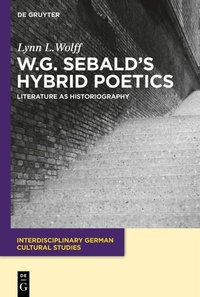
W.G. Sebald's Hybrid Poetics
Description

This book offers a new critical perspective on the perpetual problem of literature's relationship to reality and in particular on the sustained tension between literature and historiography. The scholarly and literary works of W.G. Sebald (1944-2001) serve as striking examples for this discussion, for the way in which they demonstrate the emergence of a new hybrid discourse of literature as historiography.
This book critically reconsiders the claims and aims of historiography by re-evaluating core questions of the literary discourse and by assessing the ethical imperative of literature in the 20th and 21st centuries. Guided by an inherently interdisciplinary framework, this book elucidates the interplay of epistemological, aesthetic, and ethical concerns that define Sebald's criticism and fiction. Appropriate to the way in which Sebald's works challenge us to rethink the boundaries between discourses, genres, disciplines, and media, this work proceeds in a methodologically non-dogmatic way, drawing on hermeneutics, semiotics, narratology, and discourse theory. In addition to contextualizing Sebald within postwar literature in German, the book is the first English-language study to consider Sebald's ouvre as a whole.
Of interest for Sebald experts and enthusiasts, literary scholars and historians concerned with the problematic of representing the past.
Reviews / Votes
"Wolff's book does not, however, simply challenge the interested reader to think about Sebald's literary work in a meta-representational way, it also shows the academic reader the advantages of familiarity with his critical work, the benefits of wrestling critically with - as opposed to just paraphrasing - the relevant secondary literature, the insights that come from the careful analysis of manuscript sources, and the creative understanding that derives from close reading, untrammelled by theoretical ideas for which Sebald had little or no time. Wolff has been publishing carefully researched, insightful and authoritative work on Sebald since 2007, but the originality and depth of her excellent new book will raise her into the top echelon of those younger scholars who have made Sebald's life and work one of their primary preoccupations." (Richard Sheppard, Journal of European Studies)More details
Other editions
Additional editions
Person
Content
- Intro
- Acknowledgments
- List of Abbreviations
- Introduction
- Why W.G. Sebald
- The Borders of World Literature: Sebald the Author and the Phenomenon
- International and Transdisciplinary Reception
- Scope and Method
- Chapter 1
- Literature as Historiography in Context
- Literature versus Historiography across the Ages
- Toward a Genealogy of a Present Past
- Literary Historiography: A Method of Interdiscursive Writing
- The Building Blocks of a Hybrid Form: Genre, Narration, Structure
- Overcoming the Obstacles in Representing the Past
- Chapter 2
- Conscious Historiography and the Writer's Conscience
- Writing on the Border between Literary Studies and Literature
- Literary Portraits as Self-Portrait: Logis in einem Landhaus
- From Polemic to Poetics: Luftkrieg und Literatur
- The Author's Role and the Reader's Engagement
- Chapter 3
- What is (in) an Image? Mimesis, Representability, and Visual History
- Art and Reality
- Representing the Holocaust and Photographs of Auschwitz
- Untangling Fact from Fiction: Sebald's Extratextual Materials
- Literature as Historiography and Visual History
- Coda
- Chapter 4
- Chronology and Coincidence in the Narrative Cosmos
- Outlining the Narrative Frame: From Flow to Tableau
- Plotting the Text: Simultaneity and Co-Presence of Past, Present, and Future
- Drawing Parallels: Narrative Dis/Conjuncture and Intratextual Cross-References
- Revealing Changes: Additions and Subtractions in the Austerlitz Manuscript
- Uncovering the Past: Restitution through Literary Archaeology
- Chapter 5
- Witness and Testimony in Literary Memory
- Post-Postmemory: Discourses, Concepts, and Modes of Memory
- Testimonial Structure: Making Sense of the Past by Making Meaning in the Present
- Memory's Attributes: Visuality, Physicality, Materiality, Uncertainty
- Memory's Opposites: Repression and the Crisis of Language
- Chapter 6
- Translation as Metaphor and Conservative Innovation
- Textual Translation
- Intermedial, Intratextual, and Intertextual Translation
- Metaphorical Tanslation
- Irony of/and Literary Innovation
- Translation as Context
- Conclusion
- Panoramic Outlook
- Bibliography of W.G. Sebald's Primary Works and of Works Cited
- I. Primary Sources
- II. Primary Texts of W.G. Sebald
- A. Fictional Prose and Poetry
- B. English Translations of Sebald's Works
- C. Works in Translation (cited in this book)
- D. Literary Criticism, Essays, Biographies, Translations
- III. Secondary Literature on W.G. Sebald (cited in this book)
- IV. W.G. Sebald-Related/-Inspired Films and Websites
- V. Related Primary and Secondary Literature
- Name Index
- Subject Index
