

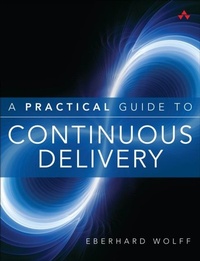
Practical Guide to Continuous Delivery, A
1st Edition
Published on 24. February 2017
288 pages
978-0-13-469154-1 (ISBN)
Description

Using Continuous Delivery, you can bring software into production more rapidly, with greater reliability. A Practical Guide to Continuous Delivery is a 100% practical guide to building Continuous Delivery pipelines that automate rollouts, improve reproducibility, and dramatically reduce risk.
Eberhard Wolff introduces a proven Continuous Delivery technology stack, including Docker, Chef, Vagrant, Jenkins, Graphite, the ELK stack, JBehave, and Gatling. He guides you through applying these technologies throughout build, continuous integration, load testing, acceptance testing, and monitoring. Wolff's start-to-finish example projects offer the basis for your own experimentation, pilot programs, and full-fledged deployments.
A Practical Guide to Continuous Delivery is for everyone who wants to introduce Continuous Delivery, with or without DevOps. For managers, it introduces core processes, requirements, benefits, and technical consequences. Developers, administrators, and architects will gain essential skills for implementing and managing pipelines, and for integrating Continuous Delivery smoothly into software architectures and IT organizations.
Understand the problems that Continuous Delivery solves, and how it solves them
Establish an infrastructure for maximum software automation
Leverage virtualization and Platform as a Service (PAAS) cloud solutions
Implement build automation and continuous integration with Gradle, Maven, and Jenkins
Perform static code reviews with SonarQube and repositories to store build artifacts
Establish automated GUI and textual acceptance testing with behavior-driven design
Ensure appropriate performance via capacity testing
Check new features and problems with exploratory testing
Minimize risk throughout automated production software rollouts
Gather and analyze metrics and logs with Elasticsearch, Logstash, Kibana (ELK), and Graphite
Manage the introduction of Continuous Delivery into your enterprise
Architect software to facilitate Continuous Delivery of new capabilities
Eberhard Wolff introduces a proven Continuous Delivery technology stack, including Docker, Chef, Vagrant, Jenkins, Graphite, the ELK stack, JBehave, and Gatling. He guides you through applying these technologies throughout build, continuous integration, load testing, acceptance testing, and monitoring. Wolff's start-to-finish example projects offer the basis for your own experimentation, pilot programs, and full-fledged deployments.
A Practical Guide to Continuous Delivery is for everyone who wants to introduce Continuous Delivery, with or without DevOps. For managers, it introduces core processes, requirements, benefits, and technical consequences. Developers, administrators, and architects will gain essential skills for implementing and managing pipelines, and for integrating Continuous Delivery smoothly into software architectures and IT organizations.
Understand the problems that Continuous Delivery solves, and how it solves them
Establish an infrastructure for maximum software automation
Leverage virtualization and Platform as a Service (PAAS) cloud solutions
Implement build automation and continuous integration with Gradle, Maven, and Jenkins
Perform static code reviews with SonarQube and repositories to store build artifacts
Establish automated GUI and textual acceptance testing with behavior-driven design
Ensure appropriate performance via capacity testing
Check new features and problems with exploratory testing
Minimize risk throughout automated production software rollouts
Gather and analyze metrics and logs with Elasticsearch, Logstash, Kibana (ELK), and Graphite
Manage the introduction of Continuous Delivery into your enterprise
Architect software to facilitate Continuous Delivery of new capabilities
All prices
More details
Edition
1. Auflage
Language
English
Place of publication
Boston
United States
Publishing group
Pearson Education (US)
Target group
Professional and scholarly
File size
2,04 MB
ISBN-13
978-0-13-469154-1 (9780134691541)
Copyright in bibliographic data and cover images is held by Nielsen Book Services Limited or by the publishers or by their respective licensors: all rights reserved.
Schweitzer Classification
Other editions
Additional editions
Eberhard Wolff
Practical Guide to Continuous Delivery, A
Book
03/2017
Addison Wesley
€40.50
Shipment within 15-20 days
Person
Eberhard Wolff, a Fellow at innoQ in Germany, has more than 15 years of experience as an architect and consultant working at the intersection of business and technology. He gives talks and keynote addresses at several international conferences, has served on multiple conference program committees, and has written more than 100 articles and books. His technological focus is on modern architectures-often involving cloud, continuous delivery, DevOps, microservices, and NoSQL. He is author of Microservices: Flexible Software Architecture.
Content
Part I: Foundations
Chapter 1: Continuous Delivery: What and How?
Chapter 2: Providing Infrastructure
Part II: The Continuous Delivery Pipeline
Chapter 3: Build Automation and Continuous Integration
Chapter 4: Acceptance Tests
Chapter 5: Capacity Tests
Chapter 6: Exploratory Testing
Chapter 7: Deploy-The Rollout in Production
Chapter 8: Operations
Part III: Management, Organization, and Architecture for Continuous Delivery
Chapter 9 Introducing Continuous Delivery into Your Enterprise
Chapter 10: Continuous Delivery and DevOps
Chapter 11: Continuous Delivery, DevOps, and Software Architecture
Chapter 12: Conclusion: What Are the Benefits?
Index
Chapter 1: Continuous Delivery: What and How?
Chapter 2: Providing Infrastructure
Part II: The Continuous Delivery Pipeline
Chapter 3: Build Automation and Continuous Integration
Chapter 4: Acceptance Tests
Chapter 5: Capacity Tests
Chapter 6: Exploratory Testing
Chapter 7: Deploy-The Rollout in Production
Chapter 8: Operations
Part III: Management, Organization, and Architecture for Continuous Delivery
Chapter 9 Introducing Continuous Delivery into Your Enterprise
Chapter 10: Continuous Delivery and DevOps
Chapter 11: Continuous Delivery, DevOps, and Software Architecture
Chapter 12: Conclusion: What Are the Benefits?
Index
