

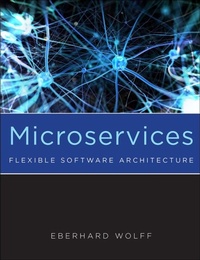
Microservices
Flexible Software Architecture
1st Edition
Published on 3. October 2016
368 pages
978-0-13-465040-1 (ISBN)
Description

The Most Complete, Practical, and Actionable Guide to Microservices
Going beyond mere theory and marketing hype, Eberhard Wolff presents all the knowledge you need to capture the full benefits of this emerging paradigm. He illuminates microservice concepts, architectures, and scenarios from a technology-neutral standpoint, and demonstrates how to implement them with today's leading technologies such as Docker, Java, Spring Boot, the Netflix stack, and Spring Cloud.
The author fully explains the benefits and tradeoffs associated with microservices, and guides you through the entire project lifecycle: development, testing, deployment, operations, and more. You'll find best practices for architecting microservice-based systems, individual microservices, and nanoservices, each illuminated with pragmatic examples. The author supplements opinions based on his experience with concise essays from other experts, enriching your understanding and illuminating areas where experts disagree. Readers are challenged to
experiment on their own the concepts explained in the book to gain hands-on experience.
Discover what microservices are, and how they differ from other forms of
modularization
Modernize legacy applications and efficiently build new systems
Drive more value from continuous delivery with microservices
Learn how microservices differ from SOA
Optimize the microservices project lifecycle
Plan, visualize, manage, and evolve architecture
Integrate and communicate among microservices
Apply advanced architectural techniques, including CQRS and Event Sourcing
Maximize resilience and stability
Operate and monitor microservices in production
Build a full implementation with Docker, Java, Spring Boot, the Netflix stack, and Spring Cloud
Explore nanoservices with Amazon Lambda, OSGi, Java EE, Vert.x, Erlang, and Seneca
Understand microservices' impact on teams, technical leaders, product owners, and stakeholders
Managers will discover better ways to support microservices, and learn how adopting the method affects the entire organization. Developers will master the technical skills and concepts they need to be effective. Architects will gain a deep understanding of key issues in creating or migrating toward microservices, and exactly what it will take to transform their plans into reality.
Going beyond mere theory and marketing hype, Eberhard Wolff presents all the knowledge you need to capture the full benefits of this emerging paradigm. He illuminates microservice concepts, architectures, and scenarios from a technology-neutral standpoint, and demonstrates how to implement them with today's leading technologies such as Docker, Java, Spring Boot, the Netflix stack, and Spring Cloud.
The author fully explains the benefits and tradeoffs associated with microservices, and guides you through the entire project lifecycle: development, testing, deployment, operations, and more. You'll find best practices for architecting microservice-based systems, individual microservices, and nanoservices, each illuminated with pragmatic examples. The author supplements opinions based on his experience with concise essays from other experts, enriching your understanding and illuminating areas where experts disagree. Readers are challenged to
experiment on their own the concepts explained in the book to gain hands-on experience.
Discover what microservices are, and how they differ from other forms of
modularization
Modernize legacy applications and efficiently build new systems
Drive more value from continuous delivery with microservices
Learn how microservices differ from SOA
Optimize the microservices project lifecycle
Plan, visualize, manage, and evolve architecture
Integrate and communicate among microservices
Apply advanced architectural techniques, including CQRS and Event Sourcing
Maximize resilience and stability
Operate and monitor microservices in production
Build a full implementation with Docker, Java, Spring Boot, the Netflix stack, and Spring Cloud
Explore nanoservices with Amazon Lambda, OSGi, Java EE, Vert.x, Erlang, and Seneca
Understand microservices' impact on teams, technical leaders, product owners, and stakeholders
Managers will discover better ways to support microservices, and learn how adopting the method affects the entire organization. Developers will master the technical skills and concepts they need to be effective. Architects will gain a deep understanding of key issues in creating or migrating toward microservices, and exactly what it will take to transform their plans into reality.
All prices
More details
Edition
1. Auflage
Language
English
Place of publication
Boston
United States
Publishing group
Pearson Education (US)
Target group
Professional and scholarly
File size
5,90 MB
ISBN-13
978-0-13-465040-1 (9780134650401)
Copyright in bibliographic data and cover images is held by Nielsen Book Services Limited or by the publishers or by their respective licensors: all rights reserved.
Schweitzer Classification
Other editions
Additional editions
Book
10/2016
Addison Wesley
€41.46
Shipment within 15-20 days
Person
Eberhard Wolff, a Fellow at innoQ in Germany, has more than 15 years of experience as an architect and consultant working at the intersection of business and technology. He has given talks and keynote addresses at several international conferences, served on multiple conference program committees, and written more than 100 articles and books. His technological focus is on modern architectures-often involving cloud, continuous delivery, DevOps, microservices, or NoSQL.
Content
1. Preface
Part I: Motivation and Basics
2. Introduction
3. Microservice Scenarios
Part II: Microservices: What, Why and Why Not?
4. What are Microservices?
5. Reasons for Microservices
6. Challenges
7. Microservices and SOA
Part III: Implementing Microservices
8. Architecture of Microservice based Systems
9. Integration and Communication
10. Architecture of Individual Microservices
11. Testing Microservices and Microservice-based Systems
12. Operations and Continuous Delivery of Microservices
13. Organizational Effects of a Microservices-based Architecture
Part IV: Technologies
14. Example for a Microservices-based Architecture
15. Technologies for Nanoservices
16. How to Start with Microservices
Part I: Motivation and Basics
2. Introduction
3. Microservice Scenarios
Part II: Microservices: What, Why and Why Not?
4. What are Microservices?
5. Reasons for Microservices
6. Challenges
7. Microservices and SOA
Part III: Implementing Microservices
8. Architecture of Microservice based Systems
9. Integration and Communication
10. Architecture of Individual Microservices
11. Testing Microservices and Microservice-based Systems
12. Operations and Continuous Delivery of Microservices
13. Organizational Effects of a Microservices-based Architecture
Part IV: Technologies
14. Example for a Microservices-based Architecture
15. Technologies for Nanoservices
16. How to Start with Microservices
