

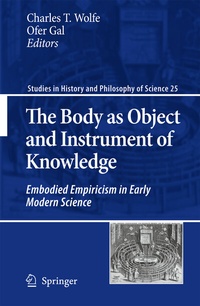
The Body as Object and Instrument of Knowledge
Description

It was in 1660s England, according to the received view, in the Royal Society of London, that science acquired the form of empirical enquiry we recognize as our own: an open, collaborative experimental practice, mediated by specially-designed instruments, supported by civil discourse, stressing accuracy and replicability. Guided by the philosophy of Francis Bacon, by Protestant ideas of this worldly benevolence, by gentlemanly codes of decorum and by a dominant interest in mechanics and the mechanical structure of the universe, the members of the Royal Society created a novel experimental practice that superseded former modes of empirical inquiry, from Aristotelian observations to alchemical experimentation.
This volume focuses on the development of empiricism as an interest in the body - as both the object of research and the subject of experience. Re-embodying empiricism shifts the focus of interest to the 'life sciences'; medicine, physiology, natural history. In fact, manyof the active members of the Royal Society were physicians, and a significant number of those, disciples of William Harvey and through him, inheritors of the empirical anatomy practices developed in Padua during the 16th century. Indeed, the primary research interests of the early Royal Society were concentrated on the body, human and animal, and its functions much more than on mechanics. Similarly, the Académie des Sciences directly contradicted its self-imposed mandate to investigate Nature in mechanistic fashion, devoting a significant portion of its Mémoires to questions concerning life, reproduction and monsters, consulting empirical botanists, apothecaries and chemists, and keeping closer to experience than to the Cartesian standards of well-founded knowledge.
These highlighted empirical studies of the body, were central in a workshop in the beginning of 2009 organized by the unit for History and Philosophy of Science in Sydney. The papers that were presented bysome of the leading figures in this area are presented in this volume.
Reviews / Votes
"The book's fifteen chapters offer fresh perspectives on Baconian science in which the body features a starring role, as both research object and medium of experience. . The Body as Object and Instrument of Knowledge represents an important interdisciplinary contribution to the history and philosophy of science. It will primarily appeal to historians and philosophers of the early modern life sciences with an interest in instruments, technology, and the cultural contexts of the body." (Margaret Carlyle, Annals of Science, Vol. 74 (4), October, 2017)
"The Body as Object and Instrument of Knowledge challenges traditional accounts of empiricism in the early modern period ... . for specialist audiences in the history of science ... . focus of the volume on the role of the body in the dialectic between subjective versus objective knowledge will provide welcome encouragement for further scholarly research ... . overall message of the importance of the embodied, lived experience for early modern debates about science is a welcome contribution to our field." (Ian Stewart, Isis, Vol. 103, No. 3, September, 2012)
"This collective volume . questions the role of the body 'as both an object of research and an instrument of experience' in the transformations of the life sciences from the late Renaissance to the early nineteenth century . . this volume, by opening many ways for exploring the transforming status of the body and its relationship with the rise of empiricism from the late Renaissance, is a very valuable tool for every scholar interested in . the history of the early modern science." (Stéphane Schmitt, Early Science and Medicine, Vol. 16, 2011)
"What the reader will extract from the text overall is an insightful and informative spectrum of medical and scientific practices (and to some extent their philosophical implications) throughout much of the early modern period. Wolfe and Gal have done a good job of bringing together a wide range of contributions emerging from various disciplines, resulting in a wonderful analysis of the practice - rather than the theory - of empiricism in early modern science." (Jordan Taylor, British Journal for the History of Philosophy, Vol. 19, No. 6, 2011)
"Three different major dimensions of the study of the body and the emergence of empiricism this is a collection, then, which makes us think anew about the origins of the methods and mentality of the scientific movement in its formative centuries. . this collection places the human body back squarely in our mapping of the development of early modern science."(John Gascoigne, Metascience, October, 2010)
More details
Other editions
Additional editions
Content
Charles T. Wolfe and Ofer Gal
Introduction
It was in 1660s England, according to the received view, in the meetings of the Royal Society of London, that science acquired the form of empirical enquiry that we recognize as our own: an open, collaborative experimental practice, mediated by specially-designed instruments, supported by civil, critical discourse, stressing accuracy and replicability.
Guided by the philosophy of Francis Bacon, by Protestant ideas of this-worldly benevolence, by gentlemanly codes of decorum and integrity and by a dominant interest in mechanics and a conviction in the mechanical structure of the universe, the members of the Royal Society created a novel experimental practice that superseded all former modes of empirical inquiry – from Aristotelian observations to alchemical experimentation. It is enlightening to consider that this view is imparted by both the gentlemen of the Royal Society, in their official self-presentations, and by much of the most iconoclastic historiography of our time.
Lines like “Boyle’s example … was mobilized to give legitimacy to the experimental philosophy,”1 are strongly reminiscent of Bishop Sprat’s 1667 eulogy of the “Lord Bacon in whose Books there are everywhere scattered the best arguments for the defence of experimental philosophy; and the best directions, needful to promote it.”2 One reason for the surprising agreement is that this picture of openness, benevolence and civility does capture some of the moral-epistemological mores of the empiricism of the New Science, but this very agreement of historians and apologists also harbors a paradox. In interpreting the emergence and modi operandi of early modern empiricism through the writings of its public champions, we are attending to the rhetoric which supported the new empirical practices – practices that aspired and promised to replace rhetoric.
This paradox in the way historians of science approached empiricism is compounded by a similar paradox in the way it is studied by historians of philosophy. Here, it was a theory that received the title ‘empiricism’ – a particular speculative account of the way human individuals acquire their knowledge of the surrounding world. It is yet more obvious in the modern interpretation of this theory, which is completely disinterested in empirical practices. This interpretation of empiricism put at its center an ahistorical, disembodied, isolated ‘mind’ – quite the opposite of what the savants of the New Science were experiencing or advocating.
Recent scholarship has done much to undo these paradoxes. We know much more about the array of practices of producing and marshalling experience that the New Science benefited from and was instrumental in developing: sophisticated experimentation, instrument-supported observation, astronomical navigation, surveying and mapping, collection and taxonomy. We are also much more familiar with the cultural context in which these were developed: commerce and seafaring, court and city, counter-reformation and education reform.
Yet we are still far from a comprehensive view of the arena in which practitioners of various empirical traditions were learning from and competing with those of other traditions for epistemological primacy; in which new empirical practices were being formed as reliable ways of creating and validating knowledge; and in which philosophical reflection and public argumentation sought to legitimize and institutionalize new and reformed empirical habits."
