

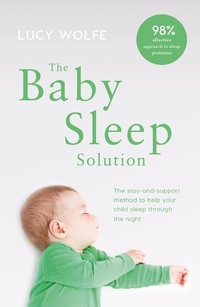
The Baby Sleep Solution
Description

Sleep: the Holy Grail for parents of babies and small children. The secret to helping babies to sleep through the night is understanding their sleep cycles and the feeding/sleeping balance. This book provides simple and effective techniques to help parents establish positive sleep habits and tackle sleep problems without feeling under pressure to resort to rigid, inflexible strategies.
Lucy Wolfe, the Sleep Fixer and Ireland's best-known sleep consultant, has developed a 'stay and support' approach with an emphasis on a child's emotional well-being, which has helped thousands of parents and babies around the world to achieve better sleep, with most parents reporting improvements within the first seven days of implementing the recommendations.
- Discover the issues that prevent a child from sleeping through the night.
- Learn about biological sleep rhythms and how feeding can affect them.
- Create a customised, step-by-step plan to get your baby to sleep.
- Use Lucy's unique two-fold sleep strategy which combines biological time keeping and gentle support to develop positive sleeping habits.
More details
Other editions
Additional editions
Person
Content
- Cover
- Title Page
- Contents
- Introduction
- Chapter 1 Why Your Child Won't Sleep
- Typical dependencies
- Biological timekeeping
- Understanding 'getting tired'
- Common sleep issues
- Routines
- Chapter 2 Getting Started
- When to start
- Get out and about
- Where do you want your child to sleep?
- Keeping a sleep log
- Chapter 3 Creating Positive Supports for Sleep
- Room acclimatisation
- Cot exercises
- The security item
- The dummy
- Connected play and one-to-one time
- The sleep environment
- Bedtime routine
- Chapter 4 Gentle Sleep-Shaping Approach: Birth to six months
- Safe sleep to reduce the risk of SIDS
- A flexible feeding and sleeping rhythm
- Learning to read your baby's sleep language
- Soothing strategies
- Where will baby sleep?
- A sleep-friendly environment
- Establishing a bedtime routine
- The percentage of wakefulness approach
- Some gentle natural solutions
- Reflux and intolerances
- Chapter 5 Stay-and-Support Sleep Learning Approach: Six months to two and a half years
- Who should start?
- How to begin
- The stay-and-support approach
- Chapter 6 The Older Child: Two and a half to six years
- How much sleep?
- Has your child stopped napping?
- Quiet time
- What is the right bedtime?
- Elements to consider
- Sleep strategies
- The anxious child
- The bedtime routine
- Chapter 7 Feeding and Sleeping Suggestions: Birth to six months
- Up to two months
- Two to four months
- Four to six months
- Chapter 8 Feeding and Sleeping Suggestions: Six months to six years
- Six to eight months
- Eight to twelve months
- Twelve to eighteen months
- Eighteen months to two and a half years
- Two and a half to six years
- Chapter 9 Developing the Daytime Routine
- Being informed
- Wake times
- Daytime sleep issues
- Bedtimes
- Daytime feeding and sleeping suggestions
- Starting the new routine
- Chapter 10 The Overnight Plan
- Nighttime feeds
- Weakening the feeding cycle
- Does your child still need a night feed?
- Chapter 11 Stages to Sleep
- Stage 1: Nights 1-4
- Stage 2: Nights 5-7
- Stage 3: Nights 8-10
- Stage 4: Nights 11-13
- Stage 5: Nights 14-16
- Stage 6: Nights 17 and onwards
- Typical outcomes
- Changing the approach - interval visits
- Early rising
- Road blocks
- Chapter 12 Landing the Nap
- Naps in a daycare setting
- Naps with a childminder
- Achieving the nap
- Nap troubleshooting
- Chapter 13 Sleep Management
- How do I manage travelling?
- What should I do when the clocks change?
- What about sleep regression and growth spurts?
- What about nightmares and night terrors?
- How do I make room-sharing work?
- What happens when I return to work?
- What about separation anxiety?
- What about teething?
- Are developmental milestones and sleep disturbances related?
- When to move from two naps to one?
- How to transition to the big bed?
- When good sleep turns bad!
- Acknowledgements
- Copyright
- About the Author
- About Gill Books
