

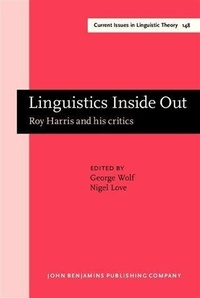
Linguistics Inside Out
Roy Harris and his critics
1st Edition
Published on 13. February 1997
XXVIII, 344 pages
978-90-272-7594-3 (ISBN)
Description

Roy Harris's thoroughgoing attack on the presuppositions underpinning the dominant traditions of Western thought about language, and his advocacy of a radically reconceived linguistics focused on the idea that the linguistic sign is contextually created and interpreted as a function of the meaningful integration of communicative behaviour, have made him one of the most controversial figures in the field today. In the essays in this volume Naomi S. Baron, Bob Borsley, Philip Carr, David Fleming, Rom Harré, Anthony Holiday, John E. Joseph, Frederick J. Newmeyer, David R. Olson, Trevor Pateman, John Sören Pettersson and John R. Taylor offer a critical examination of various aspects and implications of Harris's views, in reponse to which Harris contributes an article that both engages with his critics and develops some of the major themes of his work.
More details
Other editions
Additional editions
Book
02/1997
John Benjamins Publishing Co
€132.50
Shipment within 10-15 days
Persons
Content
- LINGUISTICS INSIDE OUT ROY HARRIS AND HIS CRITICS
- Editorial page
- Title page
- Copyright page
- Table of contents
- Dedication
- Preface
- Contributors
- Roy Harris: Publications 1956-1995
- Prologue
- 1 The "Language Myth" Myth: Or, Roy Harris's Red Herrings
- 1. Introduction: Idols of the market
- 2. Surrogationalism and nomenclaturism
- 3. Telementation
- 4. Conclusion: The "Key to All Mythologies
- 2 The Language Muddle: Roy Harris and Generative Grammar
- 1. The "language myth
- 2. Telementation
- 3. Fixed codes
- 4. The socio-historical roots of formal linguistics
- 5. Alphabetic literacy and linguistic theory
- 6. Generative grammar as a prescriptive enterprise
- 7.Harris's empiricism
- 8. Integrational linguistics
- 9. Concluding remarks
- 3 Telementation and Generative Linguistics
- 1. Introduction
- 2. The occult nature of the telementational thesis
- 3. The Minimalist Programme and problems with PF
- 3.1 The Minimalist Programme
- 3.2 Type, token and telementation in PF
- 3.3 Articulatory intentions, phonological "events" and PF as instructions
- 3.4 Production, generation, sentence and utterance
- 3.5 Phonological derivations, "externalisation" and "manifestation
- 4. Realism and "linguistic" behaviour in generative linguistics
- 4 Phonography: Setting a Term to the Evolution of Writing
- 5 A New Mentality
- 6 Science and Significance: Making Sense of Wittgenstein's Ways of Seeing
- 1.
- 2.
- 3.
- 4.
- 5.
- 7 Rules and Algorithms: Wittgenstein on Language
- A glimpse of biography
- Critique of the formalist tendency
- Descriptive and auxiliary formalisms
- The role of ontologies
- Tools and rules
- Boundaries and "agreements
- Wittgenstein and language cha
- Breaking with the Tractatus
- Nothing coerces us
- Rules and the interpretation of Wittgenstein
- Rides and practices
- Grounding skills
- The conduit metaphor
- Saying as expressing
- The last remnants of surrogationalism
- Is there an ur-language
- 8 Contextualizing "Context": From Malinowski to Machine Translation
- 1. Introduction
- 2. Malinowsk's "context of situation": new insight or bad science?
- 3. Meaning for whom? Linguists' "context" / users' "context
- Language Orienteering
- Language Users and Language Analysis
- 4. Users' meaning: the varying role of extralinguistic context
- Mode of Representation
- In-Group / Out-Group
- Domain of Communication
- Lexico-Grammatical Profile
- Body Parts
- Verbs of Motion
- Number
- Gender
- Grammatical Subjects
- 5. Culture, Context, and Machine Translation
- The Problem of Translation
- Computers and Translation
- Cultural Challenges to Machine Translation
- Politeness Indicators on Japanese Nouns: -san, o-, noun pairs
- Politeness Indicators on Japanese Verbs: Plain, Humble, Polite
- 6. Conclusions
- 9 Is Ethnomethodological Conversation Analysis an "Integrational" Account of Language?
- 1. Different approaches, a shared orientation
- Harrisian integrationism
- Ethnomethodological conversation analysis
- 2. Language from the user's point of view
- 3. Data and theory in the analysis of language
- 4. Structure and occasion in social action
- 5. Language and temporality
- 6. Conclusion: Towards an integrational rhetoric?
- 10 Linguistic Theory and the Multiple-Trace Model of Memory
- 1. Introduction
- 2. The multiple-trace model
- 3. Some problems
- 4. Language knowledge and the multiple-trace model
- 5. Cognitive grammar
- 6. The fixed-code fallacy
- 11 Language, Art and Kant
- 12 From An Integrational Point of View
- Introduction
- 1. The study of language
- 2. On linguistic theory
- 3. Far more and far less
- 4. The telementational model
- 5. Fixed codes
- 6. Making communicational sense
- 7. Language and metalanguage
- 8. Language, speech and writing
- 9. Verbal behaviour
- 10. Language, linguistics and science
- 11. Language and rules
- 12. Language, art and creativity
- 13. Context
- 14. Cotemporality
- 15. Towards an integrational linguistics
- Epilogue
- References
- Index
