

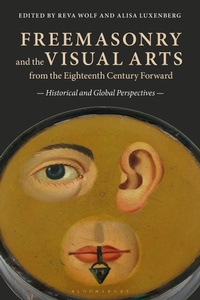
Freemasonry and the Visual Arts from the Eighteenth Century Forward
Historical and Global Perspectives
1st Edition
Published on 28. November 2019
304 pages
978-1-5013-3798-7 (ISBN)
Description

Choice Outstanding Academic Title for 2020
With the dramatic rise of Freemasonry in the eighteenth century, art played a fundamental role in its practice, rhetoric, and global dissemination, while Freemasonry, in turn, directly influenced developments in art. This mutually enhancing relationship has only recently begun to receive its due. The vilification of Masons, and their own secretive practices, have hampered critical study and interpretation. As perceptions change, and as masonic archives and institutions begin opening to the public, the time is ripe for a fresh consideration of the interconnections between Freemasonry and the visual arts. This volume offers diverse approaches, and explores the challenges inherent to the subject, through a series of eye-opening case studies that reveal new dimensions of well-known artists such as Francisco de Goya and John Singleton Copley, and important collectors and entrepreneurs, including Arturo Alfonso Schomburg and Baron Taylor. Individual essays take readers to various countries within Europe and to America, Iran, India, and Haiti. The kinds of art analyzed are remarkably wide-ranging-porcelain, architecture, posters, prints, photography, painting, sculpture, metalwork, and more-and offer a clear picture of the international scope of the relationships between Freemasonry and art and their significance for the history of modern social life, politics, and spiritual practices. In examining this topic broadly yet deeply, Freemasonry and the Visual Arts sets a standard for serious study of the subject and suggests new avenues of investigation in this fascinating emerging field.
With the dramatic rise of Freemasonry in the eighteenth century, art played a fundamental role in its practice, rhetoric, and global dissemination, while Freemasonry, in turn, directly influenced developments in art. This mutually enhancing relationship has only recently begun to receive its due. The vilification of Masons, and their own secretive practices, have hampered critical study and interpretation. As perceptions change, and as masonic archives and institutions begin opening to the public, the time is ripe for a fresh consideration of the interconnections between Freemasonry and the visual arts. This volume offers diverse approaches, and explores the challenges inherent to the subject, through a series of eye-opening case studies that reveal new dimensions of well-known artists such as Francisco de Goya and John Singleton Copley, and important collectors and entrepreneurs, including Arturo Alfonso Schomburg and Baron Taylor. Individual essays take readers to various countries within Europe and to America, Iran, India, and Haiti. The kinds of art analyzed are remarkably wide-ranging-porcelain, architecture, posters, prints, photography, painting, sculpture, metalwork, and more-and offer a clear picture of the international scope of the relationships between Freemasonry and art and their significance for the history of modern social life, politics, and spiritual practices. In examining this topic broadly yet deeply, Freemasonry and the Visual Arts sets a standard for serious study of the subject and suggests new avenues of investigation in this fascinating emerging field.
More details
Edition
1. Auflage
Language
English
Place of publication
London
United Kingdom
Publishing group
Bloomsbury Publishing PLC
Target group
Professional and scholarly
Illustrations
16 color and 106 bw illus
ISBN-13
978-1-5013-3798-7 (9781501337987)
Copyright in bibliographic data and cover images is held by Nielsen Book Services Limited or by the publishers or by their respective licensors: all rights reserved.
Schweitzer Classification
Other editions
Additional editions
Reva Wolf | Alisa Luxenberg
Freemasonry and the Visual Arts from the Eighteenth Century Forward
Historical and Global Perspectives
Book
09/2020
Bloomsbury Visual Arts
€36.50
Shipment within 15-20 days
Reva Wolf | Alisa Luxenberg
Freemasonry and the Visual Arts from the Eighteenth Century Forward
Historical and Global Perspectives
Book
11/2019
Bloomsbury Visual Arts
€178.50
Article exhausted; check different version
Persons
Reva Wolf is Professor of Art History, State University of New York at New Paltz, USA.
Alisa Luxenberg is Professor of Art History, University of Georgia, USA.
Alisa Luxenberg is Professor of Art History, University of Georgia, USA.
Content
Acknowledgments
List of illustrations
Introduction: The Mystery of Masonry Brought to Light
Reva Wolf and Alisa Luxenberg
1. Freemasonry in Eighteenth-Century Portugal and the Architectural Projects of the Marquis of Pombal
David Martín López
2. The Order of the Pug and Meissen Porcelain: Myth and History
Cordula Bischoff
3. Goya and Freemasonry: Travels, Letters, Friends
Reva Wolf
4. Freemasonry's "Living Stones" and the Boston Portraiture of John Singleton Copley
David Bjelajac
5. The Visual Arts of Freemasonry as Practiced "Within the Compass of Good Citizens" by Paul Revere
Nan Wolverton
6. Building Codes for Masonic Viewers in Baron Taylor's Voyages pittoresques et romantiques dans l'ancienne France
Alisa Luxenberg
7. Freemasonry and the Architecture of the Persian Revival, 1843-1933
Talinn Grigor
8. Solomon's Temple in America: Masonic Architecture, Biblical Imagery, and Popular Culture, 1865-1930
William D. Moore
9. Freemasonry and the Art Workers' Guild: The Arts Lodge No. 2751, 1899-1935
Martin Cherry
10. Picturing Black Freemasons from Emancipation to the 1990s
Cheryl Finley and Deborah Willis
11. Saint Jean Baptiste, Haitian Vodou, and the Masonic Imaginary
Katherine Smith
Selected Bibliography
Index
List of illustrations
Introduction: The Mystery of Masonry Brought to Light
Reva Wolf and Alisa Luxenberg
1. Freemasonry in Eighteenth-Century Portugal and the Architectural Projects of the Marquis of Pombal
David Martín López
2. The Order of the Pug and Meissen Porcelain: Myth and History
Cordula Bischoff
3. Goya and Freemasonry: Travels, Letters, Friends
Reva Wolf
4. Freemasonry's "Living Stones" and the Boston Portraiture of John Singleton Copley
David Bjelajac
5. The Visual Arts of Freemasonry as Practiced "Within the Compass of Good Citizens" by Paul Revere
Nan Wolverton
6. Building Codes for Masonic Viewers in Baron Taylor's Voyages pittoresques et romantiques dans l'ancienne France
Alisa Luxenberg
7. Freemasonry and the Architecture of the Persian Revival, 1843-1933
Talinn Grigor
8. Solomon's Temple in America: Masonic Architecture, Biblical Imagery, and Popular Culture, 1865-1930
William D. Moore
9. Freemasonry and the Art Workers' Guild: The Arts Lodge No. 2751, 1899-1935
Martin Cherry
10. Picturing Black Freemasons from Emancipation to the 1990s
Cheryl Finley and Deborah Willis
11. Saint Jean Baptiste, Haitian Vodou, and the Masonic Imaginary
Katherine Smith
Selected Bibliography
Index
