

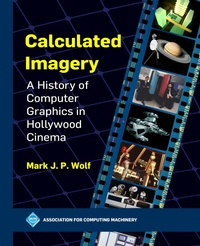
Calculated Imagery
A History of Computer Graphics in Hollywood Cinema
1st Edition
Published on 21. April 2025
1014 pages
979-8-4007-1268-5 (ISBN)
Description

This is a comprehensive history of computer graphics in Hollywood cinema. As the first such work of its kind, it is an essential reference for anyone interested in the history of cinema, visual effects, or computer graphics, and the industries of which they are a part.The book begins with a look at the history behind the calculation of images, from weaving to screen imaging, and the faux computer graphics used in movies before real computer graphics were available or affordable. Next, the author examines the rise of computer graphics and computer-animated films, and the gradual introduction of computer-generated imagery into the cinema. The narrative moves chronologically through the development of computer-generated animation and its use both for cartoonlike imagery and for photorealistic imagery. The author discusses behind-the-scenes uses of computer graphics in the film industry, and how these uses have impacted the kinds of imagery made and the technologies by which they are made. The book also looks at how computer animation is combined with approaches such as procedural generation and simulation, and the ways in which computers automate imagery.Throughout the book, the histories of individuals, companies, films, and computer graphics techniques are explored in detail, as well as changes in the visual effects (VFX) industry itself over time. Calculated Imagery: A History of Computer Graphics in Hollywood Cinema is for anyone interested in how CG changed the VFX industry, film history, and filmmaking overall, and the people, companies, and techniques that made it happen.
More details
Other editions
Additional editions
Book
04/2025
Association of Computing Machinery,U.S.
€179.10
Shipment within 10-20 days
Content
- Advance Praise for Calculated Imagery
- Calculated Imagery
- Contents
- List of Figures
- List of Acronyms
- Foreword by Gary Demos
- Acknowledgments
- Introduction
- Calculating Imagery
- Early Computer Output and Graphics
- The Spread of Computer-generated Imagery
- Photorealistic Imagery versus Photostylized Imagery
- 1 Simulating Computers and Computer Graphics
- 1.1 Screens On-screen
- 1.2 Computers On-screen
- 1.3 Simulating Computer Graphics
- 1.4 Faking Computer Graphics into the 1970s and 1980s
- 2 Computer Graphics as Diegetic Computer Graphics
- 2.1 Computer Graphics Introduced to the Public
- 2.2 Lissajous Figures, Vertigo, and John Whitney Sr.
- 2.3 Early Film Recorders
- 2.4 Vector versus Raster Graphics
- 2.5 Wireframe Imagery
- 2.6 Computer Animation Applications and Languages
- 2.7 Mathematical Visualization and Modeling
- 2.8 The Public Face of Computer Graphics in the 1960s
- 2.9 The Andromeda Strain . and the First Digital Film System?
- 2.10 The Key Frame Animation System
- 2.11 Computer Graphics' First Oscar Nominations
- 2.12 Alan Kitching and ANTICS
- 2.13 Westworld and Computer Vision
- 2.14 UFO Target Earth and Alien Revelation
- 2.15 The Scanimate System
- 2.16 HICAMP, HICAMPER, and Compufilms
- 2.17 The Frame Buffer
- 2.18 Smooth Shading: Gouraud, Phong, and More
- 2.19 Catmull and Parke Lend a Hand to Futureworld
- 2.20 The Z-buffer
- 2.21 Mapping, Fractals, and Other Innovations
- 2.22 The Film versus Video Debate
- 2.23 The Making of Star Wars
- 2.24 Logos and Title Sequences
- 2.25 The Computer Graphics Industry of the 1970s
- 2.26 Imagining Computer Graphics of the Future
- 3 Early Photostylized Computer Graphics
- 3.1 The Earliest Computer-generated Diegetic Objects
- 3.2 CG Spaceship Tests
- 3.3 Blinn's JPL Flyby Simulations and Other Projects
- 3.4 Developing Global Illumination
- 3.5 The NYIT Computer Graphics Lab
- 3.6 Lucasfilm's Computer Graphics Division
- 3.7 Scanned Images and Altered States
- 3.8 Scanned Humans and Looker
- 3.9 Rendering Nature
- 3.10 Fractals, Particle Systems, and the Genesis Sequence
- 3.11 The Making and Marketing of Tron
- 3.12 CGL's Work on The Works Continues
- 3.13 Music Videos
- 3.14 Computer Graphics and Traditional Animation
- 3.15 Creating Digital Scenes and Landscapes
- 3.16 Digital Compositing
- 3.17 Entering the Live-action Diegesis: The Last Starfighter and 2010
- 3.18 New Hardware and Software
- 3.19 Advances in Character Animation
- 3.20 Apollo Computer's Midnight Movie Group
- 3.21 Radiosity
- 3.22 The Computer Graphics Industry of the 1980s
- 3.23 The Start of Pixar
- 3.24 The DOA Fiasco
- 3.25 New Companies of the Late 1980s
- 4 Photostylized Computer Graphics as an Artistic Choice
- 4.1 Choosing Photostylization
- 4.2 Pixar's Short Films
- 4.3 The Late 1980s and Early 1990s
- 4.4 Refining and Combining Techniques
- 4.5 Photostylized Imagery for Film and Television
- 4.6 Early Computer-animated Television Shows
- 4.7 Digital Ink-and-Paint Systems
- 4.8 Disney's Computer Animation Production System
- 4.9 The Making of Toy Story
- 4.10 Computer Animation as a Mode of Production
- 4.11 The Early Years of All-CG Feature Films
- 4.12 Shorter-format Film and Video
- 4.13 Television Animation
- 4.14 The Computer-animated Feature Film Industry
- 5 Photorealistic Computer Graphics
- 5.1 Realism, Perceptual Realism, and Photorealism
- 5.2 Appearance, Behavior, and Context
- 5.3 Early Photorealistic Computer Graphics
- 5.4 Procedural Textures, Solid Textures, and Perlin Noise
- 5.5 The Knight and the Navigator
- 5.6 ILM's Computer Graphics Department
- 5.7 Invisible Effects
- 5.8 Morphing Effects
- 5.9 New Software: RenderMan and Photoshop
- 5.10 The Water Pseudopod and The Abyss
- 5.11 The Digital Effects Industry of the 1990s
- 5.12 Liquid Metal and Terminator 2
- 5.13 Skin, Bones, and Muscles
- 5.14 Cloth, Fur, and Hair
- 5.15 Character Animation Systems
- 5.16 Further Advances in Invisible Effects
- 5.17 Small-screen Science Fiction
- 5.18 Fluids, Fire, and Smoke
- 5.19 Herds, Crowds, and Armies
- 5.20 Simulating Eye and Camera
- 5.21 The Digital Effects Industry of the 21st Century
- 5.22 Photorealistic Environments
- 5.23 Simulations of Human Beings
- 6 Computer Graphics Behind the Scenes
- 6.1 Computer Usage Behind the Scenes
- 6.2 Digital Editing Systems
- 6.3 Pixel-pushing: Paint Programs and 2D Image Manipulation
- 6.4 Advances in Film Scanners and Recorders
- 6.5 Image Repair, Restoration, and Preservation
- 6.6 Digital Intermediates
- 6.7 Previsualization
- 6.8 Digital Puppeteering and Motion Capture
- 6.9 Motion Tracking, Matchmoving, and Optical Flow
- 6.10 Advanced Digital Compositing
- 6.11 Digital Cameras
- 6.12 Combining Digital and Virtual Cameras
- 6.13 Virtual Production
- 6.14 Digital Distribution and Projection
- 7 Computer Graphics as Automated Imagery
- 7.1 A Car Stunt Simulation
- 7.2 Early Forms of Simulation
- 7.3 Kinematic and Dynamic Methods
- 7.4 Procedural Generation
- 7.5 Complex Physics Simulations
- 7.6 Agents and Artificial Intelligence
- 7.7 The Future of Computer Graphics in Cinema
- Epilogue: The Cinematic Image as a Computer Graphic
- The Initial Resistance to Digital Imaging
- The Ontology of Computer-generated Imagery
- Author's Biography
- Index
