


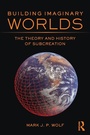
Building Imaginary Worlds
The Theory and History of Subcreation
1st Edition
Published on 14. March 2014
408 pages
978-1-136-22080-7 (ISBN)
Description

Mark J.P. Wolf's study of imaginary worlds theorizes world-building within and across media, including literature, comics, film, radio, television, board games, video games, the Internet, and more. Building Imaginary Worlds departs from prior approaches to imaginary worlds that focused mainly on narrative, medium, or genre, and instead considers imaginary worlds as dynamic entities in and of themselves. Wolf argues that imaginary worlds-which are often transnarrative, transmedial, and transauthorial in nature-are compelling objects of inquiry for Media Studies. Chapters touch on:
a theoretical analysis of how world-building extends beyond storytelling, the engagement of the audience, and the way worlds are conceptualized and experienced
a history of imaginary worlds that follows their development over three millennia from the fictional islands of Homer's Odyssey to the present
internarrative theory examining how narratives set in the same world can interact and relate to one another
an examination of transmedial growth and adaptation, and what happens when worlds make the jump between media
an analysis of the transauthorial nature of imaginary worlds, the resulting concentric circles of authorship, and related topics of canonicity, participatory worlds, and subcreation's relationship with divine Creation
Building Imaginary Worlds also provides the scholar of imaginary worlds with a glossary of terms and a detailed timeline that spans three millennia and more than 1,400 imaginary worlds, listing their names, creators, and the works in which they first appeared.
a theoretical analysis of how world-building extends beyond storytelling, the engagement of the audience, and the way worlds are conceptualized and experienced
a history of imaginary worlds that follows their development over three millennia from the fictional islands of Homer's Odyssey to the present
internarrative theory examining how narratives set in the same world can interact and relate to one another
an examination of transmedial growth and adaptation, and what happens when worlds make the jump between media
an analysis of the transauthorial nature of imaginary worlds, the resulting concentric circles of authorship, and related topics of canonicity, participatory worlds, and subcreation's relationship with divine Creation
Building Imaginary Worlds also provides the scholar of imaginary worlds with a glossary of terms and a detailed timeline that spans three millennia and more than 1,400 imaginary worlds, listing their names, creators, and the works in which they first appeared.
Reviews / Votes
"Building Imaginary Worlds is a stunning work of scholarship, encyclopedic in its scope, well-informed in its theory, and totally infectious in its enthusiasm for its topic. It will go down as the Bible of imaginary worlds." -Marie-Laure Ryan, author of Avatars of Story"Wolf shifts our focus from particular stories and media to the fantastical contexts we have created. Imaginary worlds express our deepest hopes, but we don't merely imagine these places. We try to live there, and in this choice lies tremendous social disruption." -Edward Castronova, author of Synthetic Worlds
More details
Language
English
Place of publication
London
United Kingdom
Publishing group
Taylor & Francis Ltd
Target group
College/higher education
Product notice
Reflowable
Illustrations
20 Halftones, black and white
File size
24,66 MB
ISBN-13
978-1-136-22080-7 (9781136220807)
Copyright in bibliographic data and cover images is held by Nielsen Book Services Limited or by the publishers or by their respective licensors: all rights reserved.
Schweitzer Classification
Other editions
Additional editions
Book
11/2012
1st Edition
Routledge
€80.80
Shipment within 15-20 days
Book
11/2012
1st Edition
Routledge
€263.30
Shipment within 15-20 days
Person
Mark J.P. Wolf is Professor of Communication at Concordia University Wisconsin. He is the author of Myst and Riven: The World of the D'ni, editor of the two-volume Encyclopedia of Video Games, and co-editor with Bernard Perron of The Video Game Theory Reader 1 and 2, among other books.
Content
Introduction 1. Worlds within the World 2. A History of Imaginary Worlds 3. World Structures and Systems of Relationships 4. More Than a Story: Narrative Threads and Narrative Fabric 5. Subcreation within Subcreated Worlds 6. Transmedial Growth and Adaptation 7. Circles of Authorship Glossary Appendix: Timeline of Imaginary Worlds
