

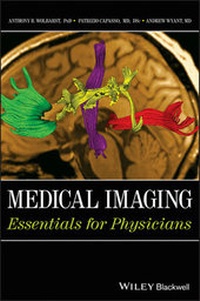
Medical Imaging
Description

More details
Other editions
Additional editions
Persons
Patrizio Capasso, MD, is Professor and Division Chief of Vascular & Interventional Radiology in the Departments of Diagnostic Radiology and Surgery at the University of Kentucky Chandler Medical Center Lexington, Kentucky, USA.
Andrew R. Wyant, MD, is Assistant Professor for Physician Assistant Studies at the University of Kentucky Chandler Medical Center Lexington, Kentucky, USA. Among many other courses that he teaches is a popular clinical skills seminar in in Radiographic Interpretation.
Content
Preface x
Acknowledgments xiii
Introduction: Dr. Doe's Headaches: An Imaging Case Study xiv
Computed tomography xiv
Picture archiving and communication system xv
T1, T2, and FLAIR MRI xvi
MR spectroscopy and a virtual biopsy xvii
Functional MRI xviii
Diffusion tensor MR imaging xviii
MR guided biopsy xx
Pathology xxi
Positron emission tomography? xxi
Treatment and follow-up xxii
1 Sketches of the Standard Imaging Modalities: Different Ways of Creating Visible Contrast Among Tissues 1
"Roentgen has surely gone crazy!" 2
Different imaging probes interact with different tissues in different ways and yield different kinds of medical information 4
Twentieth-century (analog) radiography and fluoroscopy: contrast from differential attenuation of X-rays by tissues 7
Twenty-first century (digital) images and digital planar imaging: computer-based images and solid-state image receptors 16
Computed tomography: three-dimensional mapping of X-ray attenuation by tissues 17
Nuclear medicine, including SPECT and PET: contrast from the differential uptake of a radiopharmaceutical by tissues 20
Diagnostic ultrasound: contrast from differences in tissue elasticity or density 26
Magnetic resonance imaging: mapping the spatial distribution of spin-relaxation times of hydrogen nuclei in tissue water and lipids 28
Appendix: selection of imaging modalities to assist in medical diagnosis 30
References 36
2 Image Quality and Dose: What Constitutes a "Good" Medical Image? 37
A brief history of magnetism 37
About those probes and their interactions with matter . . . 39
The image quality quartet: contrast, resolution, stochastic (random) noise, artifacts - and always dose 47
Quality assurance 57
Known medical benefits versus potential radiation risks 61
3 Creating Subject Contrast in the Primary X-ray Image: Projection Maps of the Body from Differential Attenuation of X-rays by Tissues 67
Creating a (nearly) uniform beam of penetrating X-rays 69
Interaction of X-ray and gamma-ray photons with tissues or an image receptor 75
What a body does to the beam: subject contrast in the pattern of X-rays emerging from the patient 83
What the beam does to a body: dose and risk 87
4 Twentieth-century (Analog) Radiography and Fluoroscopy: Capturing the X-ray Shadow with a Film Cassette or an Image Intensifier Tube plus Electronic Optical Camera Combination 91
Recording the X-ray pattern emerging from the patient with a screen-film image receptor 92
Prime determinants/measures of image quality: contrast, resolution, random noise, artifacts, . . . and, always, patient dose 98
Special requirements for mammography 114
Image intensifier-tube fluoroscopy: viewing in real time 122
Conclusion: bringing radiography and fluoroscopy into the twenty-first century with solid-state digital X-ray image receptors 125
Reference 126
5 Radiation Dose and Radiogenic Risk: Ionization-Induced Damage to DNA can cause Stochastic, Deterministic, and Teratogenic Health Effects - And How To Protect Against Them 127
Our exposure to ionizing radiation has doubled over the past few decades 127
Radiation health effects are caused by damage to DNA 129
Stochastic health effects: cancer may arise from mutations in a single cell 132
Deterministic health effects at high doses: radiation killing of a large number of tissue cells 139
The Four Quartets of radiation safety 146
References 151
6 Twenty-first Century (Digital) Imaging: Computer-Based Representation, Acquisition, Processing, Storage, Transmission, and Analysis of Images 152
Digital computers 153
Digital acquisition and representation of an image 157
Digital image processing: enhancing tissue contrast, SNR, edge sharpness, etc. 166
Computer networks: PACS, RIS, and the Internet 168
Image analysis and interpretation: computer-assisted detection 170
Computer and computer-network security 172
Liquid crystal displays and other digital displays 173
The joy of digital 174
7 Digital Planar Imaging: Replacing Film and Image Intensifiers with Solid State, Electronic Image Receptors 176
Digital planar imaging modalities 176
Indirect detection with a fluorescent screen and a CCD 178
Computed radiography 178
Digital radiography with an active matrix flat panel imager 179
Digital mammography 184
Digital fluoroscopy and digital subtraction angiography 186
Digital tomosynthesis: planar imaging in three dimensions 189
References 190
8 Computed Tomography: Superior Contrast in Three-Dimensional X-Ray Attenuation Maps 191
Computed tomography maps out X-ray attenuation in two and three dimensions 192
Image reconstruction 198
Seven generations of CT scanners 204
Technology and image quality 208
Patient- and machine-caused artifacts 219
Dose and QA 221
Appendix: mathematical basis of filtered back-projection 229
References 233
9 Nuclear Medicine: Contrast from Differential Uptake of a Radiopharmaceutical by Tissues 234
Unstable atomic nuclei: radioactivity 235
Radiopharmaceuticals: gamma- or positron-emitting radionuclei attached to organ-specific agents 245
Imaging radiopharmaceutical concentration with a gamma camera 248
Static and dynamic studies 254
Tomographic nuclear imaging: SPECT and PET 260
Quality assurance and radiation safety 270
References 273
10 Diagnostic Ultrasound: Contrast from Differences in Tissue Elasticity or Density Across Boundaries 274
Medical ultrasound 274
The US beam: MHz compressional waves in tissues 277
Production of an ultrasound beam and detection of echoes with a transducer 280
Piezoelectric transducer elements 281
Transmission and attenuation of the beam within a homogeneous material 285
Reflection of the beam at an interface between materials with different acoustic impedances 288
Imaging in 1 and 1 × 1 dimensions: A- and M-modes 291
Imaging in two, three, and four dimensions: B-mode 294
Doppler imaging of blood flow 300
Elastography 302
Safety and QA 303
11 MRI in One Dimension and with No Relaxation: A Gentle Introduction to a Challenging Subject 307
Prologue to MRI 308
"Quantum" approach to proton nuclear magnetic resonance 310
Magnetic resonance imaging in one dimension 316
"Classical" approach to NMR 321
Free induction decay imaging (but without the decay) 331
Spin-echo imaging (still without T1 or T2 relaxation) 338
MRI instrumentation 343
Reference 351
12 Mapping T1 and T2 Relaxation in Three Dimensions 352
Longitudinal spin relaxation and T1 353
Transverse spin relaxation and T2-w images 364
T2* and the gradient-echo (G-E) pulse sequence 372
Into two and three dimensions 374
MR imaging of fluid movement/motion 382
13 Evolving and Experimental Modalities 387
Optical and near-infrared imaging 388
Molecular imaging and nanotechnology 390
Thermography 392
Terahertz (T-ray) imaging of epithelial tissues 393
Microwave and electron spin resonance imaging 393
Electroencephalography, magnetocardiography, and impedance imaging 394
Photo-acoustic imaging 396
Computer technology: the constant revolution 397
Imaging with a crystal ball 399
References 399
Suggested Further Reading 400
Index 403
Preface
Recall how, after several years of college French, or Spanish, or Urdu, you ventured abroad and discovered that you could actually get by? You could order more or less what you wanted for dinner, you began to find your way around town. And when people asked you, slowly and clearly, where you were from and what you were doing there, you could both make out much of what they were saying and respond reasonably coherently. It might take you another year or so before you began sounding like a native, but you definitely could survive.
The objective of this book is to help and encourage you to acquire survival-level medical imaging. As such, it is designed to provide a technically solid, clear, largely non-mathematical understanding of the most significant ideas underlying the field, and yet be as short as possible (but no shorter). We include references to several much longer texts that provide reams of factual details, which are important for those who wish to go farther. The idea here, however, is to get you up and going, with a reasonable degree of competence and confidence, and to do so quickly.
Medical Imaging: Essentials for Physicians is a survival-level introduction to the extraordinary instruments and processes that create medical images, and to the ways in which radiologists, cardiologists, orthopedists, neurosurgeons, and most other physicians employ them to assist in resolving medical problems. While intended primarily for attending physicians, radiology and other residents, and medical students with limited direct familiarity with imaging, it should also be accessible to other senior medical professionals, and to biological and physical scientists as well.
This is not a textbook, nor is it written in a formal style. Hopefully you will find the manner to be relaxed and engaging, more or less like the way people speak. (We sometimes even split infinitives and end sentences with prepositions, if there's reason to.) But it is nonetheless a very serious and non-trivial book written for professionals who wish to acquire enough command of the imaging tools of their trade to be able to explain the general ideas accurately to students, nurses and technologists, to discuss them self-confidently with medical and technical colleagues and vendors, and to describe them effectively to concerned patients and loved ones. While there are no prerequisites, the read will be much more pleasurable if you happen to be the curious type. You will come to grasp a good deal about what and how imaging things happen, in any case, but it should be a more rewarding experience if you, like the authors, tend to frequently ask yourself why, as well. We like to explain things, not just describe them.
The reward for your perseverance will be a firm and technically rigorous qualitative understanding of the basic ideas of how computed tomography (CT), magnetic resonance imaging (MRI), digital subtraction angiography (DSA), and the other principal modalities really work – along with the strengths and risks of each, and the reasons that the knowledgeable physician finds one technology to be preferable to the others in a particular clinical situation. You will come to see the reasons that digital radiography (DR) and single photon emission computed tomography (SPECT) may be able to detect hairline bone fractures, say (although nuclear medicine is only rarely employed for that purpose), while ultrasound and fluoroscopy cannot. And why positron emission tomography (PET) is so adept at seeking out and searching out neoplasms, while few of the other modalities are.
You will also learn the essential role that quality assurance and safety programs play in determining that devices are delivering images with clinically optimal contrast and resolution, and at the same time with as little risk as possible from radiation or other hazards. Distressingly large numbers of physicians misread images and overdose patients with radiation, in part because they do not realize that their equipment is producing less than adequate pictures, or how to check on that routinely. Nor are they aware of just how great, or not, are the risks and benefits from routine screening mammograms, or from CT of a neonate – or that it may be possible to reduce the doses to kids considerably without compromising clinical efficacy.
In most situations, the issue of greatest importance in a diagnostic image is the visual contrast that allows the viewer to distinguish among and examine organs and other tissues, both normal and pathological. For X-ray technologies, including screen-film and digital radiography, digital subtraction angiography, and CT, contrast arises because X-ray probes collide with the atoms of different tissues in different ways and by different amounts; the shadows of bone emerge in a radiograph because that material is much more adept at absorbing and scattering away X-rays than are the surrounding soft tissues, so fewer of them make it through to expose the film or digital image receptor. There is contrast in nuclear medicine images, including SPECT and PET, because various radiopharmaceuticals concentrate preferentially in certain specific biological compartments, resulting in the differential emission of high-energy photons that can be detected and imaged from outside the body. High-frequency vibrational waves of ultrasound radiation reflect at boundaries between tissues that differ in density or elasticity, and processing the echoes can give rise to those cute pre-baby pictures of such extraordinary clarity and detail. And with MRI, in all its glory, one can generate contrast among tissues in multiple ways, based on differences in their proton density; the proton spin relaxation times T1 and T2; the flow of blood through vessels; the diffusion of water along the tracts of neural axons in the brain; the motion of relatively well-oxygenated blood to parts of the brain that require it; the list goes on.
These approaches give rise to contrast among the tissues in remarkably dissimilar ways. The resulting various kinds of contrast naturally accentuate different aspects of anatomy or physiology, and one of them may provide exceptionally valuable kinds of clinical information in a given medical situation. Much of the discussion herein will therefore focus on the ways in which the diverse methods of imaging exploit distinct biophysical processes to create contrast, on how the operator can draw it out and enhance it most effectively, on the relative risks, costs, and availability of the technologies, and ultimately on the medical reasons that a particular modality may be especially diagnostically useful in a given case.
The authorship of the book reflects its intent. The first draft was prepared by a medical physicist who has written a widely used text for radiology residents on imaging science and technology. It was then edited by a practicing interventional radiologist, who cut out some of the stuff unnecessary or uninteresting for most doctors; translated the rest into proper medicalese; and added a large number of cases to illustrate important points. Then an emergency-room physician with much experience but no special training in imaging went through it carefully to ensure the clarity of presentation and its intelligibility to non-radiologists, and to add further cases. Finally, each completed chapter on a modality was sent for review to radiologists, medical physicists, and other radiological specialists. As in the Acknowledgments section, the authors wish to express here again their great and sincere sense of indebtedness to these extremely busy professionals who took time out of their packed schedules to critique the chapters and to offer ideas for improvements.
A challenge to the authors has been, of course, to determine what topics to discuss, and in how much depth and breadth. We have attempted to cover enough to satisfy readers searching for a rapid, practical understanding of the whole field, yet also to whet the appetites of others to pursue more. Some will brush through the central topics quickly, just to pick up the main points, at least on the first pass, while others will wish to dig in a bit deeper. The presentation is therefore on two levels: the main story line appears in normal type, but paragraphs containing more detail or explanation than might be needed for a first encounter will be presented in this manner. We welcome suggestions from readers on what should be added in future editions of the book, or cut back or deleted, or changed, bearing in mind that we are making a conscious effort to keep it as short as possible while it can still do its job.
A comment on equations: in some places it clarifies ideas to express them in the language of elementary algebra. Nothing is more mathematically demanding in the text than linear equations (y = mx + b), or sine waves (sin x), or the occasional exponential (e− μx). The equations will serve to summarize and elucidate notions by re-phrasing them in another form, not to complicate them, and they are guaranteed not to cause tachycardia or severe gastric distress.
Another comment, about repetition: we use it, very intentionally so, because it is well known to aid in learning the central points in an extensive and sometimes challenging new subject. We feel that it will be helpful for many readers – but if you got the idea the first time around, please be patient if it comes up again. In any case, additional information is almost always added each time a topic is revisited – material that might have...
