

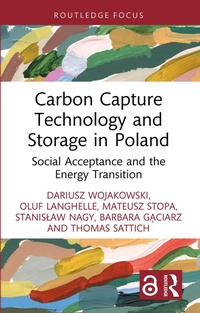
Carbon Capture Technology and Storage in Poland
Social Acceptance and the Energy Transition
Published on 9. July 2025
122 pages
978-1-040-40908-4 (ISBN)
Description

The book describes the results of the AGaStor Project's social research carried out in northwestern Poland which recognizes the main social opportunities and barriers to the introduction of CCUS to society.
At the national and regional level, the social barriers of CCUS acceptance are ignorance, uncertainty and the lack of public debate about this technology. On the local scale, social acceptance depends on the needs and fears of the local community. Some of those fears - distrust and perception of CO2 as a waste - could be recognized as universal dilemmas connected with CCUS. Although as knowledge about CCUS increases, a significant change in attitude can be observed. This change does not mean an acceptance of that technology. It is rather a shift towards more benign forms of resistance - from NIMBY to WIMBY. The book presents actual mechanisms of social reaction to UGS and CCUS investment, which will be a valuable contribution to managing social change in the context of green transition.
The issue of social acceptance of CCUS should be of interest to decision makers and practitioners who manage investment projects in the broadly understood green transformation on a daily basis, and also to postgraduate students, researchers, academics and lecturers in political studies, sociology or economics, and in engineering studies connected with energy transformation.
The Open Access version of this book, available at http://www.taylorfrancis.com, has been made available under a Creative Commons [Attribution-Non Commercial-No Derivatives (CC BY-NC-ND)] 4.0 license.
At the national and regional level, the social barriers of CCUS acceptance are ignorance, uncertainty and the lack of public debate about this technology. On the local scale, social acceptance depends on the needs and fears of the local community. Some of those fears - distrust and perception of CO2 as a waste - could be recognized as universal dilemmas connected with CCUS. Although as knowledge about CCUS increases, a significant change in attitude can be observed. This change does not mean an acceptance of that technology. It is rather a shift towards more benign forms of resistance - from NIMBY to WIMBY. The book presents actual mechanisms of social reaction to UGS and CCUS investment, which will be a valuable contribution to managing social change in the context of green transition.
The issue of social acceptance of CCUS should be of interest to decision makers and practitioners who manage investment projects in the broadly understood green transformation on a daily basis, and also to postgraduate students, researchers, academics and lecturers in political studies, sociology or economics, and in engineering studies connected with energy transformation.
The Open Access version of this book, available at http://www.taylorfrancis.com, has been made available under a Creative Commons [Attribution-Non Commercial-No Derivatives (CC BY-NC-ND)] 4.0 license.
More details
Series
Language
English
Place of publication
London
United Kingdom
Publishing group
Taylor & Francis Ltd
Target group
College/higher education
Professional and scholarly
Illustrations
18 Tables, black and white; 13 Line drawings, black and white; 1 Halftones, black and white; 14 Illustrations, black and white
File size
1,12 MB
ISBN-13
978-1-040-40908-4 (9781040409084)
Copyright in bibliographic data and cover images is held by Nielsen Book Services Limited or by the publishers or by their respective licensors: all rights reserved.
Schweitzer Classification
Other editions
Additional editions
Dariusz Wojakowski | Oluf Langhelle | Mateusz Stopa
Carbon Capture Technology and Storage in Poland
Social Acceptance and the Energy Transition
Book
07/2025
1st Edition
Routledge
€77.80
Shipment within 15-20 days
Persons
Dariusz Wojakowski is a sociologist, professor in the Department of Society and Technology Studies, and Vice-Dean for Cooperation and Students at the Faculty of Humanities of the AGH University of Krakow, Poland.
Oluf Langhelle is Professor in political science at the University of Stavanger, Department of Media and Social Sciences, Norway.
Mateusz Stopa, PhD, is a methodologist and project manager at SOLIDATA (research company, Poland).
Stanislaw Nagy is a professor at the Department of Gas Engineering, AGH University of Krakow, Poland.
Barbara Gaciarz is a professor at the AGH University of Krakow, Poland, and has a PhD in sociology and economics.
Thomas Sattich is Associate Professor at the Department of Media and Social Science, University of Stavanger, Norway.
Oluf Langhelle is Professor in political science at the University of Stavanger, Department of Media and Social Sciences, Norway.
Mateusz Stopa, PhD, is a methodologist and project manager at SOLIDATA (research company, Poland).
Stanislaw Nagy is a professor at the Department of Gas Engineering, AGH University of Krakow, Poland.
Barbara Gaciarz is a professor at the AGH University of Krakow, Poland, and has a PhD in sociology and economics.
Thomas Sattich is Associate Professor at the Department of Media and Social Science, University of Stavanger, Norway.
Content
Introduction: Idea of the Book
1 What Do We Think about Social Acceptance of New Energy Technologies?
2 CCUS Considering Global Climate Policy and the European Green Deal
3 Energy-safety Policy and the Civil Society in the Baltic Sea Region
4 Polish Public Discourse on CCUS: Analysis of the Official Documents and Media Discourse
5 West Pomeranian Province and Potential UGS Locations in North Poland
6 Uncertainty and Ignorance: The Regional Awareness of CCUS in Survey Research
7 Benefits, Risks and Protest: Local Knowledge and New Energy Technologies
8 Communication and Change: Analysis of the CCUS Promotion Meetings
Conclusions
1 What Do We Think about Social Acceptance of New Energy Technologies?
2 CCUS Considering Global Climate Policy and the European Green Deal
3 Energy-safety Policy and the Civil Society in the Baltic Sea Region
4 Polish Public Discourse on CCUS: Analysis of the Official Documents and Media Discourse
5 West Pomeranian Province and Potential UGS Locations in North Poland
6 Uncertainty and Ignorance: The Regional Awareness of CCUS in Survey Research
7 Benefits, Risks and Protest: Local Knowledge and New Energy Technologies
8 Communication and Change: Analysis of the CCUS Promotion Meetings
Conclusions
