

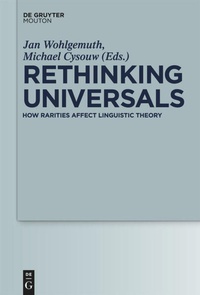
Rethinking Universals
Description

Universals of language have been studied extensively for the last four decades, allowing fundamental insight into the principles and general properties of human language. Only incidentally have researchers looked at the other end of the scale. And even when they did, they mostly just noted peculiar facts as ''quirks'' or ''unusual behavior'', without making too much of an effort at explaining them beyond calling them ''exceptions'' to various rules or generalizations.
Rarissima and rara, features and properties found only in one or very few languages, tell us as much about the capacities and limits of human language(s) as do universals. Explaining the existence of such rare phenomena on the one hand, and the fact of their rareness or uniqueness on the other, is a reasonable and interesting challenge to any theory of how human language works.
The present volume for the first time compiles selected papers on the study of rare linguistic features from various fields of linguistics and from a wide range of languages.
More details
Other editions
Additional editions
Persons
Content
2 - Contents [Seite 7]
3 - The other end of universals: theory and typology of rara [Seite 11]
4 - Rarities in numeral systems [Seite 21]
5 - Additional rarities in the typology of numerals [Seite 71]
6 - Explaining typologically unusual structures: the role of probability [Seite 101]
7 - Right at the left edge: initial consonant mutations in the languages of the world [Seite 115]
8 - "Quirky" case: rare phenomena in case-marking and their implications for a theory of typological distributions [Seite 149]
9 - Negatives without negators [Seite 179]
10 - Accounting for rare typological features in formal syntax: three strategies and some general remarks [Seite 205]
11 - Rara and grammatical theory [Seite 233]
12 - Pairwise comparisons of typological profiles [Seite 251]
13 - Language endangerment, community size and typological rarity [Seite 265]
14 - Index [Seite 289]
