

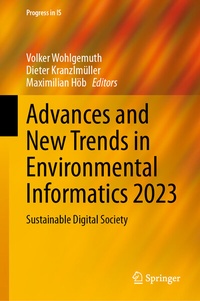
Advances and New Trends in Environmental Informatics 2023
Description

This book is an outcome of the 37th International Conference EnviroInfo 2023, held at the Leibniz Supercomputing Centre (Munich, Germany), organized by the technical committee for Environmental Informatics of the German Informatics Society. It explores the fusion of information and communication technologies with environmental sustainability. As a flagship edition of the EnviroInfo conference series, it showcases the latest advancements in applied informatics and environmental informatics.
With a focus on "Towards a Sustainable Digital Society," the conference presents innovative research on topics such as green computing, sustainable software engineering, and digital transformation. The proceedings cover essential subjects for shaping a greener future, including energy-efficient workloads, environmental management systems, legal frameworks, Earth observation, and geographical information systems. It also examines emerging technologies like robotics, AI, and reinforcement learning, highlighting their applications in environmental informatics.
From citizen science to disaster risk modeling and sustainable resource management, the book explores the interdisciplinary nature of environmental informatics. It also addresses societal aspects, including its role in developing countries. This resource is essential for researchers, professionals, and policymakers seeking to leverage ICT for addressing environmental challenges and building a sustainable digital society.
More details
Other editions
Additional editions
Persons
Volker Wohlgemuth is a full professor of Industrial Environmental Informatics at the School of Engineering - Technology and Life, HTW Berlin, University of Applied Sciences. His research fields are material flow management, modelling and simulation, green coding, and environmental management information systems. Dr. Wohlgemuth is chairman of the technical committee on Environmental Informatics of the German Informatics Society (GI e.V.) and has authored around 200 peer-reviewed articles and papers.
Dieter Kranzlmüller is a full professor at Ludwig-Maximilians-Universität München and Chairman of the Board of Directors of the Leibniz Supercomputing Centre. His scientific focus lies in e-infrastructures, including network management, grid and cloud computing, and high-performance computing. He is an international expert and has co-authored more than 300 scientific papers.
Maximilian Höb is a scientist at the Leibniz Supercomputing Centre of the Bavarian Academyof Sciences and Humanities and a lecturer at Ludwig-Maximilians-University Munich. In his research, he focuses on the analysis of containerized high-performance computing applications and their performance characteristics regarding resource usage and energy efficiency, including exascale-ready and data-centric containerized infrastructures.