

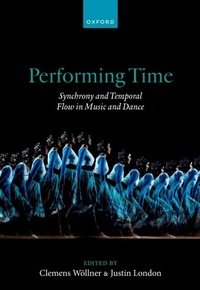
Performing Time
Synchrony and Temporal Flow in Music and Dance
1st Edition
Published on 20. June 2023
400 pages
978-0-19-265003-0 (ISBN)
Description

Music and dance can change our sense of time. Both rely on synchronizing our attention and actions with sounds and with other people, both involve memory and expectation, and both can give rise to experiences of flow and pleasure.
Performing Time explores our experience of time in dance and music, from the perspectives of performers and audiences, and informed by the most recent research in dance science, musicology, neuroscience, and psychology. It includes discussions of tempo and pacing, coordination and synchrony, the performer's experience of time, audiences' temporal expectations, the effect of extreme slowness, and our individual versus collective senses of time. At its core, the book addresses how time and temporality in music and dance relate to current psychological and neuroscientific theories as well as to the aesthetic aims of composers, choreographers and performers.
Bringing together new research on rhythm, time and temporality in both music and dance in one volume, the book contains overview chapters on the state of the art from leading researchers on topics ranging from the psychology, neuroscience, and philosophy of musical time to embodied timing in dance. In addition, numerous case studies regarding our temporal experience of music and dance are provided in shorter focus chapters, with their implications for further scientific study and artistic enquiry.
Performing Time is an invaluable and comprehensive resource for students, researchers, educators, and artists alike, and for any reader interested in how the performing arts construct and play with time in our minds and bodies.
Some chapters in this title are open access and available under the terms of a [CC BY-NC-ND 4.0 International] licence.
More details
Other editions
Additional editions
Book
07/2023
Oxford University Press
€64.00
Shipment within 15-20 days
Persons
Clemens Wöllner is Professor of Systematic Musicology at the University of Music, Freiburg, Germany. He has published widely on timing in perception and performance, expressiveness, attention and movement in music and beyond. His long-term research project "Slow Motion: Transformation of Musical Time in Perception and Performance" has been awarded a grant from the European Union. He is President of the German Society for Music Psychology, and serves in the boards of leading journals in the field.
Justin London is the Andrew W. Mellon Professor of Music, Cognitive Science, and the Humanities at Carleton College (USA). He received his Ph.D. from the University of Pennsylvania where he worked with Leonard Meyer. His research interests include rhythm and timing in non-western music, beat and tempo perception, sensorimotor synchronization and joint action, and musical aesthetics. He has served as President of the Society for Music Theory (2007-2009) and President of the Society for Music Perception and Cognition (2016-2018).
Content
- 0: Wöllner and London: Introduction to Performing Time
- 1 Foundations: The Flow of Time in Music and Dance
- 1: Bettina Bläsing: Time experiences in dance
- 2: Mariusz Kozak: Varieties of musical temporality
- 3: Keith Doelling, Sophie Herbst, Luc Arnal and Virginie van Wassenhove: Psychological and neuroscientific foundations of rhythms and timing
- 4: Sylvie Droit-Volet and Natalia Martinelli: The psychological underpinnings of feelings of the passage of time
- 2 Duration, Tempo and Pacing in Performance and Perception
- 5: Justin London: What is musical tempo?
- 6: Renee Conroy: Telling time: Dancers, dancemakers, and audience members
- 7: Molly Henry and Sonja Kotz: Preferred tempo and its relation to personal sense of time and temporal flow
- 8: Coline Joufflineau: Time through the magnifying glass of slowness: a case study in Myriam Gourfink's choreography
- 9: Alexander Jensenius: Standing still together: Reflections on a one-year-long exploration of human micromotion
- 10: David Hammerschmidt: Spontaneous motor tempo: A window into the inner sense of time
- 11: Mari Romarheim Haugen: An embodied perspective on rhythm in music-dance genres
- 3 Synchrony: Keeping Together in Time
- 12: Guy Madison: Moving together in music and dance - features of entrainment and sensorimotor synchronisation
- 13: Werner Goebl and Laura Bishop: Joint shaping of musical time: How togetherness emerges in music ensemble performance
- 14: Julien Laroche, Tommi Himberg and Asaf Bachrach: Making time together: An exploration of participatory time-making through collective dance improvisation
- 15: Birgitta Burger and Petri Toiviainen: Time and synchronisation in dance movement
- 16: Simone Dalla Bella: Unravelling individual differences in synchronizing to the beat of music
- 17: Anne Danielsen: Shaping the beat bin in computer-based grooves
- 18: Matthew H. Woolhouse: The 'synchrony effect' in dance: how rhythmic scaffolding and vision facilitate social cohesion
- 4 Performance Time Experienced: Attention, Expectation and Groove
- 19: Clemens Wöllner: Changes in psychological time when attending to different temporal structures in music
- 20: Pieter-Jan Maes and Marc Leman: Expressive timing in music and dance interactions: a dynamic perspective
- 21: Psyche Loui: Temporal aspects of musical expectancy and creativity in improvisation: A review of recent neuroscientific studies and an updated model
- 22: Anna Pakes: Experiences of time in boring dance
- 23: Jason Noble, Tanor Bonin, Roger Dean and Stephen McAdams: Evaluating the psychological reality of alternate temporalities in contemporary music: Empirical case studies of Gérard Grisey's Vortex Temporum
- 24: Kristina Knowles and Richard Ashley: Measuring experienced time while listening to music
- 25: Jan Stupacher, Michael Hove and Peter Vuust: The experience of musical groove: body movement, pleasure, and social bonding
- 5 Conclusions: Capturing Time in Performance and Science
- 26: Marc Wittmann: Embodied time: what the psychology and neuroscience of time can learn from the performing arts
- 27: Russell Hartenberger: Learning to feel the time: Reflections of a percussionist
- 28: Henry Daniel, Justin London: Performing and feeling time in contemporary dance
- 29: Kent Nagano, Clemens Wöllner: Music is a unique artform because of the temporal aspect
- 30: Stewart Copeland and Daniel Levitin: Timing, tempo and rhythm: Evidence from the laboratory and the concert stage
