

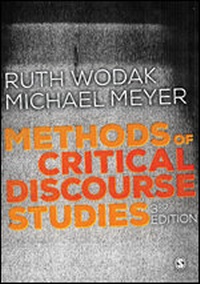
Methods of Critical Discourse Studies
3rd Edition
Published on 15. October 2015
272 pages
978-1-4739-3425-2 (ISBN)
Description

This is a sophisticated and nuanced introduction to critical discourse analysis (CDA) that covers a range of topics in an accessible, engaging style. With international examples and an interdisciplinary approach, readers gain a rich understanding of the many angles into critical discourse analysis, the fundamentals of how analysis works and examples from written texts, online data and images.
This new edition:
expands coverage of multimodality
adds two new chapters on social media and analysis of online data
supports learning with a guided introduction to each chapter
includes a new and extended glossary
Clearly written, practical and rigorous in its approach, this book is the ideal companion when embarking on research that focuses on discourse and meaning-making.
This new edition:
expands coverage of multimodality
adds two new chapters on social media and analysis of online data
supports learning with a guided introduction to each chapter
includes a new and extended glossary
Clearly written, practical and rigorous in its approach, this book is the ideal companion when embarking on research that focuses on discourse and meaning-making.
Reviews / Votes
This volume offers the most thorough introduction to current methods and areas of application of critical discourse analysis, collecting and representing the work of the leading scholars in the field. This book is a must and an invaluable resource for scholars and students interested in the nexus between discourse, power and society. -- Anna De Fina This is the best overview of CDS I know. Revised, updated with new topics such as social media, and easier to read. This book is a must for all students of discourse studies. -- Jan Renkema A classic collection on critical discourse analysis. Bringing together seminal pieces by the leading figures of the field and innovative contributions by younger scholars, this updated and enhanced edition constitutes both an important scholarly achievement and a most valuable teaching resource. -- Lilie Chouliaraki The book is undoubtedlyan essential read and a valuable sourcebook for scholars and students interested in the
interplay among discourse, ideology and power. -- Yuting Lin
More details
Series
Edition
Third Edition
Language
English
Place of publication
London
United Kingdom
Target group
College/higher education
ISBN-13
978-1-4739-3425-2 (9781473934252)
Copyright in bibliographic data and cover images is held by Nielsen Book Services Limited or by the publishers or by their respective licensors: all rights reserved.
Schweitzer Classification
Other editions
Additional editions
Ruth Wodak | Michael Meyer
Methods of Critical Discourse Studies
Book
10/2015
3rd Edition
SAGE Publications Ltd
€164.40
Shipment within 15-20 days
Ruth Wodak | Michael Meyer
Methods of Critical Discourse Studies
Book
10/2015
3rd Edition
SAGE Publications Ltd
€87.70
Shipment within 15-20 days
Persons
Ruth Wodak is Distinguished Professor of Discourse Studies at Lancaster University. Her research interests focus on discourse studies; identity politics; racism, antisemitism and other forms of discrimination; and on ethnographic methods of linguistic field work.
She was awarded the Lebenswerk-Preis in 2018, which honors outstanding life work of personalities who are promoting and achieving gender equality.
She was awarded the Wittgenstein Prize for Elite Researchers in 1996 and an Honorary Doctorate from University of OErebro in Sweden in 2010. She has held visiting professorships in University of Uppsala, Stanford University, University Minnesota, University of East Anglia, and Georgetown University (Washington, DC). She is a member of the British Academy of Social Sciences and a member of the Academia Europaea. In 2008, she was awarded the Kerstin Hesselgren Chair of the Swedish Parliament (at University OErebroe).
Ruth is co-editor of the SAGE journal Discourse & Society, and of the journals Critical Discourse Studies and Journal of Language and Politics. Recent book publications include: The discourse of politics in action: 'Politics as Usual' (2011), Critical Discourse Analysis (4 volumes, 2013), Migration, Identity and Belonging (with G. Delanty and P. Jones, 2011), The Discursive Construction of History: Remembering the German Wehrmacht's War of Annihilation (with H. Heer, W. Manoschek, and A. Pollak, 2008), The Politics of Exclusion: Debating Migration in Austria (with M. Krzyzanowski, 2009), The SAGE Handbook of Sociolinguistics (with B. Johnstone and P. Kerswill, 2010), Analyzing Fascist Discourse: Fascism in Talk and Text (with J. E. Richardson, 2013), and Rightwing Populism in Europe: Politics and Discourse (with M. KhosraviNik and B. Mral, 2013).
Michael Meyer is Professor for Business Administration at Vienna University of Economics and Business.
She was awarded the Lebenswerk-Preis in 2018, which honors outstanding life work of personalities who are promoting and achieving gender equality.
She was awarded the Wittgenstein Prize for Elite Researchers in 1996 and an Honorary Doctorate from University of OErebro in Sweden in 2010. She has held visiting professorships in University of Uppsala, Stanford University, University Minnesota, University of East Anglia, and Georgetown University (Washington, DC). She is a member of the British Academy of Social Sciences and a member of the Academia Europaea. In 2008, she was awarded the Kerstin Hesselgren Chair of the Swedish Parliament (at University OErebroe).
Ruth is co-editor of the SAGE journal Discourse & Society, and of the journals Critical Discourse Studies and Journal of Language and Politics. Recent book publications include: The discourse of politics in action: 'Politics as Usual' (2011), Critical Discourse Analysis (4 volumes, 2013), Migration, Identity and Belonging (with G. Delanty and P. Jones, 2011), The Discursive Construction of History: Remembering the German Wehrmacht's War of Annihilation (with H. Heer, W. Manoschek, and A. Pollak, 2008), The Politics of Exclusion: Debating Migration in Austria (with M. Krzyzanowski, 2009), The SAGE Handbook of Sociolinguistics (with B. Johnstone and P. Kerswill, 2010), Analyzing Fascist Discourse: Fascism in Talk and Text (with J. E. Richardson, 2013), and Rightwing Populism in Europe: Politics and Discourse (with M. KhosraviNik and B. Mral, 2013).
Michael Meyer is Professor for Business Administration at Vienna University of Economics and Business.
Content
Chapter 1: Critical Discourse Studies: History, Agenda, Theory, and Methodology - Ruth Wodak & Michael Meyer
Chapter 2: The Discourse-Historical Approach (DHA) - Martin Reisigl and Ruth Wodak
Chapter 3: Critical Discourse Studies: A Sociocognitive Approach - Teun A. van Dijk
Chapter 4: A dialectical-relation approach to critical discourse analysis in social research - Norman Fairclough
Chapter 5: Analysing discourses and dispositives: a Foucauldian approach to theory and methodology - Siegfried Jaeger and Florentine Maier
Chapter 6: Discourse as the recontextualization of social practice - a guide - Theo van Leeuwen
Chapter 7: Checks and balances: how corpus linguistics can contribute to CDA - Gerlinde Mautner
Chapter 8: Critical Analysis of Visual and Multimodal Texts - Dennis Jancsary, Markus A. Hoellerer, Renate E. Meyer
Chapter 9: Critical discourse studies and social media: power, resistance and critique in changing media ecologies - Majid KhosraviNik and Johann W. Unger
Chapter 2: The Discourse-Historical Approach (DHA) - Martin Reisigl and Ruth Wodak
Chapter 3: Critical Discourse Studies: A Sociocognitive Approach - Teun A. van Dijk
Chapter 4: A dialectical-relation approach to critical discourse analysis in social research - Norman Fairclough
Chapter 5: Analysing discourses and dispositives: a Foucauldian approach to theory and methodology - Siegfried Jaeger and Florentine Maier
Chapter 6: Discourse as the recontextualization of social practice - a guide - Theo van Leeuwen
Chapter 7: Checks and balances: how corpus linguistics can contribute to CDA - Gerlinde Mautner
Chapter 8: Critical Analysis of Visual and Multimodal Texts - Dennis Jancsary, Markus A. Hoellerer, Renate E. Meyer
Chapter 9: Critical discourse studies and social media: power, resistance and critique in changing media ecologies - Majid KhosraviNik and Johann W. Unger
