

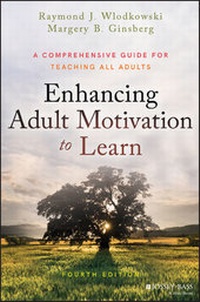
Enhancing Adult Motivation to Learn
Description

More details
Other editions
Additional editions
Persons
Content
Preface
Teachers want to know how people are motivated to learn. Having the knowledge to apply this understanding is monumental. The fourth edition of Enhancing Adult Motivation to Learn offers this potential.
We've studied motivation to learn among adults for more than thirty years. Within this time the essentials of motivating teaching and learning have been discovered, researched, applied, and refined. We've gathered these essential conditions and placed them in the Motivational Framework for Culturally Responsive Teaching. The four motivational conditions are establishing inclusion, developing a positive attitude, enhancing meaning, and engendering competence. Making these conditions a living presence in a learning environment is not an easy accomplishment, but it is more possible than ever and foundational to educational equity. We've done it ourselves and have watched others do likewise. After three decades, we're confident that for learners of all cultural, ethnic, and linguistic backgrounds, a motivational approach to instructional design is essential for academic success.
GUIDING PRINCIPLES
The principles that have guided this work are as follows:
- Motivation and learning are inseparable-attention, interest, and inspiration are emotional points along a continuum of learning, part and parcel of the process itself.
- Learning and culture are inseparable-perception, emotional response, and meaning are formed and inhabited by our family, peers, and social and ideological histories.
- Intrinsic motivation, finding the act of learning rewarding itself, is possible for everyone-in all subject areas as long as inclusion, volition, and relevance are respected as competence grows.
- A neurobiological understanding of motivation to learn is extremely promising-the means and evidence of this understanding are largely confirmatory of excellent teaching and learning at this time.
- Online learning and teaching are evolving rapidly and creatively as technical intelligence advances-its essentials parallel the conditions of the motivational framework.
- Motivation is a value-based concept-our goal is to enhance its understanding and capacity for equitable learning. This includes access, completion, graduation, and securing a predictable income that provides a living wage for oneself and one's family. It also includes satisfying engagement in learning across one's life span.
We have used multiple sources of scholarship to understand adult motivation to learn, including the social and biological sciences; ethnic, linguistic, and gender studies; arts and literature; philosophy; and personal experience. Our accumulated knowledge leads to this conclusion: All adults want to make sense of their world, to find meaning, and to be effective at what they value-this is what fuels their motivation to learn. The key to effective instruction is to evoke and encourage the natural inclination in all adults, whatever their cultural background or identity, to be competent in matters they deem important.
This book is a practical and immediately usable resource for instructors, faculty, trainers, educators, professional learning specialists, administrators, and community activists whose primary task is teaching adults in universities and community colleges, in professional and industrial settings, and in local and national organizations. At its center is the Motivational Framework for Culturally Responsive teaching, an internationally acclaimed model that scholars and practicing educators have researched and applied for more than two decades.
Although the number of books about teaching adults continues to grow, this is the only book that focuses on motivation as a constant positive influence during learning. It explains and exemplifies how to teach in ways that make the enhancement of intrinsic motivation an essential part of adult learning-in essence how to think motivationally as an instructor. Four chapters describe in detail sixty tested strategies to elicit and sustain learner motivation in any learning context. Readers can choose the strategies that best apply to their content and learning situation with confidence that the framework will consistently guide them toward productive outcomes for a range of learners.
From Seattle to Singapore, the ideas in this book have been applied, assessed, and revised through iterations that keep the framework productive and up-to-date. Through research, correspondence, on-site visits, students, colleagues, and our own teaching, we have learned the motivational framework's limitations and advantages. As with any trustworthy model, we continue to arrive at an increasingly nuanced understanding of what this enduring framework accomplishes.
An exciting new feature of this edition is its application to online teaching. There has been growing use of the motivational framework for increasing learner engagement and retention in online programs. As online instructors and former directors of an online graduate program in adult learning, we have designed and implemented online programs, courses, and teaching methods. Along with a new chapter and a complete instructional plan devoted to online teaching, we have included ideas and consideration for online instruction with the motivational strategies in this book.
As advised by our colleagues and readers, we have also increased practical examples illustrating the motivational framework and its strategies. This edition offers a full online course syllabus based on the motivational framework and extended discussions and ideas for the transfer of learning and self-regulated learning. We also address adult learning from the perspectives of growth mind-sets and instructional practices that support education as a priority in the challenging lives of adults. Our concern for community colleges and their service to first-generation college students and linguistically diverse learners has informed every chapter.
Any instructor who has searched for a straightforward, true-to-life, and useful book on how to enhance adult motivation for learning should find this book helpful. As in previous editions, we promise the reader the following:
- A minimal amount of jargon. With the growth of technology in adult education and a neuroscientific perspective as part of this edition, we have worked hard to keep this commitment.
- A range of examples. Instructors and learners continue to ask for more.
- A practical and consistent way to design instruction that can enhance adult motivation to learn any content or skill. This our professional raison d'etre. Raymond has co-taught courses in disciplines as removed from his background as an educational psychologist as dye-casting and electronics. Margery continues her work in under-resourced communities with schools, community-based programs, and colleges. She uses the motivational framework to design mutually respectful and motivating experiential learning among educators, learners, and community members. This includes working with educators to visit with linguistically diverse families in their homes to learn from their personal stories and experiences, shadowing historically underserved students to understand school and college from a learner's perspective, facilitating lesson studies among faculty members to improve instruction, and supporting faculty and teaching and learning centers in the scholarship of instructional practice.
- Motivation theory and methods positively supported by our own experience. Instructors have appreciated this characteristic of the book.
- A way to teach that respects the integrity and goals of every learner. This promise is a lifelong work in progress that we practice to consistently improve our own efforts. We continue to videotape our work to see if we do as we advocate: to make learners' histories, experiences, and perspectives an essential consideration for intrinsically motivating instruction.
OVERVIEW OF THE CONTENTS
This book is a testament to the idea that anything worth teaching can be taught in a motivating way. It provides a model and specific strategies to create optimal learning experiences for adults in culturally diverse environments. Chapter One offers a neuroscientific understanding of motivation and learning with discussion and definitions of the physiology of the brain. It also explores the intersection of cultural relevance, adult learning, intrinsic motivation, and neuroscience. The last third of the chapter discusses historically underserved adult learners in postsecondary education with a focus on the role of community colleges. The chapter concludes with a view of how instruction can be a path to improve educational success for all adults.
Chapter Two addresses the characteristics of adult learners, with particular attention to age, culture, and memory. There are overviews of different orientations to adult intelligences including multiple intelligences, practical intelligence, and emotional intelligence. The last part of the chapter offers a rationale for using a macrocultural approach to adult instruction and learning, concluding with a discussion of why every instructional plan also needs to be a motivational plan.
Chapter Three discusses the core characteristics-expertise, empathy, enthusiasm, clarity, and cultural responsiveness-that are necessary for a person to...
