

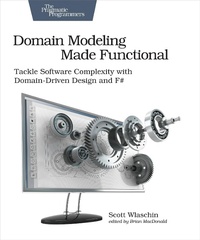
Domain Modeling Made Functional
Description

You want increased IPSer satisfaction, faster development cycles, and less wasted work. Domain-driven design (DDD) combined with functional programming is the innovative combo that will get you there. In this pragmatic, down-to-earth guide, you'll see how applying the core principles of functional programming can result in software designs that model real-world requirements both elegantly and concisely - often more so than an object-oriented approach. Practical examples in the open-source F# functional language, and examples from familiar business domains, show you how to apply these techniques to build software that is business-focused, flexible, and high quality.
Domain-driven design is a well-established approach to designing software that ensures that domain experts and developers work together effectively to create high-quality software. This book is the first to combine DDD with techniques from statically typed functional programming. This book is perfect for newcomers to DDD or functional programming - all the techniques you need will be introduced and explained.
Model a complex domain accurately using the F# type system, creating compilable code that is also readable documentation---ensuring that the code and design never get out of sync. Encode business rules in the design so that you have "compile-time unit tests," and eliminate many potential bugs by making illegal states unrepresentable. Assemble a series of small, testable functions into a complete use case, and compose these individual scenarios into a large-scale design. Discover why the combination of functional programming and DDD leads naturally to service-oriented and hexagonal architectures. Finally, create a functional domain model that works with traditional databases, NoSQL, and event stores, and safely expose your domain via a website or API.
Solve real problems by focusing on real-world requirements for your software.
What You Need:
The code in this book is designed to be run interactively on Windows, Mac and Linux.You will need a recent version of F# (4.0 or greater), and the appropriate .NET runtime for your platform.Full installation instructions for all platforms at fsharp.org.
More details
Other editions
Additional editions
Person
Scott Wlaschin is an expert on F#, author of the popular F# site fsharpforfunandprofit.com, and a board member of the F# Software Foundation. Known for his non-academic approach to functional programming, Scott is a popular speaker and has given talks at NDC, F# Exchange, DDD Europe, and other conferences around the world.
Content
- Intro
- Domain Modeling Made Functional
- About the Pragmatic Bookshelf
- Table of Contents
- Early praise for Domain Modeling Mad e Functional
- Preface
- Who Is This Book For?
- What's in This Book?
- Other Approaches to Domain Modeling
- Working with the Code in This Book
- Questions or Suggestions?
- Credits
- Acknowledgments
- Pa rt 1 Understanding the Domain
- Chapter 1: Introducing Domain-Driven Design
- The Importance of a Shared Model
- Understanding the Domain Through Business Event s
- Partitioning the Domain into Subdomains
- Creating a Solution Using Bounded Con texts
- Creating a Ubiquitous Language
- Summarizing the Concepts of Domain-Driven Desi gn
- Wrapping Up
- Chapter 2: Understanding the Domain
- Interview with a Domain Expert
- Fighting the Impulse to Do Database-Driven Des ign
- Fighting the Impulse to Do Class-Driven Design
- Documenting the Domain
- Diving Deeper into the Order-Taking Wo rkflow
- Representing Complexity in Our Domain Model
- Wrapping Up
- Chapter 3: A Functional Architecture
- Bounded Contexts as Autonomous Software Compon ents
- Communicating Between Bounded Contexts
- Contracts Between B ounded Contexts
- Workflows Within a Bounded Context
- Code Structure Within a Bounded Context
- Wrapping Up
- What's Next
- Part 2: Modeling the Domain
- Chapter 4: Understanding Types
- Understanding Functions
- Types and Functions
- Composition of Types
- Working with F# Types
- Building a Domain Model by Composing Types
- Modeling Optional Values, Errors, and Collecti ons
- Organizing Types in Files an d Projects
- Wrapping Up
- Chapter 5: Domain Modeling with Types
- Reviewing the Domain Model
- Seeing Patterns in a Domain Model
- Modeling Simple Values
- Modeling Complex Data
- Modeling Workflows with Functions
- A Question of Identity: Value Objects
- A Question of Identity: Entities
- Aggregates
- Putting It All Together
- Wrapping Up
- Chapter 6: Integrity and Consistency in the Domain
- The Integrity of Simple V alues
- Units of Measure
- Enforcing Invariants with the Type System
- Capturing Business Rules in the Type System
- Consistency
- Wrapping Up
- Chapter 7: Modeling Workflows as Pipelines
- The Workflow Input
- Modeling an Order as a Set of States
- State Machines
- Modeling Each Step in the Workflow with Types
- Documenting Effects
- Composing the Workflow fro m the Steps
- Are Dependencies Part of the Design?
- The Complete Pipeline
- Long-Running Workflows
- Wrapping Up
- What's Next
- Part 3: Implementing the Model
- Chapter 8: Understanding Functions
- Functions, Functions, Everywhere
- Functions Are Things
- Total Functions
- Composition
- Wrapping Up
- Chapter 9: Implementation: Composing a Pipeline
- Working with Simple Types
- Using Function Types to Guide the Implementat ion
- Implementing the Validatio n Step
- Implementing the Rest of the Steps
- Composing the Pipeline Steps Together
- Injecting Dependencies
- Testing Dependencies
- The Assembled Pipeline
- Wrapping Up
- Chapter 10: Implementation: Working with Errors
- Using the Result Type to Make Errors Explicit
- Working with Domain Errors
- Chaining Result-Generating Functions
- Using bind and map in Our Pipeline
- Adapting Other Kinds of Functions to the Two- Track Model
- Making Life Easier with Computation Expressio ns
- Monads and More
- Adding the Async Effect
- Wrapping Up
- Chapter 11: Serialization
- Persistence vs. Serialization
- Designing for Serialization
- Connecting the Serialization Code to the Work flow
- A Complete Serialization Example
- How to Translate Domain Types to DTOs
- Wrapping Up
- Chapter 12: Persistence
- Pushing Persistence to the Edges
- Command-Query Separation
- Bounded Contexts Must Own Their Data Storage
- Working with Document Databases
- Working with Relational Databases
- Transactions
- Wrapping Up
- Chapter 13: Evolving a Design and Keeping It Clean
- Change 1: Adding Shipping Charges
- Change 2: Adding Support for VIP Customers
- Change 3: Adding Support for Promotion Codes
- Change 4: Adding a Business Hours Constraint
- Dealing with Additional Requirements Changes
- Wrapping Up
- Wrapping Up the Book
- You May Be Interested In.
