

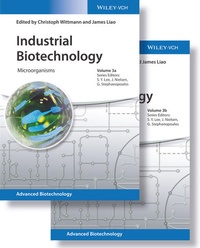
Industrial Biotechnology
Microorganisms
1st Edition
Published on 18. November 2016
LXII, 723 pages
978-3-527-80778-9 (ISBN)
Description

The latest volume in the Advanced Biotechnology series provides an overview of the main production hosts and platform organisms used today as well as promising future cell factories in a two volume book. Alongside describing tools for genetic and metabolic engineering for strain improvement, the authors also impart topical information on computational tools, safety aspects and industrial-scale production.
Following an introduction to general concepts, historical developments and future technologies, the text goes on to cover multi-purpose bacterial cell factories, including those organisms that exploit anaerobic biosynthetic power. Further chapters deal with microbes used for the production of high-value natural compounds and those obtained from alternative raw material sources, concluding with eukaryotic workhorses.
Of interest to biotechnologists and microbiologists, as well as those working in the biotechnological, chemical, food and pharmaceutical industries.
Following an introduction to general concepts, historical developments and future technologies, the text goes on to cover multi-purpose bacterial cell factories, including those organisms that exploit anaerobic biosynthetic power. Further chapters deal with microbes used for the production of high-value natural compounds and those obtained from alternative raw material sources, concluding with eukaryotic workhorses.
Of interest to biotechnologists and microbiologists, as well as those working in the biotechnological, chemical, food and pharmaceutical industries.
More details
Other editions
Additional editions
Book
01/2017
1st Edition
Wiley-VCH
€379.00
Shipment within 5-7 days
Christoph Wittmann | James C. Liao
Industrial Biotechnology - Microorganisms
Software
11/2016
Wiley-VCH
€505.57
No shipping information available
Persons
Christoph Wittmann is Director of the Institute of Systems Biotechnology at Saarland University, Saarbrücken, Germany. Having obtained his academic degrees from Braunschweig Technical University, Germany, he was postdoc at Helsinki University, Finland, held chairs for Biotechnology at Münster University, Germany, and for Biochemical Engineering at Braunschweig Technical University and was invited guest professor at Université Rangueil de Toulouse, France, before taking up his present position. He has authored more than 150 scientific publications, more than 20 books and book chapters, holds more than 20 patents and has received several scientific awards, including the Young Scientist Award of the European Federation of Biotechnology, and is board member of various scientific journals.
James Liao is currently President of Academia Sinica in Taiwan. Having obtained his PhD degree from University of Wisconsin, Madison, USA, he started his career at Eastman Kodak Company, before moving to Texas A&M, USA, and then to the University of California in Los Angeles (UCLA), USA, for his academic career. Professor Liao has received numerous scientific awards, including the US Presidential Green Chemistry Challenge Award and the Italian ENI award in renewable energy. He is also a member of the US National Academy of Sciences, National Academy of Engineering, and Academia Sinica in Taiwan.
Sang Yup Lee is Distinguished Professor at the Department of Chemical and Biomolecular Engineering at the Korea Advanced Institute of Science and Technology (KAIST). He is currently the Director of the Center for Systems and Synthetic Biotechnology, Director of the BioProcess Engineering Research Center, and Director of the Bioinformatics Research Center. He has published more than 500 journal papers, 64 books and book chapters, and more than 580 patents (either registered or applied). He received numerous awards, including the National Order of Merit, the Merck Metabolic Engineering Award, the ACS Marvin Johnson Award, Charles Thom Award, Amgen Biochemical Engineering Award, Elmer Gaden Award, POSCO TJ Park Prize, and HoAm Prize. He currently is Fellow of American Association for the Advancement of Science, the American Academy of Microbiology, American Institute of Chemical Engineers, Society for Industrial Microbiology and Biotechnology, American Institute of Medical and Biological Engineering, the World Academy of Science, the Korean Academy of Science and Technology, and the National Academy of Engineering of Korea. He is also Foreign Member of National Academy of Engineering USA. He is currently honorary professor of the University of Queensland (Australia), honorary professor of the Chinese Academy of Sciences, honorary professor of Wuhan University (China), honorary professor of Hubei University of Technology (China), honorary professor of Beijing University of Chemical Technology (China), and advisory professor of the Shanghai Jiaotong University (China). Lee is the Editor-in-Chief of the Biotechnology Journal and Associate Editor and board member of numerous other journals. Lee is currently serving as a member of Presidential Advisory Committee on Science and Technology (Korea).
Jens Nielsen is Professor and Director to Chalmers University of Technology (Sweden) since 2008. He obtained an MSc degree in Chemical Engineering and a PhD degree (1989) in Biochemical Engineering from the Technical University of Denmark (DTU) and after that established his independent research group and was appointed full Professor there in 1998. He was Fulbright visiting professor at MIT in 1995-1996. At DTU, he founded and directed the Center for Microbial Biotechnology. Jens Nielsen has published more than 350 research papers, co-authored more than 40 books and he is inventor of more than 50 patents. He has founded several companies that have raised more than 20 million in venture capital. He has received numerous Danish and international awards and is member of
James Liao is currently President of Academia Sinica in Taiwan. Having obtained his PhD degree from University of Wisconsin, Madison, USA, he started his career at Eastman Kodak Company, before moving to Texas A&M, USA, and then to the University of California in Los Angeles (UCLA), USA, for his academic career. Professor Liao has received numerous scientific awards, including the US Presidential Green Chemistry Challenge Award and the Italian ENI award in renewable energy. He is also a member of the US National Academy of Sciences, National Academy of Engineering, and Academia Sinica in Taiwan.
Sang Yup Lee is Distinguished Professor at the Department of Chemical and Biomolecular Engineering at the Korea Advanced Institute of Science and Technology (KAIST). He is currently the Director of the Center for Systems and Synthetic Biotechnology, Director of the BioProcess Engineering Research Center, and Director of the Bioinformatics Research Center. He has published more than 500 journal papers, 64 books and book chapters, and more than 580 patents (either registered or applied). He received numerous awards, including the National Order of Merit, the Merck Metabolic Engineering Award, the ACS Marvin Johnson Award, Charles Thom Award, Amgen Biochemical Engineering Award, Elmer Gaden Award, POSCO TJ Park Prize, and HoAm Prize. He currently is Fellow of American Association for the Advancement of Science, the American Academy of Microbiology, American Institute of Chemical Engineers, Society for Industrial Microbiology and Biotechnology, American Institute of Medical and Biological Engineering, the World Academy of Science, the Korean Academy of Science and Technology, and the National Academy of Engineering of Korea. He is also Foreign Member of National Academy of Engineering USA. He is currently honorary professor of the University of Queensland (Australia), honorary professor of the Chinese Academy of Sciences, honorary professor of Wuhan University (China), honorary professor of Hubei University of Technology (China), honorary professor of Beijing University of Chemical Technology (China), and advisory professor of the Shanghai Jiaotong University (China). Lee is the Editor-in-Chief of the Biotechnology Journal and Associate Editor and board member of numerous other journals. Lee is currently serving as a member of Presidential Advisory Committee on Science and Technology (Korea).
Jens Nielsen is Professor and Director to Chalmers University of Technology (Sweden) since 2008. He obtained an MSc degree in Chemical Engineering and a PhD degree (1989) in Biochemical Engineering from the Technical University of Denmark (DTU) and after that established his independent research group and was appointed full Professor there in 1998. He was Fulbright visiting professor at MIT in 1995-1996. At DTU, he founded and directed the Center for Microbial Biotechnology. Jens Nielsen has published more than 350 research papers, co-authored more than 40 books and he is inventor of more than 50 patents. He has founded several companies that have raised more than 20 million in venture capital. He has received numerous Danish and international awards and is member of
Content
PART I - INDUSTRIAL BIOTECHNOLOGY: FROM PIONEERS TO VISIONARY
1. History of Industrial Biotechnology
2. Synthetic Biology: An Emerging Approach for Strain Engineering
3. Towards Efficient Genome-Scale Metabolic Pathway Analysis
4. Cell-Free Synthetic Systems for Metabolic Engineering and Biosynthetic Pathway Prototyping
PART II - MULTI-PURPOSE BACTERIAL CELL FACTORIES
5. Industrial Biotechnology: Escherichia coli as a Host
6. Industrial Microorganisms: Corynebacterium glutamicum
7. Host Organisms: Bacillus subtilis
8. Host Organisms: P. putida
PART III - EXPLOITING ANAEROBIC BIOSYNTHETIC POWER
9. Host Organisms: Clostridium acetobutylicum/ Clostridium beijerinckii and Related Organisms
10. Advances in Consolidated Bioprocessing Using Clostridium thermocellum and Thermoanaerobacter saccharolyticum
11. Lactic Acid Bacteria
PART IV - MICROBIAL TREASURE CHESTS FOR HIGH-VALUE NATURAL COMPOUNDS
12. Host Organisms: Myxobacterium
13. Host Organisms: Streptomyces
PART V - EXTENDING THE RAW MATERIAL BASIS FOR BIO-PRODUCTION
14. Extreme Thermophiles as Metabolic Engineering Platforms: Strategies and Current Perspective
15. Cyanobacteria as a Host Organism
16. Host Organisms: Algae
PART VI - EUKARYOTIC WORKHORSES: COMPLEX CELLS ENABLE COMPLEX PRODUCTS
17. Host Organisms: Mammalian Cells
18. Host Organisms: Saccharomyces cerevisiae
19. Industrial Microorganisms: Pichia pastoris
1. History of Industrial Biotechnology
2. Synthetic Biology: An Emerging Approach for Strain Engineering
3. Towards Efficient Genome-Scale Metabolic Pathway Analysis
4. Cell-Free Synthetic Systems for Metabolic Engineering and Biosynthetic Pathway Prototyping
PART II - MULTI-PURPOSE BACTERIAL CELL FACTORIES
5. Industrial Biotechnology: Escherichia coli as a Host
6. Industrial Microorganisms: Corynebacterium glutamicum
7. Host Organisms: Bacillus subtilis
8. Host Organisms: P. putida
PART III - EXPLOITING ANAEROBIC BIOSYNTHETIC POWER
9. Host Organisms: Clostridium acetobutylicum/ Clostridium beijerinckii and Related Organisms
10. Advances in Consolidated Bioprocessing Using Clostridium thermocellum and Thermoanaerobacter saccharolyticum
11. Lactic Acid Bacteria
PART IV - MICROBIAL TREASURE CHESTS FOR HIGH-VALUE NATURAL COMPOUNDS
12. Host Organisms: Myxobacterium
13. Host Organisms: Streptomyces
PART V - EXTENDING THE RAW MATERIAL BASIS FOR BIO-PRODUCTION
14. Extreme Thermophiles as Metabolic Engineering Platforms: Strategies and Current Perspective
15. Cyanobacteria as a Host Organism
16. Host Organisms: Algae
PART VI - EUKARYOTIC WORKHORSES: COMPLEX CELLS ENABLE COMPLEX PRODUCTS
17. Host Organisms: Mammalian Cells
18. Host Organisms: Saccharomyces cerevisiae
19. Industrial Microorganisms: Pichia pastoris
