

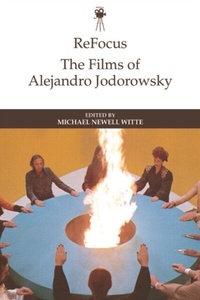
ReFocus: The Films of Alejandro Jodorowsky
Description

Examines the film practice of the Chilean-French filmmaker and artist Alejandro Jodorowsky
- The first scholarly collection dedicated to the films of Alejandro Jodorowsky
- Offers theoretical interpretations from the fields of cinema studies, art history, Latin American studies, gender studies, comparative literature, disability studies, and sound studies, from leading scholars in the field
- Includes both textual and contextual analysis of Jodorowsky's entire filmography
Known as the father of the "midnight cult movie" and co-founder of the avant-garde Panic movement in France, Alejandro Jodorowsky Prullansky defies all basic categorization. He is known as a provocateur, a performance artist, a visionary filmmaker, a controversial playwright, a philosopher, and a tarot reader, among other disparate classifications. These varied dimensions of artist and filmmaker converge seamlessly into his practice. He is recognized by audiences as a creator of controversial and mesmerizing films characterized by visual delirium, the injection of radical politics and mystical philosophy, and a post-surrealist aesthetics.
ReFocus: The Films of Alejandro Jodorowsky pursues an interdisciplinary approach to analyze and contextualize Jodorowsky's films according to a variety of conceptual modalities: from occult and mystical orientations, to the political and decolonial aspects of his major films. This collection examines the formative metaphysical elaborations involved in Jodorowsky's earliest films, his pioneering of a truly unique independent film practice in Mexico, and his emergence and development as a visionary international filmmaker.
More details
Other editions
Additional editions
Person
Content
- Intro
- List of Figures
- Notes on Contributors
- 1 Introduction: The Films of Alejandro Jodorowsky
- 2 Two Tales of Transposed Heads: "La Cravate" and "Org"
- 3 The Panic and/or Freak Aesthetic
- 4 One of Us: Corpo-reality and the Disabled Body in the Films of Alejandro Jodorowsky
- 5 Prophets and Sinners in the 1970s Films of Alejandro Jodorowsky
- 6 H. P. Blavatsky and Alejandro Jodorowsky: The Influence of the Russian Orthodox Church and Theosophy on Psychomagic in El Topo and The Holy Mountain
- 7 Dionysus Resuscitated: Alejandro Jodorowsky and the Aesthetics of Intoxication
- 8 The Music in The Holy Mountain: A Jodorowskian Sound Machine
- 9 Outlaw Artists and Esoteric Media: International Copyright and Alejandro Jodorowsky's Illicit Media Practice
- 10 Resistance in Alejandro Jodorowsky's Santa Sangre
- 11 Inherit and Repair: Self-erasure and Allegoric Montage in Jodorowsky's The Caste of the Metabarons
- 12 Alejandro Jodorowsky, the Unmade, and The Sons of El Topo
- 13 Jodorowsky, Psychomagic, and Subjective Destitution
- 14 Talmudist and Kabbalist Practices in Alejandro Jodorowsky's Psychomagic, a Healing Art
- Index
