

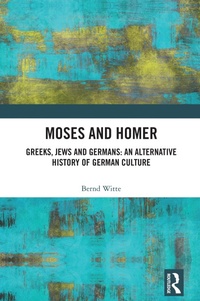
Moses and Homer
Greeks, Jews and Germans: An Alternative History of German Culture
Published on 5. June 2026
356 pages
978-1-040-92021-3 (ISBN)
Description

Moses and Homer explores the eradication of the Jewish tradition from German intellectual history between 1770 and 1800 and analyzes the numerous ruptures triggered by the exclusion of the representatives of Judaism from the German-speaking literary world.
The closing decades of the eighteenth century were distinguished by a burgeoning admiration for Ancient Greece in Germany, while at the same time Judaism which had begun to open itself to European Enlightenment was vehemently opposed in literary and intellectual circles. Goethe's and Schiller's aggressive anti-Judaism was levied against the Biblical legacy of God's revelation at Sinai and his legendary mediator Moses. Prompted by Johann Joachim Winckelmann's paean to Homeric culture, German Classics unfolded a new legitimizing discourse in which polytheism served to position the 'productive individual' and 'growing nature' as preeminent categories in modernity. The rationale was to replace monotheism with a religion of nature, a shift that had far-reaching consequences well into the twentieth century. In their distinctive ways, Moses Mendelssohn and Heinrich Heine countered by attempting to salvage the vision of a German-Jewish dialog. Additionally, a broad range of cultural reflexion is examined, including relevant contributions by Hoelderlin, Herder, Hegel, Buber, Baeck, Freud, Benn, Kantorowicz, Auerbach und Heidegger. The volume traces the ideological battle waged against monotheism, nurtured by an early rejection of Jewish intellectualism and a steadfast focus on classicism, and its impact on the militant antisemitism of the nineteenth and twentieth centuries. These intellectual developments culminated in the racial politics of the Nazi terror regime. Ultimately, the Shoah effaced the Jewish monotheistic tradition from the cultural memory of contemporary Germans.
This book is of interest to scholars of Antique Classicism, German and Jewish intellectual history, and European antisemitism.
The closing decades of the eighteenth century were distinguished by a burgeoning admiration for Ancient Greece in Germany, while at the same time Judaism which had begun to open itself to European Enlightenment was vehemently opposed in literary and intellectual circles. Goethe's and Schiller's aggressive anti-Judaism was levied against the Biblical legacy of God's revelation at Sinai and his legendary mediator Moses. Prompted by Johann Joachim Winckelmann's paean to Homeric culture, German Classics unfolded a new legitimizing discourse in which polytheism served to position the 'productive individual' and 'growing nature' as preeminent categories in modernity. The rationale was to replace monotheism with a religion of nature, a shift that had far-reaching consequences well into the twentieth century. In their distinctive ways, Moses Mendelssohn and Heinrich Heine countered by attempting to salvage the vision of a German-Jewish dialog. Additionally, a broad range of cultural reflexion is examined, including relevant contributions by Hoelderlin, Herder, Hegel, Buber, Baeck, Freud, Benn, Kantorowicz, Auerbach und Heidegger. The volume traces the ideological battle waged against monotheism, nurtured by an early rejection of Jewish intellectualism and a steadfast focus on classicism, and its impact on the militant antisemitism of the nineteenth and twentieth centuries. These intellectual developments culminated in the racial politics of the Nazi terror regime. Ultimately, the Shoah effaced the Jewish monotheistic tradition from the cultural memory of contemporary Germans.
This book is of interest to scholars of Antique Classicism, German and Jewish intellectual history, and European antisemitism.
More details
Language
English
Place of publication
London
United Kingdom
Publishing group
Taylor & Francis Ltd
Target group
College/higher education
Product notice
Reflowable
Illustrations
38 Halftones, black and white; 38 Illustrations, black and white
File size
9,72 MB
ISBN-13
978-1-040-92021-3 (9781040920213)
Copyright in bibliographic data and cover images is held by Nielsen Book Services Limited or by the publishers or by their respective licensors: all rights reserved.
Schweitzer Classification
Other editions
Additional editions
Book
approx. 06/2026
1st Edition
Routledge
€191.50
Not yet published
Persons
Bernd Witte was Professor of Philosophy at Heinrich Heine University of Duesseldorf, Germany.
Content
1. Enlightenment through Art: Johann Joachim Winckelmann's Discovery of Modern Individualism Out of the Spirit of Hellenism; 2. Juno Ludovisi and Ceremonial Law Judaism's Admittance to the European Culture of Enlightenment and the Anti-Judaism of German Classicism; 3. Christ Dionysus: Hoelderlin's 'Occidental' Myth; 4. The "People of the Book": Heinrich Heine's Formation of Modern Writing Out of the Spirit of Judaism; 5. Jews and Germans: The Myth of the People; 6. "Berlin is Sparta!": From Racial Madness to Genocide; 7. Moses and Oedipus: Sigmund Freud in London; 8. Moshe Rabenu: Leo Baeck in Theresienstadt; 9. Moses the Leader and the People of Yahweh: Martin Buber in Jerusalem; 10. Avodah - About Service: Gertrud Kantorowicz in Theresienstadt and Margarete Susman in Zuerich; 11. Odysseus and Abraham: Erich Auerbach in Istanbul; 12. One Final Time: Greeks and Germans: Martin Heidegger in Freiburg; 13. Coda: "Face to Face": Emmanuel Levinas in Paris.
