

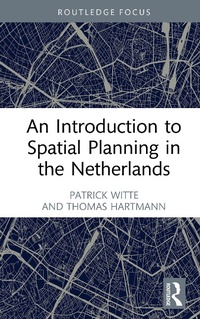
An Introduction to Spatial Planning in the Netherlands
1st Edition
Published on 13. February 2022
144 pages
978-1-000-58447-9 (ISBN)
Description

This book provides an introduction to spatial planning in the Netherlands. It explores the academic underpinnings of the discipline and its practical implications, making use of insights on planning practices from the Netherlands. As an academic book with relevance for spatial planning teaching and practice, the relation between planning practice and planning as an academic discipline are discussed.
A key analytical concept is introduced to discuss the different dimensions of planning: the planning triangle. This framework helps to bridge the strategic and conceptual elements of planning with its realization. The object, process, and context of planning and its relations are discussed. The core of the academic discipline and profession of spatial planning entails looking (far) into the future, stimulating discussion, formulating a desired future direction through an informal and collective planning process, and then formalizing and placing current action into that future perspective. In that sense, spatial planning can be understood as the strategic organization of hopes and expectations.
As a study book it is suitable for students of planning at various universities, but also for students in higher professional education. For those involved in the professional field of spatial planning, this book offers a sound foundation.
A key analytical concept is introduced to discuss the different dimensions of planning: the planning triangle. This framework helps to bridge the strategic and conceptual elements of planning with its realization. The object, process, and context of planning and its relations are discussed. The core of the academic discipline and profession of spatial planning entails looking (far) into the future, stimulating discussion, formulating a desired future direction through an informal and collective planning process, and then formalizing and placing current action into that future perspective. In that sense, spatial planning can be understood as the strategic organization of hopes and expectations.
As a study book it is suitable for students of planning at various universities, but also for students in higher professional education. For those involved in the professional field of spatial planning, this book offers a sound foundation.
More details
Edition
1. Auflage
Language
English
Place of publication
London
United Kingdom
Publishing group
Taylor & Francis Ltd
Target group
Professional and scholarly
College/higher education
Illustrations
8 Line drawings, black and white; 3 Halftones, black and white; 11 Illustrations, black and white
ISBN-13
978-1-000-58447-9 (9781000584479)
Copyright in bibliographic data and cover images is held by Nielsen Book Services Limited or by the publishers or by their respective licensors: all rights reserved.
Schweitzer Classification
Other editions
Additional editions
Patrick Witte | Thomas Hartmann
An Introduction to Spatial Planning in the Netherlands
Book
08/2024
1st Edition
Routledge
€32.90
Shipment within 10-20 days
Patrick Witte | Thomas Hartmann
An Introduction to Spatial Planning in the Netherlands
Book
02/2022
1st Edition
Routledge
€76.90
Shipment within 10-20 days
Persons
Dr. Patrick Witte is Assistant Professor in Urban and Regional Planning at the Department of Human Geography and Planning, Faculty of Geosciences, Utrecht University (the Netherlands). His research focuses on integrated spatial planning and transport infrastructure systems, with a particular focus on digital transformations of cities (planning support, smart governance, smart mobility). He is the programme coordinator of the master's programme in spatial planning, that was awarded the AESOP Certificate of Quality for Excellence in Education (2019-2024). He is coordinating and teaching courses in the master's programme in spatial planning and in the bachelor's programme in human geography and planning.
Dr. Thomas Hartmann is the Chair of Land Policy and Land Management at the School of Planning, Technical University of Dortmund (Germany) and also affiliated with the Czech University Jan Evangelista Purkyne (UJEP) in Usti nad Labem, Faculty of Social and Economic Studies. His research focuses on strategies of municipal land policy and the relation of flood risk management and property rights. He is also president of the International Academic Association on Planning, Law, and Property Rights.
Dr. Thomas Hartmann is the Chair of Land Policy and Land Management at the School of Planning, Technical University of Dortmund (Germany) and also affiliated with the Czech University Jan Evangelista Purkyne (UJEP) in Usti nad Labem, Faculty of Social and Economic Studies. His research focuses on strategies of municipal land policy and the relation of flood risk management and property rights. He is also president of the International Academic Association on Planning, Law, and Property Rights.
Content
1. Spatial planning - an exploration of the discipline 2. The object of planning: land-use 3. The process of planning: policy and governance 4. The context of planning: an administrative and institutional context 5. Discussion: the planning triangle 'revisited'
