

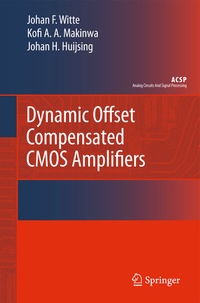
Dynamic Offset Compensated CMOS Amplifiers
1st Edition
Published on 29. June 2009
XII, 168 pages
978-90-481-2756-6 (ISBN)
Description

Dynamic Offset-Compensated CMOS Amplifiers describes the theory, design and realization of dynamic offset compensated CMOS amplifiers. It focuses on the design of general-purpose wide-band operational amplifiers and instrumentation amplifiers.
Two offset compensation techniques are described: auto-zeroing and chopping. Several topologies are discussed, with which these techniques can be used in the design of wide-band dynamic offset-compensated amplifiers. Four implementations are discussed in detail: two low-offset wide-band operational amplifiers, a low-offset instrumentation amplifier, and a low-offset current-sense amplifier, which can sense the current drawn from supply voltages up to 28V .
More details
Other editions
Additional editions
Frerik Witte | Kofi Makinwa | Johan Huijsing
Dynamic Offset Compensated CMOS Amplifiers
Book
11/2011
Springer
€160.49
Shipment within 15-20 days
Frerik Witte | Kofi Makinwa | Johan Huijsing
Dynamic Offset Compensated CMOS Amplifiers
Book
07/2009
Springer
€160.49
Shipment within 15-20 days
Persons
Co-author Emeritus Prof. J.H. Huijsing has (co-)authored numerous books for Springer, including the best-selling Operational Amplifiers (2000)
Content
Dynamic Offset Compensation Techniques.- Dynamic Offset Compensated Operational Amplifiers.- Dynamic Offset Compensated Instrumentation Amplifiers.- Realizations of Operational Amplifiers.- Realizations of Instrumentation Amplifiers.- Conclusions and Future Directions.- Layout Issues.
