

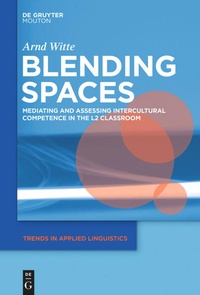
Blending Spaces
Description

This book comprehensively analyzes the development of interculturally blended third spaces by the second language learner, beginning with the linguistic and sociocultural imprints of the first language and culture on the mind and culminating in the proposal of a phase-model of the development of intercultural competence. The foundational analysis of L1-mediated constructs is followed by an analysis of forms interaction, concepts of identity and constructs of culture/interculture, thus shifting the object of analysis from the subjective to the intersubjective levels of construction and interaction. The focus of the book is on the gradual development of interculturally blended third spaces in the mind of the learner as genuinely new bases for construction. This book takes an interdisciplinary approach, drawing on research in cultural psychology, linguistic anthropology, critical theory, language acquisition and second language learning and shows how culture and interculture need to be emphasized as an integral part of second language learning.
More details
Other editions
Additional editions
Person
Content
- Intro
- Contents
- 1 Introduction: The interplay of languages, cultures, and minds
- 2 First language acquisition and early cognitive development
- 2.1 First language acquisition
- 2.2 The interplay of early linguistic and cognitive development
- 2.2.1 Vygotskian accounts of early sociocultural development
- 2.2.2 Egocentric speech
- 2.2.3 Inner speech
- 2.3 Development of everyday concepts and scientific concepts
- 2.4 Learning the written form of language
- 3 Formation of concepts and plausibility structures
- 3.1 From unmediated to mediated thought
- 3.2 Concepts, prototypes, and frames
- 3.3 Schemata and stereotypes
- 3.4 Conceptual metaphors
- 3.5 Linguistic relativity
- 3.5.1 Strong and weak versions of linguistic relativity
- 4 Language and the intersubjective construction of meaning
- 4.1 Word and utterance
- 4.2 Speech genre
- 4.3 Genre
- 4.4 Narrative
- 4.5 Discourse and positioning
- 4.6 Intersubjectivity
- 4.7 Blending spaces
- 5 Imposing structure on language-in-use: From language philosophy to discourse analysis
- 5.1 Ordinary language philosophy
- 5.1.1 Language games
- 5.1.2 Speech act theory
- 5.1.3 The cooperative principle and maxims of conversation
- 5.2 Some linguistic approaches to communication
- 5.2.1 Communicative competence and contextualization cues
- 5.2.2 Analyzing discourse
- 5.3 Activity theory
- 6 The dynamics of identity
- 6.1 Personal identity
- 6.2 Discursive negotiation of identity
- 6.3 Narrative identity
- 6.4 Social and cultural identity
- 6.5 Ascribed identities, role, and voice
- 6.6 Hybrid identities
- 7 The complexities of culture
- 7.1 Culture as distributed knowledge
- 7.2 Reading culture as text
- 7.3 Culture and social practice
- 7.4 Culture, social practice, and the subject
- 8 The interplay of cultures: Constructs of interculture
- 8.1 Hybridity
- 8.2 The third space
- 8.3 Translating cultures
- 8.4 Intercultural understanding
- 9 Fostering intercultural competence in the second language classroom
- 9.1 The role of the first language in second language learning
- 9.2 Translating and interlanguage
- 9.3 Metaphoric competence
- 9.4 Efforts of stabilizing linguistic and sociocultural context
- 9.4.1 Conceptual
- 9.4.2 Sociolinguistic
- 9.5 Learning culture in the zone of proximal development
- 9.6 Second language learning and its effects on learners' minds
- 10 Mediating and assessing intercultural competence in the L2 classroom
- 10.1 Critique of Bennett's (1993) developmental model of intercultural sensitivity
- 10.2 Mediating intercultural competence in the L2-classroom-- A model of progressive principles
- 10.3 The challenge of assessing intercultural competence
- 11 Conclusion
- References
- Name index
- Subject index

