

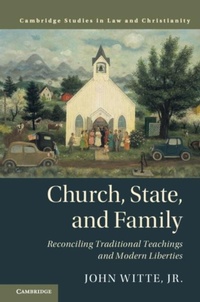
Church, State, and Family
Reconciling Traditional Teachings and Modern Liberties
Published on 3. April 2019
458 pages
978-1-316-88693-9 (ISBN)
Description

This book defends the fundamental place of the marital family in modern liberal societies. While applauding modern sexual freedoms, John Witte, Jr also defends the traditional Western teaching that the marital family is an essential cradle of conscience, chrysalis of care, and cornerstone of ordered liberty. He thus urges churches, states, and other social institutions to protect and promote the marital family. He encourages reticent churches to embrace the rights of women and children, as Christians have long taught, and encourages modern states to promote responsible sexual freedom and family relations, as liberals have long said. He counsels modern churches and states to share in family law governance, and to resist recent efforts to privatize, abolish, or radically expand the marital family sphere. Witte also invites fellow citizens to end their bitter battles over same-sex marriage and tend to the vast family field that urgently needs concerted attention and action.
Reviews / Votes
'It is hard to imagine a better researched, better balanced, more clearly argued - but also more charitable - defense of what John Witte, Jr calls the traditional 'marital family'. Witte a legal scholar of unique historical insight, here spells out clearly why a culture of 'stable monogamous marriages' harmonizes contractual, spiritual, natural, social, communicative, and economic realities - while offering special protection for women, children, and the poor of whatever gender, race, or class. It is a compelling book of landmark dimensions.' Mark A. Noll, McAnaney Professor of History Emeritus, University of Notre Dame 'The context of this engrossing, learned and far-ranging text is the way much of traditional family law has been elbowed aside in favor of new cultural and constitutional norms of sexual freedom, privacy and autonomy. For his encyclopedic knowledge and incisiveness, John Witte, Jr has no equal, and this is a fair-minded and wise attempt at the re-integration of state and faith-based institutions. I commend it unreservedly.' Iain R. Torrance, President Emeritus of Princeton Theological Seminary 'Over many years, John Witte, Jr has made a profound contribution to global scholarship and debate on law and religion. He continues to do so, with great energy and insight, in this superb book. Written in the highest academic traditions of argument and counter-argument, this book justly deserves to become an enduring stimulus for debate on the importance of the marital family in human life.' Norman Doe, Cardiff University 'Vintage Witte! Drawing on his deep wells of scholarship, and writing with characteristic clarity and charity, he offers church, state, and society a reasoned account and constructive model of the marital family as a continuing private and public good, worthy of voluntary commitment and legal support.' William Storrar, Center of Theological Inquiry in Princeton, New Jersey 'I am convinced that John Witte, Jr's circumspect research, careful evaluations and well-balanced arguments will not only provoke lively and fruitful discussions, but will also encourage the support and development of good and joy-generating practices in religious and secular communities.' Michael Welker, University of Heidelberg 'Church, State, and Family: Reconciling Traditional Teachings and Modern Liberties is an extraordinary work of meticulous scholarship and a part of the Cambridge Studies in Law and Christianity. While an exceptional and unreservedly recommended addition to seminary, college and university library Contemporary Christian Doctrinal Issues collections and supplemental curriculum studies lists, it should be noted for students, academia, clergy, and non-specialist general readers with an interest in the subject.' Jack Mason, Midwest Book Review '... attempts the impossible task of providing a valuable and nuanced perspective on the relationship between religious and secular law governing family in the United States and other common law counties ... is a satisfying compromise and a worthy read.' Michael J. Broyde, Journal of Law and Religion '... remarkable rereading and prodigious reconstruction ...' Mark D. Jordan, Journal of Law and Religion 'John Witte offers a masterful overview of the history of religious and political thought about marriage in the West ... Church, State, and Family offers a robust defense of (mostly) traditional ideas about marriage and family, grounded equally in theological doctrine, moral and political theory, and contemporary empirical research.' Brian H. Bix, Journal of Law and Religion '... impressively wide-ranging and admirably countercultural ... he has in this book offered us a highly informative, thoroughly well-documented, and penetratingly searching analysis of an inescapably controversial case of contemporary state action.' Jonathan Chaplin, Journal of Law and Religion 'Church, State, and Family provides an engaging argument for the importance of family to religion and to civil society ... The book as a whole is an intellectual tour de force ... will be an enduring book ...' Frank S. Ravitch, Journal of Church and State 'This book can serve as a resource, not only for those with an interest in the history of law and its development, but also for pastors, marriage and family therapists, and practitioners of family law - especially in those situations where the client(s) come from differing religious backgrounds. Each may find herein tools to help understand, and to help their clients understand, the values they hold, how they have come to think and act the way they do, and the implications of such thinking and acting. That understanding can be key to healing and wholeness and in some cases even reconciliation.' Ray Temmerman, Marriage, Families & SpiritualityMore details
Series
Language
English
Place of publication
Cambridge
United Kingdom
Publishing group
Cambridge University Press
Target group
Professional and scholarly
Illustrations
Worked examples or Exercises
File size
3,72 MB
ISBN-13
978-1-316-88693-9 (9781316886939)
Copyright in bibliographic data and cover images is held by Nielsen Book Services Limited or by the publishers or by their respective licensors: all rights reserved.
Schweitzer Classification
Other editions
Additional editions
Book
04/2019
Cambridge University Press
€156.50
Shipment within 15-20 days
Person
Content
Introduction; 1. The first integrative Christian theories of family life: John Chrysostom and Augustine of Hippo; 2. Marriage as an office of nature and a sacrament of the church: Thomas Aquinas and Francisco Vitoria; 3. The marital family as social estate and covenant community: Martin Luther and John Calvin; 4. The domestic market: the family as matrix of modern economics; 5. The nature of family in seventeenth-century Christian thought: Hugo Grotius and John Selde; 6. The surprising liberal defense of the traditional marital family by enlightenment liberals; 7. The multidimensional family sphere: reconstructing traditional family teachings for modern liberal societies; 8. Why suffer the children? Overcoming the modern church's opposition to children's rights; 9. Why same-sex marriage should not lead to polygamy; 10. By the power vested in whom? What place for faith-based family laws in a liberal democracy?; 11. The dangers of private ordering; Concluding reflections.
